← JOURNAL29 Sep 2026
Bento Boxes in Anime: Food, Friendship and a Practical Guide for Indian Fans
 By SoJapan
A lunchbox opens, and the camera pauses. There is rice, a neat row of yellow slices, something fried, a little green and perhaps a face made from seaweed. Before anyone tastes it, the scene has already told you that this meal deserves attention.
Bento boxes in anime can be funny, intimate or entirely ordinary. A character may have made an extra lunch for a friend, bought a box before a train journey or opened something prepared at home. The box looks similar; the situation changes what it means.
For an Indian viewer familiar with carrying a tiffin, the idea of a portable meal is not exotic. The interesting details are the foods, the arrangement, the local traditions and the way animation uses them. You do not need to buy a special imported container to begin understanding any of those things.
This guide decodes familiar lunchbox ingredients, distinguishes everyday bento from station meals and character designs, and offers practical ways to try a bento-inspired lunch. Food suggestions are flexible combinations, not a tested meal-prep recipe, a calorie plan or a promise that a box can sit unrefrigerated all day.
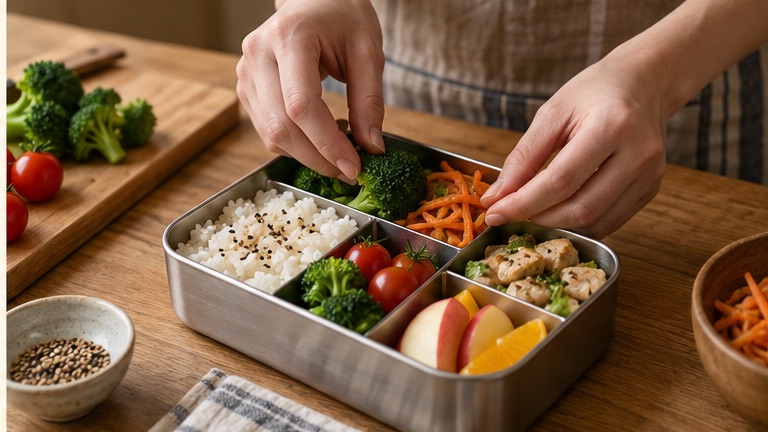
A bento is a boxed meal. It can be made at home, bought for work or travel, or presented as part of a restaurant experience. The food and container vary. A single-tier box is not more authentic than a two-tier one simply because you have seen it more often in anime.
Web Japan’s bento gallery shows everyday lunches, rice-ball boxes, commercially sold meals, station specialities and more elaborate presentations. The range is a useful correction to the idea that bento means only a tiny box filled with cute shapes. Explore the illustrated bento gallery.
For a first understanding, separate three decisions: what food is included, how it is arranged and where it will be eaten. A meal built for a desk, one carried on an outing and one served at a restaurant have different practical demands even if all are described as bento.
The familiar Indian lunchbox makes the basic function easy to grasp: a meal travels with the person who will eat it. Compartments, separate containers and choices about what stays pleasant until lunchtime are already meaningful questions.
The comparison should not become a claim that every Indian or Japanese household packs food in the same way. Both terms sit within varied habits. A leakproof container for a saucy dish, a shallow box for arranged pieces and an insulated food jar solve different problems. Choose according to the meal rather than treating one national style as inherently superior.
Food gives a story visible actions. Someone chooses, cooks, packs, offers, accepts, refuses or shares it. A character can communicate care without delivering a speech, and a response to the food can change the relationship between two people.
That is an interpretation of a storytelling device, not a claim that a homemade lunch always signifies romance in real life. In a particular scene, the same gesture could express friendship, obligation, gratitude, apology or an ordinary household routine.
Who is watching whom? Is the person offering the meal relaxed or anxious? Does the recipient know who prepared it? A pause before opening can create expectation; a quick, unremarkable opening can make the food feel like part of everyday life.
Next, notice whether the camera studies the arrangement or moves directly to the conversation. A long close-up may invite admiration, reveal a mistake or prepare a joke. The food is not just a list of ingredients; it is something the scene asks you to look at in a particular way.
Finally, watch what happens after tasting. A sincere compliment, a polite evasion and an exaggerated reaction do different dramatic work. You can discuss those choices without assuming that anime has documented the everyday behaviour of an entire country.
Start with broad shapes, then check the dialogue or menu if the exact identity matters. Animation simplifies detail, and a brown fried piece could be several different foods. Confidently naming every item from a brief shot can create more errors than insight.
| Visual clue | A likely possibility | What the picture cannot establish |
|---|---|---|
| A section of rice with a coloured centre or topping | Plain or seasoned rice with a garnish | The seasoning ingredients or a nutritional balance |
| A triangle with a dark seaweed section | Onigiri | The hidden filling |
| Neat yellow rolled slices | Tamagoyaki or another egg preparation | Whether stock, sugar or other seasonings were used |
| Brown, irregular pieces | A fried or glazed dish | Whether it is meat, fish, tofu or a mixture |
| A small mound of vegetables | A cooked or dressed side dish | Whether its broth or dressing is vegetarian |
| Dark flakes or powder over rice | A seasoning or garnish | Whether fish, seaweed, sesame or other ingredients are present |
The table is a recognition aid, not an ingredient diagnosis. If you want to recreate a particular meal, work from an official recipe or a clearly identified dish rather than treating a drawing as a complete cooking instruction.
Onigiri are shaped rice portions, often with a filling or seasoning and sometimes wrapped in nori seaweed. Triangles are familiar, but shapes vary. MAFF’s onigiri material includes examples with salmon, umeboshi and okaka, which is bonito-based. The last two unfamiliar words illustrate why a simple-looking rice ball needs a filling check. See MAFF’s onigiri introduction.
Umeboshi is a salted plum preparation, not a sweet cherry dropped into the rice. Okaka contains fish. Knowing those distinctions is more helpful than deciding from the colour of the filling alone.
MAFF documents rice balls from Hiroshima wrapped in pickled Hiroshima greens and examples from Toyama rolled in shaved kombu. These regional preparations show that the dark nori strip familiar from anime is not a compulsory feature. Read about Hiroshima’s wrapped rice balls and Toyama’s kombu version.
For your first home lunch, there is no requirement to make an immaculate triangle. If your rice does not hold the intended shape, serve it as rice in a compartment rather than compressing it endlessly for a photograph. The meal can still express the arrangement you wanted to try.
If buying onigiri in India or Japan, read the flavour name and ingredients. A seaweed wrapper does not make the centre vegetarian, and a plant-named filling does not tell you every seasoning used in it.
Tamagoyaki is a seasoned egg preparation often rolled into layers and sliced. MAFF’s Tokyo account discusses a sweeter, thicker style associated with Kanto and contrasts it with a dashi-forward rolled style associated with Kansai. These are useful regional tendencies, not a rule that every household follows. Read MAFF’s tamagoyaki account.
An Indian viewer expecting a chilli-and-onion omelette may therefore be surprised by a sweet or stock-flavoured bite. That difference is not a failure to season the egg; it reflects another preparation.
Rolled slices create a repeated shape that reads clearly in animation. They can sit neatly beside rice and other pieces without occupying the whole box. In a close-up, the cut surface helps distinguish the food from an ordinary flat omelette.
If you eat eggs but avoid fish, ask about the dashi or other seasoning. If you avoid eggs, treat tamagoyaki as an egg dish rather than assuming a yellow vegetable substitute. A tofu-based adaptation can fill a similar place in your own lunch, but label it honestly as an adaptation instead of pretending the ingredients are the same.
A lunchbox can include a main dish and smaller accompaniments, but it does not have to contain one example of every colour or cooking method. Treat an attractive anime box as a composition selected for the scene, not a standard you must meet before packing lunch.
A practical way to think about the sides is contrast. If the main item is rich and strongly seasoned, another component can offer a plainer bite. If everything is soft, you may want a different texture. If the meal is visually uniform, a vegetable you actually enjoy is more useful than a decorative ingredient you will leave uneaten.
Simmered vegetables, tofu dishes and rice toppings can include stock, sauces or fish-derived ingredients. The same vegetable can be prepared in many ways. For a purchased bento, “there are carrots in this compartment” does not answer whether the whole dish suits your diet.
Do not assume that removing an obvious piece of meat makes the rest suitable. It may have shared sauce or cooking liquid with other components. Ask for an intentionally prepared option that matches your requirements instead of trying to reverse-engineer a mixed box at the table.
Our Japanese vegetarian-food guide for India explains those checks in greater depth. The bento-specific lesson is to inspect each component while remembering that ingredients can cross between them during preparation.
Ekiben combines eki, meaning station, with a shortened form of bento. These meals are associated with railway travel and can highlight regional ingredients or distinctive packaging. JNTO introduces them as a way to encounter local specialities through a portable meal. Read JNTO’s ekiben explanation.
This is a different context from a homemade lunch passed between classmates. A station-bought box can make the journey part of the food experience: the packaging, place name and contents tell you where you are travelling.
Some ekiben are known for unusual containers. Web Japan’s account includes a pot-style meal and specially designed self-heating examples. The relevant point is that packaging can contribute to the experience, not that every station meal has an elaborate mechanism. Explore Web Japan’s ekiben feature.
If you buy one, follow that product’s handling instructions. Do not microwave an unfamiliar container merely because the meal looks like something normally served warm. A self-heating package should be used only as directed; it is not a reason to experiment with its components.
For dietary needs, check before boarding when possible. A regional speciality may centre on meat or seafood, and a beautifully illustrated lid does not provide a complete ingredient list. Availability changes, so a years-old travel recommendation is not proof that a particular vegetarian box is sold at your station today.
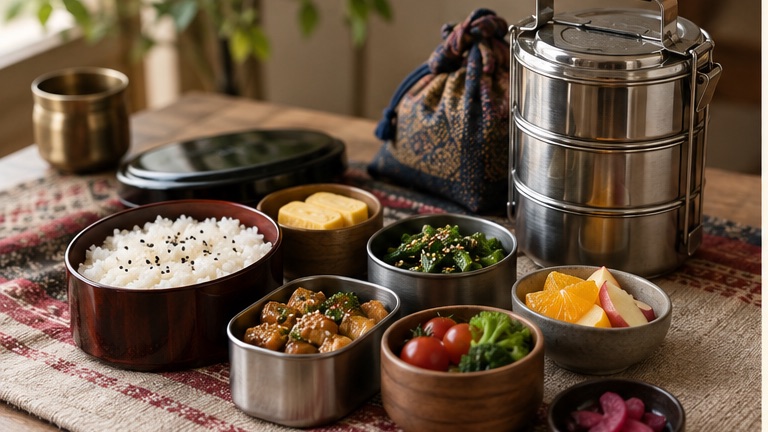
Makunouchi bento is associated with theatre intermissions and now commonly describes an assorted boxed meal with rice and multiple dishes. The name offers historical context, but not an exact universal menu. A shop’s version still needs to be read on its own terms.
Kyara-ben, also written charaben, refers to character bento. Web Japan’s niponica feature describes food arranged to suggest animals, people and figures from anime or manga, with ordinary ingredients used to create recognisable details. See the character-bento feature.
A face on rice can be charming. It can also take time, tools and patience that you do not want to spend before school or work. A normal lunch is not a lesser form of care because it lacks a character portrait.
If you want to try the visual idea, begin with one simple motif: a shape, a colour pairing or a small edible detail. You can suggest a character without reproducing every feature. That is often more practical than building a delicate sculpture that collapses in transit.
Keep non-food decoration out of the edible parts. Use food-safe equipment and remove any picks or separators before they become a hazard during eating. When preparing food for someone else, make the practical details clear instead of assuming they will recognise every decorative element.
No. Anime lunch scenes do not establish a universal school routine. School-provided meals and lunches brought from home are different arrangements, and what happens depends on the school, age group and occasion.
For a concrete example rather than a national generalisation, Web Japan’s profile of Shinanodai Elementary School describes school lunches and certain special days when children bring bento. The page is an individual school profile, not a current census of all Japanese schools. Read the school-lunch example.
A private box creates a chance to show individual choices and relationships. A shared school meal creates a different social setting. A cafeteria queue produces yet another set of interactions. Writers and directors can choose among those situations to make a scene work.
Also avoid assuming who prepared the food. A parent, sibling, partner or the character themselves might have done it; the meal might be purchased. Let the story tell you. An elaborate lunch is not evidence that all Japanese mothers spend hours on decoration, and a simple purchased lunch is not evidence of neglect.
For broader context on classrooms, clubs and school events, see our Japanese school-life guide for anime viewers.
Start with food you already know how to prepare safely. Arrange it in a container suited to the food and the journey. You can then add one Japanese-style component rather than attempting six unfamiliar recipes in one morning.
The three combinations below are editorial ideas, not traditional fixed menus or tested nutritional plans. Adapt quantities to the person eating, and use established recipes and appropriate storage for each component.
| Starting point | A possible combination | What you are exploring |
|---|---|---|
| Plant-based lunch | Rice, a clearly plant-based tofu dish, cooked vegetables and a separate portion of fruit | Contrasting textures and an arranged meal without egg or meat |
| Egg-eating vegetarian lunch | Rice, an egg dish made without fish stock, a vegetable side and a suitable condiment | The role of a compact main item beside rice |
| Familiar Indian lunch with bento-inspired arrangement | Your usual staple and dry-style sides, with sauces in appropriate separate containers | Organisation and portability without pretending the cuisine has changed |
If onigiri interests you, make that the experiment and keep the accompaniments familiar. If the attraction is rolled egg, practise that at a meal eaten at home before making it part of a packed lunch. If the arrangement is the main appeal, you can explore it with food you already cook well.
This approach helps you understand what actually changed. When every part is unfamiliar, it is harder to tell whether you dislike the dish, the recipe or the way it travelled. One deliberate change gives you a useful result for the next attempt.
Do not turn substitution into a claim of equivalence. Paneer and tofu, for example, are different foods even if each could be used in a personally adapted lunch. A familiar ingredient may make your meal practical without reproducing the taste or dietary properties of the original.
The word bento on a product listing does not tell you whether the box is leakproof, microwave-safe or insulated. Those are separate properties. Check the manufacturer’s instructions for the body, lid, seals and any removable parts.
A shallow compartment can make arranged pieces easy to see, while a taller container may suit another meal better. A divider that keeps two dry foods apart may not stop a liquid sauce from leaking. A good-looking latch is not evidence that the box can travel sideways in a crowded bag.
A 750 ml container has 50 percent more volume than a 500 ml container: the extra 250 ml divided by 500 ml is 0.5. This is only a capacity comparison. It does not mean the larger meal automatically has 50 percent more calories, because ingredients and packing density differ.
Use your existing lunch as the starting point. If it leaves you hungry or produces leftovers, respond to that experience instead of choosing a box because an online photograph looks proportionate. There is no single volume that is correct for every adult, child or commute.
Before buying specialist accessories, try a container you already own if it is suitable for the food. A purchase should solve a real problem—leaking, transport, cleaning or portion fit—not create an obligation to imitate a perfect anime lunch every day.
Japan’s MAFF advises clean handling, thorough cooking, cooling food before closing an ordinary packed lunchbox, reducing excess liquid and using cooling packs or an insulated bag when appropriate. It also recommends keeping the meal cool and eating it promptly. These principles are particularly relevant when your route includes heat and long periods away from a refrigerator. Read MAFF’s bento-safety guidance.
Do not interpret cooling before packing as permission to leave cooked food out for hours. Plan preparation and refrigeration sensibly, and follow appropriate food-safety guidance for the ingredients and conditions. A box designed for cold transport and an insulated container designed for hot food are different systems; use each according to its instructions.
A garnish, sauce or tight lid does not replace temperature control. If you cannot keep a perishable meal under suitable conditions, change the plan rather than assuming that bento is inherently safe at room temperature. An anime scene usually skips the handling that would matter in real life.
If you make an anime-inspired meal for a friend, ask about ingredients and preferences first. A surprise is less enjoyable if the person cannot eat it or has to explain a restriction in front of everyone.
Be clear about what is homemade, what is bought and what has been adapted. Someone may be excited to try a simple rice-and-tofu lunch without needing it to reproduce a specific character’s meal exactly. Honest description creates a better experience than promising an authentic replica from a screenshot.
For a group picnic or fan gathering, check the venue’s rules and your ability to transport food properly. Sharing food involves more practical responsibility than sharing an image of it. If those conditions are awkward, meeting at a suitable food venue or discussing a scene without cooking is a perfectly valid way to enjoy the same interest.
Our India anime events and communities guide can help you find a group, but an event listing is not permission to bring or distribute food. Follow the organiser’s requirements.
A bento is interesting because it joins food with a situation: the person who packed it, the place it is carried and the moment it is opened. Once you recognise the rice balls, rolled egg or station packaging, you can pay more attention to what the scene is doing with them.
You can explore more dishes through our anime food guide for India and finish with something from the Japanese sweets guide. Neither a long shopping list nor a perfect character face is required.
For your own first attempt, make a lunch you would genuinely want to eat, use a container that works and add one detail that makes you smile. That is a more rewarding starting point than measuring an ordinary morning against an animator’s carefully composed close-up.
AUTHOR OF THIS ARTICLE
SoJapan
SoJapan India Pvt. Ltd. is a Japanese-founded company based in Gurugram. We bring Japanese food, anime goods and apparel materials to Indian businesses, with a sister company in Kyoto that works directly with makers in Japan.