← JOURNAL29 Sep 2026
Japanese Sweets in Anime: A Guide to Dorayaki, Mochi, Dango and More
 By SoJapan
You recognise the snack before you know its name: two little brown pancakes in Doraemon’s hands, three coloured dumplings on a skewer, or a fish-shaped cake passed across a festival counter. Anime makes these foods memorable. A real menu makes them slightly confusing.
Does the fish-shaped one contain fish? Is mochi always filled with ice cream? Why do so many Japanese sweets contain beans? And if you avoid eggs, will something made from rice flour automatically be suitable?
The best first step is to think in textures. A crisp shell, a soft pancake, a stretchy rice wrapper and a firm slice of bean jelly offer very different experiences—even when the filling has the same name. Understanding that difference is more useful than trying to memorise a long list of unfamiliar words.
This guide introduces eight Japanese sweets connected with anime’s food imagery and the wider confectionery culture behind it. It is written for Indian fans who want to recognise the food, know what to expect and ask better questions before ordering. Recipes differ by maker, so ingredient notes are starting points rather than a promise about a particular café or packet.
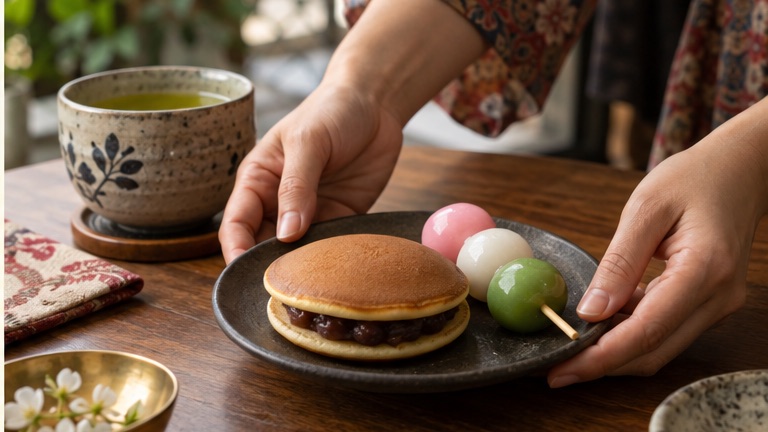
The descriptions below refer to common forms. A maker can change the dough, filling or serving style, and a café version may differ substantially from the sweet you saw on screen. Ask what the actual item contains instead of relying only on the name.
| Sweet | What you are looking at | Texture to expect | A useful first question |
|---|---|---|---|
| Dorayaki | Two small pancakes with a filling | Soft cake against a denser centre | Does the batter contain egg? |
| Taiyaki | A filled cake cooked in a fish-shaped mould | A browned shell around a softer filling | Which filling is inside this batch? |
| Daifuku | A filled sweet with a soft rice-based wrapper | Chewy outside, contrasting centre | Is it bean-filled, cream-filled or frozen? |
| Dango | Rice-flour dumplings, often on skewers | Firm, springy chew | Is the topping sweet bean paste, soy glaze or something else? |
| Nerikiri | Shaped confectionery, often resembling seasonal plants | Tender, dense paste | What ingredients and flavour are used in this piece? |
| Yokan | A sliceable set confection, commonly bean-based | Firm and smooth rather than fluffy | Which variety is it, and what sets it? |
| Monaka | Sweet filling between thin rice wafers | Delicate shell against thick paste | Is it already assembled or filled just before eating? |
| Kakigori | A mound of shaved ice with toppings | Ice that collapses and melts | Are milk, cream or other toppings included? |
If you want the most familiar structure, start with dorayaki or taiyaki after checking the ingredients. If the texture itself is your main curiosity, compare daifuku with monaka: one emphasises chew, the other a fragile shell. You do not need to like both to enjoy Japanese sweets.
Wagashi refers to traditional Japanese confectionery. It does not mean “anything sweet sold in Japan,” and it is not limited to the exquisitely sculpted flower-shaped pieces used in promotional photographs.
Japan’s Ministry of Agriculture, Forestry and Fisheries groups wagashi by methods such as steaming, baking, moulding and shaping bean paste. Its overview also discusses seasonal expression. That is a helpful reminder that Japanese confectionery is a family of techniques, not one flavour or one texture. Explore MAFF’s introduction to Japanese sweets.
A dorayaki and a piece of nerikiri can both belong in the conversation even though one looks like an everyday snack and the other like miniature sculpture. At the same time, a modern cream-filled café dessert can combine Japanese ingredients with other pastry traditions. You do not have to force every contemporary item into a pure category before enjoying it.
For anime viewing, ask what the sweet is doing in the scene. Is it a quick snack, something brought to a host, a seasonal display or an object of a character’s very specific enthusiasm? The context often tells you more than the price or intricacy of the decoration.
Anko, also called an, is sweet bean paste. A common version uses azuki beans cooked with sugar. Tsubuan retains a more noticeable bean texture, while koshian is smooth. JNTO identifies these two common forms in its introduction to Japanese flavours. Read the anko explanation.
That distinction changes the bite. If you dislike skins or a grainier filling, ask whether a smooth option is available before deciding that you dislike anko altogether. If you want more textural contrast, the less uniform version may be more interesting to you.
The colour can mislead a first-time customer. Dark bean paste inside a pancake is not necessarily chocolate. It will not automatically have chocolate’s cocoa flavour or melting behaviour. A photograph cannot tell you which filling is present, especially when shops also sell chocolate versions of the same sweet.
Indian readers already familiar with sweets made from pulses need not find the idea of a sweet bean strange. Still, anko is not simply another name for a familiar Indian preparation. Different beans, processing and flavourings produce a different result. Use that familiarity as an invitation to taste, not a promise of an identical flavour.
Dorayaki is a small pancake sandwich, commonly filled with sweet bean paste. Web Japan’s illustrated introduction describes a flour-and-egg pancake exterior with bean paste inside. The familiar anime association is real: Doraemon’s official site identifies dorayaki as his favourite in its confectionery-related coverage. See Web Japan’s food introduction and the official Doraemon reference.
The appeal for a beginner is the recognisable format. You can understand the structure immediately even if the filling is new. Instead of a syrup poured over a plate of pancakes, the filling becomes part of each bite, and the two outside pieces keep the snack portable.
Pay attention to the balance between pancake and filling. A thick centre changes the experience differently from a thin layer spread almost to the edge. The outside may contribute a browned aroma while the middle supplies most of the density. Neither “more filling” nor “thicker pancake” is automatically better; the balance is a matter of preference.
For an egg-free eater in India, the batter is the key question. Ordering the red-bean version instead of a cream version does not remove egg from the pancake. Ask whether the shop actually makes an egg-free batter, and whether the answer applies to this item rather than its general vegetarian menu.
Cream, fruit and other fillings are possible variations, but they also change storage needs. Follow the seller’s instructions for the version you buy. A sealed ambient snack and a freshly assembled cream dessert should not be treated as the same product just because both are called dorayaki.
Taiyaki is cooked in a fish-shaped mould with a filling inside. JNTO’s festival-food guide describes versions filled with sweet bean paste, sesame or custard. The shape is therefore not an ingredient declaration. See JNTO’s matsuri food guide.
Think of the shell and filling as separate decisions. One shop may emphasise a thin, browned exterior; another may offer a thicker, more cake-like bite. Freshness and the time since cooking will also affect how the outside feels. A takeaway piece carried for an hour is not a fair test of how it was intended to taste at the counter.
For a first comparison with dorayaki, order a bean-filled taiyaki. Keeping the filling broadly similar makes it easier to notice what the different exterior contributes. If you do not enjoy bean paste, a clearly labelled alternative is a reasonable entry point; there is no obligation to turn your first snack into a test of authenticity.
Egg and dairy may occur in the batter or filling, so check both. “No fish” answers only one possible concern. Custard especially deserves a specific ingredient question rather than an assumption based on how it looks.
Anime often uses the silhouette because it remains legible in a character’s hand. In a real purchase, choose the product for the experience you want, not only the recognisable outline. An ice-cream-filled fish-shaped cone and a hot filled cake may photograph similarly but are not the same serving style.
Mochi refers to a rice-based food with a characteristic sticky, chewy texture; it is not a general word for frozen dessert. Daifuku is a filled sweet in this family. MAFF’s confectionery classification places daifuku among rice-based mochi sweets, while its food-product examples include fruit wrapped with bean paste and a soft rice exterior.
An ice-cream-filled product is one variation, not the definition of the whole category. A bean-filled daifuku sold at room temperature, a fresh fruit version and a frozen mochi ice cream require different expectations. The centre changes not only the flavour but also the temperature and firmness of the bite.
Start by identifying those two layers. If the middle is creamy, ask what provides the creaminess. If a fruit is visible, ask what surrounds it inside the wrapper. Fruit alone does not prove that a dessert is dairy-free or that the whole product has only a few ingredients.
Texture is the main reason to approach this sweet slowly. The elastic outside does not behave like sponge cake and should not be swallowed whole for an anime-style gag. Japan’s Consumer Affairs Agency warns about mochi-related choking and advises manageable small amounts and thorough chewing, with particular concern for older people. Small size alone is not a guarantee of safety. Read the agency’s mochi guidance.
For a first purchase, read whether the product is intended to be eaten frozen, thawed or fresh. Do not improvise a thawing schedule from a video of a different brand. The maker’s instructions are more useful than the broad word “mochi” printed on a shop sign.
Dango are dumplings commonly made with rice flour. The familiar skewered version is kushi-dango. MAFF’s Tokyo example uses rice flours and describes toppings including sweet bean paste, kinako and a sugar-and-soy-sauce glaze called mitarashi. Explore MAFF’s kushi-dango entry.
This is why the three round shapes in a picture tell you less than you might expect. They help you recognise the format, but not the topping or precise recipe. Bright colours are also not a reliable guide to flavour: ask rather than automatically reading pink as strawberry and green as matcha.
A glossy brown sauce can look like caramel. Mitarashi introduces a sweet-salty combination instead. If you like contrast rather than an entirely sweet bite, it is a useful option to investigate. If you are expecting a plain sugar coating, knowing about the soy sauce first prevents the wrong expectation.
Dango should not be treated as simply “small mochi.” Different flour mixtures and preparations can create a different chew. A useful tasting comparison is to notice whether the dumpling feels more compact and springy than a soft filled daifuku, while allowing for the particular recipes in front of you.
Regional variation matters too. MAFF documents Misogi Dango from Hashima with bean filling and a miso-based coating. That example demonstrates why one skewer cannot stand for all dango. Read about this regional variation.
For dietary checks, ask about the dumpling and sauce separately. A rice-based centre does not tell you whether the glaze uses wheat-containing soy sauce or other ingredients you avoid.
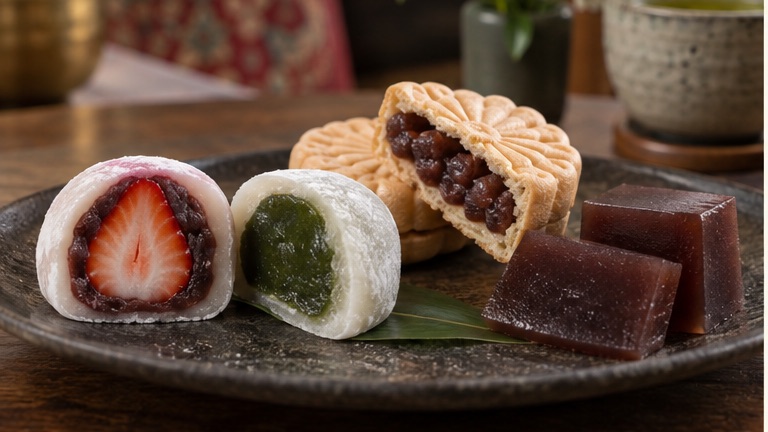
Nerikiri is the kind of shaped confectionery that can resemble a flower, leaf or other seasonal form. It is associated with carefully worked sweet paste rather than a baked sponge. JNTO describes forms using sweet white-bean paste with gyuhi, a soft rice-flour preparation, and seasonal designs. Recipes and names vary by maker. Explore JNTO’s wagashi craft introduction.
Do not expect the shape to announce the flavour literally. A pink flower does not necessarily taste like rose, and a green leaf does not guarantee mint. The design can refer to a season or idea while the ingredients follow another logic.
Look at how the design is suggested rather than fully copied. A few pressed lines, a colour transition or a small accent can make a plant recognisable. You can appreciate those decisions in the same way you notice simplified character design: the maker chooses which details carry the image.
Then taste it in a way that lets you notice the paste itself. Adding ice cream or a strong syrup may be enjoyable, but it makes a different dessert and can obscure the feature you came to explore. If it is served with tea, follow the host’s guidance rather than worrying about performing an elaborate ritual correctly.
One terminology trap deserves attention: namagashi refers to a fresh, high-moisture class of confectionery, not a guarantee that every ingredient is raw or uncooked. MAFF’s classification treats moisture and preparation method as different ways of grouping sweets. “Fresh” also does not supply a universal shelf life; follow the maker’s instructions.
Yokan is often sold as a sliceable block. For its standard method, Toraya explains a mixture of bean paste, sugar and kanten, the seaweed-derived gelling ingredient also known as agar, heated and set in a mould. The company notes that other varieties use different methods or moisture levels. Read how Toraya makes yokan.
The dark colour may make a slice look like chocolate or a familiar dense sweet from India. Let that resemblance help you identify the shape, but reset your flavour expectation. The bean base and firm set are the important clues, not a presumed cocoa or milk taste.
Yokan is a good choice when you want to pay attention to a concentrated filling-like texture without a pancake or rice wrapper around it. Compare it with anko inside another sweet and notice how setting the mixture changes the experience.
Kanten is not animal gelatin. However, that fact describes the gelling ingredient, not every product called yokan. A maker can add honey, dairy or other ingredients in a variation. Toraya itself lists multiple flavours, including a honey variety, so “plant-based core ingredients” should not be shortened to “every flavour is vegan.”
For packaged versions, check the best-before or use-by information and instructions after opening. A seller’s shelf-life statement belongs to that product and packaging. Do not apply the storage advice for one sealed bar to a freshly cut café portion.
Monaka combines a filling with thin rice-flour wafers. Toraya describes its own examples as sweet bean paste between delicate shells, with shapes such as flowers. See Toraya’s monaka introduction.
This makes monaka a particularly useful contrast with daifuku. Both can place bean paste inside another layer, yet the experience of that layer is almost opposite: a fragile wafer rather than a stretchy wrapper. If you thought that all bean-paste sweets would feel much the same, this is the comparison to try.
Ask whether the item is sold assembled or comes with a separate shell and filling. If it is a do-it-yourself package, follow its directions and fill it when you are ready to eat. The packaging arrangement can be part of protecting the intended texture, not an unnecessary complication.
Treat a thin wafer gently. Crushing the shell in a crowded bag can erase the very contrast you selected it for. For a tasting at home, open one item at a time instead of leaving every shell exposed while taking photographs.
Some modern products use similar shells around ice cream or other fillings. Read the full name and ingredients. Recognising the wafer format is useful, but it does not prove that the inside is bean paste, dairy-free or suitable for your particular diet.
Kakigori is shaved ice served with syrup or other toppings. JNTO’s seasonal-food guide includes combinations with matcha-flavoured syrup, bean paste, condensed milk and mochi. That range explains why one menu photograph can look like a simple ice snack while another resembles a layered dessert. See JNTO’s seasonal-food guide.
Indian readers familiar with flavoured ice will recognise the general idea. The comparison is a starting point, not a claim that every preparation has the same ice texture, syrup or serving style.
If you want to notice the ice, choose a simpler topping combination. If you want a mixed dessert, a version with bean paste or cream offers more contrasts. Neither choice is more correct; they answer different cravings.
Kakigori is not automatically dairy-free merely because its base is water. Condensed milk and cream may be included unless you ask for a version without them. Removing a visible topping also does not tell you the composition of the syrup underneath.
This is one sweet where photography can actively work against your first impression. It is meant to melt, so a long delay changes the structure. Take a quick picture if you want one, then eat while the form you ordered still exists. Anime can hold a perfect mound across several shots; a real bowl does not have that advantage.
Matcha is powdered green tea, but a matcha dessert is a recipe built around it. Ice cream, white chocolate, syrup and bean paste can all change the sweetness, richness and intensity you experience. Two green desserts may therefore have very different flavour profiles.
Ask whether you want tea flavour or a familiar sweet with a hint of tea. That is a more useful decision than assuming that the darkest-looking green item must be the best. Colour alone cannot establish the quality, amount or balance of the tea in a finished product.
A matcha label does not make a dessert sugar-free, vegan or egg-free. The recipe still needs checking. Nor does the presence of beans or tea justify calling the finished sweet a health food. If nutritional information matters to you, read the actual product’s information instead of borrowing claims about an isolated ingredient.
The word vegetarian can be used differently by different sellers. State your requirement directly: for example, no egg, no animal gelatin, or no dairy. If you need a vegan product, say so rather than hoping that “red bean” answers every question.
| Part to check | Why the name is insufficient | A direct question |
|---|---|---|
| Batter or wrapper | The filling may be plant-based while the exterior contains egg | Is egg used in the batter or glaze? |
| Cream or custard | Fruit and tea flavours can still contain dairy | Does the filling contain milk, cream or butter? |
| Gel or jelly | Similar-looking set textures can use different ingredients | Is it set with agar, gelatin or another ingredient? |
| Sauce and flavouring | A plain-looking sweet can carry added flavourings | Can you show me the ingredient list for the sauce too? |
| Shared preparation | An ingredient list does not describe every handling step | If relevant, what contact with other ingredients occurs during preparation? |
For Jain or halal requirements, explain the specific ingredients and standards you follow rather than assuming that vegetarian covers them. For an allergy, tell the seller explicitly that it is an allergy; a preference-level answer is not enough. If the information is unclear, choose something whose ingredients and preparation can be confirmed.
Our Japanese vegetarian-food guide for Indian readers goes further into ingredient checking. Here, the key habit is simply to check the whole construction of a sweet, not only its most visible filling.
Choose contrast rather than volume. One pancake-based sweet, one rice-textured sweet and one wafer or set sweet will teach you more than three similar cream-filled products. For example, dorayaki, daifuku and monaka let you compare different exteriors around broadly comparable bean fillings, subject to the actual products available.
Write down four ordinary observations: how the outside feels, how the centre feels, what flavour arrives first and whether you want another bite. You do not need a ten-point score or specialist vocabulary. “I like the filling but not the stretchy wrapper” is already enough to guide your next order.
Keep the comparison fair. Follow each item’s serving and storage instructions, and do not blame a sweet designed for immediate eating for the result of a long journey in unsuitable conditions. For delivery in India, check handling guidance and what condition the seller expects it to arrive in before placing the order.
There is no need to pretend that a costly imported version is the only worthwhile introduction. A locally made version can be a useful starting point if its ingredients and style are explained honestly. Equally, do not assume a local adaptation tastes identical to every Japanese example. Judge what is actually offered.
Once you know the structure, small details become visible: a character protects a fragile shell, a filling stretches, a sauce shines, or a carefully shaped sweet is presented instead of casually grabbed. Those are opportunities to notice food and animation together.
For more savoury discoveries, explore our guide to Japanese foods seen in anime or the ramen guide for Indian anime fans. Our Japanese festivals in anime guide adds context to the stalls and seasonal celebrations around many snack scenes.
Start with the sweet you have genuinely wondered about, then make one deliberate comparison. The aim is not to collect eight names. It is to move from “that looks cute” to knowing what kind of bite you actually want.
AUTHOR OF THIS ARTICLE
SoJapan
SoJapan India Pvt. Ltd. is a Japanese-founded company based in Gurugram. We bring Japanese food, anime goods and apparel materials to Indian businesses, with a sister company in Kyoto that works directly with makers in Japan.