← JOURNAL29 Sep 2026
12 Japanese Foods from Anime to Try in India: A Practical Guide for Fans
 By SoJapan
You may have known the sound of ramen being slurped, the shape of a triangular rice ball or the neat compartments of a bento box long before you knew the Japanese names for them. Anime does that unusually well: food is not decoration. It tells you who is at home, who is travelling, who is short of money and who has taken the time to care for someone.
Anime makes food memorable because the meal usually carries information beyond taste. A carefully packed bento can be an apology that the cook cannot say aloud. Instant noodles can show that a character is alone or exhausted. A shared hot pot forces rivals to negotiate space. When a hero finally eats after a dangerous journey, the ordinary act confirms that the body—and everyday life—has survived.
Indian viewers may recognise that narrative instinct. Food in Indian cinema and family life also communicates hospitality, class, region, grief and care. The ingredients differ, but the dramatic question is familiar: who cooked, who is invited, who refuses and who receives the last portion?
The difficulty is that recognition is not the same as knowing what is in the dish. A bowl that looks vegetarian may use fish stock. A fluffy omelette may sit on chicken rice. A curry that appears mild may contain beef or pork. This guide explains what 12 familiar anime foods actually are, what their scenes communicate and what vegetarian diners should ask before ordering.
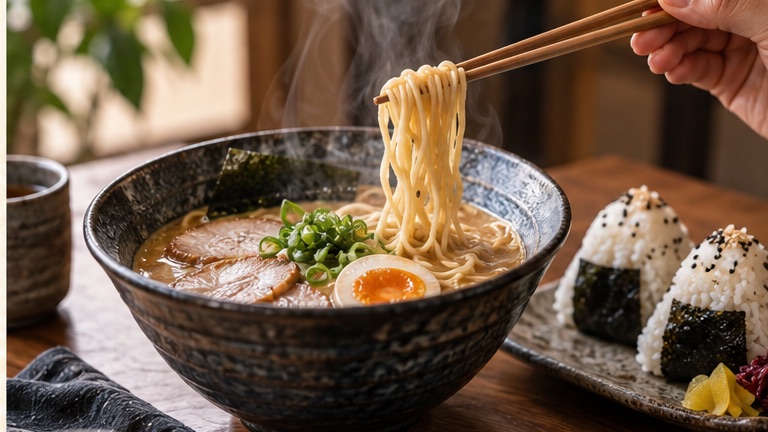
If you want the easiest introduction, start with vegetable ramen made with a confirmed plant-based broth, vegetable onigiri, veg yaki-udon, Japanese curry with a vegetarian roux, or dorayaki. These foods have familiar anchors for an Indian palate: noodles, rice, curry and filled pancakes.
Do not assume that “vegetable” means vegetarian. In Japanese cooking, the vegetables may still be seasoned with dashi made from dried bonito fish. In India, food containing fish, meat, seafood, egg or ingredients derived from them falls under non-vegetarian labelling rules; milk and milk products are treated separately. Ask about the broth, sauce and garnish, not only the visible toppings.
Here is the practical comparison. “Check” does not mean the dish cannot be vegetarian; it identifies the component most likely to change the answer.
| Anime food | What it is | What it often does in a story | Vegetarian check |
|---|---|---|---|
| Ramen | Wheat noodles in seasoned broth | Warmth, reward, late-night companionship | Broth, dashi, tare, oil, egg |
| Onigiri | Filled or seasoned rice ball | Travel, school lunch, care from home | Filling and seasoning |
| Japanese curry rice | Mild, thick curry with rice | Camp, canteen or family comfort | Roux and stock |
| Omurice | Omelette over seasoned rice | Home cooking and playful affection | Egg, rice filling, sauce |
| Bento | A composed boxed meal | Care expressed through preparation | Every compartment and sauce |
| Udon | Thick wheat noodles | Ordinary neighbourhood comfort | Broth or dipping sauce |
| Yakisoba | Stir-fried noodles with sauce | Festival energy and casual cooking | Sauce, noodles, shared pan |
| Okonomiyaki | Savoury cabbage pancake | Group cooking and regional identity | Dashi, egg, meat, sauce, bonito |
| Takoyaki | Batter balls traditionally filled with octopus | Crowds, stalls and dangerously hot first bites | Filling, batter and toppings |
| Taiyaki | Fish-shaped filled cake | Portable warmth and visual comedy | Batter and filling |
| Dorayaki | Two small pancakes with a sweet filling | Childhood pleasure and nostalgia | Egg, dairy, honey |
| Dango | Chewy rice-flour dumplings | Seasons, tea shops and festival pauses | Sauce and colouring |
Ramen is the obvious place to begin. Naruto’s attachment to Ichiraku Ramen made the bowl an anime symbol, but ramen is far larger than one series. It appears whenever a story needs warmth, speed, a late-night meal or a small reward after a hard day.
A ramen bowl has four working parts: broth, tare or concentrated seasoning, aromatic oil and noodles. Toppings sit on top of that structure. Change the broth and tare and you change the bowl, even when the noodles look identical.
This is why “veg ramen” deserves one more question in India. Traditional broths may use pork, chicken or seafood. A clear-looking shoyu ramen can still contain chicken stock and dried bonito. Miso ramen can still sit on a meat base. Even a bowl covered in corn, mushroom and spring onion is not vegetarian unless the kitchen confirms the stock and seasoning.
For a safer vegetarian order, ask: “Is the broth fully vegetarian, including the dashi and tare?” Kombu seaweed and dried shiitake can build a proper plant-based stock. They are not a consolation version; they come from an established Japanese meat-free tradition. If you also avoid egg, check the noodle and topping separately.
In flavour terms, Indian diners who enjoy savoury, spiced food often find miso ramen easier than a very delicate shio bowl. Do not expect chilli heat unless the menu says it is spicy. Japanese ramen is intense in salt, fat and umami, but not automatically hot in the Indian sense.
The dramatic bowl is often less about luxury than routine. A regular seat at a ramen counter can function like a familiar chai stall: it is where a character returns after failure, meets a mentor or recovers enough to speak honestly.
Onigiri is one of the most recognisable foods in school, travel and slice-of-life anime. It is a compact portion of cooked Japanese rice, usually shaped by hand and wrapped partly or fully in nori seaweed. It may contain a filling, have seasoning mixed through the rice, or be brushed with soy sauce and grilled.
The useful comparison for an Indian reader is not sushi. Onigiri rice is not normally seasoned with sushi vinegar. Think of it as portable comfort rice: simple, filling and designed to travel.
Traditional fillings include salted salmon, tuna mayonnaise, pickled plum and kombu. The shape tells you almost nothing about the filling, so read the label or ask. For vegetarians, umeboshi or pickled plum, kombu, sesame, edamame and some vegetable pickles can work. Tuna mayonnaise and salmon clearly do not; less obviously, kombu filling may have been cooked with fish-based seasoning.
Anime often uses onigiri to show care that survives travel. A parent packs it before a journey; a classmate shares one after practice; a badly shaped first attempt reveals effort more clearly than perfection would. The simple form makes the person who prepared it narratively visible.
For a first taste, choose a simple salted or sesame version. It lets you understand the texture before a strong filling takes over.
Anime often shows Japanese curry as a home meal, school-canteen plate or camp dish. It is thick, glossy and served beside rice, sometimes with a breaded pork cutlet. For an Indian diner, the name creates the wrong expectation unless the difference is explained.
Japanese curry is usually mild, slightly sweet and thickened with a flour-and-fat roux. Its spice profile is rounded rather than layered with a fresh tadka or a long list of whole spices. Potato, carrot and onion are common. Meat may be simmered into the sauce, or a cutlet may be placed on top.
The hidden issue is the curry roux. A vegetable curry can be made with a roux containing animal fat, meat extract or other non-vegetarian ingredients. A restaurant may remove the cutlet and still not have a vegetarian dish. Ask whether both the stock and roux are vegetarian.
For an Indian first-timer, the useful comparison is not which curry is “better.” Japanese curry developed into its own thick, mildly spiced comfort food. Expecting the layers of an Indian regional curry hides what the dish is trying to be.
Omurice combines an omelette with seasoned rice. In the classic home-style version, the rice is stir-fried with ketchup, onion and often chicken, then wrapped in a thin omelette. Modern restaurant versions may place a soft, trembling omelette over the rice and open it at the table.
It looks simple because the drama is in the egg. The filling deserves equal attention. “Omurice” does not mean vegetarian rice, and chicken rice is a standard version. A vegetarian diner should confirm the rice, sauce and stock. A person who eats dairy but not egg should obviously skip the dish; under Indian labelling rules, egg is non-vegetarian even when no meat is present.
For everyone else, omurice is an easy bridge into Japanese café food. Ketchup rice tastes more familiar than its description suggests, and the soft egg gives it the comfort-food quality anime uses so often.
A bento is a packed meal, not one specific dish. Anime uses it for school lunches, train journeys, convenience-store stops and the unmistakable gesture of one person preparing food for another. The compartments matter because they make a small meal feel considered.
A typical bento may include rice, a main item, pickles and one or more vegetable sides. The main item could be grilled fish, karaage fried chicken, a rolled omelette, tofu or vegetables. The rice may be plain, sprinkled with seasoning or topped with a pickled plum.
In anime, the person who opens the lid is reading the cook. Neat colour, favourite side dishes and even clumsy decoration can reveal intimacy. A convenience-store bento conveys something different: speed, independence, night work or a household where nobody had time to cook.
Still, check every compartment. Japanese pickles can be vegetarian while the dipping sauce is not. Tamagoyaki contains egg and may contain fish dashi. A vegetable side may use bonito flakes. “Veg bento” should mean the complete box, sauces included.
Udon is a thick wheat noodle with a soft, elastic bite. It can arrive in hot broth, cold with a dipping sauce, or stir-fried as yaki-udon. Anime often uses udon and soba to locate a scene in an ordinary neighbourhood shop rather than a special-occasion restaurant.
For an Indian first taste, yaki-udon offers a familiar stir-fried structure while the thick, elastic noodle changes the experience. Broth udon is gentler and often appears in stories when a character is ill, tired or seeking ordinary comfort.
Broth udon has the same vegetarian trap as ramen. The standard soup or dipping base often contains katsuobushi, or dried bonito fish. Bottled mentsuyu can also contain fish. A vegetarian version needs a plant-based base, commonly built with kombu and shiitake.
Anime drawing can make every noodle look equally smooth, but real udon varies by region and preparation. Some styles are very firm; others are soft. Cold, hot and stir-fried versions should not be judged as failed attempts at the same texture.
Yakisoba is a stir-fried noodle dish made with wheat noodles, vegetables and a sweet-savoury brown sauce. Despite the name, it is not normally made from buckwheat soba noodles. In anime it belongs naturally at festivals, food stalls and casual home meals.
The method feels familiar to anyone who orders street-style chowmein in India. The flavour is different: Japanese yakisoba sauce commonly leans sweet, fruity and tangy, with Worcestershire-style seasoning.
That sauce is the part vegetarians must inspect. Some products include oyster, fish, meat extract or other animal-derived flavouring; others are made as vegan versions. Egg can also appear in the noodle. Do not judge by the cabbage and carrot in the pan.
For a first order, ask for the sauce to be confirmed as vegetarian and try the dish before adding extra chilli. Its balance is meant to be sweet-savoury. Turning it immediately into chilli noodles hides the distinction you came to taste.
Okonomiyaki is often translated as a Japanese savoury pancake. The batter is mixed with a large amount of cabbage, cooked on a hot plate, then finished with sauce, mayonnaise, seaweed powder and dancing flakes of dried bonito. Regional styles differ, with Osaka and Hiroshima especially associated with distinct builds.
The visible meat or seafood is only the first check. The batter may use dashi, the sauce may contain animal-derived ingredients, mayonnaise contains egg, and bonito flakes are fish. Removing the pork or prawn does not automatically create a vegetarian okonomiyaki.
A proper vegetarian version is entirely possible: plant-based dashi in the batter, vegetables or mochi as fillings, a checked sauce, egg-free mayonnaise if required, and no bonito flakes. Ask the kitchen whether it changes the base or only removes the topping.
Okonomiyaki scenes work well because cooking happens at the table or griddle. Characters argue over flipping, divide portions and reveal regional pride. The shared process matters as much as the finished pancake.
Takoyaki are small round batter snacks cooked in a moulded iron pan. The traditional centre is a piece of octopus; “tako” means octopus. They are turned rapidly while cooking, then dressed with sauce, mayonnaise, seaweed powder and bonito flakes.
India now has versions filled with paneer, cheese, mushroom or vegetables. Those can be enjoyable anime-event snacks, but they should be named clearly. A paneer-filled ball is takoyaki-inspired, not octopus takoyaki.
Vegetarian customers again need to check the batter, sauce, mayonnaise and bonito topping. Four separate components can change the answer. A vegetable or paneer centre alone does not settle whether the whole serving is vegetarian.
If you want the Japanese original, expect a soft, almost custardy centre rather than a crisp pakora texture. The outside sets first while the inside remains hot and tender.
Taiyaki is a fish-shaped cake cooked in a hinged mould. The classic filling is sweet red-bean paste, though custard, chocolate, cheese and seasonal fillings are common. Anime uses it as a street snack: warm, portable and visually unmistakable.
The fish shape does not mean the snack contains fish. The common vegetarian concerns are egg in the batter and gelatine or other ingredients in non-traditional fillings. Diners who eat egg will usually find classic red bean the simplest choice, but the recipe still needs checking.
Taiyaki also introduces anko, the sweet azuki bean paste found across Japanese confectionery. It is often less sugary than many Indian mithai fillings and retains a distinct bean character. The first bite makes more sense when you expect sweet bean rather than chocolate hidden in a fish shape.
Dorayaki consists of two small, soft pancakes around a filling, traditionally sweet red-bean paste. It is famously associated with Doraemon, whose enthusiasm has introduced generations of viewers to the name.
This is one of the easiest formats for an Indian first-timer to understand. It can be shared and needs no special eating technique. The classic filling is vegetarian, but the pancake batter usually contains egg and may contain dairy or honey. Packaged products still need a complete ingredient check.
Chocolate, matcha cream and custard versions are widely approachable, but red bean is the useful first taste if the purpose is to understand the food seen in anime. Try it with unsweetened green tea rather than another sweet drink.
Dango are small dumplings made from rice flour and served on a skewer, often three at a time. Hanami dango uses pink, white and green colours; mitarashi dango is grilled and coated with a glossy sweet soy sauce. The snack appears around festivals, tea shops and seasonal scenes.
The ingredients can be very simple, which makes dango one of the easier potentially vegan options on this list after the sauce and colouring are checked. The question is usually not meat but texture. Dango is chewy and dense. It is not a marshmallow and it is not the same as soft mochi wrapped around a filling.
Mitarashi dango can surprise an Indian viewer because the glossy brown coating looks like caramel while tasting of sweet soy. Eat a small serving slowly and notice the contrast between grilled surface, dense chew and savoury sweetness.
Japanese food can be highly vegetable-led without being vegetarian. The safest approach is a five-part check:
This is not unnecessary caution. The visible vegetable is only one component of a Japanese dish. A direct question about broth, dashi and sauce is more reliable than guessing from colour or garnish.
Vegan and Jain requirements need separate conversations. A vegan diner will also exclude dairy, egg and honey. A Jain diner may avoid onion, garlic and root vegetables, and some will not eat mushrooms. A kombu-and-shiitake vegetarian broth therefore does not automatically work for Jain service. The kitchen needs a separate written recipe rather than an improvised subtraction.
For a full dish-by-dish checklist, continue with our Japanese Vegetarian Food Guide for Indians.
Food solves a problem animation faces: how can a story make daily life feel physical? Steam shows temperature. Chopsticks reveal hesitation. An empty bowl proves appetite. The animator can make a character’s mood visible without explaining it in dialogue.
Meals also arrange people. A school lunch places friends side by side. A restaurant counter lets strangers talk without facing each other. A family table exposes an empty seat. A festival snack gives two characters a reason to walk at the same speed.
The most important anime meal is therefore not always the fanciest drawing. Notice five recurring uses:
This is why a simple bowl can receive more screen time than a banquet. The meal completes an emotional action.
Start with one dish, not a table full of unfamiliar items. Ask the restaurant what it makes especially well and whether the key ingredients are Japanese-made, locally made or adapted. None of those answers is automatically bad; the problem is paying for one while being told it is another.
If you are vegetarian, use the five-part check above. If staff cannot answer, choose a packaged sweet with a readable label or a clearly specified rice dish instead. If you are ordering ramen for the first time, eat it when it arrives. Noodles continue to soften in hot broth, so a long photo session changes the product.
And keep the right expectation. Anime makes food look emotionally large because the meal often carries the scene. The real pleasure is usually smaller: the chew of udon, warm rice in an onigiri, the sweet-salty glaze on dango or the balance of a bento box.
Animation also edits reality. Steam remains visible at the perfect angle. Noodles never sit long enough to soften while characters talk. A cut surface is arranged for the viewer, and the most appetising bite receives a close-up. Real food can be delicious without matching the saturation, symmetry or impossible volume of a drawing.
Begin with verified vegetable onigiri, plant-based udon or ramen, and red-bean dorayaki. You will experience rice texture, savoury umami and anko without making every unfamiliar food compete on one plate.
Try yakisoba, a clearly named takoyaki or vegetarian inspired variation, and taiyaki. Eat each hot item soon after it is served. Festival anime emphasises walking and sharing, so split portions rather than turning the tasting into a heavy meal. For the setting around those stalls, see 15 Japanese Festivals and Seasonal Events in Anime Explained.
Choose Japanese curry, omurice if you eat egg, and dango or dorayaki. This route makes the differences easiest to notice because curry, rice, pancakes and sweet fillings already have Indian points of comparison.
Ramen is probably the most widely recognised, helped by its repeated role in series such as Naruto. Onigiri, bento, Japanese curry, omurice, takoyaki, taiyaki, dorayaki and dango are also common across anime genres.
Some ramen is vegetarian, but the toppings do not decide the answer. Confirm that the broth, dashi, tare, oil and noodles contain no meat, fish, seafood or egg according to your dietary requirements.
No. Both use Japanese rice, but onigiri is usually made with plain salted rice rather than rice seasoned with sushi vinegar. It is a portable rice meal or snack with a filling or seasoning.
Vegetable onigiri, dango, red-bean taiyaki, dorayaki, veg Japanese curry and plant-based ramen can all work. Check egg in batters and noodles, fish in dashi and sauce, and animal-derived ingredients in curry roux.
Japanese and pan-Asian restaurants, specialist grocery stores, anime conventions and online retailers are the main routes in large cities. Check the stated country of origin and ingredient label: a Japanese-style product is not necessarily made in Japan.
Animation controls colour, steam, composition and timing. It can hold a noodle at its most elastic moment or cut directly to the perfect cross-section. Real food should be judged by temperature, aroma, texture and balance rather than whether it reproduces a stylised drawing.
Choose ramen if a verified broth is available and you want the most iconic experience. Choose dorayaki for the lowest-pressure sweet introduction, onigiri for portable rice comfort, or Japanese curry if you want the clearest comparison with a familiar Indian food category.
AUTHOR OF THIS ARTICLE
SoJapan
SoJapan India Pvt. Ltd. is a Japanese-founded company based in Gurugram. We bring Japanese food, anime goods and apparel materials to Indian businesses, with a sister company in Kyoto that works directly with makers in Japan.