A first-time anime viewer may accept demons, psychic powers and time travel without hesitation, then become confused by an ordinary school day. Why is the academic year beginning under cherry blossoms? Why do students change their shoes at the entrance, clean their own classroom, stay late for club practice and treat a cultural festival as if the future of the world depends on it?
School anime uses a setting that Japanese viewers already understand. A brief shot of a shoe locker, a different coloured necktie or an empty clubroom can communicate age, status, season and social tension before anyone explains them. International viewers can follow the plot without that background, but they may miss what a scene is quietly telling them.
This guide explains 22 recurring parts of Japanese school life as they appear in anime. It also separates common practice from storytelling shorthand. Japan does not have one identical school experience, and anime schools are not documentaries. Rules vary among public and private institutions, regions, age groups and individual schools. Still, the routines below are grounded in real educational structures and help explain why so many anime stories feel the way they do.
| When anime shows… | The scene often communicates… |
|---|---|
| Cherry blossoms at the school gate | A new academic year, new class and fresh social beginning |
| Students changing shoes | Entry into a shared indoor space with its own rules |
| A student calling someone senpai | Recognition of seniority within a school or club relationship |
| A nearly empty clubroom | A club may be at risk because it lacks the required members |
| Students cleaning after class | Shared responsibility, routine cooperation or an opportunity for conversation |
| A cultural festival café | Class teamwork, public performance and temporary freedom from normal roles |
| A third-year student leaving a team | The end of a school stage, often before entrance examinations |
| A rooftop confession | Privacy created by fiction more often than an everyday school habit |
| A bento made for one character | Care, intimacy or family circumstances expressed through food |
| A transfer student introduction | A fast way to bring an outsider into an established social group |
The useful question is not simply, “Does this happen in Japan?” Ask what the detail allows the story to show: belonging, obligation, competition, transition or a character’s difficulty fitting into the group.
Japan’s school year generally begins in April and ends the following March. That is why so many school anime open with cherry blossoms, entrance ceremonies and characters discovering which class they have entered. Spring does more than make the background attractive. It signals a reset: new teachers, new classmates, new seating plans and a chance to become a different version of yourself.
For many Indian viewers, the emotional logic is familiar even when the month differs. A new class can rearrange friendships and academic expectations. Anime compresses that uncertainty into a few recognisable images: a school gate, posted class lists, introductions and petals moving in the wind.
The three-term calendar seen in many stories is common, but schedules differ. Some schools use two semesters, and exact holidays vary by region and institution. The dependable story clue is the April-to-March progression. When third-year students graduate while younger characters remain, the series is marking the end of one cohort rather than the end of the calendar year.
Japanese lower-secondary and upper-secondary schools commonly have three grades. In a high-school anime, a first-year student is usually at the beginning of a new institution, a second-year student occupies the relatively stable middle, and a third-year student is approaching graduation and entrance examinations.
These labels shape character roles. First years learn a club’s customs. Second years inherit responsibility. Third years must decide when to step away. A sports story can create genuine sadness from a single fact: this tournament is the seniors’ final opportunity to compete for their school.
Age alone does not explain that urgency. The academic stage does. When subtitles use “freshman,” “sophomore” or “senior,” they are translating the position rather than reproducing Japanese terminology exactly. Indian viewers can read the pattern much as they would understand the difference between a newly admitted student, a house captain and someone preparing for board or university entrance examinations. The institution gives the year social meaning.
Characters often introduce themselves as members of Class 1-A, 2-B or 3-2. The first number normally indicates the grade; the letter or second number identifies one of several parallel homerooms. It does not usually mean that Class A contains the best students, unless the fictional school explicitly sorts pupils by ability.
The homeroom matters because students spend much of the day with the same group. Subject teachers may change, but the class remains a basic social unit for announcements, events, duties and festivals. A character placed in a different class from a close friend has not merely been assigned another room. The story has reduced their daily contact and opened space for new relationships.
Anime sometimes exaggerates the permanence of these groups, but the device is grounded in school organisation. It lets writers create a manageable community inside a much larger campus. When a teacher says “Class 2-B will run a haunted house,” the entire class has become a temporary production team, including students who would never voluntarily join the same club.
The homeroom teacher in anime may appear unusually involved in students’ lives. This role can include daily attendance, announcements, guidance, paperwork and communication around class issues. The teacher is not teaching every subject at secondary level, but is attached to the class as an organisational point.
This helps explain familiar character types: the strict teacher trying to keep an unruly class on schedule, the tired teacher supervising festival preparation, or the observant teacher who notices that a student has stopped attending. Anime naturally intensifies these personalities, especially in comedy, yet the position gives the character a credible reason to remain involved beyond one lesson.
The relationship should not be romanticised. A teacher has authority, students may be reluctant to seek help, and real schools differ in the quality of support available. In storytelling, however, the homeroom teacher often stands at the boundary between institutional rules and the class’s private social world. A supportive intervention therefore carries more weight than advice from a teacher who barely knows the group.
Many Japanese secondary schools require uniforms, but there is no single national design. Blazers, sailor-style uniforms, stand collars, shirts, sweaters, skirts and trousers appear in different combinations. Private schools may treat a distinctive uniform as part of their public identity, while other institutions use simpler designs or allow more variation.
Anime uses uniforms twice: once as a believable school rule and again as visual design. A ribbon, necktie, badge or indoor slipper can help viewers identify a school or grade immediately. Characters then personalise the regulated outfit through an open collar, rolled sleeves, cardigan, hair accessory or improper footwear. The small violation tells us who follows rules before dialogue does.
Indian viewers should be cautious about reading every short skirt or perfectly fitted jacket as representative. Animation selects silhouettes for clarity and appeal, and some designs are deliberately fashionable or unrealistic. The important cultural point is the tension between belonging and individuality. Because the base clothing is shared, even a minor change becomes legible as confidence, carelessness, rebellion or economic difference.
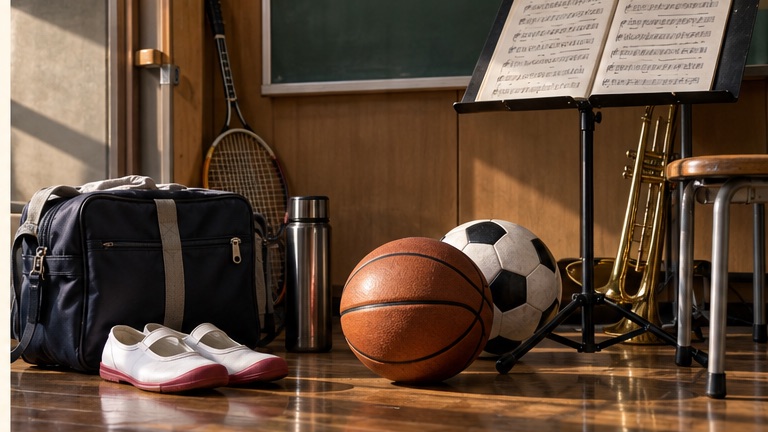
The rows of shoe lockers near a school entrance are called getabako. Students commonly change from outdoor footwear into designated indoor shoes. The practice helps keep interior floors clean and reflects a wider Japanese habit of separating outdoor and indoor spaces.
In anime, the location becomes socially useful. Everyone passes through it. Notes can be left inside a locker; students can meet before class; an unexpected pair of shoes can reveal that someone is still in the building. A mundane architectural feature becomes a message board, meeting point and mystery clue.
The romantic letter hidden in a shoe locker is a storytelling convention, not evidence that every Japanese student communicates this way. It works on screen because the locker is personal enough to receive a message but public enough to create risk. The scene carries the tension of being seen. When a character pauses there after school, the setting itself suggests that they are between the protected school day and whatever waits outside.
In many Japanese secondary schools, students stay with their homeroom group for much of the timetable while subject teachers come to the room. They may move for science laboratories, art, music, physical education or specialised classes.
This is why the same window seat can become a character’s visual home across an entire series. The classroom is not merely where mathematics happens. It is where lunch is eaten, announcements are made, gossip spreads and the day is emotionally measured. A changed seating plan can therefore function like a plot event.
Anime famously favours the desk beside the back window. It offers an unobstructed camera angle, attractive light and a view that allows the protagonist to stare outside. It should not be treated as a statistically privileged seat reserved for heroes. This is visual grammar. When you recognise it, the cliché becomes easier to enjoy: the position tells us the character is present in the group while mentally looking beyond it.
The iinchō, often translated as class representative or class president, helps coordinate class matters. Anime frequently gives the role to a serious student with glasses who demands order. Real responsibilities and selection methods vary, and the representative is not a miniature principal.
The role is narratively efficient. One student has a reason to collect forms, lead a meeting, speak to teachers or push classmates to finish festival work. A shy character being elected can create growth; an ambitious character can discover that authority means unglamorous labour.
Indian viewers may recognise elements of class monitor, prefect or house responsibility, but the exact structure is not identical across systems. The useful similarity is that a student position converts peer cooperation into an obligation. When classmates ignore the representative, the scene is not only comic disorder. It may reveal how much informal influence matters compared with an official title.
Japanese school guides for families describe a cleaning period in which students share responsibility for classrooms and school grounds. Anime shows pupils moving desks, sweeping floors, wiping surfaces and emptying bins, sometimes under a rotating duty system.
The practice is often explained internationally as character education: students learn to care for shared space. That interpretation is useful, but anime also shows the less ideal version. Characters avoid work, argue about assignments or use cleaning time to talk privately. A routine can teach cooperation without making every participant enthusiastic.
The scene is easy to misread as punishment because cleaning is sometimes assigned as discipline in other contexts. Usually, the ordinary group cleaning shown after lessons is simply part of the school day. For a writer, it is valuable quiet time. Desks move, the formal lesson has ended, and characters who might not arrange a private meeting can speak while their hands are occupied.
In many elementary and junior-high schools, lunch is provided as part of educational activity. Official guidance notes that students may help set and clear the meal. Food and nutrition education, or shokuiku, treats eating habits, health and knowledge of food as connected rather than separate topics.
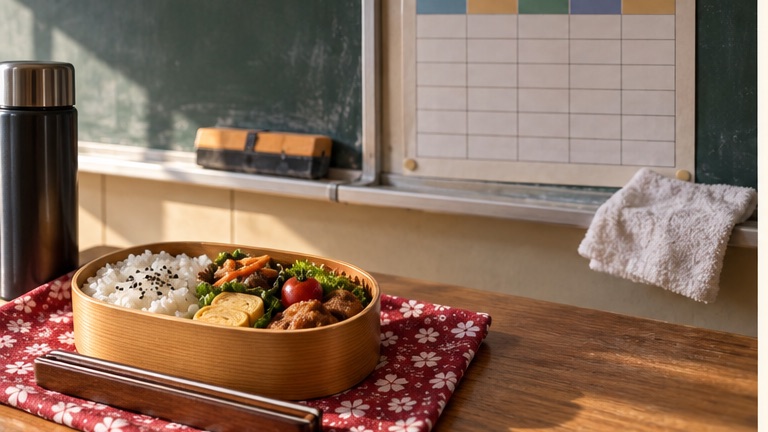
High-school anime more often shows students bringing bento, buying bread or eating in a cafeteria because arrangements vary. The lunch scene quickly reveals a household. An elaborate handmade box, convenience food, a missing lunch or a character who eats alone can communicate care, money, skill and emotional distance without exposition.
Indian viewers with vegetarian, religious or allergy requirements should not assume that a visually simple dish meets those needs. Broth, seasoning and fillings may contain fish or meat even when large pieces are not visible. Japan’s official school guidance tells families to consult the teacher about health or religious restrictions. In fiction, a shared bite may be romantic; in real life, checking ingredients remains more important than copying the scene.
Anime students sometimes sprint to a school shop for yakisoba-pan, curry bread or another popular item before it sells out. The sequence behaves like an action scene: doors open, crowds surge and one victorious character lifts a packaged bun.
Not every school has this exact daily battle. The joke works because a shop or canteen can have limited quantities, lunch breaks are short and particular items develop a reputation. It turns an ordinary preference into a temporary status competition.
For Indian viewers, the emotional mechanism may feel like reaching a canteen before the most popular samosa, cutlet or special meal disappears. The food differs; the small economy of scarcity does not. When an anime character shares the last bread, refuses to sell it or gives it to someone who missed lunch, the gesture tells us more than the price of the snack. Scarcity has made kindness measurable.
Japanese schools offer athletic and cultural extracurricular activities, although participation rules and intensity vary. Anime clubs cover familiar fields such as volleyball, football, baseball, music and art, alongside fiction-friendly groups devoted to mysteries, games or almost any subject a writer needs.
The club solves a storytelling problem: how can characters of different classes or years spend time together every day? It gives them a room, a schedule, a shared goal and a reason to travel or compete. It also creates chosen belonging. A character who feels invisible in class may become essential in a club.
Real club culture is more complicated than inspirational training sequences. Time demands can be heavy, coaching quality varies, and students may feel pressure to conform. Japan’s national sports and education authorities have also set a new reform period beginning in fiscal 2026, with schools and local communities developing ways to make activities more sustainable and widen community participation. Implementation will not look identical everywhere. A good viewer should hold both ideas: clubs can create friendship and mastery, while the same commitment can create exhaustion or hierarchy. Anime chooses which side best serves its story.
“Our club will be abolished unless we recruit one more person” is one of the most reusable school-anime plots. Schools set their own recognition rules, so there is no universal magic number. A group may require a faculty adviser, enough members, an approved purpose and access to a room or budget.
The threat is believable even when the deadline is exaggerated. Space and staff supervision are finite. An inactive club cannot assume permanent resources. For the story, recruitment forces an established pair to approach strangers and explain why their activity matters.
This is why the apparently reluctant final member often becomes central. The person was invited to satisfy paperwork but changes the group’s identity. The device can feel formulaic, yet it mirrors a real institutional truth: communities survive only when new people choose to continue them. In a series about music, sport or traditional art, membership is also a question of whether knowledge will pass to the next year.
Senpai refers to someone senior within a shared institution or activity; kōhai refers to the junior. The relationship is based on relative experience or entry order, not simply on who is older. A younger student who joined an organisation earlier can be senior in that context.
Subtitles sometimes leave senpai untranslated because “senior” does not carry all the relational meaning. The word can express respect, affection, dependence or comic obsession. It is not a romantic title by definition, even though romance anime often uses a junior’s admiration for a senior.
Hierarchy also varies. Some clubs use formal speech and strict expectations; others are relaxed. Fiction may amplify the system to create conflict or jokes. Indian viewers can compare it cautiously with relationships shaped by school year, team experience or workplace seniority, but should avoid treating Japan as uniformly rigid. Watch what the individual characters do with the relationship: does the senior teach, exploit, protect or finally trust the junior with responsibility?
In series such as Haikyu!!, Blue Lock or school baseball stories, defeat can feel enormous even when the characters are not professional athletes. The reason is partly structural. School competition follows an academic clock. Third-year players graduate, teams change and a particular combination of members may never compete together again.
That gives “one more match” its emotional force. A talented younger team can promise to return next year; a senior cannot make the same promise in the same uniform. Retirement from the club may also come before graduation so older students can focus on examinations.
Anime heightens the final whistle with memory, silence and close-ups, but the underlying loss is credible. Indian viewers familiar with inter-school sport can understand the difference between losing a game and ending a cohort. The best sports anime also respects the opponent’s clock. The other team has seniors, families and a final season too, which is why victory rarely makes the defeated side meaningless.
A bunkasai, or cultural festival, commonly features class projects, club exhibitions and stage performances. Web Japan describes students planning exhibits, plays, dance and music, with classes dividing roles and working beyond their usual groups. Our guide to Japanese festivals in anime explains how school festivals differ from shrine festivals and seasonal public celebrations.
Anime loves maid cafés, haunted houses and theatrical disasters because a festival suspends ordinary classroom behaviour. Students decorate rooms, wear costumes, invite visitors and publicly present what they have made. A quiet character must perform; a divided class must finish one project; a band finally plays for an audience.
The maid café is especially overrepresented because it creates costumes, customer interactions and romantic comedy in one location. It is an available festival idea, not a compulsory Japanese-school ritual. The deeper truth is collective production. A festival makes invisible social labour visible: who plans, who builds, who performs and who quietly completes the unwanted tasks. When a series spends several episodes preparing for one day, the preparation is often the real story.
The school sports festival, often called undōkai or taiikusai depending on context, may include races, relays and team events. Anime adds dramatic rivalries, unusual contests and conveniently meaningful pairings.
Unlike a specialised club tournament, sports day involves a much broader student population. Classes, houses or colour teams may compete, allowing the story to place athletic and non-athletic characters in the same event. A relay baton can become a lesson in trust; a borrowed-item race can become romantic chaos.
Indian viewers may find the broad concept familiar from annual sports days, but the exact events, scale and student involvement differ by school. Anime should again be read for function. The festival rearranges the normal hierarchy. The top academic student may struggle, the quiet runner may become the class hero, and teachers can appear as participants rather than distant authority figures.
Japanese summer vacation generally falls within the academic year, not between two school years. Anime characters may receive homework, attend club practice, prepare for competitions, join training camps or return for festival work.
That timing matters. Friendships formed in April have had several months to develop, and summer offers a temporary loosening without resetting the class. Beach episodes and fireworks festivals are entertaining, but the season can also expose distance: a student travels home, stops answering messages or studies while friends play.
Training camps are particularly useful fictional containers. The club lives, eats and practises together, creating both accelerated improvement and late-night conversations. Not every real club attends a picturesque camp, and anime schedules are often designed for maximum drama. Still, the blend of holiday and obligation is culturally legible. Summer is freedom with assignments attached.
The phrase “exam season” in anime can change a character’s entire routine. Admission to upper-secondary school or university may involve entrance examinations alongside grades, recommendations and institution-specific requirements. The exact pathway is more varied than a single test decides everything.
Anime represents pressure through cram schools, practice exams, study groups and characters comparing desired schools. A choice of school can also threaten a friendship or romance: two people may have different academic levels, family expectations or plans to leave their region.
Indian viewers do not need the Japanese system to be identical to recognise coaching, competitive admission and the fear that one result will define the future. The important difference is context. Terms such as juken refer broadly to entrance-exam preparation, while a juku is a private supplementary school that can support academic study. When a third-year student withdraws from club activity, the decision often reflects this approaching transition rather than loss of affection for the team.
Juku is commonly translated as cram school, although providers and purposes vary. Students may attend for examination preparation, supplementary instruction or academic advancement. Anime often shows evening lessons followed by a walk home, creating a believable time for characters from different schools to meet.
The setting can indicate ambition, difficulty or family investment. A character attending an elite programme may be highly competitive; another may be there because classroom learning is not enough. Fiction sometimes uses the word as a simple symbol of pressure and leaves the economic or educational differences unexplored.
For viewers in India, coaching-centre comparisons can be helpful but incomplete. Japanese admissions, school recommendations and testing structures have their own rules. Treat juku as a category of private supplementary education rather than assuming it maps perfectly onto preparation for one Indian examination. In narrative terms, it often represents the part of adolescence consumed by the future after the regular school bell has rung.
Anime characters confess love under a tree, behind the gym, in an empty classroom or on the roof. These spaces provide privacy while keeping the characters inside the shared world of school. They also give the director clean backgrounds, symbolic weather and the possibility that someone overhears.
Real students can of course have important conversations on campus, but anime rooftops are disproportionately accessible. Actual roof access may be restricted for safety. The location survives because it visually removes characters from the crowd without removing the school from the scene.
The same applies to the perfectly timed sunset confession. It should be understood as cinema rather than a daily custom. Yet the underlying constraint is believable: students whose schedules are organised by lessons, clubs and commuting need small pockets of privacy. The fictional location turns that limited freedom into a recognisable stage.
A transfer student stands before the class, writes a name on the board and becomes the centre of attention. Transfers happen, but anime uses them far more often than probability alone would suggest.
The reason is simple: the newcomer needs explanations. Classmates can describe rules, clubs and relationships without the dialogue feeling entirely artificial. The character also disrupts settled groups. A seat changes, an old secret enters the room or someone who does not understand local expectations asks the question the audience has.
For international viewers, this character is often an unspoken guide. We learn the school at the same speed they do. Some series reverse the pattern by making the protagonist an established student and the transfer student mysterious. Either way, arrival creates narrative permission to look closely at routines everyone else considers normal.
Recognising reality should not remove the fun. It helps separate cultural detail from genre machinery.
Anime is selective reality. It keeps details that create clear images and repeatable drama, then removes paperwork, supervision and uneventful hours.
The next time you watch a school anime, ask four questions.
A student who eats alone is not automatically lonely; they may want quiet. A character who speaks casually to a senior is not automatically rude; the relationship may be close. Culture provides the possibility, while the series provides the evidence. Avoid replacing one stereotype with another.
| If you want to notice… | Try… | What to watch for |
|---|---|---|
| Club hierarchy and team transition | Haikyu!! | Senior-junior learning, recruitment and final tournaments |
| Cultural festival preparation | Kaguya-sama: Love Is War | Class projects, student council work and confession-stage symbolism |
| Music-club practice | K-On! or Sound! Euphonium | Clubroom belonging versus serious performance demands |
| Academic and romantic pressure | Blue Box | Sport, routine, study and gradual relationship change |
| School isolation and communication | A Silent Voice | Peer groups, bullying and the long effects of classroom behaviour |
| A comic student council | Monthly Girls’ Nozaki-kun or Kaguya-sama | How anime exaggerates familiar school roles |
| Supernatural school as metaphor | Mob Psycho 100 | Clubs, self-improvement and belonging outside academic status |
These are not documentaries. Use them as stories that highlight particular structures, then compare how another series treats the same detail.
Shared cleaning is a documented part of many Japanese school routines. The exact duties, frequency and help from professional staff vary. Anime often uses cleaning time as a conversation scene because formal lessons have ended but students are still together.
Official guidance describes club activities as available to students who wish to join, but expectations vary by school, family and social environment. Some anime characters feel strong pressure to participate even when a written rule does not require it.
No exact translation covers every situation. Senpai identifies relative seniority within a shared institution or field. Tone and context determine whether it expresses ordinary respect, affection, admiration or distance.
The school and club give writers a contained peer world. Parents may be working, narratively unimportant or deliberately absent to create independence. This is a genre decision, not proof that Japanese parents are generally uninvolved.
Policies vary. Some schools welcome families, prospective students or community visitors; others restrict entry or require invitations and identification. Anime selects the version that lets outside characters enter the story.
No. Uniforms are common, especially in secondary education, but designs and requirements differ, and some schools permit ordinary clothing. Anime favours uniforms because they establish setting and group identity instantly.
The April school opening, three-year progression, homeroom, indoor shoes, student cleaning, clubs, festivals and entrance-exam pressure all have real foundations. Anime then concentrates them. It makes the club more threatened, the council more powerful, the roof more accessible and the festival more romantic because stories need visible decisions.
For Indian viewers, understanding those foundations adds a layer without turning entertainment into homework. A sports defeat becomes the end of a senior’s school career. A handmade lunch becomes a message about home. A character’s refusal to call someone senpai becomes a deliberate choice rather than a subtitle oddity.
Start by noticing the group, the season and the rule. Then notice the person who responds differently. That gap—between what school expects and what the character chooses—is where many of the best anime stories begin.
If you are choosing your first series, read 21 Best Anime for Beginners in India. For the food that appears in clubrooms, festivals and family scenes, see 12 Japanese Foods from Anime to Try in India.
School practices vary by institution and can change. Cultural explanations in this article describe common patterns and storytelling uses, not rules followed by every student in Japan.

AUTHOR OF THIS ARTICLE
SoJapan
SoJapan India Pvt. Ltd. is a Japanese-founded company based in Gurugram. We bring Japanese food, anime goods and apparel materials to Indian businesses, with a sister company in Kyoto that works directly with makers in Japan.