← JOURNAL29 Sep 2026
Japanese Curry Explained for Indian Anime Fans: Roux, Katsu and Your First Plate
 By SoJapan
An anime character serves a plate with white rice on one side and a glossy brown curry on the other. There may be potatoes and carrots in the sauce, or a sliced breaded cutlet on top. For an Indian viewer, the word curry is familiar; the particular plate may not be.
The first question is often whether it tastes like the curry you know. A better question is which familiar dish you are comparing it with. India has many cuisines and preparations, so there is no single Indian curry against which every Japanese version can be measured.
The thick, roux-based curry rice common in Japan is a useful starting point. It brings together a seasoned sauce, rice and optional ingredients or toppings. Other Japanese curry styles behave differently, including Sapporo’s soup curry and curry served with udon noodles.
This guide explains those differences for anime fans who want to move from recognising the plate to choosing one. It covers flavour, texture, roux, menu names and ingredient checks without assuming that every Indian reader wants maximum chilli or follows the same diet.
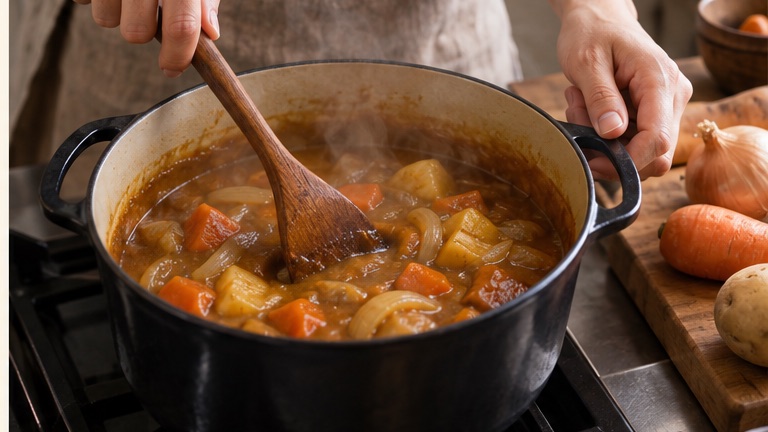
Curry rice, often written kare raisu, is curry served with rice. A familiar home-style version uses a thick sauce with ingredients such as onions, carrots, potatoes and meat. House Foods describes this style and explains the use of ready-made curry roux in home cooking. That is a common approach, not the only way curry is made in Japan. Read House Foods’ introduction to Japanese curry.
On the plate, the sauce and rice work together. Tasting a spoonful of sauce alone tells you something, but not everything about the meal. The amount of rice in a bite changes how intense the sauce feels, just as a cutlet or another topping changes the texture.
The sauce need not be understood as an unsuccessful attempt at a different regional curry. Judge the dish by the balance it is trying to create. You can find it comforting, too sweet, pleasantly mild or less interesting than your favourites without turning preference into a competition between cuisines.
The plate has a clear visual structure: pale rice against darker sauce, with large ingredients that remain readable in a drawing. A ladle, a pot and several waiting plates can also quickly establish a shared meal.
As a scene, cooking curry provides small actions that characters can share or argue over: chopping, stirring, tasting and serving. Those are storytelling possibilities, not proof that every Japanese household uses one standard recipe. An exaggerated reaction to a character’s cooking is still an exaggerated reaction.
Japanese curry’s development is commonly explained through the movement of curry powder and curry preparations via Britain, with roots in British encounters with Indian food during the colonial period. House Foods’ history traces that route, while MAFF’s Yokosuka navy-curry entry discusses a naval strand of the story. These accounts describe influences and popularisation, not the invention of India’s diverse food traditions by anyone outside India. Read MAFF’s Yokosuka curry account.
The useful point for a diner is that dishes change as ingredients, institutions and household habits change. Japanese curry acquired local forms rather than remaining an exact reproduction of one Indian preparation.
You do not need to settle every historical claim before tasting it. Be cautious about neat internet stories that assign an entire food culture to one inventor, one year or one military rule. A contemporary home curry, a restaurant’s speciality and a regional soup curry can have different histories within the broader subject.
The word roux comes from a flour-and-fat thickening preparation. A commercial Japanese curry roux commonly combines a thickening base with spices, salt and other seasonings in a concentrated form. House Foods describes its block format, while manufacturers also sell other formats.
Curry powder is a spice blend. It does not automatically contain the same thickener, fat or seasoning balance as a roux block. A ready-made sauce is different again: it is already a sauce, and its package directions may call for heating rather than building a pot from raw ingredients.
| Product | Main job | What you should not assume |
|---|---|---|
| Curry powder | Supplies a blend of spices | One spoonful replaces one roux block |
| Curry roux or curry mix | Helps season and thicken a prepared liquid | Every brand or pack uses the same water ratio |
| Ready-made curry sauce | Provides a prepared sauce to heat or serve as directed | It is concentrated in the same way as a roux |
| A restaurant’s house sauce | Provides that kitchen’s finished curry | The topping name reveals all its ingredients |
For an Indian home cook, this distinction prevents a common misunderstanding. If you replace a curry roux with a favourite spice blend but change nothing else, you have changed more than the aroma. You may also have removed the ingredients responsible for the intended body and seasoning of the sauce.
That can be the beginning of a good different dish, but it is not a direct substitution. Use a recipe designed for the product you actually have, especially on the first attempt.
Instead of asking only “Is it spicy?”, separate heat, sweetness, aroma and thickness. You may enjoy one aspect while wanting another adjusted. This gives you more useful language when choosing a menu item or comparing two recipes.
A mild curry can still contain spices. Mild describes a heat experience, not the absence of flavour. Conversely, a hot version can preserve the same general style of thick sauce while adding more heat.
Do not choose the hottest option simply because you are Indian. Personal tolerance varies, and restaurant scales are not interchangeable. Ask what a level means on that menu and whether extra heat can be added separately. A number printed beside one curry is not a universal measurement you can transfer to another shop.
Some sauces have noticeable sweetness; others are more restrained. The recipe may include sweet ingredients or rely on the balance created by its vegetables and seasonings. You cannot reliably identify all of those ingredients from colour alone.
If a sauce tastes sweeter than you expected, decide whether you dislike sweetness itself or the balance of that particular recipe. A less sweet version may suit you better without needing to turn it into a different cuisine.
Smell the sauce before adding condiments. Try to describe it in everyday terms—warm, roasted, peppery, rich—without inventing a precise spice list you cannot verify. A blended sauce can make individual ingredients difficult to isolate.
More detectable spices do not automatically mean a better dish. Sometimes the intended effect is a combined aroma rather than a sequence in which each ingredient announces itself separately. Taste can still be discussed precisely without scoring cultures against one another.
Body changes how sauce coats rice, noodles or a cutlet. Thick curry rice and soup curry are not simply two strengths of the same serving instruction. Their structures ask you to eat them differently.
If you are making curry from a packet, use the maker’s directions before judging the intended consistency. Too little water can make a sauce seem saltier or heavier than expected; too much can weaken more than just its thickness. The exact adjustment depends on the product and recipe.
These four names are a useful menu starting point. They describe differences in format, but each still leaves room for recipe and ingredient variation.
| Style | Defining feature | Choose it when you want… | Check separately |
|---|---|---|---|
| Curry rice | Curry served with rice | A clear introduction to the sauce | Sauce base and included ingredients |
| Katsu curry | A breaded cutlet served with curry, commonly with rice | Crisp coating against sauce and rice | Cutlet type, coating and sauce |
| Curry udon | Udon noodles with a curry-flavoured sauce or broth | A noodle-centred meal | Stock, seasonings and noodle ingredients |
| Soup curry | A soup-style curry associated especially with Sapporo | A looser broth with distinct ingredients | Broth base, toppings and heat level |
The most useful first choice depends on what interests you. Pick curry rice to focus on the sauce, katsu curry for contrasting textures, or soup curry when the broth-and-vegetable format is what appeals. There is no need to order the most elaborate plate first.
Katsu refers to the cutlet. A chicken katsu curry names a chicken cutlet, but it does not by itself certify every ingredient in the curry sauce. S&B’s published chicken-katsu example uses chicken, flour, egg and breadcrumbs for the coating alongside a separately prepared curry sauce. It is one recipe, not a definition of all restaurant versions. See the manufacturer’s chicken-katsu recipe.
The appeal is contrast. The coating can give a crisp bite where it remains relatively dry, then soften where it meets sauce. Sauce placement therefore affects texture as well as appearance.
Try a small bite of the cutlet, a little sauce with rice, and then a combined bite. This helps you distinguish whether your response comes from the curry, the coating or the way they work together. You do not need to separate the entire meal; a few observations are enough.
For an egg-free or plant-based version, ask about the coating as well as the centre. A vegetable or tofu cutlet can still use egg or dairy in its preparation. Shared frying arrangements may also matter depending on your requirements.
A menu’s “katsu sauce” wording can be ambiguous outside Japan. Ask whether the dish comes with curry sauce or a different condiment rather than assuming that katsu always names a curry flavour.
Curry udon centres on udon noodles rather than rice. A published S&B example combines curry mix with a separate Japanese soup-seasoning product, soy sauce and other ingredients. This demonstrates why the soup base needs checking independently of the curry mix. See the curry-udon example.
For a first-time diner, the texture is the point: noodles carry the sauce or broth differently from a spoonful of rice. A dish with a similar colour can therefore produce a different eating experience.
If you are vegetarian, ask what is in the stock and seasonings, not merely whether the kitchen can omit the visible meat. If you avoid wheat, remember that both the noodles and a flour-based roux may be relevant. Get an answer for the actual recipe rather than relying on a photograph.
When comparing it with curry rice, allow the dish to be its own preparation. It need not have exactly the same thickness or concentration to succeed. The question is whether the noodles and liquid work together, not whether a familiar rice sauce has simply been poured into a different bowl.
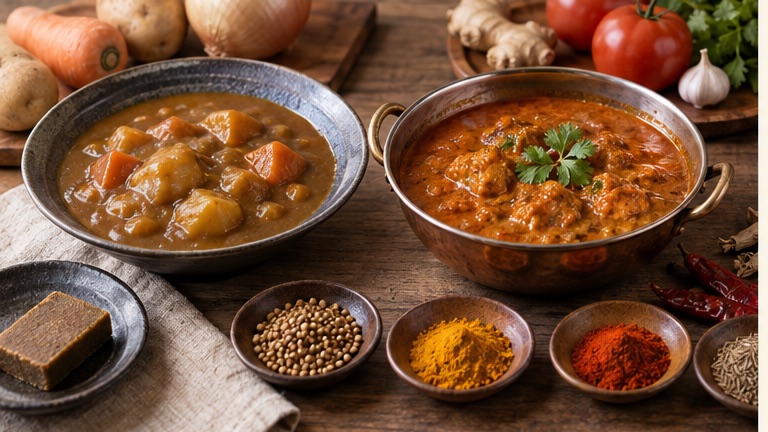
JNTO describes Sapporo-style soup curry with a lighter, soupy format, prominent vegetables and optional meat, commonly served with rice separately. The dish offers another reason not to define all Japanese curry as one thick brown sauce. Read JNTO’s introduction to Hokkaido soup curry.
Ingredients remain visually distinct, so you can encounter a vegetable or protein alongside the broth rather than always inside a uniform spoonful. That changes how you explore the meal.
A bowl can look abundant in vegetables while its base contains animal ingredients. JNTO’s profile of one Sapporo chef, for example, describes a stock drawing on several kinds of bones as well as vegetables and seasonings. That is a concrete reminder to ask about the base, not a statement that every soup curry uses the same stock. Read the chef profile and recipe context.
For heat, use the restaurant’s own explanation. Soup curry menus can offer choices, but availability and scales vary. Ordering by a familiar number from a different restaurant is less reliable than saying what level of heat you actually enjoy.
Treat the meal as four layers: the curry base, the cooking liquid, the added ingredients and the toppings. A suitable answer for one layer does not automatically cover the others.
For example, a roux with no meat ingredients can still be used in a pot containing chicken stock. A vegetable topping can sit on a meat-based sauce. A plant-based main ingredient can carry an egg-containing coating. The visible feature on the menu is not the full recipe.
S&B’s global page for Golden Curry Mix Hot 220 g states that this product contains no meat or meat-derived ingredients and lists wheat flour, vegetable oils, seasonings and garlic among its ingredients. That is information about a specified product on a specified market-facing page, not a universal declaration about every curry mix or every restaurant using the brand. Check the product’s own ingredient page.
Its garlic also illustrates why a meat-free statement would not settle a Jain reader’s requirements. Similarly, no meat does not establish halal certification or answer every vegan question. Check the exact pack sold to you and the standards you personally need.
For a restaurant order, a clear question is: “Is the curry sauce itself made without meat or fish stock, and does the topping or coating contain egg or dairy?” Adjust the wording to your diet instead of relying on a general vegetarian label.
If the staff cannot establish the ingredients, choose another clearly documented option. Our Japanese vegetarian-food guide provides a broader framework for these conversations.
A roux-based curry is a practical introduction if you choose a product that suits your ingredients and dietary needs. Read the directions before cooking: pack size, water amount, number of portions and the order of adding the mix can differ.
S&B’s UK recipe for one 92 g mix specifies its own quantities and includes turning off the heat while incorporating the roux before returning to a simmer. That sequence belongs to that recipe. Another product’s instructions may differ. Use the manufacturer’s recipe for the appropriate pack.
A block is a packaging division, not a standard unit of weight across brands and pack sizes. If a recipe specifies grams or a fraction of a particular pack, use that information. Substituting “two cubes” from another product can change the amount substantially.
For your first attempt, avoid adding several optional sweeteners, condiments and spice mixtures at once. Taste the intended base first. Otherwise, if the result is too sweet or salty, you will not know which change caused it.
Once you understand the base, alter one feature at a time. You might change the vegetable mix, the serving format or the heat. Record the specific change if you want to repeat it. This is a cooking experiment, not a requirement to follow one household’s taste forever.
A concentrated mix is not meant to be judged as if it were a finished spoonful. Even a completed sauce should be considered with the rice, noodles or other food for which it was prepared. Taste components when useful, but return to the intended combination.
A roux usually brings several things together: seasoning, thickening and fat as well as spice. Adding more can change all of them. If heat is the only feature you want to adjust, follow an appropriate recipe or the maker’s advice rather than assuming extra roux changes heat alone.
One packet or restaurant meal tells you about that preparation. It cannot represent every Japanese curry, any more than one Indian dish could represent every regional kitchen in India. A useful review describes the sauce you ate, the format and what you preferred—not an entire nation’s supposed taste.
Do not leave a large pot of curry at room temperature overnight because someone says the flavour improves. MAFF warns about food poisoning linked with improperly stored stews and curry. Its guidance recommends rapid cooling in smaller, shallow portions, refrigeration or freezing, and thorough, even reheating when used. Read MAFF’s curry-storage guidance.
Do not rely on reheating as a way to rescue a meal that has been stored unsafely. For a packed lunch, plan appropriate temperature control rather than assuming that thick sauce is protected from spoilage. Follow suitable food-safety guidance for your conditions and the product’s storage directions.
This matters more than copying an anime scene in which a pot remains conveniently available between conversations. Fiction can skip cooking and storage steps; your kitchen cannot.
Begin with the experience you want: a simple sauce-and-rice introduction, a crisp cutlet, noodles or a soup-style meal. Then confirm the base and toppings against your dietary needs. Finally, choose heat according to the seller’s scale and your own preference.
If ordering delivery, consider whether crispness is central to your choice. A sauce-covered cutlet will change during travel. If the restaurant offers separate packaging, that may help preserve the contrast, but it is not a guarantee and should not override safe handling instructions.
There is no need to start with an expensive or elaborate order. A clearly described basic plate can teach you more about the sauce than one crowded with toppings. Equally, do not claim a local adaptation is wrong simply because it uses a different garnish; ask whether it honestly describes what it is serving.
For an at-home anime evening, you could pair a curry meal with a sweet from our Japanese sweets guide. If you are more curious about noodles, compare the structure with our ramen guide for Indian fans, where stock, seasoning and toppings also need to be separated.
The next time curry appears on screen, notice the format. Is it a shared home meal, a cutlet served as the main visual attraction, or a simple plate that lets the conversation continue? Does the scene care about the food’s taste, the person who cooked it or the group eating together?
Our guide to Japanese foods in anime offers more dishes to recognise, while the bento guide explores another way food carries relationships into a scene.
You do not need to decide whether Japanese curry is better or worse than the food you grew up with. Understand the sauce, choose a suitable version and taste the actual plate. Familiar ingredients arranged around a different idea can be interesting without needing to replace your favourites.
AUTHOR OF THIS ARTICLE
SoJapan
SoJapan India Pvt. Ltd. is a Japanese-founded company based in Gurugram. We bring Japanese food, anime goods and apparel materials to Indian businesses, with a sister company in Kyoto that works directly with makers in Japan.