← JOURNAL20 Oct 2026
Katakuriko: Mixing the Slurry Is Not the Same as Thickening the Sauce
 By SoJapan
The sauce is still thin. There are also small lumps in it. Adding more of the same white mixture does not sound like a promising answer to both problems.
This is where it helps to stop treating “add potato starch” as a single action. There is the starch waiting in a small bowl, the way it enters the pan, and the cooking that follows. A mistake at one stage can be difficult to understand if you look only at the spoonful of sauce at the end.
In Japanese recipes, that prepared mixture is often called mizutoki katakuriko: starch mixed with water before use. The useful question is not simply whether you remembered to make it. Ask where the starch is now, how evenly it has been distributed, and what the recipe tells you to do next.
This guide compares published Japanese cooking methods. It is not a newly tested recipe, and the examples are not interchangeable formulas for every soup, sauce or vegetable dish.
Look at the ingredient declaration rather than relying on a white powder’s appearance. Kawamitsu, for example, identifies its Seito katakuriko products as Hokkaido potato starch and lists both thickening and karaage coating among their uses. Those are different jobs for the same ingredient. Kawamitsu’s katakuriko range
An instruction to coat a piece of food with dry starch is not therefore a contradiction of a sauce recipe that asks for a water mixture. The method depends on where the ingredient is supposed to end up. In one case it covers a surface; in the other, it must become part of a liquid.
Our tofu guide discusses a starch-coated agedashi example. Here, leave the coating question aside. We are following the sauce, including occasions when that sauce is made separately and poured over something already cooked.
If the packet you own describes a different starch or a prepared thickening mixture, do not assume this article has supplied its substitution ratio. Identify the ingredient the source recipe actually calls for before borrowing its quantities. A product name in an online photograph is not an ingredient declaration for the bag in your kitchen.
There are two quantities worth keeping apart: the water used to mix the starch, and the liquid you want to thicken. A slurry’s proportions describe the first relationship. They do not, by themselves, tell you how much of that mixture belongs in a large saucepan.
Kikkoman’s kakitamajiru lesson makes the distinction visible in its ingredient grouping. It combines one teaspoon of potato starch with two teaspoons of water, separately from the stock and seasonings. The method adds that mixture to the seasoned mushroom broth, heats it, and only then introduces the egg. Its instruction is to cook for a minute after the broth starts bubbling. Kikkoman’s egg-drop soup lesson
Read the small bowl as preparation for that particular pot of soup. “One part starch to two parts water” is not an instruction to put one part starch into two parts finished soup. Nor is the minute in this recipe a universal cooking time for every starch-thickened dish, or a safety test for ingredients added later.
That separation also helps when you scale a recipe. Keep the starch quantity visible as its own ingredient rather than recording only “a bowl of slurry.” Otherwise, a larger bowl can conceal whether you increased the starch, the mixing water, or both. The arithmetic becomes easier to follow when you preserve the recipe’s separate lines.
Imagine a recipe note that says “one teaspoon starch plus two teaspoons water.” If you double both lines, you now have two teaspoons starch and four teaspoons water. If you keep the starch at one teaspoon but increase the water to four, you have diluted the mixture without doubling the starch.
Both bowls contain more mixing water than the original. Only the first contains twice as much starch. This is hypothetical arithmetic to help read an ingredient list; it does not predict the texture of a particular dish or tell you how much sauce either bowl will thicken.
The distinction matters when a recipe uses part of a prepared mixture. “I added half” is useful only if you know what was in the bowl and had mixed it evenly before measuring out that portion. Writing down spoonfuls of an unspecified slurry makes a cooking note difficult to repeat.
For the same reason, preserve units. A teaspoon measurement of a powder is not a weight in grams, and a quantity of mixing water is not the final volume of a starch-containing mixture. There is no need to invent either conversion when the recipe already provides a clear set of measurements.
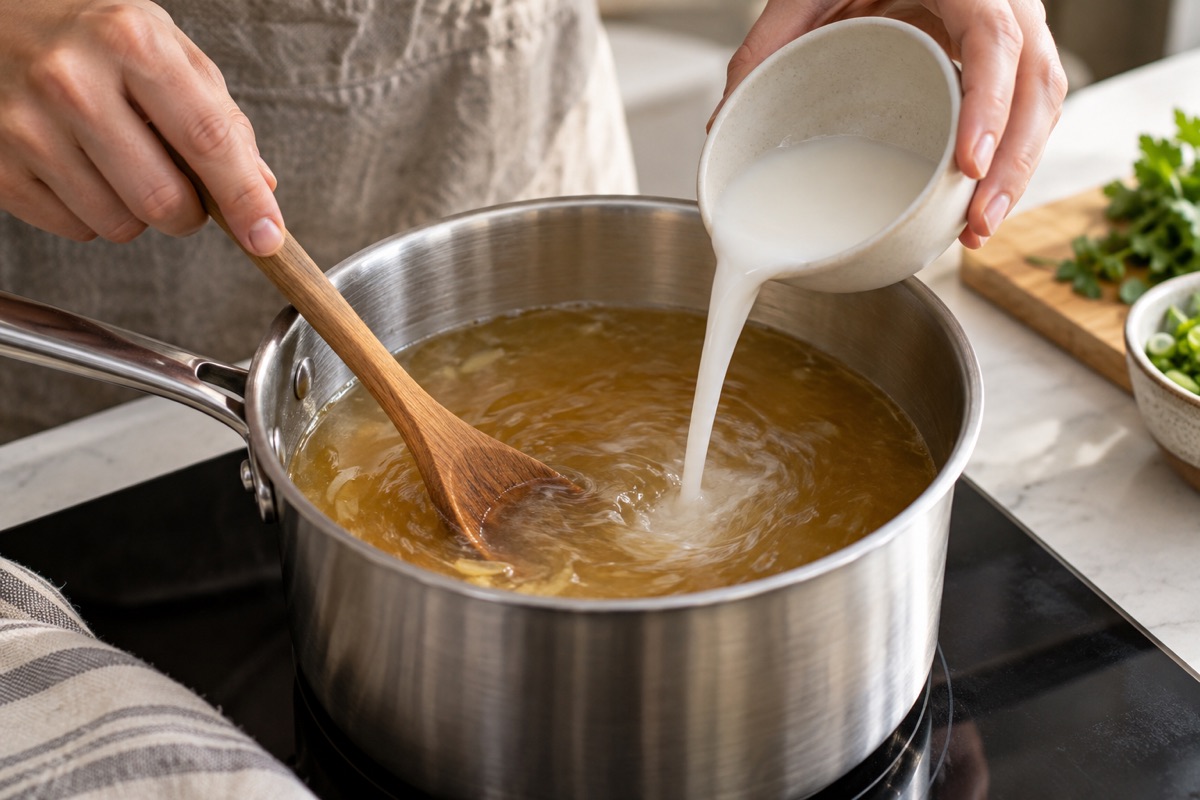
Ajinomoto’s cooking-science interview describes a sequence, not a choice between heat and no heat. Re-mix the prepared slurry because starch settles. Reduce the heat for the initial addition, introduce it gradually while stirring, then raise the heat and continue mixing to develop the thickening. The researcher separately advises turning the heat off before a later corrective addition so the new mixture can spread. Insufficient cooking after addition is one reason thickening can fail. Ajinomoto’s explanation of slurry handling
The distinction to remember is between making room to distribute an ingredient and completing the cooking. A photograph of the burner turned down cannot tell you which stage you are seeing. Read the next instruction before deciding that the sauce should never return to the heat.
When following a video, watch the pan as well as the little bowl. Does the cook stir before pouring? Where does the stream enter? What happens after the bowl is put down? Those are separate movements worth noticing, without assuming that the speed of a demonstration is the speed you must copy.
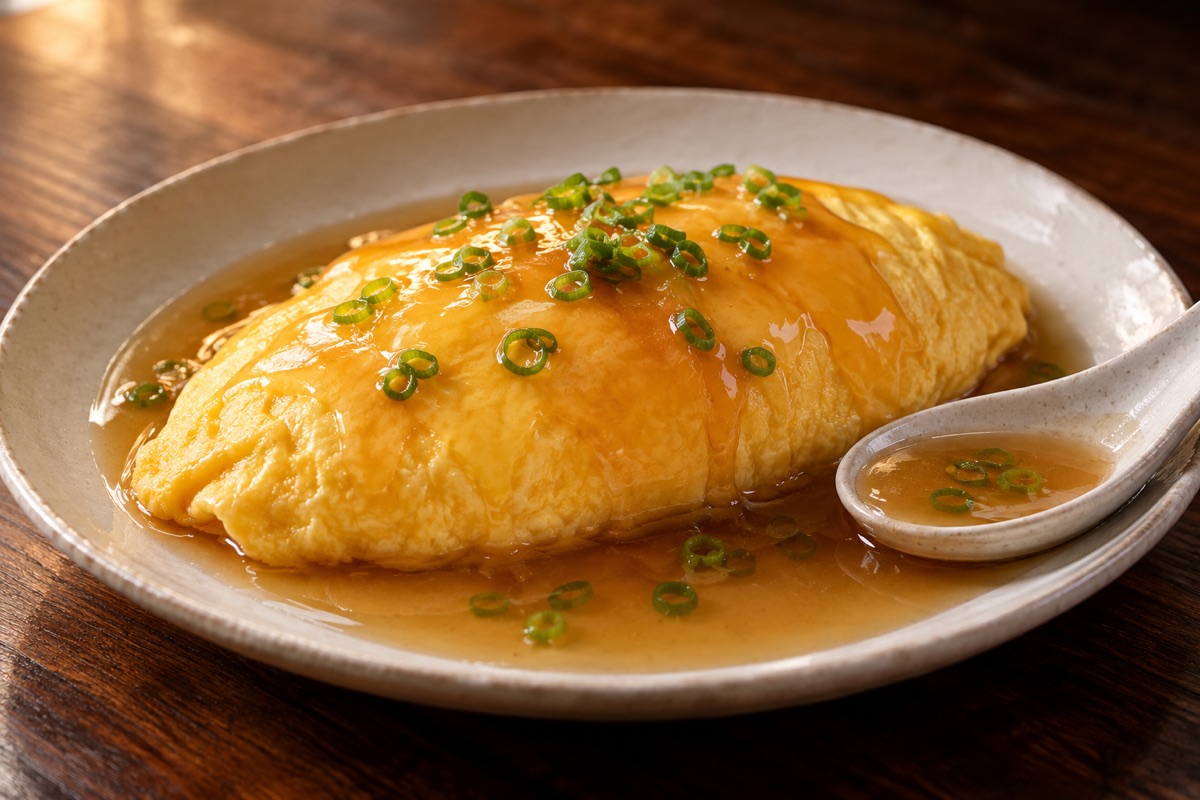
Kikkoman’s ankake omelette lesson provides a particularly clear off-heat example. The omelette goes onto a plate first. For the sauce, water is brought to a boil, dried whitebait, spring onion and soy sauce are added, and the burner is switched off. The prepared starch mixture is stirred in before the pan returns to high heat and is brought thoroughly to the boil. The finished sauce then goes over the omelette. Akari Hasegawa’s omelette and sauce lesson
Here, switching off the burner is an intermediate step. The sauce still needs its subsequent cooking before it goes over the egg.
This is a useful distinction if you know Japanese rolled omelettes already. In our tamagoyaki and dashimaki guide, the egg mixture and rolling technique are central. An ankake preparation directs your attention to the sauce over the food. The starch instruction may belong to that separate component, not to the eggs themselves.
This sauce includes fish. Readers who avoid it should choose a recipe with a suitable ingredient set, not mistake a technique summary for a vegetarian adaptation.
Must the starch always go in last? A cabbage recipe provides a useful counterexample.
In Kikkoman’s slow-cooked Chinese cabbage method, water, kombu, potato starch and seasonings are combined in the saucepan before heating. The mixture is stirred over medium heat until it boils. The cabbage goes in after that, followed by a covered simmer with occasional stirring. There is no separate little bowl added at the end. Kikkoman’s cabbage recipe
The starting conditions matter. Mixing ingredients before heating is not the same as dropping dry starch into an already hot sauce. Both happen in a saucepan, but they are different actions.
Follow this recipe’s own quantities and sequence if you try it. It demonstrates an alternative method, not a universal way to remove the slurry step from other recipes.
The table below is a reading aid for the linked recipes, not three interchangeable ways to finish the same meal. On a narrow screen, scroll the table sideways.
| Published example | Where starch enters | What follows | Instruction not to lose |
|---|---|---|---|
| Egg-drop soup | A separate water mixture joins the broth. | Heating, then egg. | The egg is a later stage, not part of the slurry. |
| Ankake omelette sauce | A separate water mixture joins the sauce off the heat. | A return to high heat before serving. | The burner-off instruction is temporary. |
| Slow-cooked cabbage | Starch is in the initial unheated mixture. | Stirring and heating, then cabbage. | The starting mixture is prepared before heating. |
There is a second exception worth knowing before judging a cooking demonstration. Marusan Mita’s Toromi-chan is a granulated potato-starch product designed to be sprinkled in without first mixing it with water. Its ingredient declaration identifies Hokkaido potato starch. The manufacturer’s Toromi-chan page
That does not mean a cook using it has forgotten the usual bowl. It means the product is designed for a different handling method. Equally, seeing it work in a video does not supply instructions for the ordinary powdered starch in your cupboard.
The maker’s illustrated use sequence still includes heat. In its sweet-and-sour pork example, the cooked ingredients and sauce are brought to a boil. The heat is stopped, the granules are sprinkled evenly and mixed in, then the pan is heated again until bubbling. The manufacturer also identifies insufficient temperature as a possible reason for poor thickening. Toromi-chan’s use instructions
So two different questions need answers when you read “no water mixing required”: does this product remove the slurry-preparation step, and what cooking does it still require? For this named product, the first answer is yes. The second answer is not “none.”
This is a product-specific comparison, not a shopping recommendation or a claim that the product is available in India. You do not need to buy a special ingredient to understand the distinction. Read the preparation instructions on what you actually have; use the manufacturer’s method for that product and the quantities specified by your chosen recipe.
Return to the awkward-looking pan at the beginning. “Not thick enough” describes the liquid. “Lumpy” describes unevenness. They can occur together, but recording only the first observation can lead you to focus on quantity before you have considered how the starch was introduced.
Ajinomoto’s explanation connects lumps with starch thickening locally before it has spread through the liquid. It also notes that vegetables can release water, and advises allowing that liquid to emerge before the thickening stage in the method it discusses. These are reasons to inspect distribution and the dish’s liquid, rather than reflexively adding a larger dose. The researcher’s explanation
This is not a diagnosis from a photograph. It is a way to make the next question more specific. Use the recipe and your actual sequence to decide which of the following situations you are investigating.
Reconstruct the addition: the state of the mixture, the pour and the stirring. Did you have your utensil ready, or stop to find it after emptying the bowl?
Those questions concern execution, not the brand of starch. They can help explain why “I used the correct amount” does not settle whether that amount reached the sauce evenly. More starch is not evidence that the original addition was handled well.
Avoid assuming that every lumpy dish has one guaranteed rescue. A plain sauce made in a separate pan and a mixture containing delicate cooked vegetables are different things to work with. This guide does not promise that aggressive beating, straining or prolonged cooking will preserve every dish. If you are following a published recipe, return to its troubleshooting advice before making several changes at once.
Check whether you completed the heating stage. Compare what you did with the original method, including the instruction immediately after the addition.
If the sequence was complete, compare quantities next. Check the starch itself, not only the volume of slurry. Check the broth and other liquids against the recipe. A casual extra pour of stock changes the dish you are asking the original measured amount to thicken.
Also check your reference point. A lightly thickened egg-drop soup and a sauce intended to sit over an omelette need not look alike on a spoon. Judge a recipe against its intended result, not against the thickest sauce you have seen in another dish.
Identify that addition in your notes. Was it an extra measured liquid? Did you transfer food together with liquid that had collected beneath it? Did the source recipe instruct you to drain anything first? These are observations you can check without inventing a new starch ratio.
Our daikon oroshi guide follows another ingredient whose solid and liquid portions need separate attention. The relevant habit here is similar: record what entered the pan, including liquid, instead of recording only the name of the food.
None of these texture observations establishes that meat, fish or eggs have been safely cooked. Thickening is the question this article addresses; use appropriate cooking instructions for the ingredients as well.
You do not need a second recipe written over the first. A few short annotations can make the original much easier to follow at the stove:
For a first attempt, following one complete source is more informative than assembling a method from three videos. If the outcome differs from what you expected, you will have a sequence you can examine: a known ingredient, a measured amount, a particular addition and a defined next step.
The little bowl is preparation. What matters to the finished sauce is what happens when its contents meet the pan—and what you do after that.
AUTHOR OF THIS ARTICLE
SoJapan
SoJapan India Pvt. Ltd. is a Japanese-founded company based in Gurugram. We bring Japanese food, anime goods and apparel materials to Indian businesses, with a sister company in Kyoto that works directly with makers in Japan.