There is already a roll of egg in the pan. Then more liquid egg goes in. Why has the cook not taken the first omelette out?
That second pour is the useful place to begin understanding layered tamagoyaki, the Japanese egg preparation you may recognise as yellow slices in a bento. The first roll is staying because it will become the centre of a larger one. New egg joins it, and the next turn adds to the same piece rather than making another serving.
But there is a qualification worth making immediately: repeated pours are a method, not a test of whether your food deserves the name. A Japanese maker also publishes a one-pour version for an ordinary frying pan. Both are useful to understand; they give you different actions to learn.
Our bento guide for anime fans explains the lunchbox setting. Here, we will stay beside the pan: what the next layer does, why the mixture matters, and where a cooking demonstration’s shaping cues stop being sufficient guidance. The examples come from published maker instructions, not a recipe we have tested in our own kitchen. Follow a complete linked recipe for quantities and cooking details.
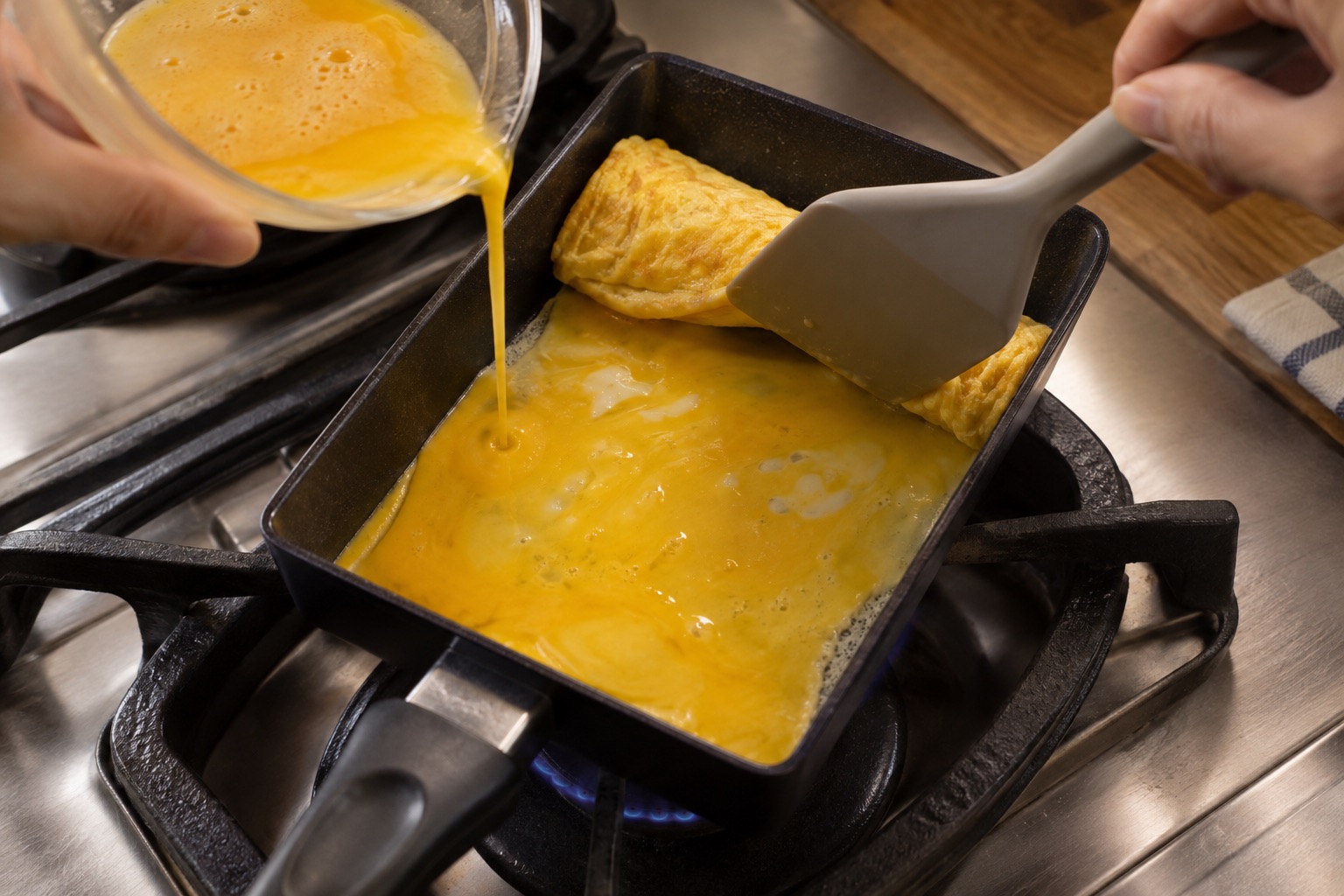
Kikkoman’s basic tamagoyaki recipe divides its mixture into three portions. After rolling the first portion, the cook moves that roll back, oils the newly exposed pan and adds the next portion. Crucially, the existing roll is lifted slightly so fresh mixture can run underneath. The next rolling movement brings the new layer around the old one. See Kikkoman’s illustrated basic method.
For reading that sequence, picture three things separately: the roll already made, the exposed cooking surface, and the fresh egg. The instruction to lift the roll is not an instruction to remove it. It creates access to the part of the pan the roll was covering. That is the easily missed action in a fast demonstration.
Think of the next turn as continuing one object. If you instead imagine a succession of separate omelettes, moving the first one away seems natural. In this construction, however, the accumulating roll is part of the next pass through the pan. Its changing position matters as much as the pouring.
There are also two different repetitions to notice. A cook can fold a single layer more than once, then add another portion of mixture and repeat the cooking cycle. The number of folds is not the number of pours. A written instruction that mentions three folds should not automatically become an instruction to divide the bowl into three portions.
For a first viewing of a tutorial, follow the movement without trying to memorise every motion of the chopsticks. Where does the roll wait? Where is the newly poured egg? What is folded over what? Those questions make the sequence legible before you try to reproduce its speed.
The first impression can be that the cook is repeatedly undoing a finished omelette. Once you recognise the centre being retained, the movement makes sense: the dish is growing around something already there.
A neat final slice can make the first turn look like a pass-or-fail test. One maker’s own teaching method offers a less rigid starting point. Kikkoman’s Japanese lesson allows the first portions to be scrambled and gathered, with later additions used to form the outside, when repeated folding is difficult. It also describes sugar as helping the mixture hold together. Read the lesson’s folding and mixture notes.
That option is useful because it distinguishes the interior being built from the surface you will eventually see. It is not a promise that every tear, stuck patch or scorched piece can be repaired. It does show that an immaculate little first roll is not the only starting point taught by a Japanese recipe publisher.
For someone learning from close-up videos, this changes what deserves attention. Instead of stopping the explanation at “mine did not look like that,” identify the stage at which the difference appeared. Was it the first gathering of the egg, a later turn around the growing centre, or the final transfer? Those are different moments, even if all three leave an untidy shape.
Do not turn that observation into a diagnosis without more information. A torn layer does not, by itself, prove that the pan was wrong or that more sugar was needed. The full method, mixture and handling still matter. The useful note is specific—“the second layer stayed on the pan when I moved the roll”—rather than a sweeping conclusion that you cannot make tamagoyaki.
The familiar contrast is a sweeter, thicker egg preparation associated with Kanto and a dashi-forward rolled preparation associated with Kansai. MAFF’s Tokyo account describes that contrast, but its own ingredient list includes both stock and sugar. Sweet and stock-flavoured are not mutually exclusive categories. Regional descriptions are helpful context, not a complete prediction of an individual recipe. MAFF’s Tokyo tamagoyaki account.
That matters when you decide what you want to eat. “Not too sweet” is a preference about seasoning. “I want a dashi-rich version” concerns another part of the mixture. Neither statement tells you everything about how the egg will be cooked or what colour its surface should become.
Kewpie’s basic lesson makes two useful connections. It advises mixing the white and yolk evenly without whipping in air, and it warns that increasing the sugar makes browning more likely. Those are reasons to treat a change in sweetness as a change to the cooking task, not only to the flavour. Kewpie’s basic tamagoyaki tutorial.
If you want a less sweet result, choose a recipe designed around that preference before changing several ingredients in another one. That is an editorial recommendation about keeping the comparison understandable, not a claim that there is one correct sugar quantity. It lets you assess a defined preparation instead of wondering which of several simultaneous changes produced the result.
Compare the colour with the intended finish of the method you used. A pale roll should not automatically be judged against a browned reference photograph.
If your interest began with an anime lunchbox, this is where the drawing stops helping. A yellow cross-section may suggest rolled egg, but it cannot tell you how much stock, sugar or seasoning went into the bowl. The recipe supplies those decisions; the image supplies the initial curiosity.
Kikkoman’s dashimaki lesson explains that increasing broth relative to egg makes the mixture harder to set. Its particular solution uses potato starch mixed with cooled dashi, followed by egg and seasoning. The mixture is stirred again before pouring so the starch does not remain settled. During rolling, the pan is taken off the heat; cooking then continues as directed. The recipe’s stock includes kombu and bonito. Kikkoman’s detailed dashimaki method.
The useful lesson is not “all dashimaki contains starch.” It is that this author has designed a combination of ingredients and handling for a broth-rich result. Borrowing the liquid from one preparation and the rolling instructions from another would discard that relationship.
There is a tempting shortcut in thinking of dashi as merely a seasoning: add it until the flavour seems right, then cook the egg as usual. For a novice following a demonstrated method, that is not a controlled substitution. You have changed the mixture the demonstration was written for. Start with the full dashimaki method if that is the texture and flavour you want to explore.
Notice, too, the difference between moving the pan away to perform an action and declaring the dish cooked. Removing it from the burner can be part of a sequence that later returns to cooking. A short clip of the rolling moment may omit that return. Watch what happens next before treating the pause as the endpoint.
The bonito in the cited stock also makes a practical distinction for readers in India who eat eggs but avoid fish. “Egg dish” does not describe all the ingredients in this example. Check the actual stock rather than making the name dashimaki stand in for an ingredient declaration. If you avoid egg itself, neither removing fish stock nor choosing a sweeter version resolves that restriction.
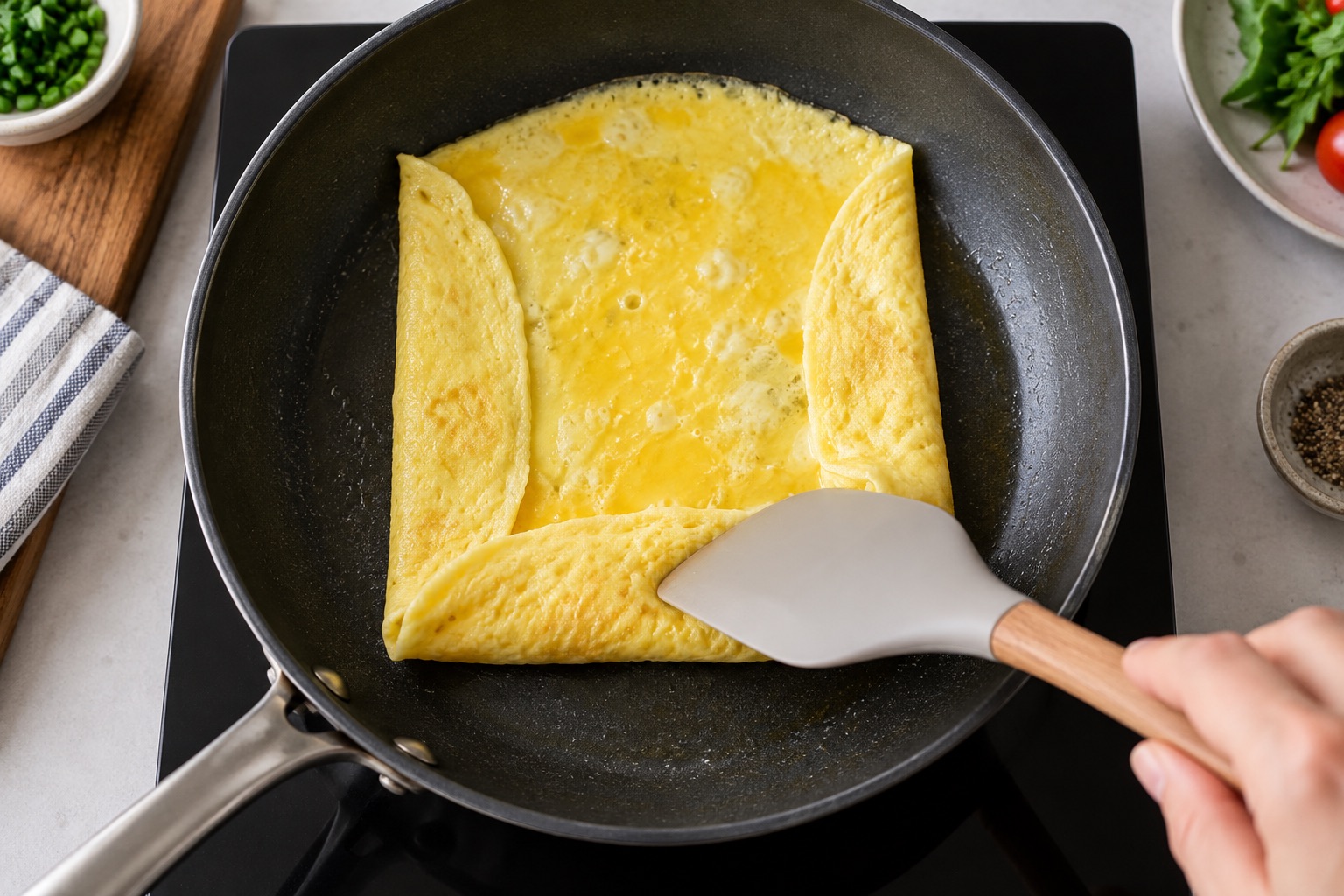
Yuko Ihara’s English-language lesson for Kikkoman includes a standard-frying-pan route alongside the rectangular-pan method. In that alternative, the mixture is poured in together, the sides are folded inward, and the egg is rolled. A spatula and fork help with the larger piece. It is not the same repeated-pour sequence squeezed into a different outline. See the frying-pan alternative in Kikkoman’s English lesson.
That does not make one pour compulsory for every round-pan recipe. It makes the repeated-pour method one route rather than an authenticity test.
The difference also answers a more practical question than “which pan is authentic?” Ask which sequence you are going to follow with the equipment you have. If the instructions show side folds, those folds belong to the construction. If they show a growing roll being retained while new portions are added, that is a different sequence. Do not silently replace one with the other and expect the photographs to line up.
Kewpie’s tutorial also treats pan movement as part of folding rather than asking the chopsticks to do all the pulling. It describes re-oiling between additions, including under the retained roll. These are purposeful handling actions, not decorative flourishes in the demonstration. Kewpie’s rolling and oiling notes.
Before trying either approach, find the instructions for the pan you will actually use: suitable heat, utensils and care are equipment-specific. An online cook’s burner position is not a reason to ignore the manufacturer’s guidance for your cookware. This article is not a recommendation to buy imported equipment, and it does not establish the availability of any pan in India.
Kikkoman’s English lesson describes rolling when the surface still looks underdone but no longer flows on tilting the pan. Too cooked can mean poor adhesion; too soft can mean difficult handling. These are intermediate cues, not a serving endpoint. The lesson’s rolling-readiness explanation.
The distinction is especially important because the word “done” can refer to different things in casual cooking talk. Someone may mean that a layer is ready for the next movement, that the outside has the desired colour, or that the whole dish has finished cooking. A beginner needs to know which meaning applies at that exact step.
For packed lunches, MAFF explicitly advises cooking egg dishes such as tamagoyaki until fully set rather than leaving them half-cooked. It calls for thorough heating through the centre and recommends checking with a clean cooking thermometer. Its guidance also covers cooling before packing, keeping the meal cool and using cooling packs or a cool bag for longer transport. MAFF’s packed-lunch safety guidance.
Do not use the roll’s neat outline, an attractive browned surface or a short resting time as proof that the centre has been safely cooked. And cooling before packing is not permission to leave cooked egg unrefrigerated for hours. A meal eaten shortly after cooking and one carried to lunch involve different handling decisions; the bento guide linked earlier covers that wider context.
The most revealing moment in a tamagoyaki demonstration is still the second pour—but now you know what to look for. Watch whether the existing roll is joined to fresh egg, how the selected method manages its mixture, and what cooking remains after the shaping movement. The yellow slice at the end is no longer just a shape to imitate. You can follow how that particular cook built it.

AUTHOR OF THIS ARTICLE
SoJapan
SoJapan India Pvt. Ltd. is a Japanese-founded company based in Gurugram. We bring Japanese food, anime goods and apparel materials to Indian businesses, with a sister company in Kyoto that works directly with makers in Japan.