One tofu recipe tells you to put a weight on the block. Another explicitly tells you not to. Both are preparing tofu for frying. Which instruction should you trust?
The apparent disagreement is real: Kikkoman’s tofu steak recipe uses weighted draining, while its agedashi lesson by Makiko Oda deliberately leaves the weight off. The second method aims to preserve a soft interior. “For frying” is not a complete description of the texture each cook wants.
The useful answer is to stop treating pressing as a compulsory upgrade for every block. First identify the tofu, then read what the recipe wants it to become. A preparation that suits one dish can work against the point of another.
This guide separates three things that are easily confused: how the tofu was made, how its maker describes its firmness, and how a particular recipe asks you to drain it. It explains the Japanese names momen and kinugoshi, then uses specific recipes to make those distinctions practical. It is a guide to choosing and reading a method, not a new recipe assembled from several authors’ quantities.
Momen is commonly called cotton tofu; kinugoshi is silken tofu. Their names sound like a comparison between two fabrics, but the important difference is in the way the block is formed.
The Japanese Tofu Association describes momen as coagulated soymilk curd that is broken up, placed in a cloth-lined mould with drainage holes, and pressed to remove water. For kinugoshi, soymilk and coagulant set into a smooth block without that cloth-lined, perforated, weighted stage. Silken tofu is not tofu filtered through silk. The association’s types guide and manufacturing explanation set out the distinction.
That process helps explain the familiar contrast: cotton tofu has a more substantial, coarser texture, whereas silken tofu is fine and smooth. Those are useful starting descriptions, not a promise that every manufacturer’s blocks will feel identical.
At home, pressing is a preparation step applied to something that has already been made. It does not replay the production process. Pressing a silken product does not make it momen, just as declining to press a momen block before dinner does not make it kinugoshi.
This matters when a recipe names a type and then adds a draining instruction. The two details are not redundant. “Use momen” identifies a starting ingredient; “drain without a weight” specifies what to do with that ingredient for this dish. Reading only the second instruction loses information, but reading only the first does too.
For an English-speaking reader in India, the practical difficulty may be a recipe using Japanese names while a shop description gives only an English firmness word. Do not silently fill that gap. Look for the maker’s own product description or ask for the exact pack name. A listing that says only “firm tofu” has not necessarily answered whether it is a silken-style product.
There is no need to become a tofu-manufacturing specialist before cooking. You need enough information to match the starting block to the method. If that match remains unclear, selecting a recipe written for your identifiable product is a better first experiment than changing several preparation stages to compensate for an unknown ingredient.
Mori-Nu sells a product actually named Silken Extra Firm Tofu. Its product page recommends uses including grilling, stir-frying and sautéing. That is a concrete reason not to translate “silken” into “always the softest option” or “never suitable for frying.”
The example has a boundary. It demonstrates what this manufacturer says about this product. It does not mean every delicate kinugoshi block can be substituted into the same pan technique. Nor does it establish an identical firmness scale across different brands.
Mori-Nu’s manufacturing explanation in its FAQ describes its soy mixture and coagulants being sealed in aseptic packaging, with the tofu forming inside. A product can therefore have its own formulation and production details while still belonging to a silken range. The word “silken” alone cannot replace the rest of the label.
Read a pack in layers. The type tells you one thing about the food. The firmness description tells you how that maker positions the particular version. The suggested uses help you connect the product to a cooking task. None of these is the storage instruction, which needs a separate check.
Imagine two hypothetical listings: one says “extra-firm silken tofu,” the other simply “firm tofu.” It would be tempting to rank the first as universally sturdier because “extra” sounds stronger. But the listings do not provide a shared measurement. They may also describe different types. Without further product information, that ranking is an assumption, not a comparison you have established.
For a first attempt at a Japanese recipe, prioritise a clear match over the strongest-sounding adjective. If the author specifies momen, look for that type or an explicitly suitable equivalent. If you already have a named silken product, start with its manufacturer’s handling guidance and recipes. Substitution is possible to explore later; it should not be invisible to you while you are learning the original method.
This is not a recommendation to buy the named imported product. Its role here is to clarify terminology. We have not verified its Indian stock, price or distribution, and another product’s instructions should not be inferred from its name.
Now return to the two frying recipes. Their details make the difference much clearer than a general instruction to remove as much water as possible.
Kikkoman’s Simple Tofu Steak specifies a 400 g firm block. The tofu is wrapped in paper towel on a tray, with a 500–1,000 g weight for about 15 minutes. It is then cut, floured and pan-fried until golden on both sides, with a soy-sauce finish. Use the complete recipe for its proportions and sequence.
Those numbers describe a particular preparation, not a standard for all tofu. A smaller pack, a differently shaped piece or a different product has not automatically been covered by the same instruction. In particular, “one block” should not be treated as a fixed unit across recipes and shops; this author has supplied the mass.
The useful reading habit is to keep the preparation attached to the dish. You are not trying to obtain the driest tofu you can possibly make. You are following a method that has selected a starting ingredient and a way of preparing it before the pan stage.
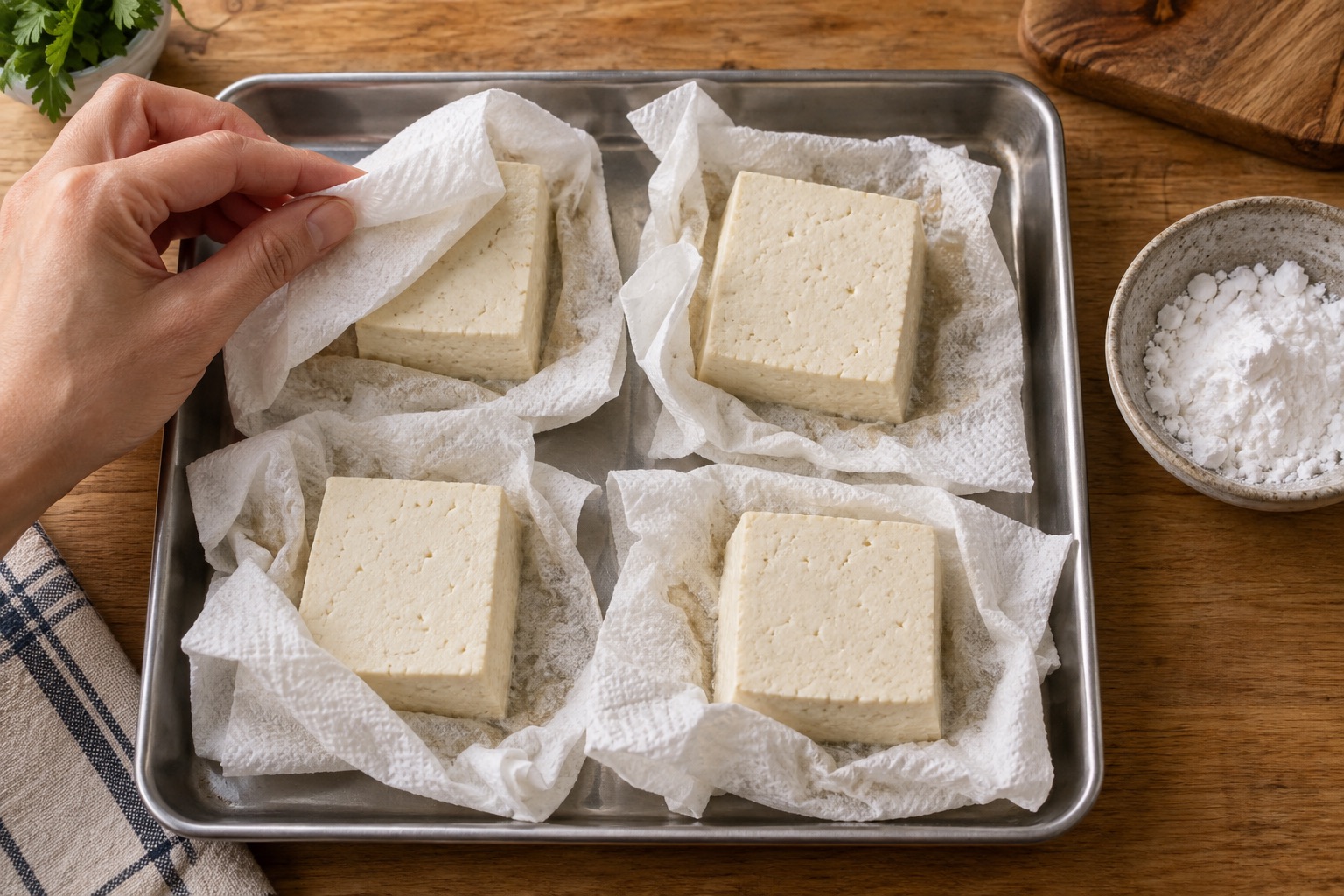
Makiko Oda’s agedashi lesson uses 300 g of momen, cut into quarters. Each piece is wrapped in paper towel and left for 20 minutes without a weight. The lesson explains that the tofu’s own weight releases moisture while preserving its soft interior. Potato starch coats the pieces before frying; a dashi-based sauce accompanies them. Read the illustrated lesson for the complete cooking method.
This is not an instruction to skip draining. It is an instruction to drain differently. Adding a heavy object because another fried-tofu recipe used one would override an explicit choice in this recipe.
The editorial lesson from the comparison is that a soft centre can be the target. If your idea of success is always “firmer than before,” you may judge a desired result as a fault and change the method in the wrong direction.
In Kikkoman’s chilled tofu with mixed nuts and soy sauce, the instruction is to gently drain and pat the tofu dry before cutting and serving. There is no weighted pressing stage. The ingredient list simply says tofu; it does not specify momen or kinugoshi, so this recipe should not be cited as proof that only one type belongs in a cold dish.
The following comparison is a reading aid for these three sources, not a combined set of cooking instructions.
| Recipe | What to notice | What not to import from it |
|---|---|---|
| Tofu steak | A weighted preparation is part of this pan-fried method. | A universal pressing rule for every block. |
| Oda’s agedashi | The centre is deliberately kept soft. | The idea that unweighted means undrained. |
| Chilled tofu | Gentle draining and patting are sufficient in this method. | A firm-or-silken requirement the author did not give. |
Notice what would be lost if you reduced the first two rows to “fried tofu.” You would erase the recipe’s intended interior and the preparation chosen for it. A category can help you search for dinner, but it cannot supply every instruction needed to cook it.
Likewise, resist averaging the two draining times or taking the weight from one method and the coating from another. That would create an untested hybrid, not resolve a disagreement. Choose one complete method first. If you later adapt it, recognise which variable you are changing rather than describing the result as a test of the original recipe.
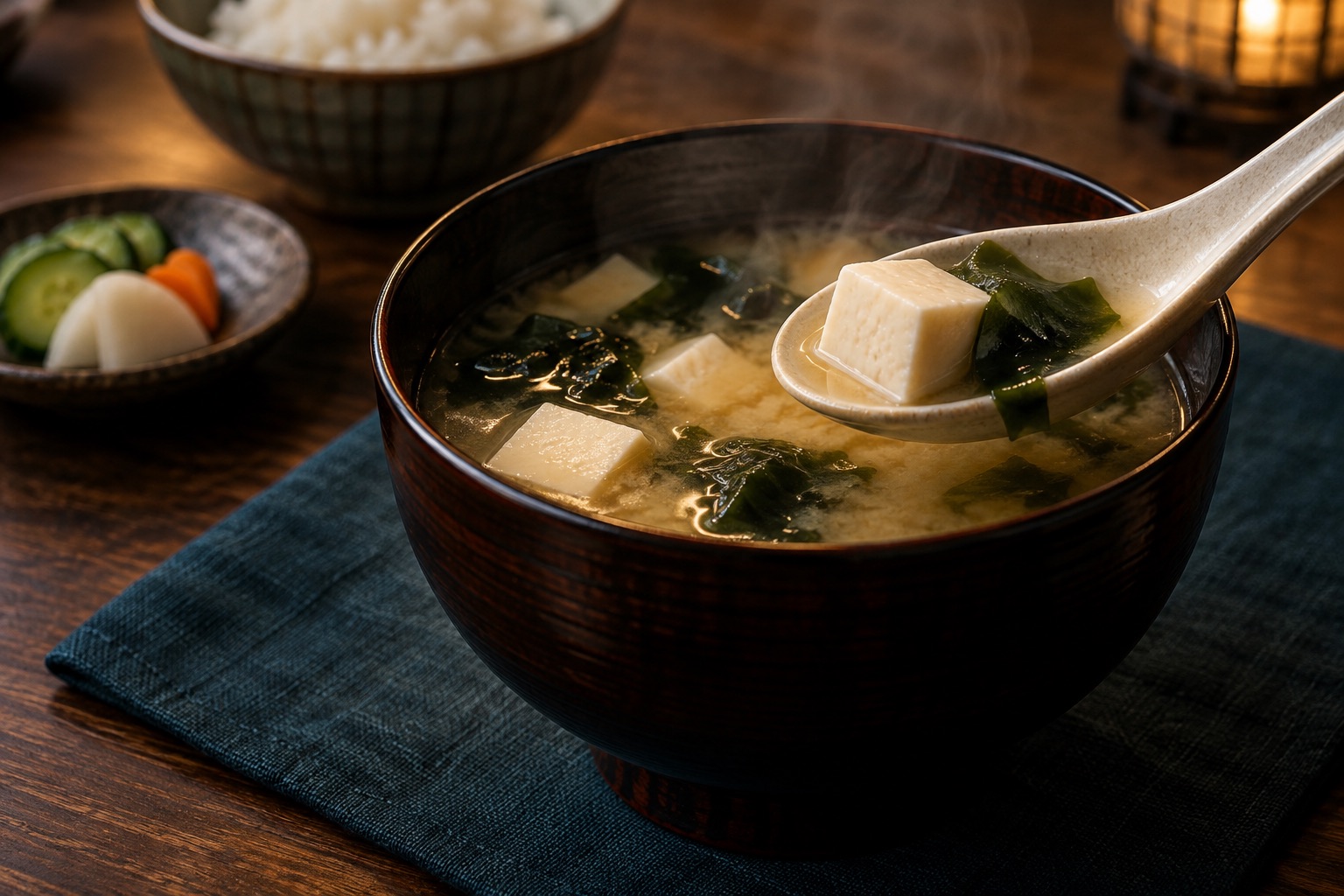
Soup offers another useful correction to rigid categories. Silken tofu is not the only possible tofu for a Japanese soup.
Japanese tofu maker Sagamiya discusses both types: cotton’s substantial character alongside hearty soups, and silken’s smooth texture in lighter combinations such as tofu-and-wakame miso soup. Its comparison is about the eating experience, not a rule that assigns every soup to a single type.
Ask what role you want the tofu to have in the spoonful. Do you want a smooth element in a relatively simple bowl, or an ingredient with a more pronounced presence among other additions? That is a more useful preference question than “Which one is authentic?” It also makes the choice intelligible if you are new to both textures.
The soup’s flavour and the tofu’s texture are separate decisions. Changing the block does not, by itself, tell you whether the stock is stronger, the miso more diluted or the bowl more heavily seasoned. If the taste is the issue, investigate those components rather than expecting a firmness label to explain everything. Our miso soup guide covers the relationship between paste, dashi and the finished bowl.
Gentle heating can also be part of a tofu-centred method. Kikkoman’s tofu in kombu stock instructs the cook to simmer rather than boil; it does not add a weighted-draining stage. Again, its ingredient list does not specify cotton or silken. Use it as evidence for that method, not as permission to attach a type label the author omitted.
For a reader choosing a first dish, these examples offer different starting points. A cold preparation lets the tofu remain the main focus without a frying stage. A soup puts it in relation to broth and other ingredients. A steak or agedashi method adds preparation and cooking choices that should be followed together. Choose the eating experience you want, then choose a recipe whose starting product you can identify.
You do not need to decide which type you prefer for all purposes. Liking one tofu in a bowl is a reason to repeat that pairing, not evidence that the other type is inferior. A useful personal comparison would keep the dish broadly similar while changing the named tofu; changing the sauce, seasoning and preparation at the same time would make it harder to know what you actually preferred. That is a suggested way to observe your own cooking, not a tasting test we have conducted.
The most difficult instruction is often the one that looks shortest: “Drain the tofu.” If the recipe explains how elsewhere, follow that explanation. If it does not, look for photographs, preparation notes or a linked basics page before assuming that draining means applying a heavy weight.
A helpful recipe note has four parts: the named tofu, its amount, the preparation before heating, and the result being sought. You can jot these down before beginning. A blank space in that note shows exactly what you still need to clarify.
For example, suppose your packet is identifiable as silken but the recipe calls for momen. The missing information is not how many more minutes to drain it. The starting ingredient has changed. Look for a recipe or maker’s direction that addresses your product, rather than trying to compensate with an invented timer.
If a first attempt disappoints, record the exact product and the method you followed before changing everything. “The tofu was wrong” is too broad to help next time. Did you substitute a different type? Apply a weight the recipe did not request? Misread the preparation time? Or simply discover that you wanted a different eating texture? A preference is not the same thing as a procedural mistake.
This approach also avoids unsupported promises. No label or draining time in this guide guarantees that every product will behave identically, and draining does not make frying risk-free. Follow the complete recipe’s cooking precautions and your product’s directions; do not use this comparison as an abbreviated frying tutorial.
Storage belongs to the actual product and its opened or unopened state, not to the firmness adjective. A pack that says silken has not, through that word alone, told you whether it belongs on a shelf or in a refrigerator.
Mori-Nu provides a useful, specifically bounded example. For its aseptic tofu, the maker distinguishes unopened storage from opened handling. It directs users to refrigerate unused opened tofu promptly in an airtight container, use it within a maximum of two days, and not cover it with water. Check the maker’s current FAQ and your own pack. Do not apply those directions to a different brand merely because its tofu is also silken.
That last instruction is why a general internet tip should not displace a product-specific one. Keep the packaging long enough to check how the remaining portion should be handled. A texture comparison is not a shelf-life guide, and this article does not offer a way to rescue tofu that has been stored incorrectly.
Dietary suitability is another separate check. The agedashi lesson above includes bonito dashi and mirin in its sauce. A dish built around tofu is therefore not automatically vegetarian or suitable for someone avoiding alcohol. For the broader questions about stocks, toppings and seasonings, use our Japanese vegetarian-food guide; do not expect a firmness label to answer them.
The next time two tofu recipes seem to contradict each other, look at their intended centres before reaching for a weight. Identify the block and keep the draining step attached to the dish it was written for. The aim is not to press every tofu into the same result. It is to preserve—or deliberately change—the texture you actually want to eat.

AUTHOR OF THIS ARTICLE
SoJapan
SoJapan India Pvt. Ltd. is a Japanese-founded company based in Gurugram. We bring Japanese food, anime goods and apparel materials to Indian businesses, with a sister company in Kyoto that works directly with makers in Japan.