An anime episode does not move from a manga page directly into a finished video. Between those two images sits a chain of decisions: what the episode should cover, where a scene should cut, which poses carry the acting, how the light should feel, when a sound should enter and whether hundreds of separate materials arrive in time to be combined.
That chain is why two adaptations of similar source material can feel completely different. The production is not merely tracing. It is translating a story into time, movement, colour, sound and performance.
This guide explains how anime is made in twelve practical stages. The order is a readable model, not a claim that every studio follows one rigid conveyor belt. Backgrounds, music, voice work, 3DCG and drawing may overlap. Different studios use different job titles and digital tools. Corrections can send a cut backwards. What remains consistent is that finished anime is collaborative: no single drawing, department or famous name explains the whole result.
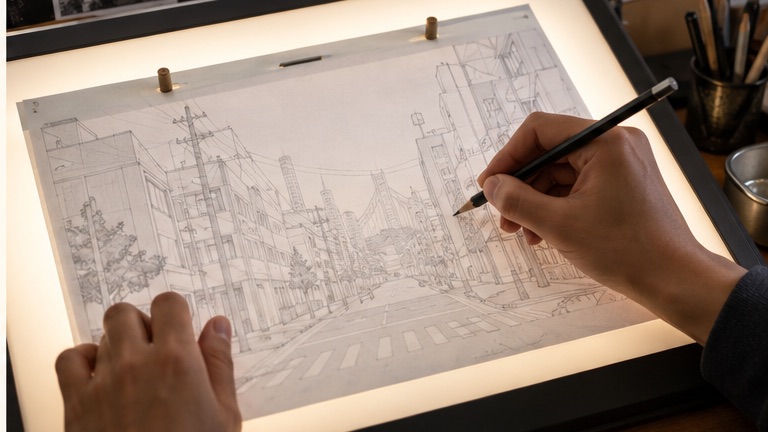
Anime is made by dividing a moving story into manageable units. A script is broken into scenes; scenes are broken into cuts; storyboards describe the camera and timing; layouts establish the space; key animators draw the important poses; in-between artists connect those poses; other teams create backgrounds, colour and 3DCG; compositors combine the materials; and editors and sound staff shape the final rhythm.
Toei Animation’s official process presents twelve broad steps: project proposal, script, storyboard, key animation, colour designation, in-betweening, colouring, special effects, backgrounds, CG, compositing and recording/editing. That sequence is a useful map, but real production is less tidy. Several departments may work at once, and a single television series can involve a lead studio, partner studios and freelancers in more than one country.
| Stage | Main question | Typical output | What viewers notice |
|---|---|---|---|
| 1. Planning | What are we making and for whom? | Proposal, format and schedule | Premise, episode count, overall direction |
| 2. Series composition and script | What happens, and in what order? | Series outline and episode scripts | Pacing, dialogue and adaptation choices |
| 3. Design and setting | What does this world consistently look like? | Character, prop and location sheets | Recognisable silhouettes and visual continuity |
| 4. Storyboard | How will the script become shots? | Drawn shot plan with timing notes | Camera, cuts, emphasis and visual storytelling |
| 5. Layout | Where is everything inside each shot? | Detailed spatial and staging plan | Perspective, posing and screen composition |
| 6. Key animation | Which poses define the movement? | Key drawings and timing instructions | Acting, impact, weight and memorable motion |
| 7. In-betweening | How do the key poses connect? | Connecting drawings | Smoothness, speed and continuity |
| 8. Backgrounds and colour | What world surrounds the characters? | Background art and coloured drawings | Atmosphere, palette, depth and time of day |
| 9. 3DCG and digital effects | What benefits from another technique? | 3D assets and effects materials | Vehicles, crowds, cameras, particles and complex objects |
| 10. Compositing | How do all visual layers become one image? | Final shot images | Light, focus, glow, weather and visual unity |
| 11. Editing | What is the exact rhythm of the episode? | Timed picture edit | Tension, comedy, clarity and episode flow |
| 12. Sound and delivery | What completes the experience? | Dialogue, music, effects and master | Performance, impact, mood and final polish |
Before anyone draws a dramatic cut, the project needs a reason to exist and a form it can realistically take. Planning establishes the proposed audience, format, broad creative direction, schedule, budget and route to release. A television series, theatrical film, short promotional animation and streaming original do not create the same production problem.
The phrase “based on a manga” answers only where some material comes from. It does not decide how many chapters fit into an episode, where a season should end, what must be introduced early or how much original connective material is necessary. Those are production and adaptation choices.
A television episode must create shape within a limited running time. A film can hold a scene longer but must sustain a complete theatrical arc. A short may depend on one visual idea. Planning therefore affects what viewers later describe as “pacing,” even though pacing is refined at many later stages.
This is also where fans should resist a common simplification: the animation studio does not automatically own every high-level decision. Projects can involve publishers, broadcasters, distributors, music companies and other partners. The exact structure differs by title. It is safer to read the official credits and production information than to assume one company controlled everything.
Series composition organises the long arc: which material belongs in which episode, when information should be revealed and how character development is distributed. Episode scripts then turn that plan into scenes, action and dialogue.
For an adaptation, this stage is interpretation rather than transcription. Head writer Yoriko Tomita explained in an official interview about My Dress-Up Darling that manga material does not naturally arrive in a roughly twenty-minute television shape. A script may need to compress, expand or reposition material so an episode has a satisfying centre and ending.
An anime script may:
None of these choices proves that an adaptation is automatically better or worse. The useful question is whether the new structure communicates the intended relationship, information and feeling in animated time. For a fuller medium comparison, read Anime vs Manga: 18 Differences for Indian Beginners.
Characters must be drawable from many angles, in many emotions and by many artists. Character design therefore does more than produce an attractive poster. It translates an idea or source design into usable production information: proportions, expressions, clothing construction, hair volume, hands, accessories and turnarounds.
Setting work performs a similar job for places, props, machines and rules of the world. A classroom needs a stable arrangement. A sword needs a consistent length and grip. A fantasy device needs to open the same way in different episodes. These sheets reduce guesswork across departments.
Viewers sometimes treat any departure from the standard character sheet as an error. That misses the expressive purpose of animation. A pose can stretch, simplify or distort to communicate speed, force, panic or comedy. The animation director’s corrections help maintain necessary identity and quality, but strong movement is not created by freezing every facial feature into one approved shape.
The better distinction is between purposeful variation and distracting inconsistency. If exaggeration makes the action clearer, it can be good animation. If proportions drift because the production could not stabilise the cut, the result may pull attention away from the scene.
The storyboard, or ekonte, converts the script into a sequence of shots. It usually indicates framing, character positions, major actions, camera movement, dialogue and approximate timing. Toei describes it as a series of illustrations functioning as the production’s blueprint.
The drawings do not need to look like finished animation. Their job is decision-making. A rough sketch that clearly communicates a low angle, a pause and a sudden cut can be more useful than a beautiful picture that says nothing about time.
Imagine a character receives bad news. The storyboard can show the speaker, cut to the listener, remain on an empty doorway or focus on a hand tightening around a cup. The script event is unchanged, but the audience’s experience changes completely.
This is one reason direction cannot be reduced to “good art.” Direction controls attention. It decides when to reveal information, when to withhold a reaction and how one shot collides with the next.
Animation is measured through frames and cuts, but timing is dramatic rather than merely mathematical. A held image can produce embarrassment, dread or calm. A rapid series of short cuts can create chaos. The storyboard begins this rhythm, while layouts, animation and editing continue to refine it.
A layout develops a storyboard panel into a more precise plan for the final cut. It establishes perspective, camera position, character scale, posing, background information and the relationship between layers. In many workflows it is a crucial bridge between direction and key animation.
If the storyboard says “two students argue in the corridor,” the layout must answer practical visual questions. How wide is the lens? Where is the vanishing point? Which student is closer? Does a window frame separate them? How much of the corridor must the background artist paint? Can the camera move without exposing an unplanned area?
A weak layout can create problems downstream. Animators may draw convincing motion in the wrong perspective. A background may not align with the feet. Compositing may struggle to create depth from incompatible elements. Correcting the spatial plan early protects work that comes later.
Layout is also where ordinary scenes become authored scenes. The placement of a desk, a patch of sunlight or empty space around a character can make loneliness visible without dialogue.
Key animation, or genga, provides the important drawings that define an action. These are not simply the first and last frames. Depending on the cut, they may include anticipation, contact, recoil, a change of expression or another pose necessary to describe the movement.
Toei’s official explanation says key animation determines the structure of the scene and the drawings that form the basis of character movement. That “basis” contains acting choices. A character can sit quickly, lower themselves carefully, collapse from exhaustion or pretend to be relaxed. The destination is a chair in every case; the key poses tell us who the person is.
Among international fans, sakuga is often used for a noticeably impressive sequence. In Japanese, the word broadly relates to drawing animation. Fan usage is useful when it encourages attention to craft, but it can become misleading if every spectacular cut is credited to “the studio” or one presumed animator.
Credits, animator posts and reliable production documentation are better evidence than visual guessing. Styles can be influenced, corrected or deliberately imitated. Admiring the cut is safe; naming an unconfirmed artist as fact is not.
Fluid movement can be beautiful, but drawing count is not a quality score. A forceful limited movement may use carefully selected poses and timing. A subtle conversation may rely on a blink, a small shoulder shift and a precisely held silence. The question is whether the movement communicates weight, intention and emotion.
In-between animation, often called douga in the Japanese pipeline, creates the drawings between approved key poses according to timing and spacing instructions. This work translates a movement plan into a continuous sequence.
Suppose a hand moves from the table to a face. Even when the key poses are correct, badly spaced in-betweens can make the hand accelerate strangely, wobble in volume or travel along the wrong path. Good in-betweening preserves the intended motion and line quality without drawing attention to itself.
Timing asks how many frames an action occupies. Spacing asks where the drawing appears on those frames. Even spacing produces a steady movement. Drawings clustered near the start and spread farther apart later create acceleration. This distinction helps explain why two cuts with the same duration can feel completely different.
In-between work is sometimes described as purely junior labour. That description undervalues the observation and control required. It is also not a universal career ladder; roles, training and employment patterns differ across studios and artists.
Background artists build the environments behind the animated characters: rooms, skies, streets, forests and imaginary architecture. Their work follows layouts and art direction so individual locations belong to the same world.
Colour design establishes palettes for characters and objects under different conditions. Finishing applies specified colours to the animation drawings. A white shirt at noon, at sunset and under blue emergency light cannot simply use one unchanging white.
A background is not empty decoration. Wear on a doorway can imply age. Repeated advertisements can establish a district. A perfectly ordered bedroom and a chaotic one tell different stories before the character speaks. Art direction decides how detailed, graphic, soft or realistic the environment should feel.
Warm and cool are not fixed emotional labels, but palette changes guide perception. Saturation can make a memory feel intense or artificial. Reduced contrast can create haze. A sudden restricted palette can separate a frightening moment from everyday reality.
When fans praise “the animation” in a beautiful still frame, they may actually be responding mainly to background art, colour design, compositing or all three. Learning the departments does not reduce the magic; it makes the praise more accurate.
Modern anime can combine hand-drawn animation with 3DCG for vehicles, crowds, moving cameras, mechanical objects, environments or entire characters. The choice is not automatically a shortcut and not automatically an improvement. It is a tool whose success depends on design, movement, rendering and integration.
A 3D model can maintain mechanical proportions across complex rotations. It can also look disconnected if line weight, frame rate, lighting or motion does not fit the surrounding work. Conversely, viewers may not notice successful CG at all because it supports the shot rather than announcing itself.
The most useful question is not “Is this 2D or 3D?” but “How are the techniques sharing the shot?” A vehicle may be 3D while effects and character reactions are drawn. A 3D environment may guide a difficult camera move, with drawn layouts and corrections shaping the final appearance.
Digital tools also assist tasks that are not visible as obvious CG: checking perspective, moving layered materials, painting, retakes and managing production data. “Hand-drawn anime” usually does not mean a production untouched by computers.
Compositing combines character animation, backgrounds, CG and effects into the image the audience sees. In Japanese credits, this department is often associated with “photography,” a term inherited from the process of photographing animation cels and backgrounds. The work is now largely digital, but the core task remains the assembly and photographic treatment of visual materials.
The director of photography can shape focus, depth, light, glow, shadow, particles, weather and camera movement. In an official interview about Demon Slayer: Kimetsu no Yaiba Infinity Castle, director of photography Yuichi Terao described gathering materials from many production pipelines—character animation, backgrounds and 3D assets—and composing them into one screen.
Place the same character drawing against a sharp bright background and it may feel exposed. Lower the background contrast, add foreground rain and hold a reflection across the face, and the emotional reading changes. The drawing is the same; the shot is not.
Effects should still serve legibility. Excess bloom can erase forms, aggressive camera shake can obscure choreography and filters can flatten carefully chosen colours. Strong compositing unifies departments while protecting the information the shot needs to deliver.
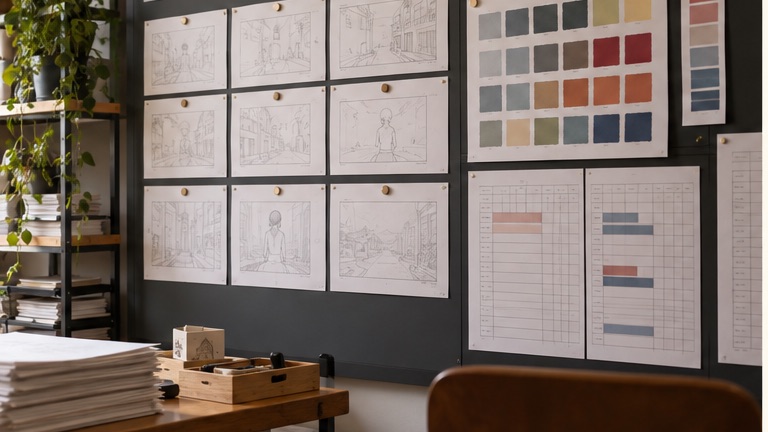
Editing places shots in sequence, adjusts their exact duration and makes the episode function as a continuous experience. Storyboards already plan the order, but finished materials reveal new timing needs. A reaction may require three more frames. A transition may repeat information. A music cue may work better if the cut lands later.
Editing is especially visible in comedy and suspense. A joke can fail if the reaction arrives too early. A scare can weaken if the shot explains the threat before the audience has time to search the frame. Neither problem is solved by adding more detailed drawings.
The nominal broadcast slot is not the same as uninterrupted story time. Opening and ending sequences, title cards, previews, recaps and commercial structures all influence how much narrative material an episode can contain. This is why chapter-count comparisons alone cannot measure adaptation pacing.
Dialogue recording gives breath, hesitation, intensity and personality to the script. Music shapes expectation and emotional scale. Sound effects make materials and spaces believable: cloth, footsteps, wind, machinery, impacts and room tone.
These elements do not merely decorate finished images. A quiet performance can motivate a restrained edit. A composer may work from project direction and visual material before the episode is fully complete. Depending on the production, voice recording may use pre-existing visual guides, storyboards or animation at different levels of completion.
Anime voice performance must fit the dramatic moment and production timing. A line includes more than words: inhalation, interruption, distance from another character and whether the speaker is running, whispering or holding back tears. Performance can make an off-screen character feel close or make a silent room feel socially tense.
A drawn door has no physical sound. The sound team decides whether it slides lightly, sticks in an old frame or slams with enough force to change the mood. Impacts, weapons and magical effects gain perceived mass through layers of sound. Silence is also a choice; removing expected noise can focus attention or create unease.
When anime is dubbed into English, Hindi, Tamil, Telugu or another language, the new team must preserve meaning and character while working with timing, mouth movement, performance conventions and local language. A literal line may not be the most accurate dramatic line if it cannot be performed naturally in the available time. Viewers comparing tracks should listen for intention and relationship, not only word-for-word similarity.
For current legal language and platform options in India, use Where to Watch Anime in India Legally.
Anime credits contain several supervisory roles, and translations vary. The episode director coordinates the dramatic execution of an episode. Animation directors check and correct drawings to maintain performance and necessary consistency. Chief animation directors may support consistency across a series or handle higher-level corrections. The series director oversees the larger work.
This does not mean every corrected line belongs artistically to one supervisor. A finished cut can contain decisions from the storyboard artist, layout artist, key animator, animation director, colour staff, background team, compositor, editor and director. Production is layered authorship.
Corrections are built into the workflow. They communicate design, perspective, acting and quality expectations. The problem is not that corrections exist; it is whether the schedule allows staff to review and implement them without pushing unsolved problems into later departments.
Production assistants help materials and information move between people. They track cuts, communicate deadlines, collect work, arrange checks and respond when a task is late or needs reassignment. The exact job differs by studio, but the role explains why anime production is also a logistics problem.
A brilliant drawing delivered too late can affect several departments waiting behind it. A background cannot be finalised without a stable layout. Compositing cannot finish a cut without all required layers. Sound and editing need usable picture timing. Coordination protects the connections.
The anime SHIROBAKO is popular partly because it dramatises these dependencies, although it remains fiction rather than a universal documentary. It can teach the vocabulary of production stress, but official process guides and staff interviews are better sources for factual claims.
Viewers often notice a weak episode and ask whether the studio “ran out of budget.” Money matters, but visible quality cannot be diagnosed from the screen with that single explanation. Time, available staff, late designs, retakes, outsourcing, changing requirements and the difficulty of particular cuts can all affect the result.
More time does not guarantee greatness, but insufficient time can prevent normal review and correction. Experienced artists still need approved materials. Departments need stable inputs. When work arrives late, later stages may have to compress their checks.
Anime production has long involved partner companies and freelancers. Toei describes a network connecting its Tokyo operation with domestic studios and its subsidiary in the Philippines. The important issues are communication, supervision, schedules and whether materials are prepared clearly—not the mere fact that more than one company appears in the credits.
Industry labour conditions deserve serious reporting, but a screenshot cannot prove who drew it, how long they had or how they were employed. Avoid turning staff welfare into fan speculation. Use named reporting, official statements and direct testimony when discussing people’s working lives.
Credits are the starting point for recognising staff. They are not always easy for international viewers: names may be romanised differently, streaming versions can omit translated roles and companies may be credited at a departmental level.
Use this order:
This method keeps admiration attached to evidence. It also prevents a studio brand from swallowing the work of individual artists and partner teams.
| Myth | Better explanation |
|---|---|
| The studio draws every frame in one building | Productions can combine core staff, freelancers and partner studios across locations |
| A higher frame count always means better animation | Posing, spacing, timing and purpose matter more than raw drawing quantity |
| CG is used only because artists are lazy | CG can solve specific camera, crowd, vehicle and consistency problems; execution determines quality |
| The manga already contains the storyboard | Manga panels do not specify screen duration, sound, continuous motion or the complete shot sequence |
| One bad-looking shot proves the entire staff failed | A shot passes through layered roles and constraints; screen evidence alone rarely identifies the cause |
Choose a scene of thirty to sixty seconds. Watch it once normally. Then replay it with one question at a time.
Where does your eye go first? Which character is larger in the frame? Is the camera close because the emotion is intimate, or because the production is hiding information outside the frame?
Pause only at major changes. Can you understand the action from those poses? Look for preparation and recovery, not only the moment of impact.
Notice where movement accelerates, slows or stops. Does a held drawing create tension? Does a quick movement feel fast because it travels far between frames?
Mute the scene and study background, colour, focus and lighting. Then listen without watching. What do music, footsteps, breathing and silence tell you that the image does not?
Count the shots. Why does the scene cut at each point? Imagine holding one shot longer or removing a reaction. You are now examining direction and editing, not simply visual polish.
This exercise works with action, romance, sport and comedy. Anime Genres Explained can help you compare how different genres use the same production tools.
| Term | Plain-English meaning | Do not confuse it with |
|---|---|---|
| Ekonte | Storyboard that plans shots and timing | A polished comic version of the episode |
| Layout | Detailed spatial plan for a cut | The finished background alone |
| Genga | Key animation drawings defining important motion | Every drawing shown on screen |
| Douga | In-between/clean animation work connecting keys | “Video” in the everyday English sense |
| Sakkan | Animation director checking and correcting drawings | The sole animator of an episode |
| Satsuei | Digital compositing or “photography” | Live-action camera filming |
| Seiyuu | Japanese voice performer | A character’s singer in every context |
Japanese production vocabulary is useful, but it should clarify rather than police other fans. If someone says “animation” when they mean the whole image, correct the department only when that distinction helps the discussion.
Understanding production makes discussion more specific. Instead of saying “the animation was good,” you can notice that the storyboard withheld a face, the key poses gave an action weight, the background carried the season or the compositor separated foreground rain from a distant light.
It also creates more ways to participate. Fans who enjoy performance may explore voice acting. Artists may study layout, background painting, colour or movement. Editors may examine rhythm and sound. Cosplayers can use character sheets and silhouette hierarchy when translating designs into fabric; the Anime Cosplay in India guide explains that process.
The goal is not to turn every viewing session into an exam. Production knowledge should give you more words for what you already feel, then let you return to the story.
Anime uses sequences of drawings or rendered images, but not every visible frame requires a completely new full drawing. Holds, repeated frames, layered movement, camera work and digital effects all contribute. The number and spacing of drawings depend on the cut.
“Anime” refers to Japanese animation in common international usage, but production work can cross borders through subsidiaries, partner studios and individual artists. The creative and organisational centre of a title may be Japanese while some materials are produced elsewhere.
Some directors also storyboard, animate or perform other craft roles, but directing primarily coordinates the work’s visual and dramatic decisions. Hundreds of credited contributions can sit behind a series.
A held drawing with a camera move can focus attention, control cost and time, or create a deliberate dramatic effect. Limited movement is not automatically poor animation; its success depends on the scene.
Productions may correct drawings, effects, compositing or editing after broadcast. The amount and reason vary. Do not assume every difference proves the broadcast version was unfinished in the same way.
Yes. Writing, production coordination, editing, sound, music, translation and research all contribute. Visual departments still benefit from drawing and observation, but “making anime” is not one job.
SHIROBAKO is the best-known fictional introduction to television anime workflow, while Keep Your Hands Off Eizouken! explores the imaginative and practical process of creating animation. Watch them as stories informed by production, then use official studio explanations for factual detail. If you need approachable titles in other genres, see 21 Best Anime for Beginners in India.
Anime is not a manga that began moving by itself. It is a negotiated sequence of plans, performances and images. The proposal defines the promise. The script organises time. The storyboard directs attention. Layout gives the shot space. Key animation creates acting. In-betweens carry motion. Background, colour and CG build the world. Compositing unifies the image. Editing finds rhythm. Voices, music and effects give the scene breath and weight.
The next time a sequence stays with you, look beyond the studio logo. Ask what the shot chose to show, when it moved, what it held back and which department made that choice visible. That is where “how anime is made” becomes more than a pipeline: it becomes a way to see collaboration on screen.

AUTHOR OF THIS ARTICLE
SoJapan
SoJapan India Pvt. Ltd. is a Japanese-founded company based in Gurugram. We bring Japanese food, anime goods and apparel materials to Indian businesses, with a sister company in Kyoto that works directly with makers in Japan.