← JOURNAL29 Sep 2026
Anime Figures for Beginners in India: Sizes, Styles and Buying with Confidence
 By SoJapan
You find a figure of your favourite anime character, then notice several versions: a small one with a large head, a fixed dramatic pose, an action figure with interchangeable hands and a much bigger model marked 1/7. All of them depict the same character. They offer very different things.
The right first figure is not necessarily the largest, newest or most expensive. It is the one whose expression, pose and format you will enjoy, whose dimensions fit your space and whose identity you can verify before paying.
This guide is for Indian anime fans making that first decision. It explains figure terminology, size calculations, product photographs, seller checks, preorders and display planning. It does not rank Indian shops, quote unverified local prices or promise that a collectible will increase in value.
Manufacturer examples are used to explain categories, not to suggest that a particular product is currently available for delivery to India. Check the actual listing and seller terms when you are ready to buy.
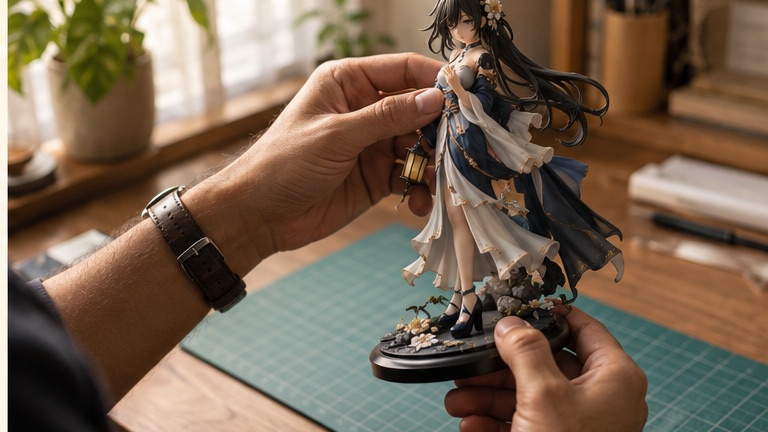
Before learning brand names, ask what you like about the character. Is it a calm expression, a comic reaction, a costume, a fighting stance or a relationship with another character? That answer can narrow the choice more effectively than a generic list of expensive products.
A battle pose may look impressive in a photograph yet feel wrong for the character as you remember them. A simpler figure with the expression you recognise may give you more pleasure each day. Collecting can be about a particular interpretation, not completing a catalogue.
Also decide how you want to interact with it. Some people want to arrange one display and leave it alone. Others enjoy changing faces and poses or making photographs. Neither approach is more serious. They just favour different designs.
For a first purchase, choose one character and one purpose. That keeps comparison manageable and makes it easier to notice when a seller is offering a different edition from the one you intended.
Figure categories overlap. A figure can be non-scale and fixed-pose, or stylised and articulated. Brand names describe particular product lines; they are not universal terms for every similar-looking object.
| Format or label | What it helps you understand | Check before choosing |
|---|---|---|
| Fixed-pose figure | The sculpt is designed around a particular pose | Viewing angle, base footprint and protruding parts |
| Articulated figure | Joints allow some posing or adjustment | Joint range, included hands and support stand |
| Chibi-style figure | Proportions are deliberately stylised, often with a large head | Exact line, accessories and available movement |
| Scale figure | A stated ratio relates the design to the represented subject | Actual overall dimensions, including the pose and base |
| Non-scale figure | No single scale ratio is specified | Listed measurements rather than assumed proportions |
| Prize figure | A product associated with a prize-distribution format | Exact manufacturer, version, condition and local seller |
Do not read this as a quality ladder. A well-chosen fixed-pose figure can be more satisfying than a complicated one you never enjoy arranging. A less elaborate sculpt can also have a strong silhouette and an excellent expression.
Bandai Spirits describes its Banpresto amusement-prize business as producing items for crane games and other amusement machines, while also discussing overseas distribution. That is a legitimate product route, not a synonym for an unlicensed imitation. Read the manufacturer’s description.
The label still does not authenticate an individual listing. A seller can misuse a real category name just as it can misuse a brand name. Identify the exact product rather than accepting “Japanese prize figure” as a complete description.
Good Smile describes standard Nendoroids as chibi-style figures around ten centimetres tall, with interchangeable face plates and parts for different looks. The attraction is expressive variation in a compact format. See the official Nendoroid introduction.
A serious character can become charming in this style without the figure trying to reproduce the proportions of a dramatic anime frame. If you want a small display with recognisable expressions, that transformation may be exactly the appeal.
Check the actual included parts. Do not assume that every Nendoroid comes with the same number of faces, the same articulation or the prop shown beside another character in a promotional image. Related products and optional accessories may be photographed together.
The Nendoroid Doll line uses doll-like bodies and clothing possibilities. Some listings are bodies or outfits rather than complete characters. Good Smile’s Nendoroid Doll archetype: Boy (Cinnamon) page, for example, explicitly states that head parts are not included and that compatibility has exceptions. See this specific product’s contents.
This is why a surprisingly inexpensive listing deserves a contents check before excitement. It may be a legitimate component rather than a complete figure. The important question is what you will receive, not whether the headline includes the character or line you recognise.
For a beginner, a complete product with a clear contents list is easier to understand than assembling a custom combination. Customisation can come later, once you know which parts are intended to work together.
Lines such as Max Factory’s figma and Bandai Spirits’ S.H.Figuarts put movement at the centre of their appeal. Good Smile’s figma collection describes articulated character figures, while Tamashii Nations explains its emphasis on character expression through posing. Explore figma’s stated focus and Tamashii Nations’ articulation approach.
Visible joints are part of the trade-off. They allow movement but may interrupt a smooth silhouette. A fixed sculpt can commit to folds, hair and balance for one position; an articulated design must work across several.
Look for the pose you want in the manufacturer’s examples and read whether it requires an included or separately sold stand. An unsupported jumping pose in a photograph may depend on equipment outside the figure itself.
A long coat, large hair piece or weapon can limit a pose even when the body has many joints. Likewise, an expressive hand or face may matter more for a scene than another few degrees of movement.
If your favourite moment is a quiet conversation, check whether the figure has a suitable face and relaxed hands. If it is an action scene, look at the stance, weapon grip and support arrangement. Buy for the actual expression you want to create rather than an abstract articulation score.
Do not force a joint beyond the range shown in its instructions. If something resists, stop and consult the manual or manufacturer support. A collector photograph is not an instruction to bend a particular part in the same way.
A scale ratio describes proportional reduction. In a simplified example, a character represented as 168 centimetres tall would be 24 centimetres at 1/7 scale and 21 centimetres at 1/8 scale when standing straight, before considering a base or pose.
That is arithmetic, not a specification for a real product. A crouching figure can be shorter overall, while a raised sword or tall base can make it higher. Use the manufacturer’s actual dimensions when planning a display.
The ratio also does not establish that two different characters will have equal height on your shelf. If the represented characters have different heights, equal scales should preserve some of that difference. Stylised designs may follow a different visual logic again.
Good Smile’s page for POP UP PARADE Naruto Uzumaki describes a line whose figures typically stand around seventeen to eighteen centimetres, but lists that particular posed Naruto at approximately fourteen centimetres. The individual specification matters more than the general line description. Read the product measurements.
Non-scale does not mean that the manufacturer forgot to measure the product. It means you should not infer one fixed proportional ratio. Look for millimetres or centimetres and check whether the stated height includes the base.
If the listing gives only height, ask for width and depth when the pose extends sideways. A character with a long weapon can fit under a shelf while still colliding with everything beside it.
The first photograph is designed to attract your attention. Before buying, look at the face, silhouette, costume, base and different viewing angles separately. This is not about finding microscopic imperfections; it is about deciding whether you like the object you will actually display.
Ask whether the expression captures the character you have in mind. A technically detailed face can still feel emotionally wrong to you. The eyes, mouth and head angle work together, so inspect them as a whole rather than only zooming into the paint.
Imagine the figure as a dark outline. Can you still understand the action or attitude? A clear silhouette often reads well from across a room. A complex sculpt that only makes sense from one exact camera position may be less satisfying on your particular shelf.
Decide whether extra effects support the character or distract from them. Flames, water or motion shapes can be exciting, but they also occupy space. If you mainly want to see the face, a large effect piece may compete with the feature you care about most.
A figure placed above eye level will not look like the same figure photographed from slightly below its face. Think about where your eyes will be in everyday use. The base is part of that presentation, not just a technical necessity to ignore.
Manufacturer images may show prototypes, and final paintwork can vary; Good Smile explicitly notes such limitations on the Naruto product page. That does not excuse every defect, but it does mean a promotional sample is not a promise of pixel-for-pixel identity.
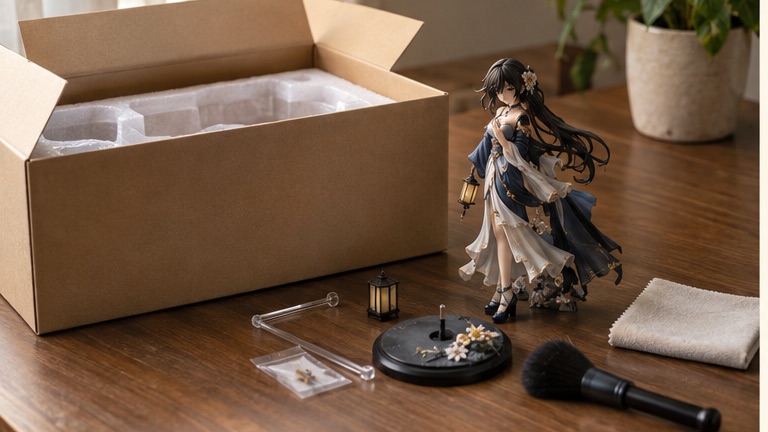
Start with the manufacturer’s exact product name, version and official page. Compare those details with the listing. A character may have several official figures with similar names, so identifying the wrong edition can create confusion even when both products are genuine.
Good Smile’s counterfeit guidance recommends its official store or listed partner shops and identifies warning signs such as missing branding or copyright information. Crucially, it also says that not every counterfeit shares every warning sign. Its guidance notes that licence stickers can vary or be absent on legitimate products. A sticker alone is not a universal authentication test. Read the current manufacturer guidance.
Bandai Namco separately describes anti-forgery stickers for Tamashii Nations products, with exceptions. Do not transfer one manufacturer’s packaging rule to every figure brand. Read Bandai Namco’s explanation.
“Premium,” “imported,” “collector quality” and “Japanese style” are not substitutes for a manufacturer and product identity. Ask whether the item is an officially licensed product from the named maker, which version it is, and what proof of purchase or support will be provided.
On a marketplace, identify the actual seller, not just the platform carrying the listing. Good Smile’s older counterfeit warning specifically highlights marketplace sellers and the possibility that official photographs can be reused to sell a different item. See that warning.
Do not accuse a seller of counterfeiting solely because a price is low or a photograph looks imperfect. Those are reasons to investigate. If the listing cannot answer basic identity and contents questions, passing on it is easier than trying to settle uncertainty after delivery.
A locally stocked item and a direct overseas preorder can involve different delivery, payment and support arrangements. Neither route is automatically better. Compare what is included and what remains your responsibility.
For a local listing, establish whether the item is actually in stock in India, available on request or part of a future import batch. Ask whether the quoted total includes domestic delivery and any charges the seller is handling. Get the answer in writing with the order details.
For an overseas listing, check whether the seller ships that exact product to your Indian address, how shipping is charged and whether duties or other import charges are included. Good Smile’s global shipping guide states that its store charge covers the product and applicable shipping, while destination duties and import taxes may remain the customer’s responsibility. Read the store’s shipping terms.
This article does not supply an Indian customs rate. The amount depends on the shipment and applicable rules; obtain current information from the relevant customs authority or carrier for your order. A stranger’s old delivery bill is not a reliable quote for a different purchase.
Suppose two hypothetical offers are ₹4,000 with ₹500 delivery, and ₹4,300 with delivery included. If all other applicable charges and terms are genuinely equal, the second totals ₹200 less. But if one price excludes additional charges, the comparison is incomplete.
These numbers are an arithmetic illustration, not actual figure prices. Use the same approach with the quotes you receive, and include uncertainty rather than treating an unknown fee as zero.
Also compare the process for a missing or damaged part. A lower price can be less attractive if you cannot establish who will respond, what evidence they need or whether return shipping could be your responsibility. Read the actual terms instead of assuming every seller follows the manufacturer’s direct-store policy.
A preorder is not an in-stock order that someone is simply slow to dispatch. You are reserving a future release, and the expected manufacturing, shipping and local delivery dates may be different.
Good Smile’s shipping calendar explicitly distinguishes dates such as shipment from the company or arrival at wholesale stores from a universal consumer delivery date. Use that distinction when reading a retailer’s estimated arrival month. See the shipping-calendar explanation.
Release schedules can change. For a concrete dated example, Good Smile’s November 2025 notice moved several products to later months because of manufacturing-schedule adjustments. That establishes that changes occur; it does not predict a delay for any figure you are considering now. Read the dated notice.
Before committing, establish when payment is due, whether a deposit is refundable, how cancellation works and what happens if the release changes. Do not assume you can cancel freely because the product has not shipped. Equally, do not assume that every shop has the same restrictions.
Avoid planning a time-sensitive birthday gift around an uncertain release month unless you have an alternative. An in-stock product with a clear dispatch estimate is easier to plan around, although delivery still requires normal caution.
A used figure can be a sensible way to find a particular edition, but “good condition” needs detail. Ask for photographs of the actual item and a list of included faces, hands, weapons, base parts and instructions. A promotional photograph cannot show what the previous owner has lost.
For articulated figures, ask whether joints are damaged or loose and whether parts have been repaired. For fixed-pose figures, inspect delicate protrusions, attachment points and the base. A missing support can matter more than a small mark on packaging.
Separate box condition from figure condition. A damaged outer box does not automatically mean the figure is broken, while a neat box does not prove that every accessory is inside. If you care about both, state that explicitly.
Our suggested inspection order is identity, completeness, structural condition, visible finish and packaging. That prioritises the things most likely to affect whether you can display the figure as intended. It is an editorial checklist, not a substitute for a seller’s written description or a manufacturer’s assessment.
Measure the clear height, width and depth of the space—not just the total size of the furniture. Leave room for the base, pose and safe handling. Avoid a position where a door, curtain, moving cable or your own arm will regularly strike the figure.
For a busy desk, a compact stable display may be more enjoyable than an elaborate action scene beside your keyboard. For an enclosed shelf, check how you will reach the figure without catching a weapon or hair tip on the opening.
Follow the product’s handling and storage instructions. Do not improvise cleaning with solvents, apply heat to a difficult joint or glue a part before checking support options. A method recommended for one material or finish may damage another.
Keep small accessories together and labelled by product. If several figures have similar hands or connectors, mixing them can make later assembly frustrating. Packaging and instructions are useful for moves and support enquiries even if you do not plan to resell anything.
Treat age guidance seriously when children share the space. A colourful collectible with small parts is not automatically designed as a young child’s toy. Choose a display location appropriate to the actual product and household.
One figure can be a complete collection for your purposes. You do not need every version of a character, a matching full cast or a more expensive piece to justify enjoying what you have.
If your interest is creative, try arranging a simple scene or photographing the figure from different angles. You can learn a surprising amount about silhouette, lighting and character expression without buying another object. Our anime-production guide offers related ways to notice visual choices on screen.
If the social side interests you, our India anime-events and communities guide can help you find fan spaces. Community advice can be useful, but popularity inside a group is not a guarantee about an individual seller or transaction.
You might also discover that you prefer making a costume, drawing a character or discussing a series to owning a figure. The cosplay beginner’s guide explores another way to express that connection. Buying merchandise is one form of fandom, not a membership requirement.
For the first purchase, keep the decision clear: a character you care about, a version you like, a format you understand and an offer you can verify. The figure should make you glad to look at your shelf—not make you feel permanently behind someone else’s collection.
AUTHOR OF THIS ARTICLE
SoJapan
SoJapan India Pvt. Ltd. is a Japanese-founded company based in Gurugram. We bring Japanese food, anime goods and apparel materials to Indian businesses, with a sister company in Kyoto that works directly with makers in Japan.