← JOURNAL19 Oct 2026
Dried Shiitake: Plan the Soak, Then Give the Mushrooms and Liquid Separate Jobs
 By SoJapan
A recipe can say “20 minutes” and still be a poor choice for tonight if the first ingredient is dried shiitake that should already have been soaked. The missing time is not necessarily spent at the stove. It belongs to getting the mushrooms ready for the stove.
There is another small surprise at the end of that preparation: you have two things to manage. There are softened mushrooms, and there is the water they soaked in. One may become a substantial part of the dish while the other supplies some of its cooking liquid. They do not have to travel together in the same quantity.
For whole dried shiitake, a refrigerated soak is a useful planned-ahead route. Follow the instructions for your particular product, check that it has rehydrated through, and cook it properly afterwards. Keep usable soaking liquid for a method that calls for it; do not automatically pour the entire bowl into whatever you are making.
That is the practical answer. The rest of this guide explains the decisions hidden inside it, including why a thin-sliced product can have different directions and why “ready to use” does not mean “ready to eat.” The manufacturer examples are published methods, not recipes independently tested by SOJPN. They make no claim about stock or prices in India.
Kikkoman’s simmered-shiitake recipe displays a cooking time of 20 minutes plus a note: rehydration is excluded. Its first step is an overnight soak. That is not a contradiction; the page is counting a different part of the work from the person standing in the kitchen with an unopened packet. Check the recipe’s timing note.
When deciding whether a dish fits your evening, scan the first two steps before the headline time. “Rehydrated,” “soaked” and “prepared” can move a significant task outside the visible cooking estimate. The useful question is: what state must this ingredient already be in when the numbered method begins?
This is especially worth doing when a recipe is saved as a screenshot. If the image contains only the ingredient list and final cooking steps, reopen the original page. A missing footnote can matter more than a beautifully clear photograph of the finished dish.
For a first attempt with whole dried mushrooms, planning ahead is usually easier to understand than collecting emergency shortcuts. You can choose the meal, read the packet, prepare a suitable container and make room in the refrigerator. Then the cooking session begins with an ingredient whose preparation you have actually accounted for.
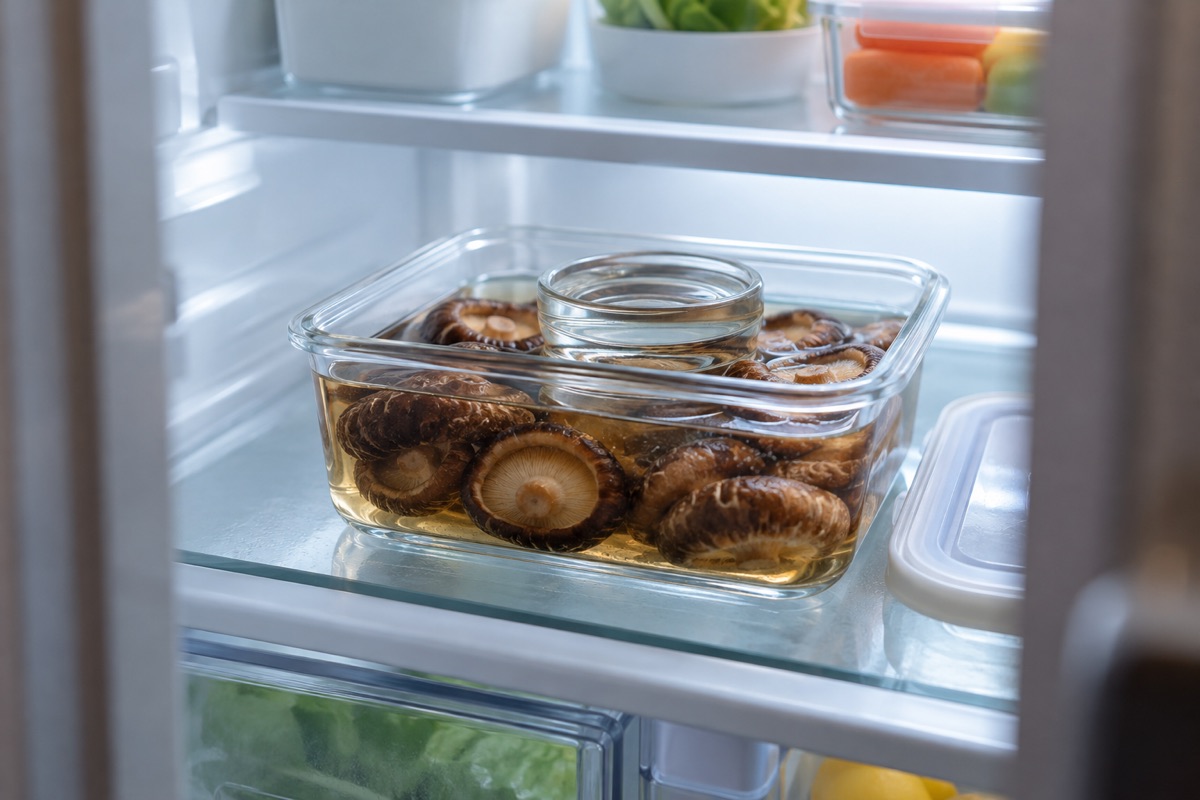
Sugimoto’s detailed whole-shiitake guidance calls for washing, complete submersion and slow rehydration in the refrigerator. Its published range is 5–24 hours below 10°C, presented as flavour-oriented guidance. It also asks the cook to check that the tough stem area has softened to the core. The source supplies both a planning range and a physical check, not merely a timer to obey. Read Sugimoto’s rehydration method.
Keep “in the refrigerator” attached to that instruction. Water drawn cold from a tap and then left on a kitchen counter overnight is not the same method. Nor is the maker’s flavour discussion a recommendation to change your refrigerator’s temperature setting.
There is a separate food-safety reason to take the location seriously. Hong Kong’s Centre for Food Safety explains that rehydration increases the mushrooms’ water content and that prolonged room-temperature soaking can allow bacteria to multiply. It advises clean running water, a clean soaking container and refrigeration for a long soak; its general room-temperature limit is no more than two hours. Read the official soaking guidance.
For an overnight plan, start in the refrigerator. The two-hour figure is not a target to use up before moving the bowl. Make the cold storage space part of your preparation, just as you would make sure the pan was available before starting to cook.
The packet’s form helps you decide which directions are relevant. Sugimoto describes donko as thick, relatively closed caps and koshin as more open, thinner caps. Those names can be useful clues, but the product in your hand matters more than memorising a category. See the maker’s explanation of the two forms.
For example, a large flat cap and a small thick one can suggest different preparation questions. Diameter alone does not tell you how far water must reach through the flesh. Look at thickness and whether the mushroom is whole or already sliced; then read the preparation directions that belong to it.
Do not treat the higher price or more impressive appearance of a whole mushroom as a reason to ignore the dish. If you want recognisable caps in a simmered side dish, an intact form has a clear purpose. If the recipe wants small strips throughout a filling, preserving an entire cap until serving does not serve that purpose.
Sugimoto publishes a separate quick method for thin-capped Koshin. It removes the stem, keeps the cap submerged, and cuts the mushroom after an initial 5–10 minutes so water can enter through the cut surfaces. The approximate 20-minute endpoint is readiness for cooking. The page explicitly sends thicker Donko back to a slow overnight soak. Read the complete thin-cap method.
The qualification matters. A shortcut based on cutting cannot preserve the same intact presentation as a whole-cap preparation. Before choosing it, decide whether the finished shape still suits your meal. Saving preparation time is useful only if the resulting ingredient can do the job you chose it for.
There is also no need to force a knife through a resistant dry cap to meet the clock. The source describes cutting during rehydration, once the mushroom permits it. Keep that sequence intact, including the product restriction, rather than reducing the method to “all shiitake takes 20 minutes.”
The Japanese specialist retailer Herushiitake recommends refrigerated cold water in its whole-mushroom guide. Yet its separate article on dried slices uses water that has been boiled and taken off the heat, with about a ten-minute soak. These are instructions for different starting forms, not two universal rules that you need to average. Compare its whole-mushroom guidance with its sliced-mushroom explanation.
This is a good reason to read beyond a search result’s first sentence. “Hot water” can be a relevant direction on a sliced-product page and an unhelpful substitution for a particular whole-cap method. Equally, a long cold-soaking recommendation does not invalidate every manufacturer’s faster preparation.
If your pack contains slices, find directions for those slices. If it contains thick whole mushrooms, find a method that actually addresses them. When the pack is unclear, a seller or manufacturer who can identify the product and its preparation is more useful than an anonymous claim that one temperature always wins.
The aim is not to collect the maximum number of methods. It is to choose one that matches the ingredient, available time and desired shape.
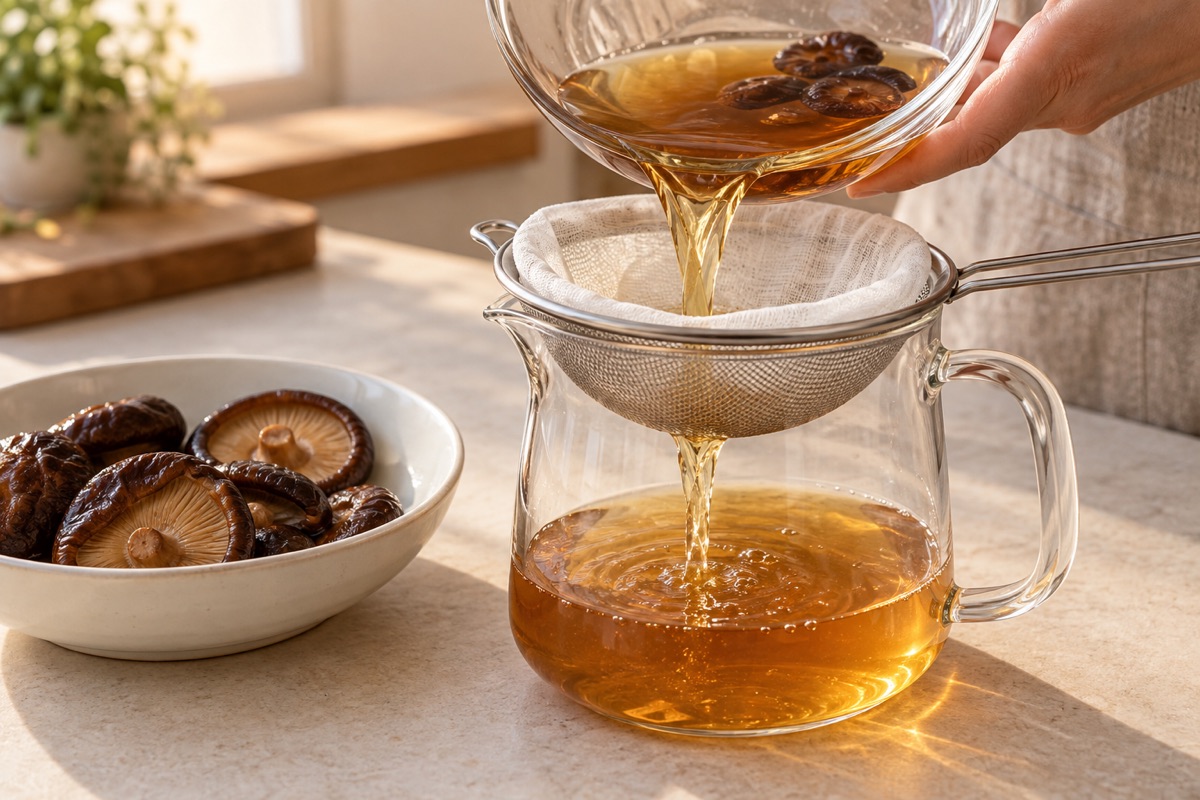
A strainer over the sink makes sense when you intend to discard water. It is a frustrating arrangement when you remember halfway through that the recipe wanted the liquid. Decide its destination first and put a clean collecting vessel underneath if you are keeping it.
Sugimoto recommends straining shiitake soaking liquid to remove fine particles before heating it. Straining and cooking are separate tasks: removing visible debris does not turn an uncooked liquid into a ready-to-drink soup. See the maker’s liquid-handling advice.
Now read the recipe as two short ingredient trails. Where do the mushrooms go after trimming or cutting? Where does the retained liquid go, and how much is requested? A direction to reserve the liquid means keep it available. It does not necessarily mean use every drop in the same dish.
This is the point where the word dashi can confuse a beginner. Calling the soaking liquid shiitake dashi identifies a possible culinary role. It does not establish that it has the flavour, seasoning or preparation of a different stock mentioned elsewhere in a recipe.
Herushiitake’s article on the liquid explicitly makes the amount depend on its concentration and the intended dish. That is more useful than a blanket rule to replace every liquid with mushroom water. Read the specialist’s discussion of using the soaking liquid.
Our editorial suggestion is to choose the liquid’s role before deciding its amount. Do you want a mushroom-led dish, or are you trying to support another main flavour? A broth intended to foreground mushrooms is a different starting point from a delicate soup whose other ingredients you want to notice.
That is a taste decision, not a contest to extract the greatest possible quantity of anything. There is no obligation to use the entire soaking bowl simply because you kept it. If the chosen method asks for only part, plan an appropriate use or storage for the remainder instead of changing dinner’s proportions to empty the container.
Suppose a hypothetical recipe calls for 300 ml of prepared cooking liquid, and you intend to use 100 ml of suitable mushroom liquid within that amount. The remaining portion would be 200 ml, not another 300 ml. This is only an arithmetic illustration; it is not a recommended shiitake-stock ratio or a tested substitution.
The distinction is between replacing part of a stated total and adding an extra liquid on top. If the original recipe gives separate fixed amounts, follow that structure instead. Do not silently rewrite it to fit the example.
Rice dishes make that mistake particularly easy to notice because the liquid has a specified measuring endpoint. Our takikomi gohan guide explains where retained liquids belong relative to rice-cooker markings. Here, the earlier decision is simply whether the recipe intends the mushroom liquid to enter the pot at all.
| What the method asks for | Your next decision | What it does not imply |
|---|---|---|
| Soaked mushrooms | Check rehydration, then trim, cut and cook as directed | Softened pieces are ready to eat raw |
| Reserved soaking liquid | Collect, strain and identify its later cooking step | Every drop must go into this dish |
| A measured amount of mushroom liquid | Measure the requested portion after handling it | The original soaking-water amount equals the amount available |
| Another named stock | Use that stock or choose a suitable alternative recipe | Any liquid called dashi is an identical replacement |
Swipe sideways on a small screen; keyboard users can focus the table and use the arrow keys.
Kikkoman’s dedicated simmered-shiitake method begins with six dried mushrooms in 400 ml of water. After soaking, the mushrooms cook in their rehydrating liquid, with seasonings introduced in stages. Here the liquid is deliberately part of the dish. The point is the explicit connection, not a new universal water-per-mushroom ratio. Follow the linked recipe for its quantities and cooking sequence, and use refrigerated overnight soaking as discussed above. See the full simmered-shiitake recipe.
Compare that with the same publisher’s simmered chicken and vegetables. Its dried shiitake are cold-rehydrated, trimmed and halved, then join the vegetables during cooking. The seasoning mixture specifies a separate bonito broth. It does not tell the cook to pour in the entire soaking bowl. Read the chicken-and-vegetable method.
These examples answer a common practical hesitation: “If I don’t add the soaking liquid, am I doing something wrong?” Not necessarily. Follow its actual role in the selected recipe. Saving an ingredient for another appropriate use is different from assuming the current pan must absorb it.
The first dish makes shiitake the main event. The second combines them with other ingredients and a separately defined liquid. If you borrowed the retained-liquid step from the first while keeping every quantity in the second, you would be developing a different recipe. That may be a deliberate experiment, but it should not happen unnoticed.
The second example contains chicken and bonito broth; the first includes sake and mirin. A mushroom ingredient does not make every linked preparation suitable for every diet. If those ingredients are unsuitable for you, choose a complete method that fits your needs instead of treating this comparison as permission to remove them without reconsidering the dish.
For a vegetarian cook, the useful distinction is between a plain ingredient and the recipe assembled around it. Check packaged seasonings as well as visible solids. An unfamiliar English stock name is worth resolving before cooking, not after the mushrooms have gone into the pan.
You also do not have to recreate a Japanese menu in its entirety to learn this one ingredient. Start with a manageable dish in which you can tell what the mushrooms contribute. If you decide to use them in soup, our miso soup guide deals with the separate question of balancing paste, stock and additions. It is not a replacement for preparing the mushrooms properly first.
The texture check tells you about rehydration. It does not certify cooking. Sugimoto’s FAQ advises proper cooking of the mushrooms and warns against consuming the rehydration liquid raw. Treat both as ingredients awaiting the appropriate cooking process, not as a cold snack and a drink produced by the soaking bowl. Read the manufacturer’s cooking guidance.
This is not only a matter of taste. France’s ANSES and poison-control authorities warn that raw or insufficiently cooked shiitake can cause a skin reaction, and that a quick stir-fry may be insufficient. Follow a complete method that cooks the mushrooms thoroughly; a splash of hot liquid at serving should not be substituted for that step. Read the official shiitake cooking warning.
If you want mushrooms on a cold finished dish, look for a preparation that cooks them before the later serving stage. “Served cold” describes the plate at the end, not permission to omit cooking at the beginning.
Kikkoman’s glossary describes cool, dark, low-humidity storage for unopened dried shiitake and avoiding moisture after opening. Those are directions for the dry ingredient, not the bowl after soaking. Check its dry-storage guidance.
For soaked mushrooms, the Centre for Food Safety advises using and consuming them promptly and discarding them if slime or abnormal smells develop. A normal appearance or smell does not replace a reliable handling history. If you cannot establish how the batch was kept, do not treat this flavour guide as a way to rescue it. See the soaking and handling advice.
Sugimoto suggests freezing soaking liquid in small portions. That can help when a recipe uses less liquid than the soaking bowl contains, but it is not a reason to soak a large batch without a plan. Freeze only properly handled liquid, keep it identified, and retain the distinction between a portion awaiting cooking and finished food. See the maker’s storage suggestion.
A useful label says what the container holds and when you prepared it. “Shiitake soaking liquid—uncooked” communicates more than “stock” alone. If you portion it for a particular recipe, record the amount too. This is an organisation suggestion, not an extension of any product’s storage limits.
Before starting the soak, make a short note for the intended meal:
Those two lines catch different mistakes. The first prevents a thick whole cap from inheriting a sliced product’s shortcut. The second prevents useful liquid from disappearing down the sink—or an unmeasured extra bowlful from entering the pan.
For your first attempt, the best result is not simply “more umami.” It is knowing why you chose that soak, what condition the mushrooms should reach, and where both products of the soaking bowl go next. Once those decisions are clear, dried shiitake becomes an ingredient you can plan around, rather than a last-minute instruction that quietly moves dinner to tomorrow.
AUTHOR OF THIS ARTICLE
SoJapan
SoJapan India Pvt. Ltd. is a Japanese-founded company based in Gurugram. We bring Japanese food, anime goods and apparel materials to Indian businesses, with a sister company in Kyoto that works directly with makers in Japan.