← JOURNAL29 Sep 2026
Miso Soup at Home: Choose the Paste, Build the Broth and Fix the Flavour
 By SoJapan
You dissolve a spoonful of miso in hot water. The colour looks right. There is tofu in the bowl. Yet the first sip seems salty and strangely incomplete. Another spoonful makes it stronger, but not necessarily better.
The useful question is not simply “How much more miso?” It is “What is missing from this particular bowl?” The paste, the liquid beneath it, the ingredients and the cooking sequence all matter. A packet containing seasoned soup concentrate also behaves differently from a tub of plain fermented paste.
For Indian readers exploring Japanese food, this distinction solves two problems at once: it makes cooking less mysterious, and it helps you check what you are actually eating. A bowl with only tofu and seaweed visible can still contain fish. Conversely, a fish-free version does not have to be an apology for the original.
This is a guide to understanding and adjusting miso soup, with links to makers’ recipes for exact preparations. The suggested comparisons are learning exercises, not claims that SOJPN has tested a new recipe in a kitchen.
Miso soup need not be a thick, blended soup. Nor must every serving contain noodles or a long list of toppings. A relatively light bowl can make sense beside rice, while a vegetable-heavy version gives you more to eat between sips.
Kikkoman’s food-culture introduction describes both simple combinations, such as tofu and wakame, and heartier household soups. It also points out that miso and dashi choices allow substantial variation. There is no single restaurant-style bowl that every home cook must reproduce. Read Kikkoman’s introduction to miso soup.
Decide its job in your meal before choosing its contents. If the soup accompanies rice and several other dishes, a small number of ingredients lets you notice the broth. If it is the main warm element of a simple lunch, you may prefer more vegetables and tofu. Those are different design choices, not different levels of authenticity.
This matters when judging whether something is “thin.” Do you mean the flavour disappears immediately, or that the liquid is not creamy? More miso may change the former, but miso soup does not need cream-like thickness to be successful. Describe the problem precisely before attempting a repair.
For a rice accompaniment, our onigiri guide deals with a different part of the meal: rice texture, fillings and when to add nori. You do not need to turn the soup itself into a rice bowl to enjoy the two together.
Miso is fermented paste made with soybeans, salt and koji. Koji is the cultivated fermentation starter; rice, barley or soybeans can be involved, depending on the type. It is not another name for stock. Hikari’s overview explains the ingredients and production.
Before opening a tub or sachet, find its preparation instructions. Three products can carry the word “miso” while asking you to do different work.
| What you have | What to establish first | The avoidable mistake |
|---|---|---|
| Plain miso paste | Which broth or ingredients will provide the rest of the bowl’s flavour? | Assuming every paste already includes soup stock |
| Dashi-added miso | What stock ingredients are included, and what dilution does the maker suggest? | Automatically adding a second full dose of seasoned stock |
| Complete instant soup | How much water, how many sachets and which toppings belong to one serving? | Treating a portioned concentrate like a tub of plain paste |
Kikkoman specifically notes that some miso already contains dashi and can be made into soup with water. That convenience is useful, but it changes the seasoning decision. Adding separate stock is then an adjustment, not an automatic missing step.
With instant soup, empty all the components intended for that serving and follow the printed water amount. Hikari’s FAQ describes products with separate soup and topping packets and advises stirring the bottom of the bowl so the paste dissolves. Do not assume every brand uses the same packet arrangement. Read the instant-soup preparation advice.
The shopping consequence is straightforward: compare products that solve your actual task. A single-serving instant soup may suit an occasional office lunch; plain paste offers more control when you want to vary stock and solids. A larger tub is not automatically the better first purchase if you do not yet know how you will use it or store it after opening.
Consider one concrete label rather than a general warning. Hikari’s 400 g Organic Dashi Miso lists bonito, anchovy, frigate mackerel and scad, as well as soybeans. Its ingredient list also includes alcohol. The organic description does not make this particular paste vegetarian. Check the actual pack, because formulations and market labels may differ. See the manufacturer’s product ingredients.
When preparing soup for someone else, ask what they exclude rather than supplying your own definition. A fish-free bowl may still contain an ingredient that a particular diner avoids. Vegetarian, vegan, Jain and halal requirements are not interchangeable, and an English flavour name is not certification.
Our Japanese vegetarian food guide for Indian readers explains the broader label and restaurant questions. Here, carry that checking habit through every layer: paste, stock, additions and garnish. Removing a visible topping does not remove an ingredient dissolved in the liquid.
White and red are useful words to recognise, but poor substitutes for reading the product description. Colour is one classification; the grain or soybean koji, flavour style and formulation are others.
Hikari’s Japanese miso encyclopedia separates classification by koji, taste and colour. Its examples include both sweet red miso and saltier pale miso categories. That alone shows why “red always means saltier than white” is too crude a buying rule. It explains sweetness partly through the ratio of koji ingredients to soybeans, not colour alone. Explore the manufacturer’s classification.
For a first tub, look for a clearly described soup use and a label you can understand. That is more valuable than finding the darkest or palest paste. If you already have miso, start by learning its behaviour rather than deciding it is the wrong type because it does not match a photograph.
Taste comparisons become clearer when the broth and dilution stay constant. If you compare one paste in water with another in strong fish stock, the result tells you about two complete mixtures. It does not isolate the difference between the pastes.
The same caution applies to texture. A smoother paste and one with visible grain fragments may look different after dissolving. If the maker describes a textured product, do not judge every small particle as a failed technique. A lump with a concentrated salty centre is a different issue from evenly dispersed fine texture.
Blending two pastes is an option, not a beginner requirement. Learn each separately first; otherwise, a disappointing mixture leaves you guessing whether to change the blend, its total amount or the broth.
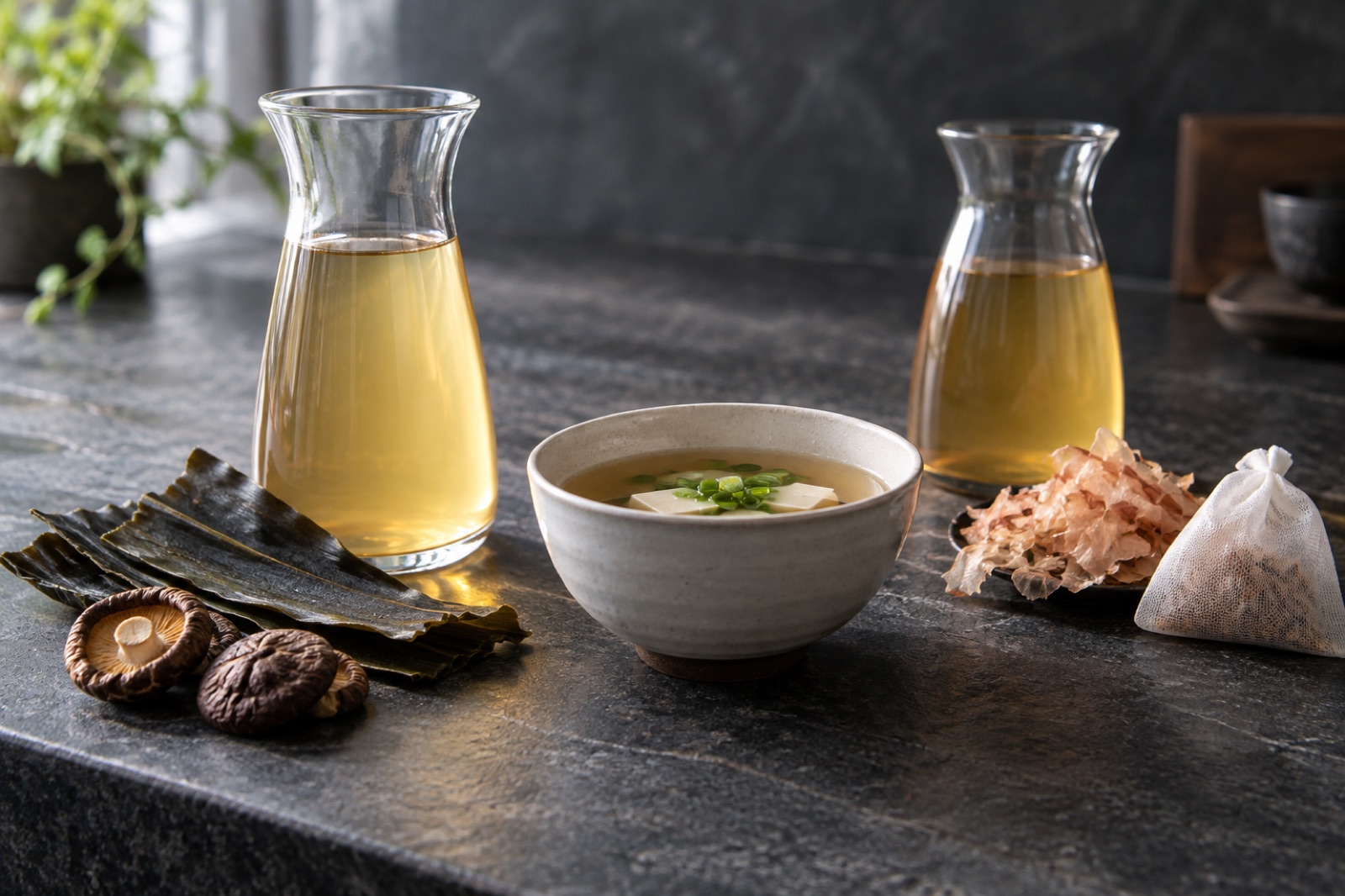
Saltiness and savouriness are related in cooking, but they are not the same sensation. Dashi contributes a flavour foundation; it is not merely water made salty. That is why chasing a missing broth character by increasing the paste can lead you in the wrong direction.
The Umami Information Center identifies glutamate in kombu, inosinate in fish ingredients such as katsuobushi, and guanylate in dried shiitake. It also describes kombu and dried shiitake as ingredients for vegetarian dashi. Their contribution is more specific than the vague instruction to “add something Japanese.” Read its explanation of dashi and umami.
You do not need to memorise the chemistry to use the distinction. Ask which ingredient is supplying the stock character in your chosen recipe. If the answer is none, decide whether that is intentional. A vegetable-rich soup can draw flavour from its cooked ingredients; a very sparse bowl may ask more of a separately prepared broth.
For a vegetarian-compatible route, select an appropriate kombu or mushroom preparation and verify any packaged stock blend. A picture of kelp on the front does not tell you everything else in the sachet. For a fish-based route, choose a recipe designed around that stock rather than adding several powders on top of one another.
Concentrated stock products introduce another measurement problem. A teaspoon of granules, a stock bag and a ladle of finished broth are not equivalent units. Prepare the stock at the maker’s stated dilution first. Then assess the soup. If you start with over-concentrated stock, reducing miso alone may not resolve the saltiness.
If specialist stock ingredients are unavailable, Hikari’s FAQ allows alternatives including vegetable broth and even water. Treat an alternative as a different flavour direction, not a promise that it will taste identical. An unsalted or lightly seasoned base gives you room to judge the miso; a strongly seasoned base has already made some of that decision for you.
An editorial suggestion for learning: start with one stock approach and two manageable solid ingredients. Changing the stock, paste, toppings and garnish simultaneously may produce an enjoyable lunch, but it produces very little information about which change helped.
Two reasonable recipes can specify different miso amounts. Hikari’s Japanese basic soup uses 400 ml of dashi and two tablespoons of miso for two servings. Its English tomato-and-tofu recipe gives a general guide of one tablespoon per cup, explicitly defining that cup as 240 ml. These are starting points in different recipes, not one universal ratio. Compare the Japanese basic method with Nami’s tomato-and-tofu recipe hosted by Hikari.
There is a second trap inside the word “cup.” Hikari’s Japanese bonito-stock instructions equate five cups with 1,000 ml: 200 ml per cup in that source. Five of the 240 ml cups above would instead hold 1,200 ml. That is 200 ml, or 20%, more starting water. The arithmetic is ours; it compares those stated measures, not laboratory-tested differences in flavour. Check the Japanese stock measurements.
The practical fix is pleasantly undramatic: use the millilitre amount printed in the recipe. Do not mix one page’s cup convention with another page’s spoon ratio. And do not use an unmeasured drinking mug as though it were automatically a measuring cup.
Distinguish starting water from finished broth, too. Some water remains with strained stock ingredients, and some may evaporate during cooking. When a recipe asks for a measured quantity of prepared dashi, measure that quantity after making the stock rather than assuming it equals everything you poured in earlier.
For repeatable soup, keep a short note: product name, finished broth volume, miso amount and any other salty ingredient. If your kitchen scale is suitable for small quantities, recording the paste by weight can help you reproduce your own preferred bowl without debating how rounded the spoon was.
A useful adjustment sequence is to reserve part of the recipe’s miso amount, dissolve the rest, then taste before adding the reserve. This is an editorial method for controlling seasoning, not a new fixed ratio. You still need enough flavour; the point is to reach your preference deliberately rather than overshoot and then enlarge the entire pot.
“Do not boil miso soup” is easily misunderstood. It is not an instruction to leave raw ingredients insufficiently cooked. Separate the cooking stage from the finishing stage.
Marukome’s classic method heats the tofu and rehydrated wakame in broth before removing the pan from the heat to dissolve the miso. It then uses very low heat and adds green onion at serving. The sequence matters more here than treating every ingredient as something to stir into a finished bowl. Read Marukome’s classic preparation.
If you choose firmer vegetables, use a recipe that accounts for their cooking needs. A carrot slice, a large piece of potato and a cube of soft tofu should not be expected to finish at the same moment merely because they share a saucepan. Cutting changes the problem as well: a thick chunk and a thin slice of the same vegetable are not interchangeable cooking units.
Plan the order before turning on the heat. Which ingredient needs time to soften? Which needs gentle handling? Which is intended as a fresh finishing aroma? This lets you use the recipe intelligently when your vegetables are cut differently, instead of treating a timer as evidence that everything must be ready.
Read whether the recipe means dried, rehydrated or salt-preserved wakame. Hikari’s Japanese basic recipe specifies salt-preserved wakame and washes and soaks it before use. Marukome’s recipe explicitly uses dried wakame and rehydrates it separately. Their quantities should not be transferred between products as if both weights referred to the same state.
This is particularly easy to miss when an online shopping page says only “seaweed.” Buy for the recipe’s role and check preparation instructions. If your packet specifies rehydration and draining, do that before judging the volume you will put into the bowl. Do not discover that you used the wrong form only after the rest of the soup is seasoned.
For delicate tofu, leave space to move the liquid without repeatedly striking the pieces. A vigorous stir intended to break up a lump of miso can also break up the tofu. Solving those tasks separately makes the finishing stage much easier.
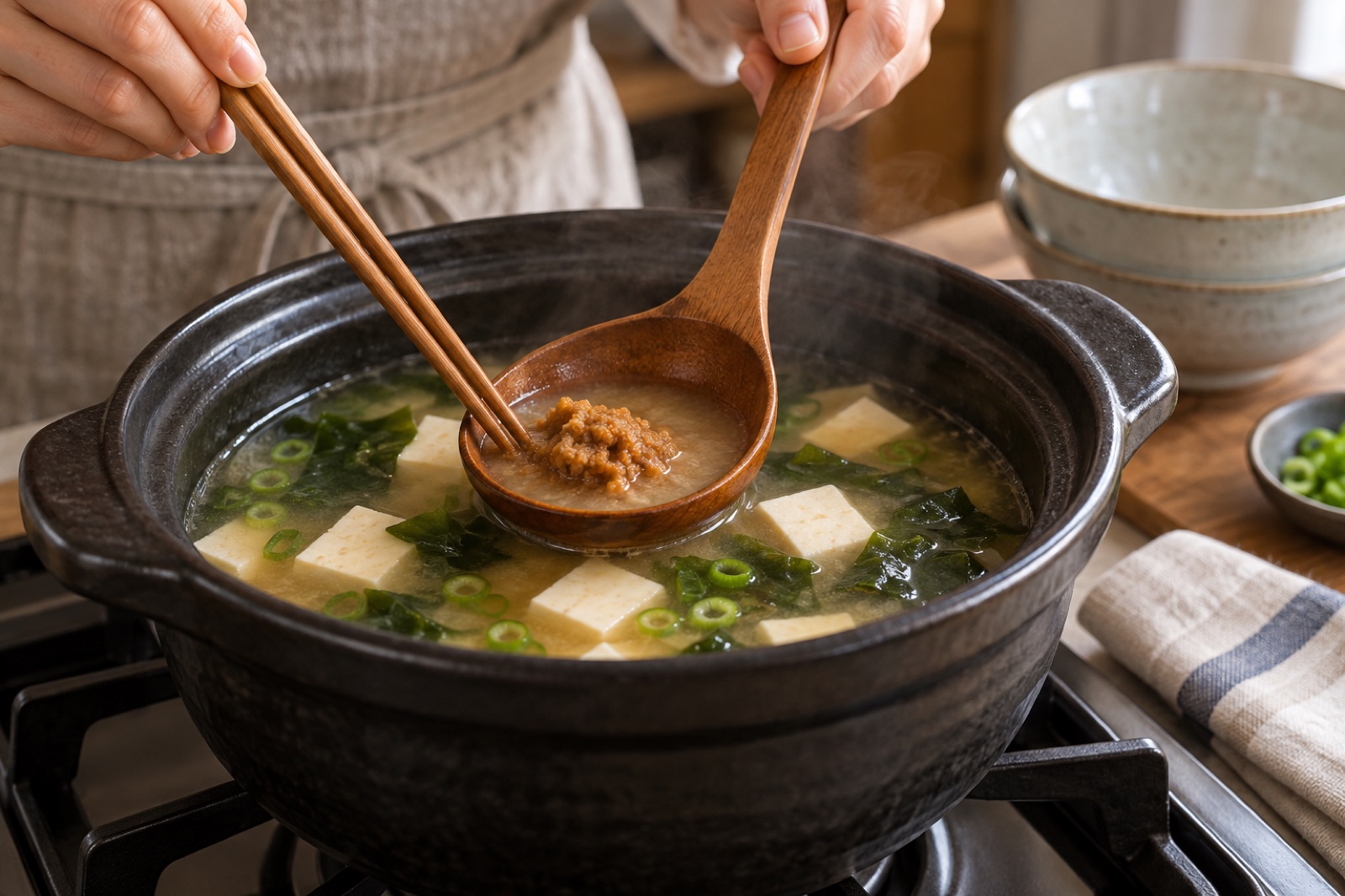
The aim is even distribution, not a whirlpool. Set aside the measured miso, then loosen it with some hot broth in a ladle or small bowl before returning it gently to the pot. Alternatively, use a suitable strainer as your recipe directs. Keep the utensil stable and take care with hot liquid.
The tomato-and-tofu recipe linked above demonstrates dissolving miso in a strainer or ladle after turning off the heat. It also notes that grain residue can remain in a strainer. That is different from an undissolved blob of paste, and the recipe treats keeping that residue as a preference.
Once you have mixed the soup evenly, taste a safely cooled spoonful. Tasting before the paste has dispersed can be misleading: one sip may contain little seasoning, while the next encounters a concentrated pocket. You might add more to solve a distribution problem and inadvertently create a salt problem.
For freshly made soup, avoid a prolonged vigorous boil after the final miso addition if you want to preserve its aroma. This is a culinary finishing preference, not a health claim about keeping a specified number of beneficial organisms alive. Nor does it override safe reheating of stored leftovers, discussed below.
Arrange the rest of the meal before this stage when practical. That gives you a chance to serve the finished soup without leaving it simmering while you prepare every other dish. A small change in organisation can be more useful than buying another specialised utensil.
The following is a diagnostic approach, not a promise that every batch can be restored. Use it with freshly prepared, safely handled soup. If the concern is spoilage or uncertain storage, tasting is not the test to perform.
Salty but lacking depth: stop adding paste. Check whether the stock was absent, weak or simply different from what you expected. Adding unsalted prepared broth can change both dilution and flavour; adding salted concentrate may push the original problem further. For the next batch, compare the broth before it meets the miso.
Too strong in every sip: test dilution in a small separate portion before changing the whole pan. For a hypothetical example, adding 25 ml of water to 100 ml of evenly mixed soup increases the liquid volume to 125 ml. Ignoring solids and evaporation, the dissolved seasoning concentration becomes 100/125, or 80%, of the starting concentration. That is a 20% reduction, not proof that it will taste exactly 20% less salty. Dilution spreads the existing seasoning through more liquid; it does not remove it from the pot.
Weak in every respect: first confirm you have stirred thoroughly and measured the intended water. If both are correct, a little more dissolved miso may be appropriate. Record the new amount. That is more useful than declaring the entire type of paste flavourless after one overly diluted attempt.
One ingredient dominates: consider its amount and preparation, not just the paste. A strongly mushroom-led broth may be enjoyable, but it can be the wrong starting point if you were hoping to notice a subtler miso. Adding several other strong ingredients to conceal it makes the next attempt harder to understand.
The tofu has disintegrated: seasoning cannot reverse the texture. You can still decide whether the safely cooked soup is pleasant to eat, but the next adjustment concerns handling, tofu choice and cooking sequence. Reduce unnecessary agitation rather than compensating with additional miso.
The broth is fine but the bowl feels crowded: reduce the solids next time or choose a larger serving format. More ingredients can make a heartier meal; they do not automatically make a more informative first taste. Keep the version that suits your meal, rather than the one with the longest shopping list.
A tub of concentrated fermented paste and a saucepan containing diluted soup, tofu and vegetables are different foods. Do not transfer the paste’s storage reputation to the finished meal.
Hikari’s dedicated storage guide recommends refrigerating opened miso, keeping it covered and using clean, dry utensils. Follow your product’s own directions and date information. Avoid dipping a spoon carrying soup or food fragments back into the tub. Read the manufacturer’s paste-storage guidance.
For cooked leftovers, USDA advises prompt refrigeration within two hours, shortened to one hour when the temperature is above 90°F, approximately 32°C. Divide large quantities into shallow containers rather than leaving a deep pot out to cool slowly. Its reheating advice for soups is a rolling boil. These are food-safety instructions, and they take priority over aroma-preserving advice for freshly finished miso soup. Read USDA’s leftovers guidance.
If you mainly want a fresh-tasting single bowl, making a manageable amount is simpler than repeatedly reheating a large batch. Planning the portion is part of cooking, not an afterthought. Do not rely on a normal smell or appearance to excuse soup that has been left out beyond safe limits.
Once you have a version you enjoy, change one meaningful thing. Keep the paste and finished liquid volume constant while trying a different suitable stock. Or keep the broth and ingredients constant while comparing two pastes. Serve the samples at comparable, comfortable temperatures and decide what you actually prefer.
Write observations you can act on: “the broth is noticeable before the miso,” “this dilution suits a small bowl beside rice,” or “the tofu broke during stirring.” Those notes lead to a specific next step. “Needs more flavour” does not tell you whether to change stock, paste, concentration or expectation.
You do not need a cupboard full of imports to learn this. Start with a product whose ingredients suit you, one coherent recipe and measurements you can repeat. Once the first bowl makes sense, the choice between a light tofu soup and a more substantial vegetable version becomes enjoyable rather than confusing.
The goal is not the maximum possible amount of miso. It is a bowl in which the paste, broth and ingredients do the jobs you intended—and one you know how to make again.
AUTHOR OF THIS ARTICLE
SoJapan
SoJapan India Pvt. Ltd. is a Japanese-founded company based in Gurugram. We bring Japanese food, anime goods and apparel materials to Indian businesses, with a sister company in Kyoto that works directly with makers in Japan.