The soy sauce is measured. The mushrooms are ready. Your rice cooker has a line marked “2.” Now comes the surprisingly awkward part: do you fill to that line and then add the seasoning, or does the seasoning already belong inside that measurement?
For the water-line methods examined here, the seasoning liquid goes in before the final adjustment to the line. But that is not permission to apply one water ratio to every takikomi gohan recipe. Another manufacturer’s recipe measures a prepared cooking liquid in a jug instead. The important question is what the recipe means by its final liquid amount.
Takikomi gohan is Japanese rice cooked with flavouring and other ingredients, rather than a plain cooked bowl receiving a sprinkle at the table. Zojirushi distinguishes it from maze gohan, where ingredients are mixed into rice after cooking. That timing is the useful distinction for a beginner; the English phrase “mixed rice” alone does not tell you when the mixing happens. Zojirushi’s introduction to takikomi gohan explains the two approaches.
This is a guide to reading published methods, not an independently tested recipe or a promise that any rice cooker can prepare every version. For an Indian home cook using unfamiliar Japanese ingredients alongside familiar kitchen equipment, that distinction matters. You do not need to buy a particular machine to understand the dish. You do need instructions compatible with the machine and rice you actually have.
Consider the structure of Zojirushi’s classic mixed-rice recipe. Its seasoned liquid and reserved shiitake soaking water are combined, then added to rinsed, drained rice. Water brings the pot to the appropriate marked level. Only after that adjustment and mixing are the prepared solids spread across the rice.
Both retained liquids therefore belong before the final adjustment—not in a separate pour after the pot has reached its mark.
The practical reading habit is to trace every liquid until you reach an instruction that fixes the final amount. Mark “keep,” “drain” or “measure again” beside each one if necessary. The ingredient list tells you what to gather; it may not tell you what volume eventually enters the rice cooker.
Imagine two cooks following the same hypothetical instruction: “Add the seasoning, then add water to the mark.” One puts seasoning in first and stops adding water at the mark. The other fills with water first, then pours in the seasoning. They have not assembled the same pot, even if every spoonful of seasoning was measured correctly. The second cook has added liquid after the stated endpoint.
This is a reading example, not a replacement water formula. It explains the ordering error without pretending to know the capacity of your bowl, how much water remains after rinsing, or how much a particular batch needs.
A number stamped inside a cooker is easy to misread as a free-standing volume. In a rice recipe, it belongs to the stated rice amount, the relevant scale and the correct inner pot. “Level 2” is therefore not an instruction to pour in two kitchen cups of water.
Tiger’s support guidance pairs the supplied rice measure with the corresponding inner-pan scale and warns that the scale discussed there is based on short-grain rice; other grains can differ. It also directs readers to their model’s minimum and maximum cooking amounts. See Tiger’s rice-cooker measurement guidance.
For a household accustomed to measuring rice with a steel tumbler or a favourite mug, this is a change of measuring system, not a criticism of that familiar method. A household ratio can be consistent on its own terms. It does not become the manufacturer’s measured batch simply because the number of scoops is the same.
Before switching systems, decide which one you are following. Use the original recipe’s defined measure, or choose a method that supplies clear weights or volumes. Avoid taking the rice quantity from one system and the water marking from another.
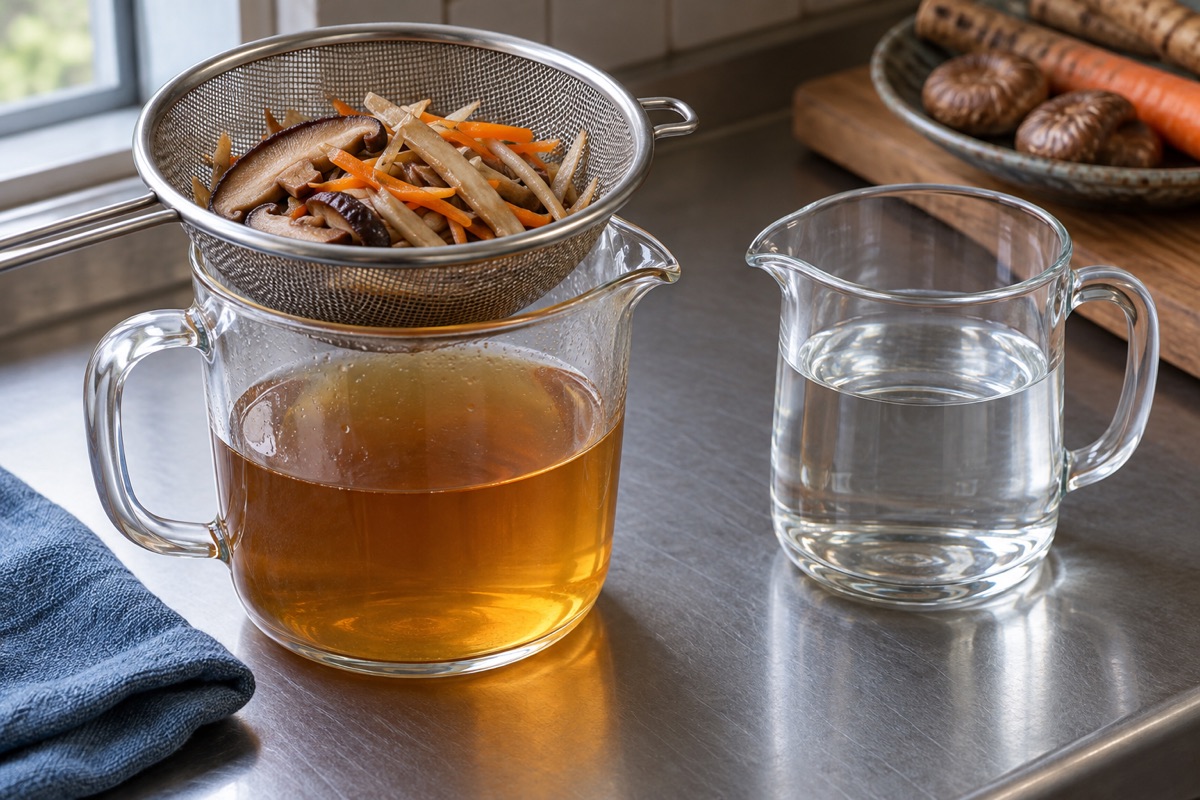
Kikkoman’s mushroom takikomi gohan makes the liquid accounting especially visible. The recipe first simmers chicken, burdock and mushrooms in seasoned stock, then separates the solids and retains the liquid. After cooling, it calls for 480 ml of that prepared liquid, topped up with water if necessary. This is the amount used with its stated 400 ml of japonica rice. The solids go on top. The page defines its US cup as approximately 240 ml. Read Kikkoman’s complete mushroom-rice recipe.
The useful lesson is not “480 ml makes takikomi gohan.” It is that an amount earlier in the preparation is not necessarily the final amount being measured. Here the recipe deliberately brings the cook back to a measuring step after another cooking process.
“Use all the liquid” and “measure liquid from this mixture” are different directions. A measuring step after simmering is a checkpoint, not a redundant repeat of the shopping list.
For an arithmetic-only illustration, suppose an unrelated recipe asks for a final 500 ml of prepared liquid and you have 430 ml. Bringing it to 500 ml requires 70 ml more. Adding another 500 ml would produce 930 ml. These invented numbers are not a rice recipe, seasoning adjustment or recommended ratio; they simply show what “top up to” means.
| Instruction style | What ends the measuring step? | The misleading shortcut |
|---|---|---|
| Add specified liquids, then water to a named line | The correct pot reaches that line at the stated stage | Fill with water first and add the flavouring afterwards |
| Measure prepared cooking liquid and top up to a total | The combined liquid reaches the specified volume | Add the full water amount again, on top of the retained liquid |
| A recipe separately specifies fixed amounts of water and seasoning | Its own complete instructions, checked for any later adjustment | Subtract a guessed seasoning volume because a different recipe used a water line |
On a small screen, swipe the table sideways. Keyboard users can focus it and use the arrow keys.
The third row matters. Learning the water-line principle should not create a new mistake: rewriting every recipe to fit it. These are ways to interpret a method, not interchangeable formulas. If a recipe is genuinely unclear about whether its liquid quantity includes the seasoning, choose a clearer recipe or ask its author before cooking.
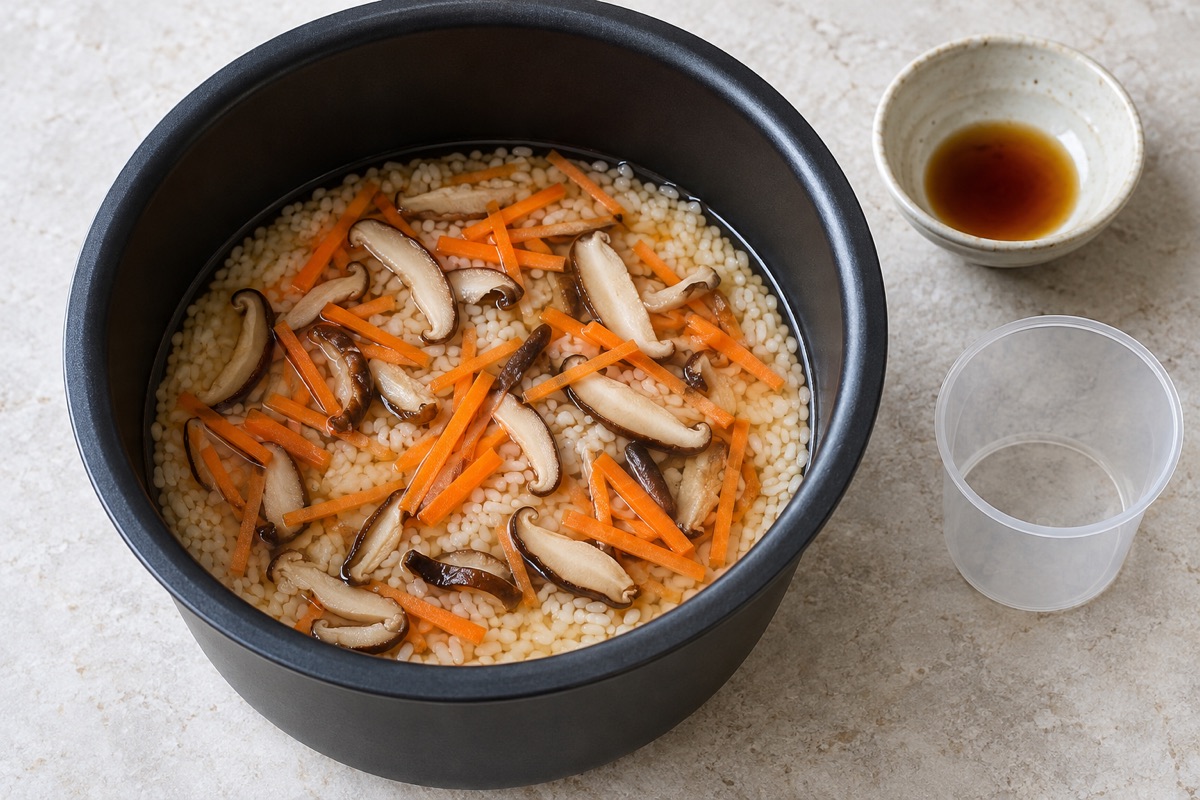
A finished bowl has rice and small pieces distributed together. It is tempting to assume the uncooked pot should already look like that. But a photograph of the serving bowl does not establish the loading order.
There are three useful meanings of “mix” to watch for: combining the liquid seasonings; distributing those seasonings through the rice and liquid; and folding the cooked rice together with its additions. A recipe may request all three while still telling you to leave the solids on top before cooking.
Zojirushi’s general takikomi guidance explicitly separates the seasoning stage from the vegetables-and-protein layer, which it says not to mix into the uncooked rice. It then calls for turning the rice and ingredients together after cooking. That is a sequence, not a contradiction. See the manufacturer’s loading advice.
When a step says “mix well,” look immediately backwards. What has entered the pot so far? If the mushrooms and carrot appear only in the next instruction, they cannot be what the previous mixing instruction referred to. This small grammatical check is often more useful than remembering a slogan about rice cookers.
Tiger’s JBX-A gomoku rice keeps snow peas out of the initial pot and adds them after cooking, following separate preparation. Its final mixing step is therefore also the point when an ingredient joins the dish. The JBX-A method shows that timing.
The editorial takeaway is to sort additions by destination before starting: ingredients entering with the rice, ingredients prepared separately, and final garnishes. “Everything is chopped” is not the same as “everything is ready to go into the same vessel.”
That distinction can make a first attempt less frantic. Put the later addition somewhere you will not automatically tip it into the cooker with the first group. A separate small dish is enough; elaborate meal-prep equipment would add nothing to the lesson.
These examples do not establish a universal prohibition on stirring solids in every rice-cooker dish. They show why the selected recipe’s order deserves attention. A different named recipe can have a different assembly method. Keep its instructions together rather than importing one sentence from another dish.
On Tiger’s JBX-A gomoku page, the instruction uses the Plain water scale but the Mixed cooking menu. The smaller 1.0-litre, 5.5-cup model’s recipe uses two cups of rice and level 2; the larger 1.8-litre, 10-cup version uses three cups and level 3. These are the two published recipe batches, not claims about either machine’s maximum mixed-rice capacity. Check the model columns and method together.
This is why “I used Plain” is not enough information to understand what someone did. Did they use the Plain scale to add liquid, or choose a Plain programme? One describes a measurement; the other describes the cooking operation.
Keep a separate note for each. A useful recipe card has a field for “water scale or measured liquid” and another for “menu.” If the wording differs, do not automatically correct it to make the words match.
Tiger’s US takikomi page provides another reason not to transfer labels casually: its method refers to an Ultra scale and a Mixed menu. The page also specifies the rice measure supplied with the cooker. Those instructions are evidence of the method presented there, not proof that your inner pot must have an Ultra marking. Read Tiger’s US method in full.
If your pot has no matching scale, pause at that mismatch. Do not use a porridge line because it happens to carry the same number, or choose a similarly named button as a guess. Find the matching model manual and an appropriate recipe, or use another supported cooking method. An electric pressure cooker, a simple cook-and-warm rice cooker and a multi-menu machine should not be treated as identical controls with different branding.
The writer may simply be looking at a different inner pot from yours.
Once the sequence is clear, the next temptation is to change several ingredients while keeping the original liquid amount. That may be a reasonable development project for an experienced cook, but it is a poor way to learn what the published recipe was meant to do.
Start by identifying the size of the change. Replacing an optional finishing garnish is a different decision from replacing the rice itself. Removing a listed piece of chicken is different from replacing all the cooking liquid with a bottled sauce. The word “substitute” hides changes at very different levels.
For a first attempt, we would prioritise an already suitable recipe over extensive adaptation. That is an editorial recommendation about learning: when the initial result differs from the description, fewer changes mean fewer possible explanations.
Check the grain named by your chosen method. A recipe written for Japanese short-grain rice does not validate an unchanged batch made with whatever long-grain rice happens to be in the cupboard. Nor should a water instruction for white rice be treated as evidence for brown rice. Look for a recipe that actually addresses the grain and equipment combination you intend to use.
Likewise, “mushroom” is not a complete preparation instruction. A dried ingredient awaiting rehydration and a fresh sliced ingredient start at different stages. Read whether the soaking liquid is retained, whether the solids are drained, and whether the pieces are cooked before entering the rice cooker. Do not merge separate preparations merely because both finish with mushrooms in the bowl.
Burdock presents another practical reading task: shavings, strips and chunks are not the same instruction. If that ingredient is new to you, our gobo cutting guide examines how published methods choose the cut for the dish. It is more helpful to understand the requested shape than to copy a root-vegetable preparation from an unrelated recipe.
For readers who do not eat meat, fish or alcohol-containing seasonings, choose a fully suitable version before assembling the pot. A mushroom-led title does not itself tell you what the stock contains, and omitting a visibly unsuitable ingredient does not check the rest of the ingredient list. This guide makes no vegetarian, vegan, halal or alcohol-free claim for the linked classic recipes.
If a recipe depends on ingredients you cannot obtain or do not use, selecting another complete method is a perfectly reasonable start.
Packaged rice seasonings deserve their own check. Our furikake guide separates finishing sprinkles from products mixed into cooked rice. If your packet tells you to use cooked rice, the water-line discussion in this article is not an instruction to put it into an uncooked batch.
The manufacturer’s directions on the exact packet decide how that product is used. A Japanese dish name, a bowl photograph or the English phrase “rice seasoning” is not enough to establish the stage. Read the verb and the state of the rice before opening the cooker.
Choose one complete recipe, then write a short preparation note in your own words. It does not need to reproduce the whole page. It needs to preserve the decisions most easily lost while switching between a phone screen and the kitchen.
Now check that note against the original page once more. If you cannot fill in a field, the useful next step is to resolve that particular gap. There is no benefit in buying more toppings while the rice measure is still uncertain.
For your first batch, keep the chosen method intact and make only an amount supported by the equipment instructions. Plan when you will serve it; do not assume plain-rice timer or keep-warm habits apply to a mixed dish. Consult the model’s directions for those functions rather than using this recipe-reading guide as storage or food-safety advice.
After eating, a brief note can help you improve the next attempt: the exact rice used, the liquid instruction followed, the batch size and any deliberate change. Describe the result specifically—rice texture, seasoning or the distribution of additions—rather than labelling the whole dish a success or failure. This is a suggested learning record, not a report of our own kitchen testing.
The central skill is modest but useful: recognise the moment when measuring ends and the next job begins. Once you can distinguish seasoning from top-up water, a liquid scale from a cooking menu, and uncooked layers from the final mix, a takikomi gohan recipe becomes much easier to follow without guessing what “mixed rice” is supposed to mean.

AUTHOR OF THIS ARTICLE
SoJapan
SoJapan India Pvt. Ltd. is a Japanese-founded company based in Gurugram. We bring Japanese food, anime goods and apparel materials to Indian businesses, with a sister company in Kyoto that works directly with makers in Japan.