A bowl of grated daikon presents a surprisingly consequential question: what should happen to the liquid underneath it?
If you are picturing the small white mound beside a Japanese meal, squeezing it into shape can seem like the obvious next step. Yet that liquid may belong in a noodle sauce. In another dish, the cook deliberately separates the juice from the pulp, heats the juice first, and adds the pulp later. Draining is not always an instruction to throw something away.
Daikon oroshi is grated daikon radish. Its destination should decide how you handle it. For a topping, a recipe may ask for light draining. For an integrated sauce, it may want the juice too. Grater texture, radish pungency and water handling are separate choices; making one change does not automatically settle the others.
This guide follows those choices through named Japanese recipes and food-culture sources. It is an explanation of their methods, not a newly tested recipe or a claim that every radish sold in India behaves identically.
Consider Kikkoman’s tofu with an oroshi topping. The tofu is pan-browned; the grated radish is lightly drained, then combined with cucumber, corn and ponzu before being put on top. The radish is part of the topping mixture, not the liquid in which the tofu cooks. That distinction appears in the actual method, not merely in the finished photograph. Kikkoman: tofu with grated-radish topping
For a beginner, the important word is “lightly.” It does not describe wringing the pulp into a dry, compact ball. Nor does it tell you that every drop must be removed before any seasoning can touch the radish. Read it as a limited preparation step within this particular topping.
Kewpie supplies an even more concrete example. Its mushroom-sauce udon recipe tells the cook to put the grated radish in a sieve and lightly drain it before using it as a topping on warmed, dressed noodles. The noodles are already combined with their sauce when the radish is added. Kewpie: udon with grated daikon
These examples help separate two questions that often get collapsed into one:
If you are learning from a photograph, you can see the first answer but not necessarily the second. A neat mound does not reveal how long it drained, whether the cook pressed it, or whether the collected liquid went somewhere else. Copying the silhouette is a poor substitute for reading the instruction.
The same restraint helps when choosing seasoning. Plain grated radish, radish mixed with ponzu, and a finished commercial oroshi sauce are not interchangeable names for one condiment. If your uncertainty is really about the bottle rather than the radish, our ponzu guide deals with citrus seasoning and bottle distinctions. Here, the decision comes one step earlier: are you preparing a separate component or making a combined sauce?
Suppose you have made a topping and dislike a puddle around it. Before changing the next batch, identify which part of the dish bothers you. Is loose liquid spreading across the plate? Is the sauce weaker than intended? Or is the radish itself too coarse? Those observations point to different adjustments.
Removing more liquid will not turn large radish pieces into finer pulp. Changing the grater will not tell you whether a particular noodle sauce expected radish juice. Adding more soy sauce changes seasoning; it is not a neutral way to correct a preparation step.
The useful habit is to describe the result specifically: “I want less liquid on the plate,” or “I want a finer topping,” rather than “I need better daikon oroshi.” That makes the next choice smaller and easier to judge.
Fukui’s oroshi soba offers a particularly good counterexample to the idea that grated radish must always become a dry garnish. Japan’s Ministry of Agriculture, Forestry and Fisheries records three arrangements: adding the broth and grated radish separately, mixing the grated radish into the broth, or combining the squeezed radish juice with the broth. Its account also notes regional and household variation. MAFF: Fukui oroshi soba
That last arrangement changes what to look for. The radish contribution need not announce itself as a large white mound. Conversely, a visible mound does not tell you that the rest of the bowl contains no radish juice. Appearance alone cannot explain the preparation.
For a diner, the useful question becomes, “How has the radish been incorporated?” It is more informative than trying to decide whether a bowl looks sufficiently authentic. The documented variation gives you room to notice the bowl in front of you without turning one presentation into a compulsory template.
There is also a straightforward manufacturer example of using pulp and liquid together. Kikkoman’s oroshi tsuyu recipe combines grated daikon including its juice with a specifically named fourfold-concentrated noodle sauce, then chills the mixture. It does not direct the cook to drain the radish first. Kikkoman: oroshi tsuyu
The concentrate detail matters if you follow that link. It is not permission to use any quantity of any bottle labelled tsuyu. A formula written for one concentration has that ingredient built into it. Replacing it with a ready-to-use sauce while keeping the rest unchanged would be an adaptation, not faithful execution of the source recipe.
Likewise, do not read “including the juice” as an instruction to add an arbitrary amount of extra water. The phrase concerns the liquid released by the radish being used. The distinction is small on the page and substantial in the mixing bowl.
For readers already choosing between noodle types, this is a different decision from buckwheat content. Our soba guide explains the noodle side of the meal. Here, two bowls could use the same noodles yet give the grated radish a different role.
The comparison below is a reading aid, not a set of replacement recipes. It shows why a single “always squeeze” rule fails.
On a small screen, swipe the table sideways. Keyboard users can focus it and use the arrow keys.
| Example | Radish handling | What to notice |
|---|---|---|
| Tofu or sauced-udon topping | Light draining | Added as a topping after the main component is prepared |
| Kikkoman oroshi tsuyu | Pulp and juice together | Part of the sauce mixture |
| Yamato’s canned-mackerel mizoreni, discussed below | Juice separated and retained | Juice and pulp enter the pan at different stages |
An oroshi grater and a tool sold as an onioroshi need not produce the same sort of radish. KAI describes its onioroshi as having coarse teeth that give a crunchy result, and suggests uses including hot pots and soba condiments. That is the manufacturer’s description of its tool, not evidence that it is superior to every finer grater. KAI: onioroshi grater
The practical question is whether you want to notice individual pieces or a finer mass. Neither aim is inherently more accomplished. A coarser result is not necessarily an unfinished version of a fine one; it may be the texture you chose.
It is worth separating that choice from how much liquid you retain. “Coarse” describes the solid part. “Lightly drained” describes water handling. You can understand those as two settings rather than opposite ends of one scale. A tool name alone cannot tell you where the collected juice belongs.
If a recipe explicitly calls for onioroshi, take the instruction seriously before swapping in whichever grater is closest. Ask what the finished dish is trying to make noticeable. If you want to follow the source closely, use the specified texture. If you are adapting, acknowledge that the mouthfeel is one of the things you are changing.
For a first attempt, there is little benefit in changing the radish variety, grater, seasoning and draining method all at once. You may enjoy the result, but it will be difficult to tell which change mattered. A simpler comparison uses the same radish and serving idea while changing only the texture. This is a suggested way to learn your preference, not a report of a kitchen test we performed.
Also examine the tool you actually own. A face intended to make long shreds should not be assumed to reproduce a recipe photograph of fine pulp. Look at the stated function of the grating surface rather than deciding that any vegetable grater must do the same job. Follow that tool’s handling instructions; forcing a small remaining piece across exposed teeth is not necessary to prove that the whole root has been used.
A second decision is how much radish pungency you want. Kikkoman’s ingredient guide distinguishes the leaf-end section, suggested for raw dishes, from the more pungent tip, suggested for grated condiments. It also discusses thick peeling for simmered daikon; that separate instruction should not be lifted out of its context and imposed on every grated preparation. Kikkoman: daikon preparation guide
Kagome gives a more specific approach for a milder oroshi: choose the leaf-end portion, peel it, hold it perpendicular to the grater and grate slowly in circles. Its guidance also distinguishes that result from grating at an angle. Treat this as the maker’s preparation advice, not a guarantee that any root will become completely free of pungency. Kagome: choosing and grating daikon
“Milder” is a preference, not a quality grade. Choose it if a sharp raw-radish accent is not what you want in this meal.
If radish is familiar to you as mooli, that familiarity is useful, but it does not identify the exact variety used by a Japanese recipe author. This guide does not promise that an unidentified local root will match the cited sources in pungency or water content. You can still use the comparison questions: which part am I grating, which surface am I using, and what result do I want?
Avoid treating every strong result as a drainage problem. A sharp-tasting topping and a puddle on the plate are different observations. The first points you toward the radish and the preparation approach; the second toward how the liquid is handled in that dish. They can occur together, but that does not make them the same issue.
Nor is a photograph a reliable guide to intensity. A white topping does not advertise whether it was made from the leaf end or tip. If you are serving people with different preferences, offering the condiment separately lets each person choose a portion. Again, that is practical serving advice, not a claim about how every Japanese household serves dinner.
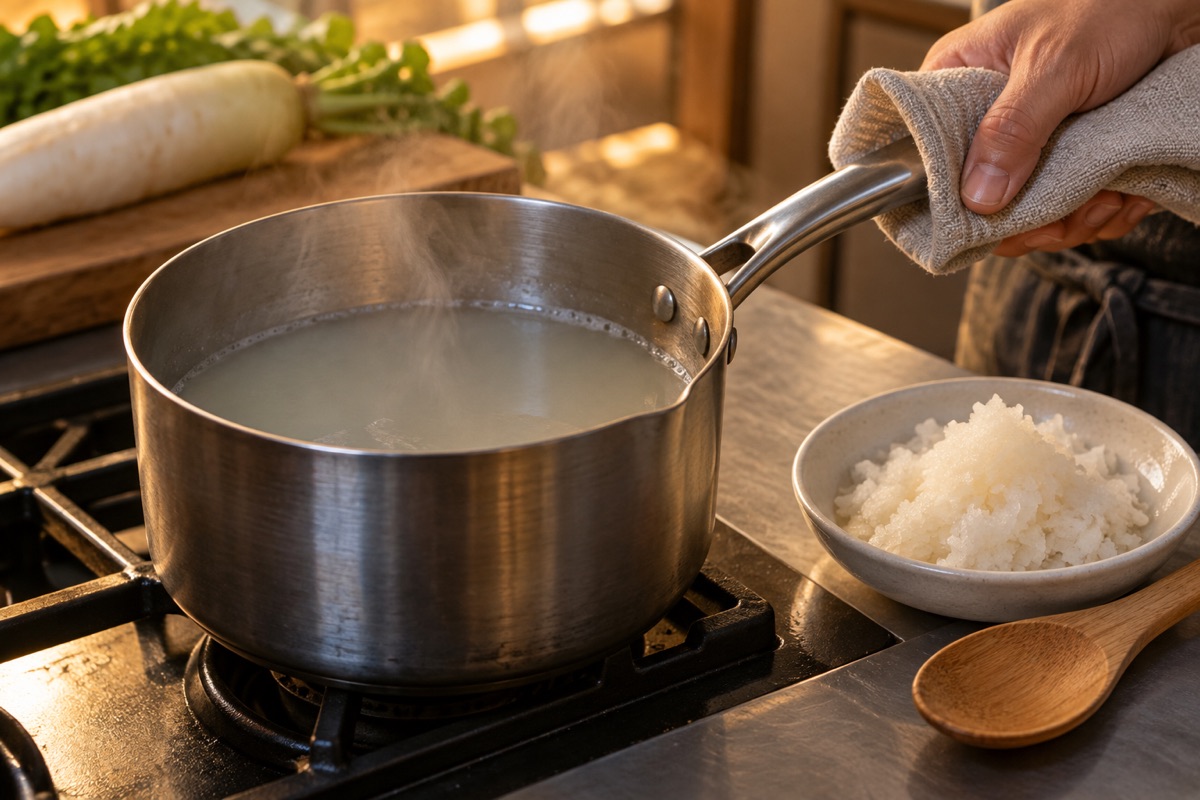
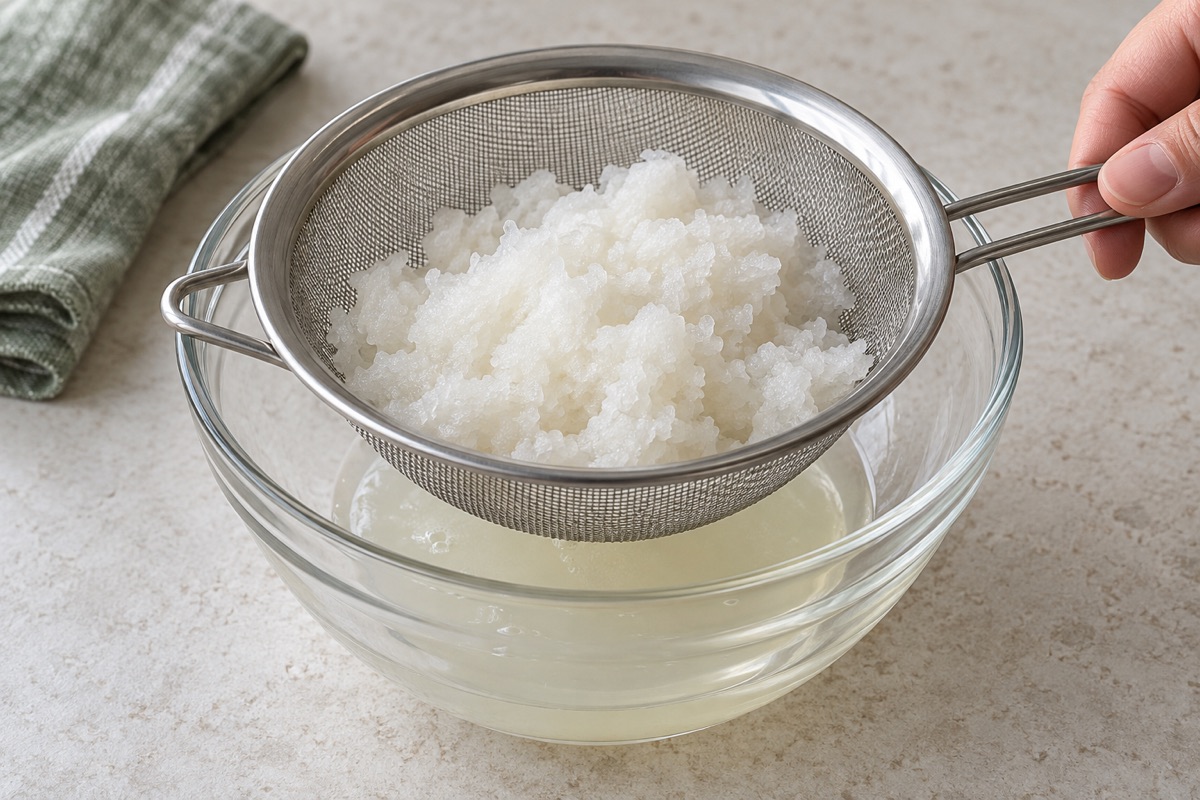
Yamato Soy Sauce & Miso’s canned-mackerel mizoreni makes the distinction unusually clear. The radish drains in a sieve over a bowl. The collected liquid goes into the pan with seasonings first. The radish pulp is added later, alongside a starch slurry. Both parts are used, but not at the same moment. Yamato: canned-mackerel mizoreni
This is why the bowl underneath the sieve matters. If you interpret the first draining instruction as “discard the water,” you remove an ingredient required by a later step. The mistake would happen before any cooking began.
The lesson is not that this sequence belongs in every hot radish dish. It is that preparation can separate ingredients temporarily to control the order in which they enter a pan. The pulp is not simply sitting on the sidelines while unwanted liquid disappears.
A different hot-sauce example appears in Ajinomoto’s recipe by MYON for mochi-filled fried-tofu pouches. After the pouches are removed, grated radish with its juice, starch slurry and yuzu juice are added to the remaining cooking liquid to make the sauce. Here the relevant distinction is between cooking the main component and finishing what will be poured over it. Ajinomoto: mochi pouches with mizore sauce
These are method comparisons, not complete cooking instructions. If either dish appeals to you, use its linked recipe for quantities and the full sequence. Combining the seasoning from one example with the liquid handling of another creates a new preparation; the original author has not tested that combination on your behalf.
For reading a recipe, a small two-column note can be more helpful than a long shopping list. Write “juice” on one side and “pulp” on the other, then mark the step at which each is added. If both enter together, the note is simple. If they take different routes, you have spotted the part that is easiest to miss.
It is equally useful to identify the role of any starch. Do not assume that all the body of a finished sauce comes from the grated radish merely because the dish looks cloudy or white. The named hot-sauce examples include a separate thickening ingredient. Their appearance does not prove that radish alone will reproduce the same result.
For a vegetarian reader, the radish itself is only one part of the decision. The examples here include fish, a chicken-containing noodle sauce, and recipes with dashi-based seasonings. A vegetable topping does not certify the ingredients underneath it. Check the complete recipe and the actual sauce label, not just the English dish name.
That need not turn a pleasant food question into a complicated buying guide. It means deciding which example is useful to you. You can understand the juice-and-pulp method from a fish recipe without choosing to cook or eat that dish. A source can explain a technique without being a recommendation for everyone’s dinner.
By this point, “Should I squeeze daikon oroshi?” should feel like an incomplete question. Add the name of the dish and the intended role, and it becomes much easier to answer.
Before starting, check:
You do not need a universal ratio or a perfectly sculpted mound to begin. You need to know what you are making. Keep the source recipe open through the preparation steps, and put a bowl under the sieve whenever the method calls for reserving the liquid.
The small white topping is only one possible end point. Sometimes the radish belongs in the sauce; sometimes its juice starts cooking before its pulp. Once you notice that distinction, draining stops being a reflex and becomes a deliberate part of the dish.

AUTHOR OF THIS ARTICLE
SoJapan
SoJapan India Pvt. Ltd. is a Japanese-founded company based in Gurugram. We bring Japanese food, anime goods and apparel materials to Indian businesses, with a sister company in Kyoto that works directly with makers in Japan.