← JOURNAL6 Oct 2026
Soba Explained: Buckwheat, Nihachi, Juwari and the Bowl Beyond the Label
 By SoJapan
Two packets say “soba.” One contains wheat; the other lists only buckwheat flour. A pale noodle looks less like the brown strands you expected, yet its maker describes it as a high-buckwheat product. Then you turn the packets over and discover that their cooking instructions are different too.
None of those details has to be a contradiction. Soba is worth understanding as a noodle with several separate decisions behind it: which flour is used, how that flour is milled, how the strand is made and how the finished noodle is served.
For a reader in India choosing a first packet or ordering from a Japanese menu, the useful question is not “Which soba is the most authentic?” It is “What does this particular description tell me, and which part of the eating experience do I still need to find out?”
The short answer: nihachi describes an 80:20 buckwheat-to-wheat flour blend; juwari describes an all-buckwheat flour formulation. Neither is a complete tasting note, a universal cooking instruction or an assurance about every ingredient in a finished meal. The manufacturer’s examples below show why.
Use this guide in three passes: decode the flour language, compare the actual strands, then plan a first meal that lets you notice their differences. Product information was checked on 6 October 2026. These are examples from manufacturers’ own pages, not claims that the products are stocked in India, and not hands-on product reviews.
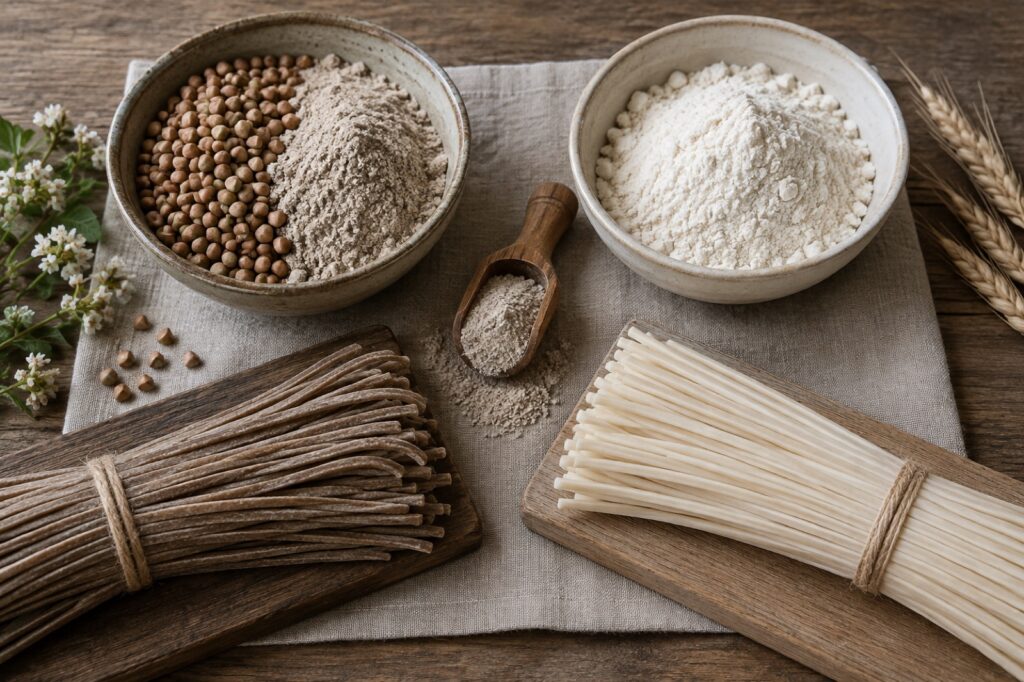
In the flour-blend sense used here, nihachi means two parts wheat flour and eight parts buckwheat flour. Yamamoto Kajino explicitly describes that relationship on its Dento no Nihachi Soba listing. The product also lists salt, which is a useful reminder that a flour ratio is not necessarily the complete ingredient list. Manufacturer’s nihachi description and ingredients.
Juwari means ten parts out of ten: all buckwheat flour. For a concrete example, the same maker’s Ganso Juwari Soba lists buckwheat flour as its ingredient and says it uses neither wheat flour nor added salt. That is a statement about this particular product, not a reason to stop reading another packet. Manufacturer’s juwari listing.
The terms help you understand what was combined before the noodle reached the plate. They do not tell you whether you personally will prefer its aroma, how thick the strands are, or what sauce comes with it.
Why include wheat at all? Nisshin Seifun Welna explains, in its advice on hand-making soba, that buckwheat lacks the proteins needed to form gluten and that gluten-rich wheat flour can act as a binder. You may see the binder referred to as tsunagi. Wheat is therefore doing a structural job, not simply diluting the name on the packet. Manufacturer’s explanation of soba binding.
That is a useful reason to approach a blend on its own terms. The question becomes how the finished strand behaves, rather than whether a second flour disqualifies it. Conversely, the existence of a wheat binder does not mean wheat is essential to every soba noodle: the juwari product above provides a concrete counterexample. Different formulations require different ways of making the noodle. For a diner, understanding that distinction is more helpful than treating the ingredient list as a contest for the fewest entries.
Here is a deliberately simplified calculation, not a manufacturer’s recipe. If you combine 200 grams of flour at an 80:20 ratio, the mixture contains 160 grams of buckwheat flour and 40 grams of wheat flour. Those numbers describe the flour mixture. They do not mean that a 200-gram cooked bowl contains 160 grams of buckwheat: the noodle has taken up water, and the meal may include sauce and toppings.
That distinction matters when comparing packages. “200 g” can be the net weight of dried noodles; it is not another way of writing “200 g of buckwheat flour,” and it is not automatically one serving. Read the amount, formulation and preparation information as different fields.
Nor should 80% become a score of eight out of ten. A cook may deliberately choose a blend for a particular texture. A diner may enjoy that result more than another noodle with a larger percentage. Calling the blend inferior before tasting it confuses a recipe decision with a ranking.
For your first purchase, a stated ratio is valuable because it makes the product easier to understand. A missing ratio is a reason to ask a question if the percentage matters to you, not permission to calculate an exact number from the colour or the product photograph.
A brand can make several formulations. Even a company strongly associated with juwari can sell wheat-containing noodles as well. Read the individual product name and ingredients together; a logo is not a substitute for either.
If an online shop photograph and its written description disagree, ask for the current packet details before buying. Keep the exact name, pack size and ingredient photograph together. “That Japanese soba in the green packet” is a poor reference when you want to buy the same thing again or clarify a dietary question.
Colour is one of the easiest clues to notice and one of the easiest to overinterpret. Rather than memorising “dark equals more buckwheat,” compare what a manufacturer says it has done to the flour.
Hakubaku’s Sobayu Made Oishii Soba Kuro uses flour that includes material from the buckwheat husk, according to its product description. Its Shiro counterpart uses a different milling selection involving the kernel and inner skin. Both ingredient lists begin with buckwheat flour and also include wheat flour and wheat protein; Kuro additionally lists yam flour. These are two designed formulations, not a colour chart from which you can read a percentage. Kuro product details, Shiro product details.
A second example makes the distinction sharper. Yamamoto Kajino’s Dento no Nanawari Sarashina Soba is described as a pale noodle with a 70% buckwheat formulation incorporating flour from the centre of the buckwheat seed. Its ingredients include wheat flour and salt. The word “pale” therefore does not mean “almost no buckwheat.” Seven-tenths Sarashina product description.
The same maker’s Juwari Shin Seiro incorporates central-seed flour, also called Sarashina flour, while remaining a 100% buckwheat product. Its published ingredient line is buckwheat flour. “Which part of the seed?” and “What percentage of the flour mixture?” are separate questions. Shin Seiro product description.
There is a useful way to read these examples without turning a shopping trip into a milling lesson. First identify the blend, where it is stated. Then look for the maker’s explanation of the flour and strand. Finally, treat descriptions such as aromatic, smooth or firm as the maker’s intended character, not as a result this article has independently tasted and confirmed.
Imagine choosing between a pale 70% noodle and a darker noodle with no disclosed percentage. The pale product gives you more precise formulation information. The dark one gives you a visual impression. Neither photograph settles which you will enjoy with a particular sauce, and the missing percentage cannot be filled in by guesswork.
This also changes how you interpret a bowl at a restaurant. A pale strand need not be udon mistakenly served as soba. Ask what kind of soba it is. A short explanation of the flour or style will tell you more than comparing the plate with an unrelated online photograph.
Flour content is only one part of the noodle. Strand width and the maker’s process also matter, so transferring a timer from the last packet to the next one is an avoidable gamble.
Yamamoto Kajino makes this unusually easy to see. Its explanation of Kokusan Nihachi Zaru Soba compares that product with Dento no Nihachi Soba and points out their different widths despite both being eight-tenths buckwheat noodles. The thinner zaru product is specified at 3 minutes 30 seconds. Manufacturer’s comparison of the two noodles.
The following timings belong to the named dried products only. They illustrate differences; they are not a general soba cooking chart. Follow the packet in your hand if it differs from an online listing.
| Yamamoto Kajino product | Stated buckwheat formulation | Published timing |
|---|---|---|
| Dento no Nihachi Soba | 80% | Approximately 5 minutes boiling |
| Kokusan Nihachi Zaru Soba | 80% | 3 minutes 30 seconds boiling |
| Ganso Juwari Soba | 100% | 6 minutes boiling, then 2 minutes resting |
| Juwari Shin Seiro | 100% | Approximately 7 minutes boiling |
On a phone, swipe across the table. Sources: the linked Dento, Kokusan Zaru, Ganso and Shin Seiro manufacturer pages in this article; checked 6 October 2026.
Notice two things. First, the two 80% products have different timings. Second, the two 100% products do not share a single sequence: one has a separately specified rest. “Cook all juwari for eight minutes” would misread the first instruction and overwrite the second.
For the resting example, six plus two equals eight minutes across two stages. It does not equal eight minutes of continuous boiling. When a recipe distinguishes stages, preserve the distinction instead of simplifying everything into one timer.
A practical preparation note should therefore contain verbs as well as numbers: boil, rest if instructed, rinse, drain and serve. Writing only “8 min” on a shopping note loses the information most likely to change the result.
If you are cooking two products for comparison, do not place both in the same pot and pull them out together merely because their percentages match. Prepare each according to its own directions. Otherwise the comparison is partly a test of which product tolerates the wrong treatment, not which noodle you prefer when properly prepared.
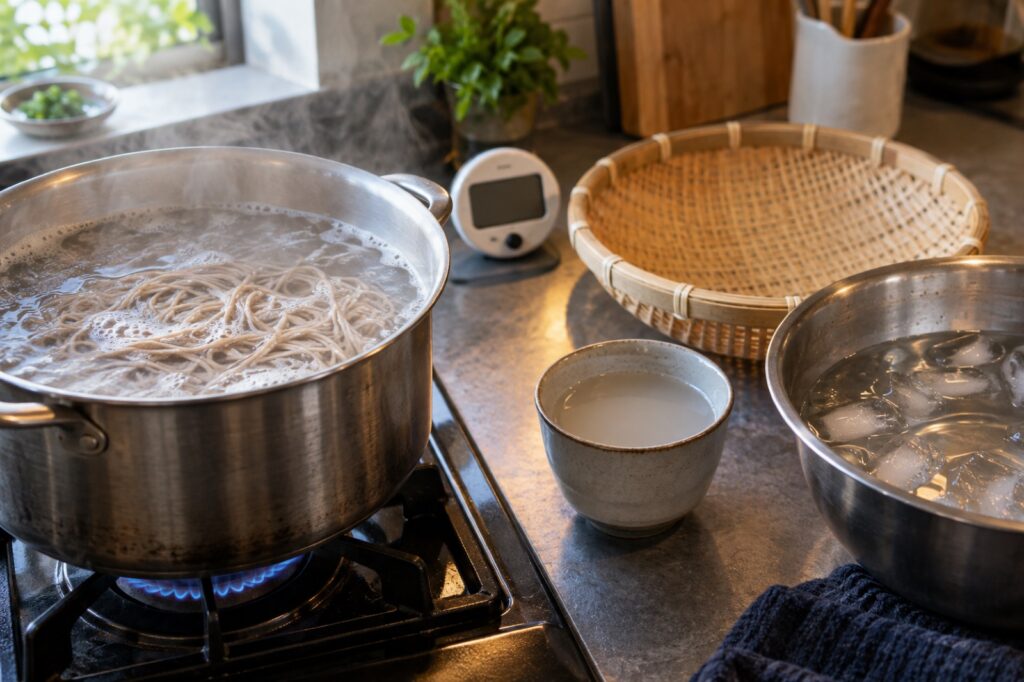
Before opening the packet, put the serving bowl, strainer, sauce and any toppings within reach. That may sound less interesting than choosing a premium noodle, but it avoids a familiar kind of first-attempt confusion: the noodles are ready while everything else is still being assembled.
Nisshin Seifun Welna’s dried-noodle guidance recommends at least one litre of boiling water per 100 grams of dry noodles as a general reference. It also advises reducing the heat if the water threatens to boil over, rather than adding cold water. Its cooling guidance notes that warm summer tap water may need ice to chill the noodles. Follow the product’s specific method alongside that general advice. Official dried-noodle cooking guidance.
For an Indian home kitchen, the practical point is to plan the water you will cook with and the water you will rinse with. Use water suitable for food preparation. Do not assume water described as “cold” in a recipe will actually feel cold from your tap on the day you cook.
If your packet gives a water quantity, measure it before heating. If your pot is too small for the recommended quantity and noodle portion, reduce the portion or use a larger pot rather than silently changing the method. Leave enough room to manage the boil safely.
Keep the packet visible while cooking, especially on the first attempt. A noodle you have never used is not the place to rely on a remembered video about a different product. If instructions include a rest, prepare for it before the boiling stage ends.
For a cold preparation, the sequence after cooking deserves attention too. Yamamoto Kajino’s nihachi recipe directs the cook to wash the cooked noodles gently in cold water and drain them. That is a specific finishing step, not an instruction to leave the strands sitting in rinse water until convenient. Maker’s cold nihachi preparation.
The rinse has a purpose beyond cooling. Nisshin Seifun Welna explains that starch released during boiling produces surface slipperiness, and that washing removes it and helps give the noodles their finished bite. If you skip this stage, you are changing the surface you will taste, not merely serving the same noodle at a different temperature. Why dried noodles are washed after boiling.
On your first attempt, resist adding several unrequested interventions: oil to the cooking water, extra boiling “to be safe,” a long soak and then a vigorous toss. If the texture disappoints, you will have no clear way to identify which change mattered.
Instead, record the product, dry quantity, water quantity, actual sequence and anything you changed. “I skipped the two-minute rest” is useful information. “Juwari is difficult” is a conclusion that one altered preparation cannot support.
Sobayu is the water in which soba has been cooked. Several of the manufacturers’ products discussed here are expressly presented as suitable for enjoying that liquid. It is worth noticing because the noodle and its cooking water need not be treated as unrelated parts of the meal.
Hakubaku’s Sobayu Made Oishii range is designed around this idea and highlights its no-added-salt formulation. That is product-specific information, not a direction to drink every kind of noodle cooking water. Hakubaku’s sobayu range.
If you want to try it, choose a product whose maker provides that guidance and follow the relevant instructions. Keep cooking liquid distinct from the later rinse water. Reserve it safely before draining, using suitable utensils and taking care around the hot pot.
You do not need to turn sobayu into a health claim to find it interesting. It offers another way to notice what cooking has drawn out of the noodle. Nor is trying it an authenticity test: for a first meal, getting the strands and sauce ready together is enough.
Here is an editorial suggestion for exploring soba, not a traditional rule or a reported tasting experiment: begin with one noodle and keep the sauce separate. Try a small, fully cooked mouthful before dipping the next. Then decide how much sauce you enjoy with that strand.
This is not a demand to eat unseasoned food as proof of sophistication. It simply gives you a reference point. If your first mouthful is heavily dressed, it is harder to say whether a strong flavour comes from the noodle or from what you added.
Pay attention to specific sensations rather than searching for the “correct” reaction. Does the strand feel fine or substantial? Does it separate easily as you lift it? What happens when you bite through it? Do you notice a grain aroma before adding sauce, or mainly the seasoning afterwards?
You may prefer a smoother noodle even if another tastes more strongly of buckwheat. You may enjoy a substantial strand with one preparation and a finer one with another. Those are useful preferences, not mistakes to correct by buying the highest percentage next time.
If you later compare two packets, choose the question first. To explore the effect of different flour percentages, try to keep other features reasonably similar. To explore strand width, two products with the same stated percentage may be more informative. You cannot isolate every variable at home, but you can avoid changing everything deliberately.
An optional small comparison might use 50 grams of dry noodles from each of two packets. That is an illustrative tasting quantity, not a recommended meal portion. Cook them separately using their own instructions and water amounts. Serve with the same prepared sauce, and taste each promptly rather than leaving the first batch waiting through a long photography session.
Make notes in ordinary language. “I preferred B with a small dip; A felt thicker and held more sauce in each mouthful” is more useful than assigning unexplained scores of 8.7 and 9.2. Record which product was which so you can repeat the meal you actually enjoyed.
If you only have access to one suitable packet, there is no need to order several imports for this exercise. Explore that noodle first. On separate occasions, change one aspect of how you serve it and see what you prefer. A first bowl should make the next decision easier, not turn into a costly collection of half-used packets.
For a broader explanation of how Japanese noodles differ from a broth-centred ramen meal, our ramen guide for Indian anime fans explains the roles of broth, seasoning and noodles. Here, the useful starting point is the soba strand itself.
This matters especially when the reason for reading a label is dietary rather than culinary. “No wheat flour in this noodle’s ingredient list” and “this finished dish meets my needs” are different statements. Sauce, toppings and preparation remain separate questions.
For example, Kikkoman Australia’s Dashi Tsuyu is described as gluten-free but lists fish powder and declares fish and soy. It is a clear illustration of why gluten-free and vegetarian cannot be used interchangeably. This example refers to the manufacturer’s Australian product, not every tsuyu or a verified Indian retail listing. Kikkoman’s ingredients.
If you require gluten-free food for medical reasons, do not rely on the word juwari alone. Check the exact product’s relevant assurance and clarify preparation and cross-contact with the manufacturer or restaurant; follow your clinician’s guidance. Likewise, having no wheat ingredient does not answer a question about buckwheat itself.
For a vegetarian meal, ask what is in the dipping sauce or broth rather than asking only whether the noodles contain meat. When ordering for someone else, establish their actual requirements first. Do not silently substitute “vegetarian” for their more specific restrictions.
The detailed restaurant questions belong in our Japanese vegetarian food guide for Indians. The point here is narrower: the percentage on the noodle packet cannot certify the rest of the bowl.
Read a soba description as several layers of information. The flour ratio tells you about a blend. The milling description may help explain colour and intended character. The strand and cooking instructions tell you how that particular product should be handled. Sauce and toppings complete the eating experience.
For your next packet, keep three details: its exact name, its ingredients and its full cooking sequence. For your next restaurant bowl, ask about the noodle style and the sauce if either is important to your choice. You do not need an encyclopaedia of regional terminology to begin noticing the difference.
Most importantly, let the number help you ask a better question rather than end the conversation. An 80% noodle and a 100% noodle can both be worth exploring. The useful discovery is the bowl you understand well enough to enjoy again.
AUTHOR OF THIS ARTICLE
SoJapan
SoJapan India Pvt. Ltd. is a Japanese-founded company based in Gurugram. We bring Japanese food, anime goods and apparel materials to Indian businesses, with a sister company in Kyoto that works directly with makers in Japan.