A recipe tells you to add ponzu. You find a bottle with citrus fruit on the label. Before pouring, there is a more useful question than whether it looks authentically Japanese: does it already contain soy sauce?
The answer can change what the bottle does in your dish. A citrus-and-vinegar seasoning without soy is not the same mixture as a citrus-seasoned soy sauce, even when both are described as ponzu. And once you are looking at soy-seasoned versions, the citrus, sweetness and other ingredients still deserve attention.
Kikkoman’s explanation of the term distinguishes ponzu in a narrower citrus-based sense from ponzu soy sauce, while acknowledging that the latter is commonly called simply ponzu. So a short recipe title or shop description may not tell you enough.
For a first bottle, identify the mixture before deciding what to cook. For a bottle already in your kitchen, work out what it contributes before adding your usual soy sauce and vinegar alongside it.
The named products below are examples from Japanese manufacturers’ Japanese-market pages, checked in October 2026. They illustrate differences, not a ranking or a promise of availability in India. If an imported bottle’s label differs from a website, establish which version you actually have.
Mizkan offers a particularly clear comparison because its catalogue includes both Ponzu and Ajipon. Its own Ajipon explanation describes the progression from citrus juice and brewed vinegar to a soy-seasoned version. That does not make every brand’s recipe identical; it gives us two concrete products to examine.
The Mizkan Ponzu product page lists citrus juice, brewed vinegar, acidulant and flavouring. Soy sauce is not listed. Notice what this also rules out: calling it “pure citrus juice” would be inaccurate. The vinegar and other listed ingredients remain part of the product.
The Japanese-market Ajipon page, by contrast, lists soy sauce containing wheat and soy, glucose-fructose syrup, citrus juice, brewed vinegar and salt, followed by additives. Mizkan describes dipping and pouring uses, including gyoza and cold tofu. Here, several components of a sauce have already been brought together.
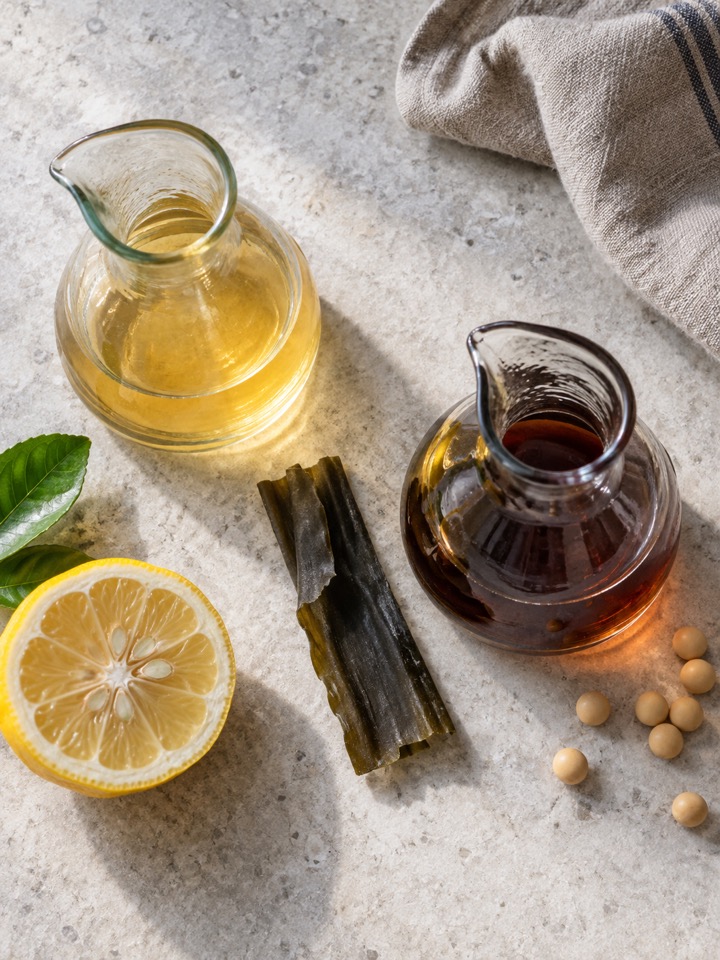
The following comparison is about substitution, not which product is better. Neither bottle needs to win: they leave the cook with different decisions.
| Named example | What the ingredient list establishes | What to reconsider before substituting |
|---|---|---|
| Mizkan Ponzu | Citrus and vinegar; no soy sauce listed. | Does the recipe expect the replacement to supply soy seasoning as well? |
| Mizkan Ajipon | Soy sauce, citrus, vinegar and sweetening ingredients are already combined. | Would your usual added soy and vinegar duplicate ingredients already present? |
| Another bottle labelled ponzu | The name alone does not establish the exact combination. | Read that bottle before applying either example to it. |
Imagine a recipe designed around a combined sauce, with no separate soy sauce in its ingredient list. Replacing that ingredient with a soy-free citrus-and-vinegar product is not merely changing the brand. You have removed one of the contributions the recipe expected. This is an editorial substitution example, not a tested conversion formula.
The reverse deserves equal care. If a recipe separately specifies citrus seasoning and soy sauce, replacing its citrus component with a soy-containing ponzu introduces soy at an additional point. Keeping all the original quantities is no longer a like-for-like swap.
This is why “just add the same amount” is poor advice when the category itself has changed. First decide whether you want to reproduce the linked recipe or make a different sauce with the ingredients you own. Both are reasonable goals. They simply require different expectations.
You do not need to translate every Japanese marketing phrase to begin. Locate the ingredient list and the exact product name. If the recipe belongs to a manufacturer, use its linked product page to see what the named ingredient means. That is more informative than matching two similar bottle photographs.
After confirming that you have a soy-seasoned ponzu, you may still face a choice between a general citrus blend and a bottle highlighting yuzu. Think of that as another question, not a replacement for the first one.
Kikkoman identifies several citrus fruits used in ponzu, including yuzu, sudachi, kabosu and lemon, as well as blends. It also notes that products can include different dashi ingredients. Citrus juice and vinegar contribute sourness, soy contributes saltiness, and soy and dashi can contribute savouriness. Those are separate parts of the combination, even when the front label celebrates only one of them. Kikkoman’s ponzu glossary
For example, Mizkan Kaori no Kura Marushibori Yuzu combines whole-pressed yuzu juice with bonito and kombu dashi. Its ingredients also include soy sauce, sweetening ingredients and vinegar. The maker’s statement about using Kochi-grown yuzu describes the origin of the yuzu used; it does not mean that the bottle contains nothing but yuzu juice.
That is a useful habit when reading food labels more broadly: ask what a percentage or origin statement modifies. “All of the yuzu comes from this place” and “all of the contents are yuzu” are very different claims.
There is also a practical distinction between choosing a sauce for its citrus aroma and choosing it as part of a cooked seasoning. In a September 2026 comparison, Mizkan’s staff describe Ajipon’s soy-and-acid character as suited to heating and dishes involving oil or spices. For Kaori no Kura, they emphasise yuzu aroma and suggest finishing uses such as salads and steamed vegetables, cautioning against excessive heating. These are the manufacturer’s assessments, not our tasting results.
The sensible takeaway is not “ponzu must never be heated.” It is to choose a use consistent with what you want from that particular bottle. If your reason for choosing it is its advertised aroma, a maker-supported finishing use gives that choice a clear purpose. If you want a cooked dish, look for a recipe that actually cooks with the product.
There is no need to buy several bottles to explore this difference. Start with a supported use for the one you have.
Two manufacturers’ recipes show why the instruction around “ponzu” matters as much as the ingredient name. Neither example below is a complete recipe; follow the linked method for its full quantities and preparation.
Mizkan’s summer vegetables and tofu with Ajipon finishes the assembled dish with sauce. The tofu is lightly drained and spooned onto a plate; vegetables and toppings are added before Ajipon is poured over. The maker specifically notes the spooned tofu and torn lettuce as ways to help the sauce cling. The recipe uses Ajipon as needed rather than prescribing a universal dose.
Importantly, that original recipe also includes bonito flakes. A dish built around tofu and vegetables is not necessarily vegetarian as written. Keep the finishing technique and the dietary question separate when deciding whether this is the right recipe for you.
Here, the sauce meets the food at the end. As a first-use choice, that has an editorial advantage: you can try a small portion without committing all the assembled food to the same amount of sauce. It is a way to learn your preference with that dish, not a claim that a particular spoonful is correct for every reader.
Now compare Yamasa’s pork and tomato stir-fry, credited to recipe developer Manami Kase. It uses Kombu Ponzu at two stages: first on the pork before a starch coating, then later in a mixture with mirin during cooking. The same bottle appears more than once because it has more than one assigned role in the method.
If you eat pork and want to try this preparation, follow that complete recipe. If you do not, use it as an example of how to read instructions, not as a suggestion to make an automatic protein substitution. A different main ingredient needs an appropriate method of its own.
The contrast is not cold food versus hot food in the abstract. It is sauce added to an assembled dish versus seasoning built into a cooking process. In the second case, adding everything at the finish would omit the earlier application. Adding everything at the beginning would omit the later one. Even though the total ingredient names could look unchanged, you would no longer be following the same method.
When choosing a recipe, read all the steps once before measuring the sauce. If ponzu is divided between a preliminary step and a finishing mixture, keep those amounts separate. A quantity alongside an ingredient is not always an instruction to use it all at the first opportunity.
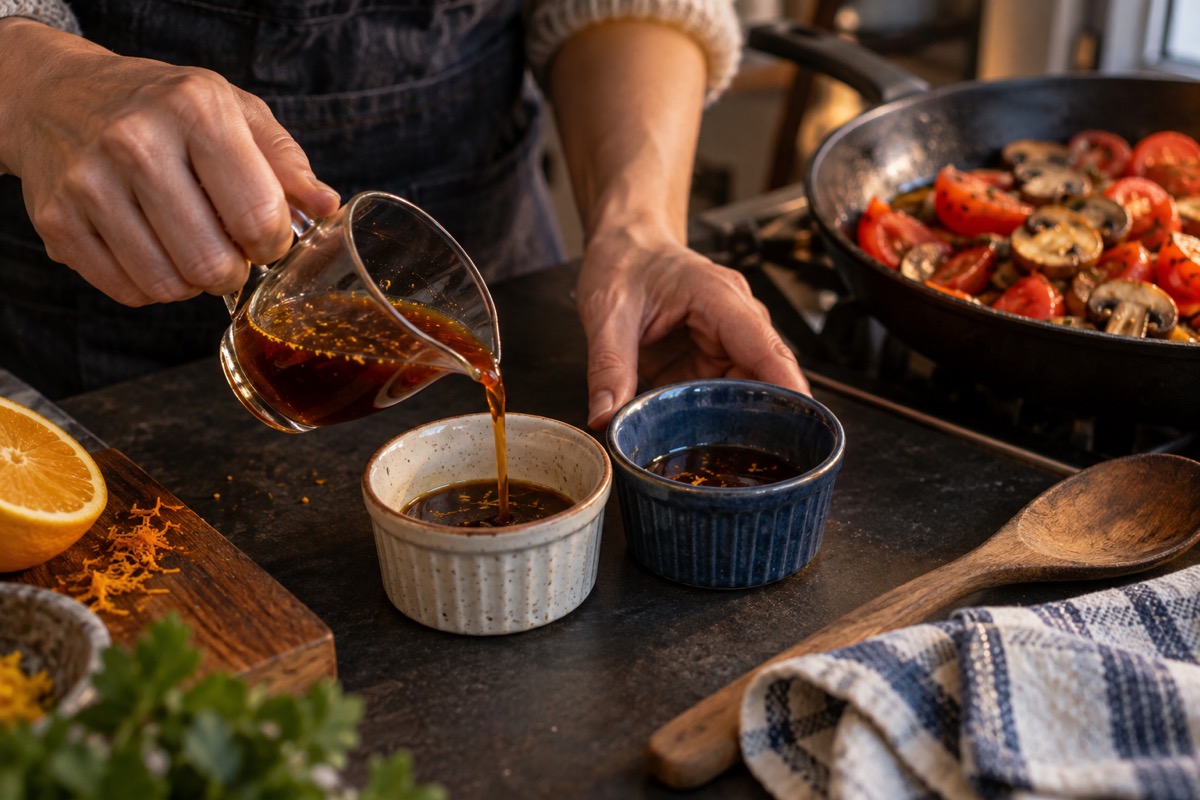
Also distinguish “used directly” from “used alone.” A sauce can be ready for dipping yet still appear with other ingredients in a recipe. Conversely, seeing water, oil or mirin in one recipe does not establish a mandatory addition for every use of that bottle. Read the combination as belonging to that preparation.
For noodle-specific questions, our udon and tsuyu guide explains why a dipping liquid and a soup can require different instructions. Do not transfer a noodle-base dilution ratio to ponzu just because both are bottled seasonings.
The difficult moment is often not buying a first bottle. It is opening a recipe, recognising most of the ingredients, and realising that the ponzu in your cupboard is not the one pictured.
The recipe uses soy-seasoned ponzu, but yours has no soy. This is the category change described earlier. For a first attempt at that particular recipe, the straightforward choice is to find the specified kind of sauce or choose a recipe written for your product. Trying to reconstruct the missing combination is a separate cooking experiment, not something a generic one-to-one replacement can guarantee.
Both are soy-seasoned, but the citrus or other ingredients differ. You are closer to the intended category, but you have not established identical flavour or strength. For an assembled dish, a small trial portion is a reasonable place to make that judgment. For a cooked recipe, using the named product removes one variable while you learn the method. Neither approach requires declaring the alternative bottle inferior.
The dish is already seasoned and you want a citrus finish. Decide whether you actually want another combined sauce. Adding a new ingredient because a dish seems to need “something fresh” is a different task from following a ponzu recipe. Identify what you want to change before reaching for a product that brings several things together.
You only have lemon juice and soy sauce. That may be the beginning of an improvised sauce, but it is not evidence that you have recreated any of the named products here. A shortcut should be presented honestly as an adaptation. If you want a repeatable homemade preparation, choose a complete recipe rather than assuming there is one universal ratio hiding behind the word ponzu.
For a simple trial on cooked food, keep the experiment small and change one thing at a time. Put aside an unseasoned portion, add the sauce to that portion, and decide whether it is the effect you wanted before dressing the rest. This is an editorial suggestion for comparing preferences, not a manufacturer-tested protocol or a recipe with guaranteed results.
If you keep a note for next time, record the product name, dish and amount used, not just “ponzu.” That gives you a starting point for repeating a result or adjusting it.
Kombu is an especially useful example of the gap between a highlighted ingredient and the whole recipe. The name can draw attention to kelp while leaving other ingredients to the back label.
Yamasa’s Japanese-market Kombu Ponzu lists kombu alongside fish-derived ingredients, including bonito extract and soda-bushi. Its ingredient list also identifies wheat and soy in the soy sauce, and apple in the vinegar. This named product demonstrates why “kombu ponzu” should not automatically be read as fish-free.
That is not a claim that every ponzu contains fish. It is a reason to check the exact product instead of making either blanket assumption. Nor does a short allergen summary replace the full ingredient list when your question is whether the sauce contains animal ingredients.
The same distinction applies after you select a bottle. The tofu example above includes bonito flakes separately from the sauce. A bottle that meets your requirements does not, by itself, establish that the finished dish does. Check toppings and the rest of the recipe as well.
For broader questions about dashi, sauces and ordering, use our Japanese vegetarian food guide for Indian readers. Here, the practical point is narrower: a citrus illustration, a kelp name or a tofu photograph cannot answer a complete ingredient question.
If you require a particular certification or need information the label does not supply, ask the maker about that exact product. This article does not certify any example as vegan, halal, Jain-compatible, gluten-free or alcohol-free. Do not turn an ingredient that is not explicitly named on a webpage into a broader guarantee the manufacturer has not made.
Storage is another place where the general category is less useful than the exact product. Before choosing a large bottle, check what its label says about opening and refrigeration, and consider how you actually plan to use it.
Mizkan’s published storage guidance gives an indicative four months refrigerated after opening for Ajipon, Ajipon MILD and its plain Ponzu. The same page gives one month for specified variants, including Ajipon for Utsunomiya Gyoza and Hokkaido Batapon. It explicitly says these periods are guides, not guarantees, and distinguishes them from an unopened best-before date under the stated storage conditions.
So “ponzu lasts four months” would lose an important part of the information. Use the instructions for your actual bottle. Do not apply a commercial bottle’s period to a homemade mixture or sauce that has already been served for dipping.
Writing the opening date on the bottle is a practical way to keep the relevant starting point visible. Choosing a smaller format, where one is available, can also make sense if you are learning whether you like the product. Neither requires calculating an imaginary cost saving or buying for meals you do not expect to cook.
For your first use, return to two questions: what is already in this bottle, and what job do I want it to do? A finishing sauce for tofu, a dip and a seasoning used during cooking can all be worthwhile choices. Matching the actual mixture to a supported use is what makes the choice understandable—and gives you something useful to build on the next time you cook.

AUTHOR OF THIS ARTICLE
SoJapan
SoJapan India Pvt. Ltd. is a Japanese-founded company based in Gurugram. We bring Japanese food, anime goods and apparel materials to Indian businesses, with a sister company in Kyoto that works directly with makers in Japan.