← JOURNAL29 Sep 2026
Doraemon’s Gadgets Explained: Why the Shortcut Is Only Half the Story
 By SoJapan
Which Doraemon gadget would you choose: a door that takes you where you want to go, a way to fly, or bread that lets you memorise what you have copied onto it?
The question is fun because each answer starts with something recognisable. You want to reach someone, escape a difficult journey, prepare for a test or undo damage. The machinery is impossible; the wish is not.
But a gadget list misses the best part of Doraemon. Once a shortcut exists, someone has to decide what to do with it. A small convenience can become a competition, an act of kindness, a reckless experiment or a plan that grows far beyond its original purpose.
For Indian fans returning to the series, this is a way to look beyond familiar names and childhood associations without assuming everyone watched the same dub. We will examine five gadgets, then compare what happens when a device changes hands or its user’s ambition changes.
There are light premise spoilers, but no need to know the endings. English gadget labels below are descriptive reading aids alongside the Japanese names; they are not a claim that every Indian-language dub uses the same terminology. The interpretations are our reading of the storytelling, not statements about the creator’s private intentions.
Doraemon is a creation of Fujiko F. Fujio, credited as the original author by TV Asahi. The central setup pairs a cat-shaped robot from the twenty-second century with Nobita, a schoolboy whose everyday difficulties give the future technology somewhere very ordinary to land. See the official original-author credit.
TV Asahi’s character guide describes Doraemon as both a protective figure and a friend to Nobita. It also allows him to be careless and make mistakes. Nobita, meanwhile, is not only a boy who struggles with school and sport: the profile emphasises his kindness and sensitivity to others’ pain. Read the official character descriptions.
Those details matter more than a catalogue of powers. If Doraemon were simply a perfect vending machine and Nobita only a request button, the gadget would be the entire story. A fallible helper and a vulnerable, sometimes thoughtless child create a relationship instead. Helping someone can involve affection, impatience, indulgence and disagreement at once.
Consider the difference between two questions: “How can Nobita get what he wants?” and “Why does he want it so badly?” The first invites a device. The second invites a story about embarrassment, jealousy, belonging or care. Watch the moment before the invention appears and you will often have the more interesting question already.
This does not mean every episode must be reduced to a moral warning. Sometimes the pleasure is simply imagining a different way to move through the world. Wonder and consequences can coexist; a story need not punish every enjoyable use of technology to remain meaningful.

The Anywhere Door, or Dokodemo Door, makes movement wonderfully simple: open the door and reach the desired place. TV Asahi’s gadget catalogue gives that basic function. The important imaginative leap is not that it is a faster vehicle. It removes the journey between departure and arrival. Find Dokodemo Door in the official catalogue.
That changes how a scene can work. A place that was far away can suddenly be just beyond an ordinary doorway. Instead of spending the story getting there, the characters can immediately discover what being there means. The door therefore creates possibilities as well as solving a transport problem.
There is also a boundary worth noticing: access is not automatically an invitation. If someone could arrive instantly, that would not tell them whether another person was busy, wanted company or had agreed to a visit. This is a question raised by the power, not an instruction to treat every scene involving the door as the same joke.
Doraemon Channel’s official manga commentary points to occasions when the door needs repair or sends its users somewhere unintended. The examples establish that a powerful tool can still be unavailable or unreliable in a particular story. They do not supply a measured failure rate for every version of the gadget. Read the official Anywhere Door discussion.
Imagine choosing a gadget for a fictional day out. If your only aim is to arrive, the door sounds ideal. If the point is to see the landscape on the way, instantly skipping the journey removes something you wanted.
When watching, ask whether the door is being used to approach something or avoid something. The same movement could express curiosity, generosity or an unwillingness to face an ordinary problem. Its function stays recognisable while the character’s reason gives it a different meaning.
The Bamboo-Copter, or Take-copter, offers a different fantasy: personal flight. Rather than replacing the route with a doorway, it allows the journey itself to be imagined in the air. This makes it a useful contrast with the Anywhere Door, even though both can answer “How do we get there?”
Our reading is that flight preserves the experience of moving through space. A viewer can think about the view, the route, the people travelling together and the possibility of stopping. Arrival is one pleasure; having the journey available as an experience is another.
The official manga commentary also reminds readers that the device is not endlessly available power. It cites a battery-limit explanation from the long-form manga Nobita’s Dinosaur: eight hours of continuous operation at 80 kilometres per hour. Treat those numbers as a detail attached to that cited fictional example, not a universal specification covering every adaptation. Read the franchise’s Bamboo-Copter commentary.
The numbers are interesting because they introduce duration into an apparently effortless ability. “We can fly” and “we can keep flying for as long as the situation requires” are different claims. A capability does not erase the need to think about its availability.
For understanding the drama, the finite battery is the useful information. Multiplying those figures into a guaranteed range would require assumptions that this story reference does not establish.
Compare the two travel gadgets by what they let a story keep. The door can remove travel time; the copter leaves room for travel to become action. Neither comparison requires a league table of strongest inventions. A device can be less convenient for one purpose and more enjoyable for another.
The appeal is fictional flight, of course—not something a toy propeller can reproduce.
Memory Bread, or Anki Pan, puts the promise of easy memorisation into a wonderfully ordinary object. TV Asahi’s catalogue describes copying the material onto the bread and eating it to remember it. The shape of the invention is part of its appeal: the abstract work of remembering becomes a physical action with a familiar food. See Anki Pan in the official catalogue.
For a viewer who knows the feeling of an approaching test, the attraction is immediately understandable. The story does not need a lecture on futuristic storage technology. It starts from a wish that is emotionally legible before the gadget receives any explanation.
TV Asahi’s summary of “Test ni Anki Pan”, broadcast in Japan on 12 August 2005, places that wish under pressure. After a failed test and a warning about his allowance, Nobita uses Shizuka’s notes with the bread; the synopsis then flags overeating as a complication. That is the setup, not the ending. Read the broadcaster’s story summary.
There are two useful things to notice here. First, the shortcut has not removed the need for material to learn: somebody else’s notes become important. Second, the gadget uses a body that still has ordinary limits. A magical way to acquire information is placed inside a very non-magical appetite.
As an interpretation, this creates a tension between wanting a result and caring about the process that produces it. Nobita wants relief from an immediate problem. The viewer can understand that wish while still noticing that the proposed solution has not become unlimited, effortless control over everything that comes next.
There is also a distinction worth bringing to the discussion without pretending it is a new rule of the gadget: recalling words and understanding an idea are different questions. The catalogue describes memorising material. It does not establish that every form of reasoning, judgement or practical skill is automatically mastered as well.
That makes “Would Memory Bread help with this particular task?” a better conversation than “Would it make someone a genius?” You are asking what the stated ability covers. A language conversation, a written definition and a practical demonstration do not ask exactly the same thing of a person.
The pleasure is recognising the temptation, then watching the story make its terms less simple than the wish sounded.
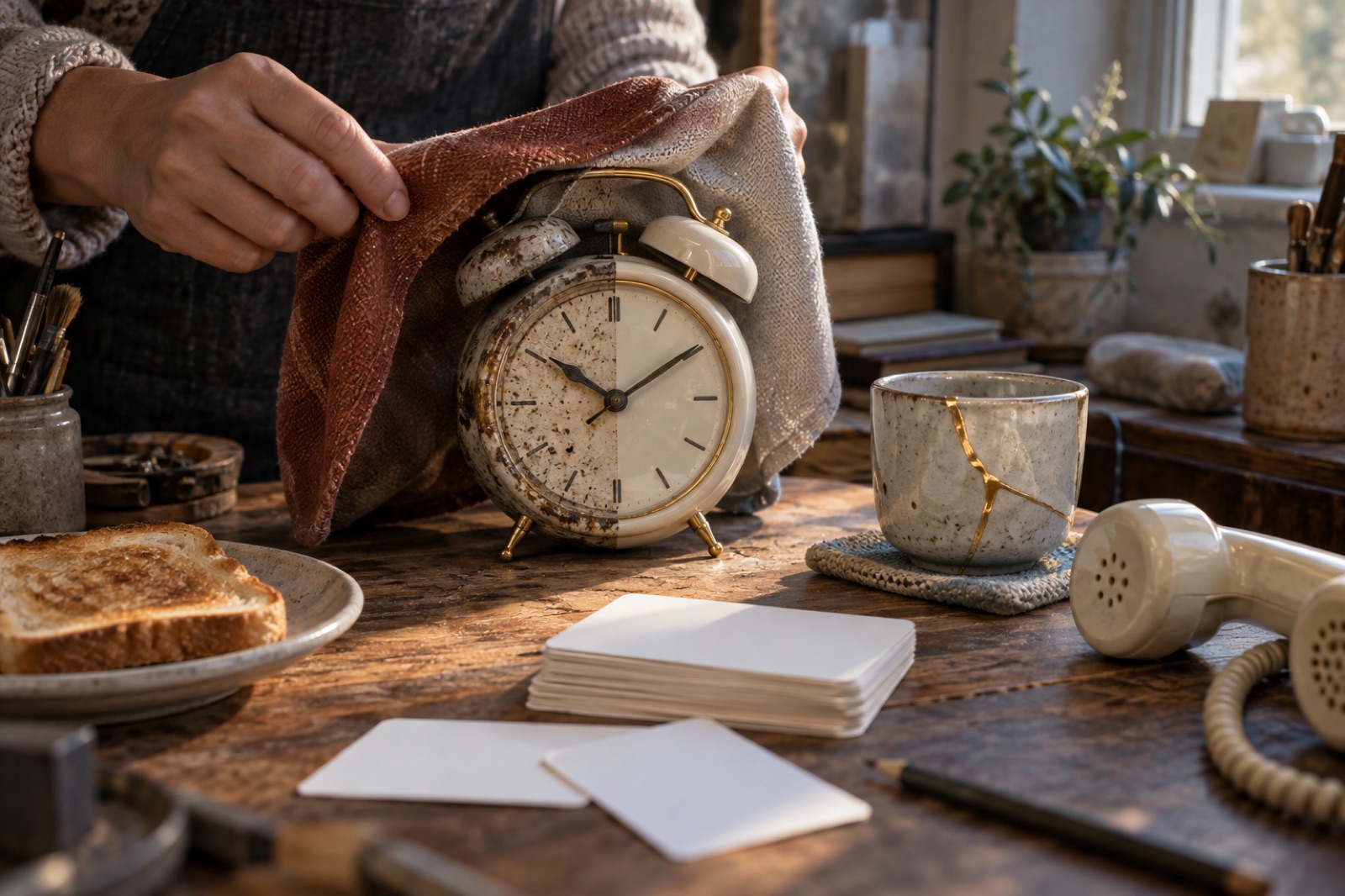
The Time Cloth, or Time Furoshiki, is easy to confuse with a general time-travel solution if you look only at its name. The official archived gadget description says it can make what it wraps newer or older; it also describes changes of age when living things are wrapped. Its basic focus is the condition of the wrapped subject. Read the archived official Time Furoshiki description.
That is conceptually different from sending the characters to another date. Reversing wear on an object and revisiting the event at which it was damaged are not the same story action. One changes what is in front of you; the other would change where in time a scene takes place.
The distinction becomes concrete in TV Asahi’s “Time Furoshiki” synopsis for 8 February 2025. A broken television and other household appliances establish a useful repair problem. Once the cloth restores them, Nobita starts thinking about collecting unwanted things, renewing them and selling them. The premise moves from meeting a household need to seeking a wider advantage. Read the official television-story setup.
The interesting change is not necessarily that the tool has become more powerful. The user’s goal has expanded. A device introduced for one broken thing becomes the basis of a plan involving many things and other people.
This is a particularly useful example if you find gadget stories repetitive. Look for the point where the original problem has already been addressed. What keeps the story moving after that? In this case, the synopsis offers a fresh ambition rather than simply another broken appliance.
The cloth also provides a way to discuss value without turning the article into a business lesson. Does the character want something because it works, because it looks new, because someone else wants it or because it creates an advantage? Those are different motives. The gadget makes them easier to see by making one kind of change unusually easy.
Do not stretch the description into an answer to every possible science-fiction question about age, memory or history. A short catalogue entry is not a complete system of physics. Stay with what the selected story establishes, and leave the untested edge cases as questions rather than fan theories presented as fact.
The What-If Box, or Moshimo Box, changes the scale of the wish. Instead of asking for transport or a repaired possession, its user proposes a condition for the world. The story can then explore what that condition actually feels like to live with.
In TV Asahi’s summary for 12 January 2007, Nobita is uncomfortable with familiar New Year games and requests a world without them. The telephone-box-like device makes the requested situation real within the story; the synopsis then has Nobita introducing those same games to children who lack them. Read the official Moshimo Box episode premise.
This reversal is more interesting than simply saying “be careful what you wish for.” Removing an activity changes its social context. Someone who felt disadvantaged when everyone else knew a game can occupy a different position when he knows something that others do not.
Our interpretation is that the wish concerns more than the activity itself. It also concerns the feeling of being compared with other people. Changing the environment can alter that comparison without automatically changing the person making the wish.
The box therefore invites a broader question than “Did it work?” A requested world might be created successfully and still fail to deliver the exact feeling the requester imagined. Functional success and emotional satisfaction are not identical.
For a discussion with friends, choose a harmless hypothetical rule such as “Nobody ever has to wait for anything.” Then ask what else changes: anticipation, taking turns, preparation or the pleasure of a long-awaited meeting. These are invented discussion possibilities, not effects officially assigned to the Moshimo Box or descriptions of an actual episode.
You also do not need to settle the entire franchise’s cosmology to appreciate the premise. Descriptions of altered worlds, possible worlds and their relationship to the original setting can become complicated across stories. This guide uses the broadcaster’s stated scenario and does not declare a universal theory of parallel universes.
That restraint helps preserve the fun. You can examine a thought experiment closely without insisting that every gag and every adventure must first pass the same exhaustive metaphysical test.
Here is a compact reading guide, not a power ranking. The middle column summarises the functions discussed above; the final column offers our interpretation of what remains interesting after that function works.
| Gadget | What it changes | A question the power does not settle by itself |
|---|---|---|
| Anywhere Door | Access to a desired destination | Why go there, and is the visit welcome? |
| Bamboo-Copter | The ability to travel through the air | What makes the journey worthwhile, and can the tool remain available? |
| Memory Bread | Memorisation of copied material | What material is needed, and what does the task actually require? |
| Time Cloth | The age or condition of what is wrapped | What will someone do once renewal becomes easy? |
| What-If Box | A proposed condition of the world | Will the new situation produce the feeling its user wanted? |
A “strongest gadget” debate tends to hide these differences. If the aim is to enjoy the view, eliminating the journey is not obviously the best answer. If the aim is to understand a relationship, arriving instantly is not the same as having the right conversation.
Try specifying the wish before choosing the device. “I want to reach a friend” is narrower than “I want the friendship to feel right again.” The first is about access; the second involves another person’s feelings.
It also explains why an apparently less spectacular tool can carry an engaging short story. An invention does not need to alter the universe if it reveals a precise, recognisable wish.
A device changing owners can alter the direction of a story without changing its listed function. In the Time Cloth synopsis, other children become involved after Nobita’s plan expands. The social question is no longer just whether a household object can be renewed; it is also who gets to use that ability.
Keep the characters more interesting than fixed labels. The official guide gives Gian a forceful side but also a strong concern for friendship, while Suneo’s pride in his family’s wealth exists alongside practical hobbies and skills. Those descriptions do not excuse unkind behaviour; they prevent “bully” and “show-off” from becoming the entire explanation of every scene.
Watch who proposes a use, who hesitates, who joins in and who is left out. A gadget can become a shared activity or a way to control access. The difference lies in the arrangement between people, not merely in its technical ability.
This is also why it is worth watching Doraemon’s reaction rather than only Nobita’s. Does the helper understand the request? Is he pleased, reluctant or distracted? The relationship around the pocket gives the scene a second source of uncertainty: even before the device is used, two people may not be imagining the same outcome.
It would be a thin reading to conclude that every gadget exists to punish laziness. TV Asahi’s “Koi Suru Doraemon” synopsis, dated 13 September 2025, gives the Anywhere Door another context. Doraemon uses it while visiting a cat he likes, and the premise includes her wish to experience the outside world. Read the official story introduction.
Without revealing the outcome, that setup already changes the discussion. The device is not only a way for Nobita to avoid a chore. It can make an experience possible for someone else. Affection, hopes and misunderstandings remain, but so does the generosity of imagining what another being might enjoy.
The door has not acquired a new listed power. The emotional meaning comes from the situation. This is why “all shortcuts are bad” is too blunt a conclusion for a series built around the pleasure of impossible possibilities.
There is room to enjoy an invention before analysing it. The fantasy of flight, a doorway into a distant place or a familiar object unexpectedly restored has an appeal of its own. Critical viewing need not become a search for a lesson that cancels the delight.
If Doraemon’s favourite sweet catches your attention as much as the inventions do, our Japanese sweets guide explains dorayaki separately. A small everyday preference can make an extraordinary character feel approachable without needing another power attached to it.
If you watched an Indian-language dub, start from the gadget’s visible action when a remembered name does not match an English article. Use the Japanese name and the official linked summary to identify the reference more carefully. The Japanese broadcast dates given here identify particular source entries; they are not Indian broadcast dates or promises of current streaming availability.
Likewise, a manga example and a television synopsis are different kinds of evidence. The Bamboo-Copter battery reference above is specifically a manga citation. It should not be silently turned into dialogue claimed to appear in whichever episode a reader remembers. Our anime-versus-manga guide explores why adaptation details deserve that distinction.
For your next viewing, choose just one question: What does the character still have to decide after the gadget works? It might be where to go, what to learn, how much is enough or how to include someone else. You do not need to pause every scene or count every invention.
If the answer is “nothing—the moment is simply delightful,” that can be enough too. Doraemon’s inventions are not only problems waiting to happen. They are invitations to imagine a different everyday life, with recognisable people still standing inside it.
AUTHOR OF THIS ARTICLE
SoJapan
SoJapan India Pvt. Ltd. is a Japanese-founded company based in Gurugram. We bring Japanese food, anime goods and apparel materials to Indian businesses, with a sister company in Kyoto that works directly with makers in Japan.