← JOURNAL29 Sep 2026
Japanese Tea at Home: Fix Bitter Sencha, Clumpy Matcha and Weak Hojicha
 By SoJapan
The packet says Japanese green tea. Your cup tastes fiercely bitter, or the matcha has little green lumps, or the hojicha latte smells promising but tastes mostly of milk. Buying a more expensive tea might not solve any of those problems.
Start by identifying what you are making. Sencha leaves need an infusion that you then separate from the leaves. Matcha needs its fine powder dispersed through liquid. Hojicha can arrive as loose leaves or powder, and those two forms need different handling. A longer wait is not the answer to every weak cup; hotter water is not the answer to every lump.
This guide is for Indian readers exploring Japanese tea at home, whether the curiosity began with anime, a café drink or Japanese sweets. It is not a tea-ceremony manual or a café business plan. The aim is to make your next cup more informative—and more enjoyable—without insisting that everyone must prefer the same strength.
Find your problem first: bitter leaf tea needs an extraction check; lumpy matcha needs a mixing check; a disappearing tea flavour in a latte needs a dilution check. If several things seem wrong, fix texture before judging the flavour of a powdered drink.
Three words explain a useful starting distinction. Sencha is a leaf tea, commonly processed through steaming, rolling and drying. Matcha is made by grinding tencha, a differently processed tea, into powder. Hojicha is roasted tea. MAFF’s account of Uji tea describes these separate production routes; they are not simply three strengths of the same drink. MAFF: Uji tea and its production methods.
For preparation, the next question is more immediate than the region or prestige of the name: what is actually inside this packet?
Imagine comparing a spoonful of pure matcha with a spoonful of a hypothetical mixture containing tea, sugar and milk powder. Even if both drinks look green, equal spoonfuls would not establish equal tea doses. Adding more of the mixture could increase sweetness at the same time as tea flavour. That is a product-identification problem, not a failure to whisk hard enough.
Keep the original packet or photograph its directions before transferring the contents. Record the tea name, whether it is leaf or powder, and the opening date. An attractive unlabelled jar makes troubleshooting harder when several teas share the cupboard.
For more food discoveries beyond tea, explore our guide to Japanese foods from anime. A drawn cup’s colour alone cannot identify which tea a character is drinking.
If your usual tea routine involves simmering leaves with milk and spices, keep that as a different method rather than automatically applying it to sencha. There is no need to rank one tradition above another. They are aiming at different drinks.
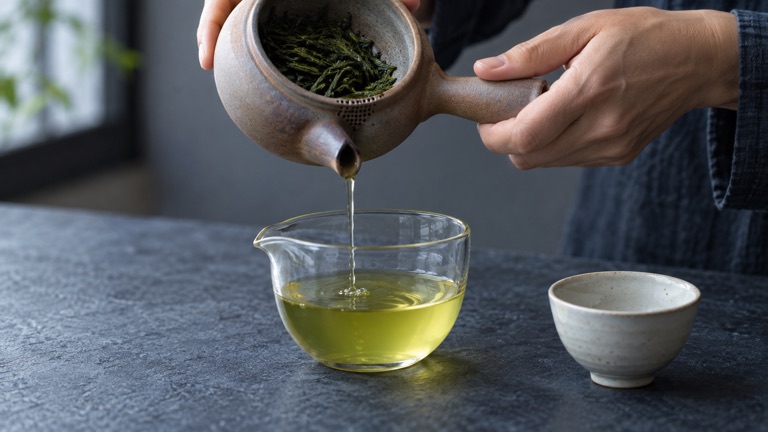
For a concrete reference, Ippodo’s standard sencha preparation uses 10 g of leaves, 210 ml of water at 80°C, and 60 seconds before pouring off the tea. The maker also advises against disturbing the leaves during that infusion. These are its recommended starting conditions, not a compulsory recipe for every sencha sold in India. Ippodo’s sencha brewing guide.
The easy-to-miss part is the ending. If you pour one small cup but leave the rest sitting with the leaves, the remaining drink has not stopped infusing just because the timer rang. Decant the brewed liquid into a separate heat-safe serving vessel, or remove the infuser. Then you can drink slowly without asking the leaves to keep brewing throughout the episode you are watching.
Try describing the problem without using only “strong.” Is the whole drink too concentrated? Does an initially pleasant sip leave an uncomfortable dry sensation? Is there a harsh flavour immediately? These observations will not identify a chemical cause on their own, but they help you choose a useful comparison.
Ippodo explicitly acknowledges that its recipes reflect its own preferences and may be too intense for some drinkers. Its suggested adjustments include less leaf, cooler water or a shorter infusion. Some bitterness and astringency can also be part of the tea’s intended character. Zero bitterness is not a universal authenticity test. Ippodo: help with bitter tea.
Our practical recommendation is to change just one of those variables in the next batch. If you know you left the leaves soaking far beyond the directions, correct the time first. If you followed the timing but used freshly boiling water instead of the packet’s cooler recommendation, correct that next. Do not simultaneously halve the leaves, double the water and shorten the steep, then conclude you have discovered the ideal temperature.
You can add a little water to a poured cup if its overall intensity is the problem. That is a serving adjustment, not a way to undo the extraction. If the diluted drink is still unpleasant, record it as such rather than repeatedly topping it up until nothing remains to taste.
“Use 80°C water” sounds precise but leaves three questions unanswered: how much tea, how much water and for how long? A recipe is a set of conditions, not an isolated temperature.
For comparison, Marukyu Koyamaen recommends a 70–75°C sencha preparation for a milder result and describes 85–90°C with a shorter wait as an option for people who prefer a sharper taste. Its second-infusion advice also differs from its first infusion. This is useful evidence against treating every departure from one temperature as a mistake. Marukyu Koyamaen’s sencha preparation.
Use grams and millilitres when you can. A spoon measures space, not mass: differently shaped leaves do not pack identically. Nor does the word “cup” tell you whether the writer means a small tea serving, a measuring cup or your large breakfast mug.
Here is a calculation, not a tested recipe. Starting from the 10 g to 210 ml sencha reference, the dry-leaf input is about 4.76 g per 100 ml. Using the same 10 g in 350 ml lowers that input to about 2.86 g per 100 ml—40% less leaf per unit of water. You have changed an important condition even if you kept the timer and kettle setting identical.
That does not prove the resulting drink has 40% less flavour, caffeine or any particular compound. Extraction is not a direct percentage conversion from dry-leaf mass. The arithmetic explains why “I used the same amount of tea” is incomplete information.
If scaling a recipe, keep notes on the vessel too. A small quantity of water in a broad bowl and a full, prewarmed pot will not cool in exactly the same way. A thermometer helps check temperature, but you need not buy an elaborate kettle before trying tea. Without one, use the packet’s cooling method consistently and acknowledge that your temperature is an estimate. A fixed number of minutes after boiling is not an exact temperature under every kitchen condition.
Matcha is not an instant extract that completely disappears like sugar. Finely ground leaf particles are dispersed through the drink, and some settling can occur. A little sediment after the cup has stood is therefore different from dry-centred lumps present immediately after mixing. Matcha.com’s explanation of suspension and settling.
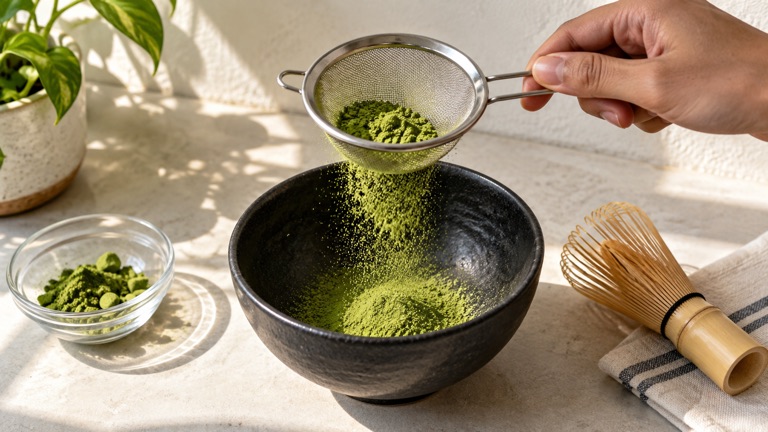
This distinction changes the remedy. Stirring a drink that has settled can redistribute particles. It does not follow that pouring hotter water over a compact lump will make it vanish. Ippodo specifically recommends passing matcha through a dry fine-mesh strainer before preparation because pouring hot water on clumps does not dissolve them. Ippodo’s sifting instructions.
For a reproducible first attempt, Ippodo’s usucha method calls for 2 g of sifted matcha and 60 ml of water at 80°C, whisked briskly for about 15 seconds with an M-shaped motion. Usucha is a small, concentrated drink, not an instruction to fill a large mug to its rim. Ippodo’s classic matcha recipe.
Before adding milk or extra water, look at that small base. Is powder stuck around the edge? Are there visible clumps at the bottom? Can you mix freely in the vessel, or does its narrow shape restrict the whisk? These are more useful observations than whether the colour matches a filtered café photograph.
If the base is smooth but the drink becomes weak after you finish assembling it, the main question has moved from mixing to proportion. If it is already gritty, adding more powder to “strengthen” the latte makes diagnosis less clear. Get a consistent base first, then adjust the finished drink.
A bamboo chasen is well suited to aerating matcha, and a bowl with room for a back-and-forth motion can help. But a thick foam cap is not the sole definition of a successful cup. Ippodo discusses deliberately foam-free preparation and notes that cold-whisked matcha can be enjoyed with less foam. Its guide to foam and whisking technique.
Judge whether the drink is evenly mixed and pleasant to you before chasing a photograph. If your goal is a cold everyday drink rather than whisk practice, Ippodo’s Matcha To-Go directions include a cold-water travel-flask method. That is a separate serving style, not a promise of the same foam as a whisked bowl. Do not substitute hot liquid in a sealed shaker or travel flask.
A water-only matcha recipe and a latte recipe answer different questions. Ippodo’s latte example uses 3 g of matcha with 100 ml of 80°C water, whisked before adding 100 ml of milk. It gives you a named starting point, not a promise to reproduce a café’s undisclosed drink. Ippodo’s matcha latte recipe.
Now consider two hypothetical drink builds, assuming the liquid volumes add together and ignoring foam volume. Both contain 3 g of pure matcha. One has 200 ml total liquid; the other has 300 ml. The first contains 1.5 g of matcha input per 100 ml, the second 1 g per 100 ml. The larger drink has one-third less powder per unit of liquid, although its total matcha dose has not changed.
This is why a drink can become less tea-forward when you use the same scoop but a taller glass. It is not evidence that the new carton of milk has “destroyed” the tea. You changed the ratio.
Taste a small amount of the base at a comfortable temperature before adding the rest. If you like the base, make a smaller finished drink or compare two milk quantities while holding the powder dose steady. If the base is already too harsh, adding still more powder to compete with milk is not a sensible first diagnostic step.
Milk choice is another variable. Keep the same milk or plant-based drink during a comparison rather than changing its brand, sweetness and volume together. For dietary needs, check the actual ingredients of the powder, milk, syrup and toppings. A green drink is not automatically dairy-free; a vegetarian drink is not automatically vegan. Our Japanese vegetarian food guide explains why names and appearances cannot replace ingredient checks.
Sweetening the drink is a preference, not a failure. For learning purposes, make the tea base first and then add your chosen sweetener in a recorded quantity. That lets you recreate the cup you liked instead of searching for it with a different free-poured amount every time.
Hojicha’s roasted identity does not tell you its physical form. Loose leaves belong in an infusion that is strained. A powdered hojicha latte uses powder mixed into liquid. Swapping one for the other spoon for spoon is not a controlled substitution.
Even among leaf preparations, there is no single temperature all makers prescribe. Ippodo uses 10 g, 240 ml, 100°C and 30 seconds for its standard hojicha brew. Hojicha Co. suggests 8 g, 240 ml, 80°C and 30 seconds for its traditional loose-leaf preparation. Ippodo’s method and Hojicha Co.’s method should be read as complete recommendations for their teas, not competing universal laws.
The editorial lesson is simple: start with the directions attached to your actual product. Do not combine one maker’s dose, another’s temperature and an unrelated video’s waiting time and call the result the official Japanese method.
If a plain hojicha infusion seems pleasant but becomes faint after adding milk, investigate dilution before extending the infusion indefinitely. If it is unpleasant before milk, return to the leaf preparation. The same symptom-led logic works, but matcha’s sifting step is not suddenly relevant to a pot of intact roasted leaves.
Hojicha Co. also publishes distinct latte methods for leaves and powder. Its powder example mixes the powder with water before adding milk; its leaf version makes a stronger infusion first. That separation is the useful point here. Choose the appropriate method rather than expecting a spoonful of leaves to remain in the glass like powdered tea.
For a home comparison, label your notes “leaf infusion” or “powder.” That distinction matters more than copying the colour of someone else’s latte.
Ice is an ingredient once it melts. A drink can be right at the first sip and weaker later without any change in the tea itself.
Use a deliberately simplified example: you have 200 ml of brewed tea, then melting ice contributes 100 ml of additional water. Assuming complete mixing and no other additions, the original tea is now spread through 300 ml. Its concentration relative to the initial liquid is two-thirds, a reduction of about 33%. This is dilution arithmetic, not a prediction of the exact taste or melt rate in your glass.
That suggests two different experiments. You can make a recipe intended to be poured over ice, or you can chill a prepared drink without adding the same amount of meltwater. Do not compare a heavily iced glass with an un-iced one and attribute the whole difference to brewing temperature.
Ippodo’s Hosen page illustrates the distinction with separate hot, iced and cold-brew instructions rather than one recipe with ice casually appended. Its hot-water-over-ice method is not identical to its standard warm serving. Hosen’s preparation options.
For your own test, keep the glass, ice quantity and time before tasting similar. If you drink slowly, taste once near the beginning and once later. Record whether the later drink is merely less concentrated or whether the flavour balance also feels different. Those are personal observations, not proof that all cold tea has the same character.
Use safe drinking water for both the tea and the ice. Follow the product’s preparation and storage directions; this guide does not establish a room-temperature storage allowance for tea or milk drinks.
Water is worth investigating after you can reproduce the dose and timing. Ippodo advises starting with water you enjoy drinking plain, discourages distilled water for its teas, and describes different flavour characters from softer and harder water. Ippodo’s water guidance.
For a useful comparison in an Indian kitchen, do not assume your city name tells you the composition of the water at your tap. If two safe drinking waters are available, use one for each otherwise identical brew. Taste the waters plain too. You are comparing those two water supplies, not proving that every bottled water is better than every filtered supply.
Storage can change the tea before it ever reaches the bowl. Marukyu Koyamaen warns that heat, humidity, light, air and surrounding odours affect matcha. For its canned matcha it recommends refrigeration, with an important qualification: allow the closed container to reach room temperature before opening it. Opening it cold exposes it to conditions that can encourage clumping. The maker’s matcha storage guidance.
Follow your own product’s instructions rather than extending that advice to every blend or instant mix. Keep a dry utensil for taking powder out, close the pack promptly, and avoid opening it over steam. Do not expect a new whisk to restore a tea whose aroma has already deteriorated.
Package size should fit how often you actually drink it. In a hypothetical example, a 40 g packet used at 2 g per serving contains 20 servings before losses. At two servings a week, finishing it takes ten weeks. That is not a shelf-life guarantee; it is a reason to consider a smaller pack and compare the maker’s after-opening guidance before buying in bulk.
Use the following as a diagnostic notebook, not a laboratory verdict. The first test is chosen to answer a question; it is not a guarantee of a cure.
| What you notice | Check before the next cup | Change first |
|---|---|---|
| Sencha becomes harsher while you drink | Is liquid still sitting with the leaves? | Separate the finished infusion completely |
| Sencha is unpleasant immediately | Actual temperature and contact time versus the packet | Correct the clearest departure from those instructions |
| Matcha contains lumps from the start | Was the powder sifted dry and the base mixed evenly? | Improve that mixing step before adding milk |
| Matcha settles after standing | Was it smooth when freshly mixed? | Stir and reassess; do not diagnose quality from sediment alone |
| Latte base tastes good, finished drink seems weak | Total milk, water and melted ice | Reduce added liquid in a comparison cup |
| Different batches vary unpredictably | Unmeasured scoops, mugs or timing | Establish one repeatable baseline |
For a temperature test, use fresh equal portions from the same packet, equal water volumes, the same vessel and the same infusion time. Change only the water temperature measured just before pouring. For example, if your baseline sencha recipe uses 80°C and 60 seconds, a comparison at 70°C should retain that 60-second wait and the same leaf-to-water ratio. This is an optional tasting experiment, not a tested improvement guarantee. Comparing a first infusion with a second infusion is not that test: the leaves have already changed through use.
Write observations in ordinary words. “Less drying after swallowing, but less aroma” is more informative than “better.” You might decide the trade-off is worthwhile. Someone else might prefer the other cup. Neither response requires an invented universal score.
If sharing tea with a friend, use anonymous A and B labels before revealing which preparation changed. This will not make a home comparison a scientific study, but it can stop the more expensive packet or elaborate method from winning purely by expectation. Keep the sample sizes comfortable; learning about tea does not require finishing every trial.
Finally, compare the drink in the way you intend to enjoy it. A plain matcha bowl, a sweetened iced latte and tea beside a snack serve different purposes. Our Japanese sweets guide can help you choose a texture or filling to explore alongside tea, without treating one pairing as compulsory.
Your best next purchase may be nothing at all. First identify the product, make one repeatable preparation, and decide whether the problem begins during infusion, mixing or the final additions. Once you can name that point, the next cup becomes a choice rather than another guess.
AUTHOR OF THIS ARTICLE
SoJapan
SoJapan India Pvt. Ltd. is a Japanese-founded company based in Gurugram. We bring Japanese food, anime goods and apparel materials to Indian businesses, with a sister company in Kyoto that works directly with makers in Japan.