You recognise Pikachu, you have opinions about Luffy’s crew, and perhaps an anime scene has made you want to shout “Stand up, Vanguard!” across a table. A trading card game turns that attachment into something you can actually do with another fan. You build a deck, make decisions with imperfect information, and discover that the card you dismissed yesterday can become the centre of your next idea.
For a beginner in India, however, “buy some cards” is an incomplete instruction. A collectible pack is not necessarily a playable deck. Japanese and English releases are not automatically interchangeable for organised play. A popular franchise on social media may have fewer nearby players than a less familiar game.
This guide explains the choices that matter before your first purchase. It focuses on Pokémon, Cardfight!! Vanguard and the ONE PIECE Card Game: three different ways of connecting Japanese entertainment with tabletop play. It is not a price forecast, a ranking of investment opportunities or a claim that one game is best for every Indian city.
TCG means trading card game. Instead of both players using one shared fixed pack, each usually brings a deck assembled from a wider pool of cards. The collection can grow through preconstructed decks, individually selected cards, trades and randomized packs. Deck construction becomes part of the game: you decide what your cards should achieve together before the first turn begins.
Think of the difference between admiring a fictional team and choosing the team’s approach yourself. Do you want to attack early, develop a powerful late-game board, repeatedly disrupt the opponent, or assemble a particular combination? Your preference influences the cards you include and the decisions you practise.
Trading is optional. You can enjoy a TCG without swapping cards, collecting every expansion or entering tournaments. Likewise, you can enjoy the illustration and character history without playing at all. Neither approach is more legitimate. The trouble starts when a purchase designed for one activity is expected to solve the other.
A single card may be a game piece, a picture of a favourite character and an object with a particular printing history. These identities overlap without being identical. A striking alternate illustration can be attractive to a collector while contributing no additional gameplay benefit over an equivalent regular printing.
Meanwhile, two cards showing the same character may have completely different effects. The character name alone is therefore not enough when requesting a specific card. Use the game’s identifying details: card number, expansion, language and the relevant version. This is particularly important when a seller’s photograph shows several visually similar releases.
Start with the kind of decisions you would enjoy repeating, then check who can play with you. Familiar characters provide motivation, but you will spend more time reading effects and making choices than staring at the box art.
| Game | The central attraction | Normal constructed setup, in brief | A useful first question |
|---|---|---|---|
| Pokémon TCG | Building a board of Pokémon, developing attackers and managing a Prize race | A 60-card deck | Do I enjoy preparing an attacker while planning what comes after it? |
| Cardfight!! Vanguard Standard | An evolving central avatar, attack sequences and active defensive decisions | Normally a 50-card main deck plus a five-card ride deck including a crest; special exceptions exist | Do I enjoy choosing which attacks to guard and which risks to accept? |
| ONE PIECE Card Game | A Leader-led crew and a resource system used for both development and pressure | One Leader, a 50-card deck and a separate ten-card DON!! deck | Do I enjoy deciding whether resources should build my board or strengthen this attack? |
These numbers describe different systems, not a complexity ranking. A smaller main deck does not prove a game is easier. Use the official Pokémon deckbuilding guide, Vanguard Fighter’s Rules and ONE PIECE rules hub for the full requirements and exceptions. Rules were checked for this guide on 29 September 2026.
Pokémon can appeal to someone who likes seeing a plan develop across the board. The pleasure is not simply recognising a species: it is arranging the resources and supporting cards that let a chosen attacker function. A deck full of favourites does not automatically provide that support.
For an anime fan, this is a useful change of perspective. A dramatic Pokémon in the series need not be the centre of your first learning deck. You might enjoy a less familiar attacker because its plan is easier to understand, then return to your favourite once you can judge the available versions.
The official parents’ TCG introduction distinguishes introductory products. Battle Academy includes three complete 60-card decks and learning materials; My First Battle uses a simplified mini-deck experience. They are different learning steps, not interchangeable boxes containing the same game setup.
Vanguard’s central unit gives a deck an immediately recognisable identity. The appeal is partly theatrical: your avatar develops, an attack places pressure on the opponent, and a defensive choice can become the moment everyone remembers afterwards.
It is also a game where following only your own turn misses much of the interest. You need to pay attention when the opponent attacks. For the right player, that makes the table feel like an ongoing conversation rather than alternating stretches of action and waiting.
For a new group, begin with the same format and compatible introductory decks. “Vanguard” on both boxes is not enough: Standard, V Premium and Premium are distinct formats. A nostalgic anime connection is a reason to explore a deck, not evidence that an old deck list belongs in today’s Standard game.
The Leader makes a satisfying bridge between fandom and play. You are not merely collecting disconnected portraits; you are exploring a game plan built around a specific identity. A fan who enjoys discussing why a crew works together may particularly like this aspect.
The resource decisions are another attraction. Rather than treating every available resource as something to spend immediately, you learn to consider pressure, board development and the next response. The interesting question is often not “What can I play?” but “What does this choice leave possible afterwards?”
You do not need to catch up with the entire manga to learn the rules. However, artwork, names and abilities can reveal characters or transformations beyond your current viewing point. Ask a friend to suggest a spoiler-conscious entry point if discovery is important to you.
Each game has its own dedicated guide: Pokémon cards in India explains evolution, Energy and the Prize race; Cardfight!! Vanguard explores riding, guarding and nations; and ONE PIECE focuses on Leaders, DON!! and defensive decisions.
For a player, the unit of progress is a functioning deck and a better understanding of its decisions. For a collector, it might be a binder page, a character theme or a favourite illustrator’s work. These goals can coexist, but separating them makes purchases easier to evaluate.
Imagine two fans with the same spending limit. One wants to play this weekend; the other wants a page devoted to a favourite character. The first should check whether a purchase completes a playable setup. The second should check whether the exact version fits the collection. Neither is helped by a vague instruction to buy whatever is currently attracting attention online.
“Cards featuring my favourite crew member” is a workable theme. “Every valuable card” is not a bounded project. Other enjoyable boundaries include a single expansion, one illustration style, a particular evolution line or a small set of memories from the anime.
A boundary does not need to be permanent. It simply gives you a reason to say no. Leave spaces in a binder if you like anticipating future additions; do not treat those spaces as debts that must be filled immediately. Completion is a personal preference, not a deadline imposed by the hobby.
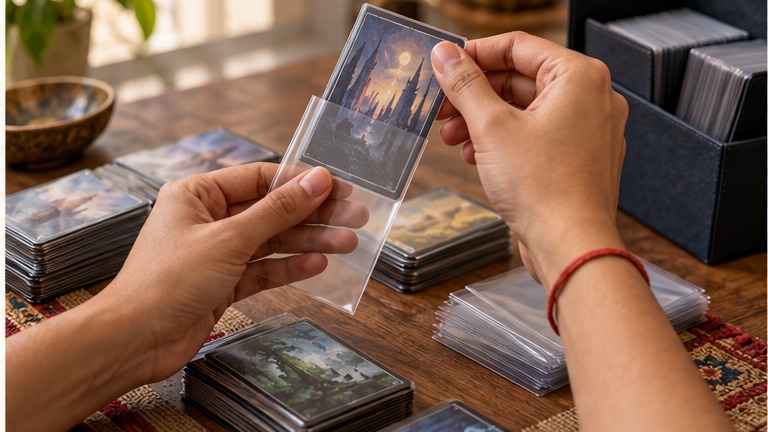
Cards handled repeatedly during games will have different practical needs from a display collection. Appropriate sleeves, a deck box and a clean play surface may contribute more to your daily enjoyment than a cosmetic upgrade. For a cherished display card, suitable storage and clear identification can matter more than its tournament usefulness.
Our anime figures guide explores a related distinction: buying for the pleasure of ownership is different from assuming that every collectible is an investment. With cards too, future resale demand should not be treated as a guaranteed exit plan.
A preconstructed deck is a deck assembled by the publisher in advance. It gives you a coherent starting point and a known contents list. A booster pack usually gives a randomized selection that may be interesting to open but may not provide the pieces required for a specific deck.
For someone who wants to play, the most useful purchase question is: “Can I complete a learning game with this, and what else will both players need?” Check the contents rather than assuming every product labelled starter, collection, gift or battle has the same purpose.
Suppose one hypothetical option costs ₹1,800 but requires ₹700 of additional necessary items, while another costs ₹2,300 and includes what your session needs. The relevant totals are ₹2,500 and ₹2,300. These figures are arithmetic examples, not Indian market quotations.
Apply the same reasoning to two-player products versus single-player decks. A box with two usable learning decks solves a different problem from a box containing one deck and decorative extras. If you are learning with a friend, compare the cost of getting both people to the table.
Do not add every accessory to the definition of necessary. A premium playmat, decorative counters and a themed carrying case can be enjoyable, but the rulebook and chosen product should determine the actual playing requirements.
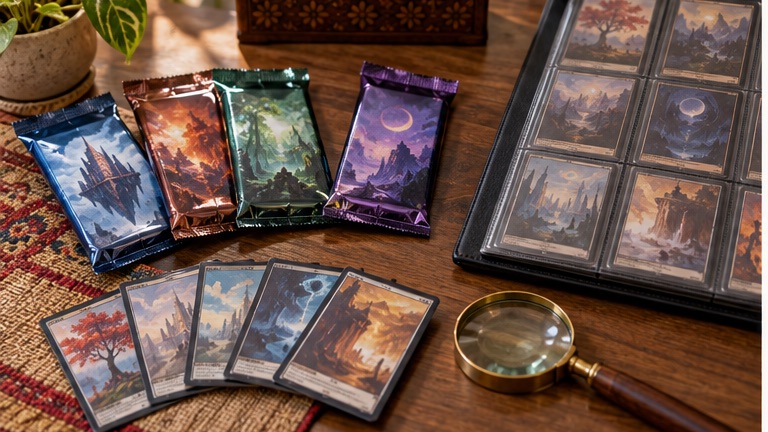
The term “oripa” is commonly used for seller-created assortments or packs. These are not automatically the same thing as a manufacturer’s factory-sealed booster product. Contents, selection methods and any advertised chances depend on the particular offering.
Before buying any randomized product, understand exactly who assembled it, what is guaranteed, what is merely possible and whether the description explains the selection. A photograph of a desirable card does not mean that card is in your pack. For deck construction, a known deck list or exact individual card is easier to plan around than an uncertain pull.
Aim to finish a game you understand. You do not need to understand every card, every format and every tournament procedure before starting. An experienced friend can help by using two uncomplicated decks and announcing the reason for each action.
Ask to see the table layout before the opening hand. Which zone holds the deck? Where do used cards go? Which information is public? What condition ends the game? Learning these foundations prevents confusion when a card later refers to a named area.
For an agreed teaching game, both players can discuss their hands and possible choices. This is a learning exercise, not a normal competitive match. It allows a teacher to explain why a legal move may still be unhelpful, and lets the beginner ask questions without worrying about revealing a plan.
Then play another game with normal hidden information. The same choices will feel different once you must infer what the opponent might hold. That transition is an excellent introduction to why TCGs remain interesting after the basic rules become familiar.
After the game, choose one turning point. Was a key card used too early? Did an attack achieve less than developing another option would have? Did you misunderstand a rule, or understand it but choose a risky line?
Those are different problems. A rule misunderstanding needs clarification. A risky decision needs discussion of what was known at the time. Judging every choice by the final result teaches hindsight, not better play. A sensible decision can lose; a careless decision can occasionally succeed.
The most useful beginner deckbuilding question is “What job does this card do?” Possible jobs include advancing your main plan, finding another card, protecting a position or answering an opponent’s threat. If a card has no clear role, a familiar character portrait alone may not justify the slot in a play-focused deck.
Start with a complete published or introductory list and learn why its pieces are there. Replacing cards before understanding the original plan can remove support that looked unimportant. Make one small change at a time and observe whether the problem you identified actually occurs less often.
Consider a hypothetical shuffled 60-card deck with four copies of one card. Before any other information or card movement, one random card has a 4/60 chance of being that card: approximately 6.7%. With one copy, the corresponding chance is 1/60, approximately 1.7%.
This is a single-card calculation, not an opening-hand probability and not a win-rate prediction. It illustrates why repeated copies can make a plan easier to access. Actual games add draws, searches, hidden zones, restrictions and decisions, so copying the percentage into a claim about deck strength would be misleading.
Players often call early-pressure plans aggressive, resource-denial or response-heavy plans control, and interaction-dependent plans combo. These labels help conversation, but they are not sealed boxes. A deck can change its role depending on the matchup or stage of the game.
Ask a more concrete question when someone recommends a deck: “What does a normal good turn look like?” A short demonstration of the plan usually tells a beginner more than three unexplained competitive labels.
Choose a community by evidence of actual play, not only membership totals. A large social account may mainly share collection photographs. A smaller local group with recent game nights, clear venue details and welcoming teaching sessions may be a better starting point.
Our guide to anime events and communities in India explains how to evaluate fan spaces. For card games, add a more specific check: which exact game, format and card language do the people attending use?
A useful introduction is: “I am new to ONE PIECE, based in this city, and looking for a beginner session. Do you play the English edition, can I borrow a learning deck, and is the meeting casual or an official event?” Adapt the game and details to your situation.
That is more actionable than “Where can I buy cards?” It also reveals whether the group’s main activity matches yours. Collectors, competitive players and anime fans may share a room while looking for different experiences.
A community tournament can be enjoyable without being publisher-sanctioned. Conversely, an official event may have eligibility, registration and deck requirements that a casual meetup does not. Ask the organiser to identify the relevant event listing and regulations; confirm the actual date and venue before travelling.
This guide does not claim that every game has an officially supported competitive circuit in every Indian city. Imported products, active local fans and official regional programme availability are separate questions. Check all three when organised play is your goal.
For kitchen-table play, friends can agree on a learning arrangement. For organised play, the organiser’s applicable rules determine which editions and languages are accepted. Do not assume that knowing the English translation makes a Japanese card eligible for an English-edition event.
A format defines which cards and construction rules are permitted. A collection can remain enjoyable when a particular card is not legal in the format your friends play. Before buying an older deck list, identify its format and date, then check the publisher’s current rules and restrictions.
Card condition and authenticity are separate from legality. A genuine old card can be format-ineligible; a pristine-looking card can still require authentication. Compare identifying details with the official card database and request clear photographs of the actual item. A single visual clue or unusually low price is not conclusive proof either way.
Keep a small record of what you enjoyed rather than a running list of everything you lack. Perhaps you liked the tension of defending a Vanguard attack, the satisfaction of building a Pokémon board, or a ONE PIECE turn where resource allocation created several possibilities. Those observations help you choose your next deck more reliably than a popularity chart.
You can also enjoy the game away from the table: organise a character binder page, discuss an illustration, watch an official teaching video, or explain a favourite interaction to another beginner. None requires chasing every release.
The strongest start is modest and repeatable: one understandable game, one compatible opponent, one complete setup and a reason to want another match. Let the characters bring you in, then let the decisions show you which game deserves a place in your routine.
If you run a card shop or organise anime events in India and want to discuss Japanese card or anime-product sourcing, contact So Japan with your city, the game and the language you need. Product availability and suitability should be confirmed individually.

AUTHOR OF THIS ARTICLE
SoJapan
SoJapan India Pvt. Ltd. is a Japanese-founded company based in Gurugram. We bring Japanese food, anime goods and apparel materials to Indian businesses, with a sister company in Kyoto that works directly with makers in Japan.