A recipe for stir-fried noodles tells you to add water. Another tells you to start by frying the noodles on their own. If you have come to yakisoba through an anime festival scene, neither the name nor the finished plate explains why both instructions exist.
The short answer is that loosening a noodle, cooking off moisture and adding flavour are different jobs. A recipe arranges those jobs around its ingredients. Taking the water quantity from one method and the cooking order from another does not necessarily give you the best of both.
This guide compares named Japanese manufacturers’ instructions, then explains what those differences mean when you choose a recipe at home. It is not a new universal recipe, a claim that these products are stocked in India, or a report of our own cooking tests. The practical recommendations are editorial interpretations of the linked methods.
Keep three things in view:
The noodle in a chilled packet and a rigid instant-noodle block may both be destined for yakisoba. That does not mean the frying pan has the same work to do with them.
Otafuku’s explanation of yakisoba noodle types distinguishes raw Chinese-style noodles, steamed noodles and boiled noodles. The steaming or boiling is an earlier manufacturing step, not an alternative name for the finished dish. The maker also identifies dried, frozen and long-life forms. Its account describes wheat-based noodles; the name does not require the buckwheat noodle you might associate with soba.
For a home cook, the useful question is therefore not simply “Can I make yakisoba with this?” Ask: “What must happen to this particular noodle before the recipe expects to season it?”
Consider two hypothetical shopping situations. In one, you have bought a noodle-and-seasoning pack with its own preparation sequence. In the other, you have bought plain noodles and a separate bottle of sauce. The first gives you a matched starting point. The second requires you to check that the noodle preparation and the sauce recipe actually fit together. A photograph of a similar-looking plate does not establish that fit.
The distinction is particularly important if a recipe lists “one portion” rather than a precise noodle weight. A portion is not a promise that every package has the same mass, moisture content or preparation needs. Find the product or noodle state specified by the author before deciding that a different packet is an equivalent replacement.
If your question is broader—how dried, frozen or pre-cooked noodles work across soup, dipping and stir-fried dishes—our udon guide covers those arrangements. Here, the narrower question is how the steps fit together in yakisoba.
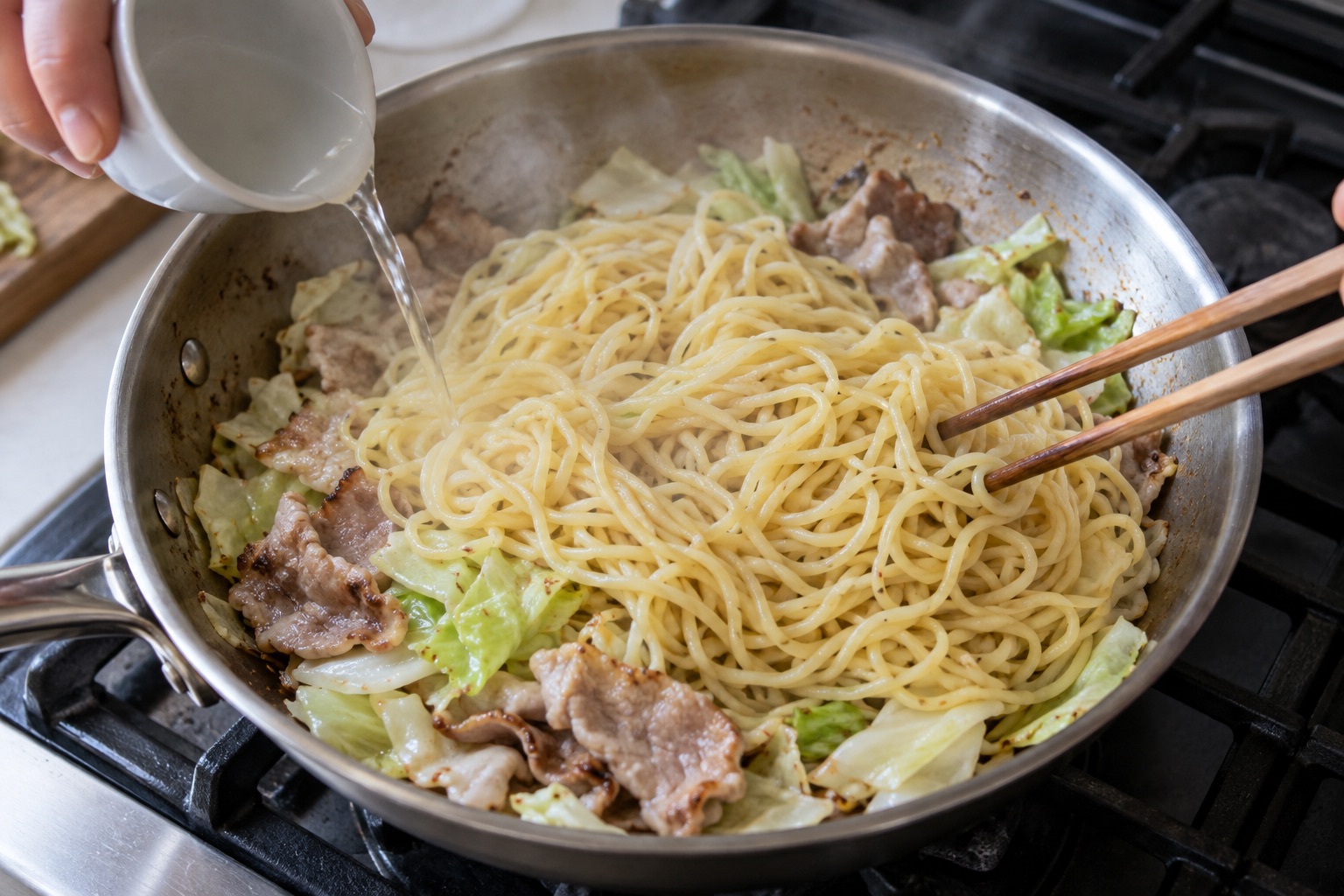
Maruchan’s three-point cooking guide uses one noodle portion from its three-serving sauce-flavoured yakisoba pack. For the specified meat and vegetable quantities, it lists 60 ml of water. That is a measurement for this example, not an instruction to add 60 ml to every packet—or to the entire three-serving pack.
The maker explains that water helps steam and loosen the noodles. Its sequence places them over the cooked ingredients, adds water, allows a little time, then turns and gently separates them. The moisture is subsequently cooked away. Powdered seasoning enters on reduced heat, kept off the bare pan sides, before a brief final stir-fry.
Notice the change of purpose within that sequence. Something useful at one stage does not have to remain useful at the next. “Water belongs in this recipe” and “the finished mixture should not remain watery” are not contradictory statements.
That is a more helpful distinction than dividing all advice into “add water” and “never add water”. Those slogans leave out the starting product, the other ingredients and the point in the sequence at which the observation was made.
A useful way to read an unfamiliar recipe is to annotate its transitions. Beside one instruction, write “separate”; beside another, “remove moisture”; beside another, “season”. These are reading notes, not replacement cooking directions. They make it easier to notice when a step is doing something other than the job you first assumed.
For example, if you think every moment in the pan is simply “frying”, you might treat a loosening instruction as an unnecessary delay. If you think every liquid is flavouring, you might treat water as a weak substitute for sauce. Naming the jobs prevents both misunderstandings before you start improvising.
Otafuku’s frying-pan yakisoba recipe begins with loosened yakisoba noodles. They are fried first and moved aside while the pork and cabbage are cooked. The components are combined, then sprouts, tenkasu and the maker’s liquid yakisoba sauce enter near the finish. Added water does not appear in this recipe’s ingredient list or steps.
Its separate explanation of noodle-first cooking connects the approach with reducing moisture and developing a toasted surface aroma. These are the manufacturer’s stated aims, not results of a comparison test conducted for this article.
The following table is a map of the differences, not a substitute for either full recipe.
| Question | Maruchan’s linked chilled-pack guide | Otafuku’s linked pan recipe |
|---|---|---|
| What leads the pan sequence? | Meat and vegetables | Noodles, then moved aside |
| Is water deliberately added? | Yes, for the specified preparation | No added-water step listed |
| How does seasoning enter? | Powder after moisture removal, on reduced heat | Liquid sauce near the finish |
It would be tempting to turn the comparison into a competition. Which method is the authentic one? Which is guaranteed to be better? The sources do not establish either verdict. They describe different combinations of ingredients and actions.
For a first attempt, our recommendation is to choose the complete method closest to the product you actually have. If you have the named seasoned pack, its own instructions are the obvious starting point. If you are combining a suitable plain noodle with a bottled sauce, choose a recipe written for that combination. Neither choice requires dismissing the other.
Be especially cautious about hybrid instructions collected from short videos. “Noodles first” may be followed by a suggestion to pour in water, then a different cook’s sauce quantity, then a third person’s instruction to keep stirring. Each tip may have made sense in its original demonstration. Together, they may no longer describe anyone’s tested recipe.
The recipes also contain meat, and Otafuku’s named tenkasu includes squid. They should not be presented as vegetarian just because noodles and cabbage occupy most of the plate. A vegetarian adaptation needs appropriate ingredients and a suitable recipe, rather than an assumption that the visible vegetables settle the question.
The comparison above might suggest a new shortcut: whatever else happens, put the sauce in last. There is a manufacturer-documented exception to that rule too.
In its 6 March 2023 announcement for Maruchan Seimen Yakisoba, Toyo Suisan described dried instant noodles and explicitly highlighted a sauce-first preparation. This is a dated example of product design, not current cooking instructions for a packet you may buy today. It is enough to show why the timing cannot be inferred from the dish’s name alone.
Do not confuse that Seimen product with the chilled three-serving product discussed earlier. A shared manufacturer name is not a shared method. The seasoning pack, noodle and instructions belong together.
Equally, “powder” and “liquid” should not become a new pair of universal timing rules. The question is how a particular seasoning is intended to work with a particular noodle. Its physical form is relevant information, but not the whole instruction.
When reading a recipe, distinguish three details: the quantity of seasoning, its placement in the sequence, and where it is directed. A bottle measurement does not tell you when to add it. A finishing instruction does not tell you whether another product is equally concentrated. Those details must be supplied by the recipe or packet, not filled in from habit.
Suppose, hypothetically, you have followed a recipe’s noodle preparation exactly but replaced the accompanying seasoning with an unrelated bottle. You have kept the sequence while changing what it was designed to handle. That might be a deliberate adaptation, but it is not evidence that the original recipe used too much or too little sauce if your result disappoints.
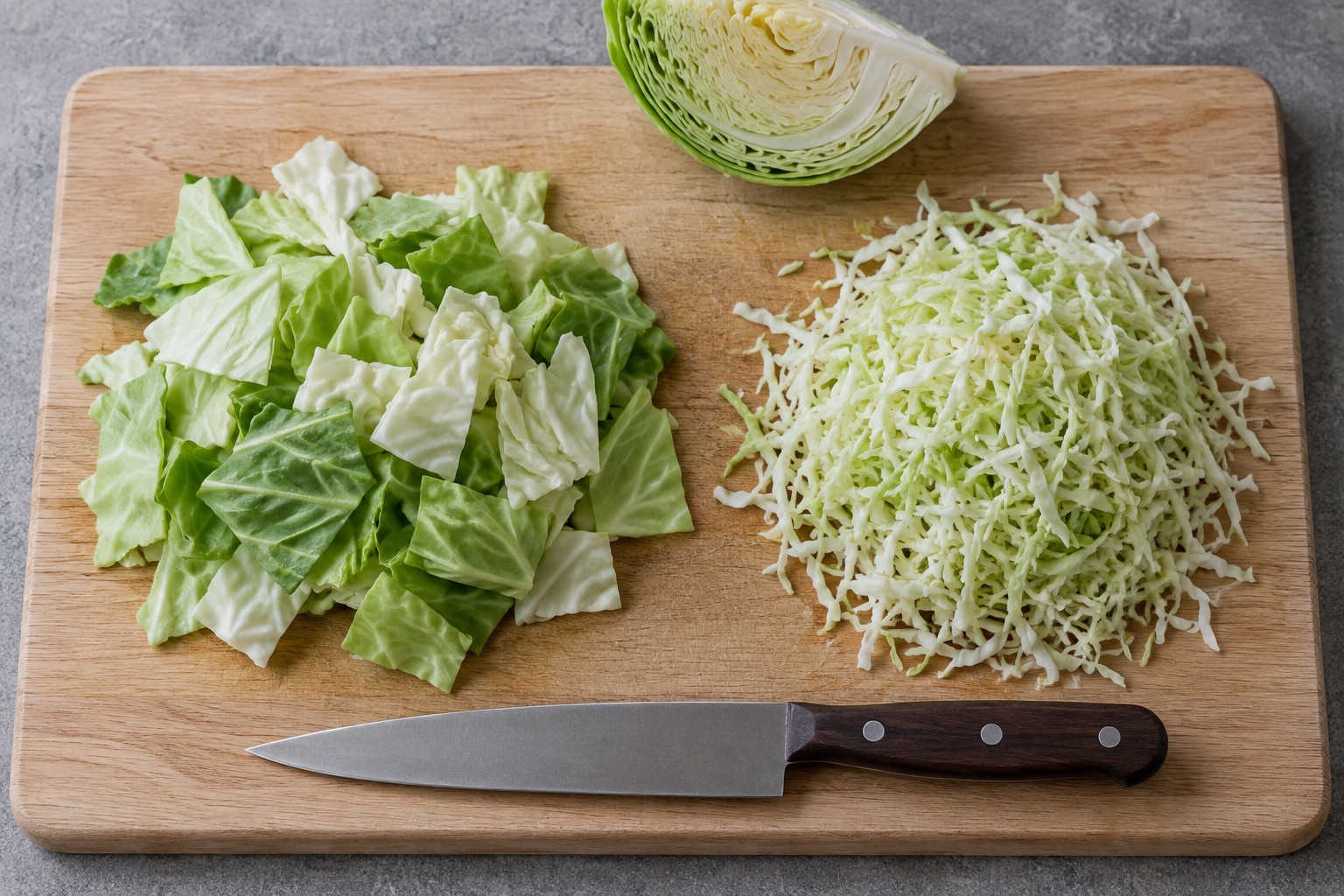
A bowlful of cabbage is easy to regard as a fixed ingredient whose shape hardly matters. Yet the cut can be a deliberate part of the eating experience.
Otafuku’s cabbage-cutting comparison describes chunks as giving more contrast with the noodles, with less cut surface competing for sauce. It describes shredded cabbage as integrating more closely and distributing the sauce through both components. Those are the maker’s culinary observations, not a claim that everyone will perceive exactly the same flavour difference.
The practical decision is about what you want a mouthful to contain. Do you want a recognisable piece of cabbage beside the noodle, or a finer mixture in which the two arrive together? There is no need to turn that preference into a ranking of correct and incorrect yakisoba.
This also changes how to read a recipe photograph. A mound of finely shredded cabbage and a similar-looking mound of chunks may occupy comparable space in a bowl, but “one bowl” is not a precise ingredient specification. If the recipe gives a weight and a cut, preserve both when you are trying to understand its result.
For an explicitly hypothetical comparison at home, you could keep the noodle, sauce, cabbage weight and cooking method unchanged while trying a different cut on a later occasion. You would then be asking a focused question about the mixture rather than changing half the dish. This is a proposed learning exercise, not a test we have carried out or a promise of a particular outcome.
Keep substitutions honest in the description as well. A version made with your chosen vegetables and sauce can be a useful home adaptation without being presented as the manufacturer’s recipe. That small distinction respects both the source and the person who might try to reproduce your meal.
Multiplying an ingredient list is easy. Multiplying the usable surface of a pan is not.
Otafuku’s large-batch cooking article warns that too much food in a frying pan can hold moisture in the mixture. It recommends using the space of a hotplate to spread the noodles when making larger batches. Its advice is conditional on equipment and quantity, not a universal serving limit for every frying pan.
The relevant lesson for an ordinary home kitchen is about space, not buying an appliance. If a recipe relies on spreading the noodles and temporarily moving them aside, ask whether your intended batch still leaves room for those actions.
Imagine a hypothetical two-stage sequence: noodles occupy one part of the cooking surface while another ingredient cooks in the remaining area. Doubling both ingredients in the same pan changes that arrangement even if the ratios remain perfect. The recipe has a spatial requirement as well as a list of weights.
This gives you a more concrete planning question than “Is my stove powerful enough?” Can the ingredients occupy the positions the method describes? If everything must remain in one deep mound, you may no longer be following the same process.
Choosing a smaller recipe or cooking in manageable batches can be a reasonable response, but coordinate the complete meal rather than leaving one component waiting indefinitely. Follow the relevant product’s preparation and food-handling guidance; this article does not supply a holding-time rule.
Also keep the cookware’s instructions in charge of heat limits. A manufacturer recipe’s strong-heat recommendation for its demonstration should not be read as permission to overheat an empty non-stick pan or exceed your appliance’s operating limits. Resolve an equipment mismatch by choosing an appropriate method, not by assuming that the highest setting must be the most authentic.
Our okonomiyaki guide examines another use of cooking order: mixing ingredients into a batter versus assembling layers. With yakisoba, the question here is different but equally concrete—where can each component go while the next stage takes place?
When an attempt does not turn out as expected, resist diagnosing it only from the finished colour. A darker plate does not tell you whether the noodle was prepared correctly, and a pale one does not by itself establish that it needs another sachet.
Use the recipe as a record of decisions. Three short prompts can help without pretending to diagnose every kitchen remotely.
If the strands were difficult to separate: what product did the recipe request, and what preparation did your packet require? Note whether the difficulty appeared before seasoning. That keeps a noodle-preparation question separate from a sauce question.
If the mixture stayed wetter than expected: what did you add or enlarge? Record the noodle preparation, vegetables, any deliberate water addition and the batch size. You are looking for differences from the method, not trying to prove that one ingredient is always at fault.
If the seasoning caught or tasted harsher than expected: record the sauce product, timing and heat setting rather than immediately reducing the amount of every ingredient. A change to quantity and a change to application are different experiments.
These are editorial troubleshooting prompts, not guarantees that a single cause explains a particular result. They are most useful when the original recipe and the changes are still easy to remember.
You do not need a detailed kitchen diary. “Same noodles; larger batch; sauce added earlier” is already more informative than “yakisoba did not work”. It identifies choices that can be reconsidered one at a time.
For a first home attempt, choose the noodle product, find a matching recipe, and read through to the finish before preparing the vegetables. Check the serving count, sauce identity and equipment assumptions together. Keep the original method available so that a remembered shortcut does not quietly replace a crucial step.
The named recipes in this guide are examples for understanding technique, not shopping recommendations or assurances of Indian availability. Read the actual ingredients for dietary restrictions; a different market version or sauce bottle may not match the example.
After you understand one method, adapt it deliberately. Perhaps you want a different cabbage cut, a different balance of vegetables, or another seasoning. Name that choice rather than changing everything at once.
The useful insight is not that yakisoba secretly requires water, or that it should never contain added water. It is that a good instruction has a context. A noodle’s starting state, the space in the pan and the role of the seasoning explain far more than a universal rule about what goes in first.

AUTHOR OF THIS ARTICLE
SoJapan
SoJapan India Pvt. Ltd. is a Japanese-founded company based in Gurugram. We bring Japanese food, anime goods and apparel materials to Indian businesses, with a sister company in Kyoto that works directly with makers in Japan.