← JOURNAL6 Oct 2026
Udon Beyond the Soup Bowl: Hot, Cold and Stir-Fried Noodles Explained
 By SoJapan
A plate of cold noodles beside a small cup of sauce can look unfinished if your idea of Japanese noodles begins with a steaming soup bowl. With zaru udon, however, that separation is the point. You dip a mouthful as you eat. Pouring a bowlful of that stronger prepared dipping sauce over everything would create a different meal—and possibly a much saltier one than you intended.
Udon becomes easier to understand when you start with how you want to eat it. Do you want to alternate noodles and spoonfuls of hot broth? Dip chilled strands into a separate cup? Or lift noodles coated in seasoning from a stir-fried plate? Each arrangement asks something different of the liquid and the preparation.
For Indian readers trying udon at home or choosing it from a menu, this guide connects those decisions. It is not a claim that one imported brand is available everywhere in India, or that every household needs Japanese cookware. The aim is to help you understand the packet and the dish in front of you.
Udon belongs to Japan’s wheat-noodle tradition. Japan’s Ministry of Agriculture, Forestry and Fisheries describes its dough in terms of flour and salt water, and records fresh, boiled, frozen and dried forms. It also notes regional differences in thickness and texture. The thick white strand familiar from many photographs is a useful starting image, not a specification for every udon product. See MAFF’s explanation of traditional grain products.
Separate three descriptions when you shop: the noodle’s identity, the condition in which it is sold, and the dish you will make. “Udon” identifies the noodle family. “Frozen” tells you something about the product’s condition. “Yaki udon” tells you that the intended dish is stir-fried. Those words answer different questions.
This distinction prevents a common shopping mismatch. A recipe may ask for a weight of already-boiled noodles, while your cupboard contains a dry bundle. Matching the printed gram number does not establish an equivalent portion: the boiled product already contains the water taken up during preparation. Use the recipe’s specified noodle state and your packet’s serving guidance instead of treating all weights as interchangeable.
Nor should you judge the noodle entirely by whether it looks like ramen. Our ramen guide for Indian anime fans explains a bowl through stock, concentrated seasoning, oil and toppings. That is useful for ramen, but udon invites a wider first question: does this dish even have a soup to sip?
You do not need to rank one noodle above another. If what appeals to you is a bowl of broth, choose a soup preparation. If you want to notice the noodle against a separately controlled sauce, try a dipping preparation. If you prefer vegetables and seasoning distributed through the noodles, a stir-fry may be the more inviting introduction.
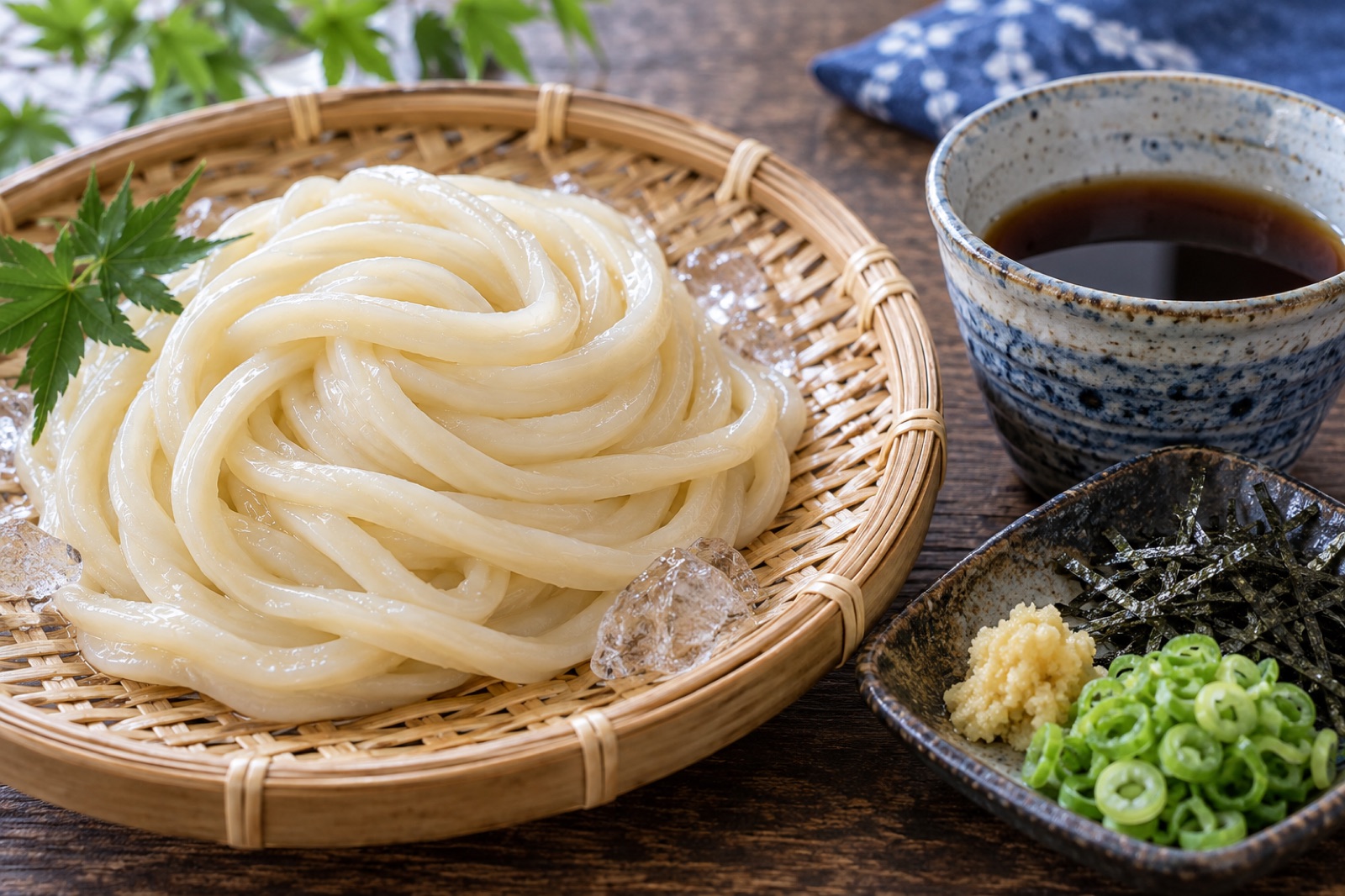
The most useful comparison is what happens between the plate and your mouth. Temperature matters, but the location and quantity of liquid matter just as much.
| Serving arrangement | How you eat it | What needs particular attention |
|---|---|---|
| Hot soup udon | Noodles sit in broth; you can alternate noodles and soup | Soup dilution, hot components and timely assembly |
| Chilled zaru udon | Lift noodles from a separate plate and dip each mouthful | Draining the noodles and using a dipping sauce, not a bowl of soup |
| Chilled udon with sauce poured over | Noodles and toppings share the sauce in one bowl | The recipe’s specific sauce quantity and water from the toppings |
| Yaki udon | Eat noodles stir-fried with other ingredients and seasoning | Preparing the noodle first as required, then managing liquid in the pan |
Zojirushi’s chilled zaru udon recipe serves the noodles on individual plates and the chilled sauce in separate cups. Condiments are added to the sauce, and noodles are dipped as they are eaten. You can understand the serving method without reproducing the manufacturer’s entire recipe or buying a bamboo serving tray.
At home, a plate and a small bowl can teach the same distinction. Start with a manageable mouthful rather than moving the whole noodle portion into the dipping cup. That keeps the serving arrangement intelligible: one vessel holds the noodles, and the other seasons the mouthful you are about to eat.
A poured-over cold bowl is another option. Kikkoman’s Chilled Udon Deluxe heats frozen noodles, cools and drains them, then combines them with toppings and a measured sauce. It explicitly warns that its 4X Hon Tsuyu requires a different liquid adjustment from a 3X version. “Cold udon” alone therefore does not tell you either the serving method or the dilution.
The practical ordering question is: “Does the sauce come separately for dipping, or is it poured over the noodles?” That is more informative than asking only whether the dish is cold. Keep any additional table seasoning separate from the sauce supplied with the meal until you know what it is for.
Cold serving does not mean skipping cooking. Pre-boiled does not mean every product can be handled identically. And a frozen block should not be treated as a dry noodle bundle with a shorter timer.
Before heating anything, find the preparation method for the exact packet: boiling, microwave heating, or another specified approach. Check whether the instructions are for one portion, whether the wrapper must be removed, and whether the recipe expects cooked noodles. Do not infer microwave suitability from the fact that the food is frozen.
For a dried noodle, the work includes cooking it through. For a pre-cooked product, the work may primarily be heating and loosening it according to its instructions. Both can eventually enter a stir-fry, but that does not make their preparation steps identical. The final pan is not a substitute for understanding what state the noodle is in.
Consider two manufacturer instructions. In Kikkoman’s detailed udon lesson, dried noodles are boiled according to their packaging, drained and rinsed, then briefly warmed in the prepared soup. The rinse is part of that specified sequence; it does not mean the finished soup dish is served cold. Read the noodle-preparation section of Kikkoman’s udon lesson.
Tablemark gives different guidance for its own frozen udon added at the end of a hot pot. It explains that these noodles have already been boiled, cooled and rapidly frozen, and allows them to be heated in a microwave and added directly. Its instructions also describe a frozen-to-pot route. That is a product-specific reason not to insert an extra rinse automatically. See Tablemark’s hot-pot FAQ, in Japanese.
These instructions are not contradictory. They begin with different products and lead to a particular dish. “Rinse every udon noodle” and “never rinse udon” both erase the information that makes the method work.
For a cold serving of its frozen udon, Tablemark separately advises heating first and then cooling in cold water. It discourages simply thawing its noodles at room temperature or under running water because the desired texture suffers. Keep that advice attached to the manufacturer’s products, rather than turning it into an invented universal rule for every frozen noodle. Read the cold-serving FAQ.
Once rinsing or cooling is complete, give the noodles a chance to shed water before they meet the sauce. A bowl with water visibly collecting beneath the noodles has an extra ingredient, even if you did not measure it.
For a dipping dish, that water can travel into the small sauce cup over successive mouthfuls. For a poured-over bowl, it mixes with the sauce immediately. In a stir-fry, it joins the liquid in the pan. These are different consequences of the same easily missed step.
Use a colander and a serving vessel that lets you notice pooling. There is no need here for a supposedly perfect draining time in seconds: noodle shapes, quantities and equipment differ. The useful check is whether water continues to collect where you are about to add a carefully measured seasoning.
Keep the surrounding work ready. If the noodles are prepared but the topping still needs chopping and the sauce bottle is unopened, you have created a waiting stage that the recipe may not expect. Read the whole sequence once before beginning; noodle preparation is usually easier when it is coordinated with the other components.
Tsuyu is a useful word to recognise around noodle sauces and broths. Bottled mentsuyu can combine stock ingredients with seasonings, but bottles are not interchangeable measuring units. A concentration number is only useful when connected to the intended application.
Here is one verified example, not a universal recipe. For Kikkoman Koi Dashi Hon Tsuyu, the maker specifies concentrate-to-water ratios of 1:3 for noodle dipping sauce and 1:6–8 for noodle soup. These instructions belong to that named product. Check your own label, including the market version, before using them. Read Kikkoman’s application-specific dilution FAQ.
That difference explains why a good dipping sauce should not automatically become your soup. The same bottle has separate jobs, with different amounts of water.
For a general ratio 1:n, the final mixture contains 1 + n parts. In an independent hypothetical calculation, choose a final volume of 180 ml and a ratio of 1:5. The arithmetic is 180 ÷ 6: 30 ml concentrate plus 150 ml water. This illustrates measurement, not the named product’s instructions, a suggested serving size or a laboratory measurement of flavour.
If an instruction instead says to add 180 ml of water, that is a different starting point. At the hypothetical 1:5 ratio, it would require 36 ml of concentrate and produce 216 ml of mixture, ignoring small volume effects. “Water to add” and “finished sauce volume” must not share the same box in your notes.
Kikkoman’s Hon Tsuyu product explanation illustrates its 4X dipping use as one part concentrate to three parts water. Four parts water would create five total parts, not four. The extra water might look like a tiny reading error, but it changes the mixture you intended to make.
For an independent hypothetical example, suppose you prepare 100 ml of sauce from 25 ml concentrate and 75 ml water. Then 20 ml of unwanted rinse water joins it. The concentrate remains 25 ml, but the total becomes 120 ml: its volume share falls from 25% to about 20.8%. This does not calculate perceived saltiness; it simply shows why draining affects a measured sauce.
Use a measuring vessel with millilitre markings when comparing instructions from different countries. “A cup” is less useful if the recipe never tells you which cup measure it means. Likewise, a dining spoon is not automatically a calibrated tablespoon. Resolving the measurement is easier than trying to repair the entire dish afterwards.
Hot udon is appealing when the broth, noodle and topping feel like parts of the same meal. It is less convincing when one component is ready long before the others and everything must be reheated indiscriminately.
Plan backwards from serving. Have the broth prepared to the correct strength, the topping cooked as its recipe requires, and the bowls ready. Then complete the noodle preparation and combine the components in the order your chosen recipe specifies. This is an assembly plan, not a fixed number of minutes for every kitchen.
A topping is also a seasoning decision. If you add a strongly seasoned accompaniment with its cooking liquid, you are adding more than a solid garnish. Taste the assembled combination before reaching for another splash of concentrate. A pleasant broth on its own may need no extra seasoning once the topping joins it.
Crisp toppings involve a different choice. Put a crisp item into soup and you invite it to absorb liquid; keep part of it above the surface or alongside and you preserve more contrast while eating. Neither choice needs to be declared the only authentic way. Decide whether you want the broth-soaked texture, the crunch, or a little of both.
This is why an elaborate bowl is not necessarily the most instructive first attempt. If you combine several seasoned toppings, chilli, a rich sauce and an unfamiliar noodle, it becomes hard to tell which component you want to change next time. A simpler bowl makes the noodle and broth easier to evaluate.
Taste in sequence: a little broth, a noodle with broth, then a mouthful including the topping. These are three observations, not a formal tasting ritual. If the first is pleasant but the third seems too salty, the topping deserves attention. If the noodle feels wrong while the broth is good, more sauce is unlikely to solve the texture.
Do not automatically add chilli because the flavour seems unfamiliar. If heat is what you want, use it deliberately and in a way that lets other diners choose. If what you want is more savoury depth, adding chilli changes another dimension. Indian readers do not all share one spice preference, and the dish does not need that assumption built into it.
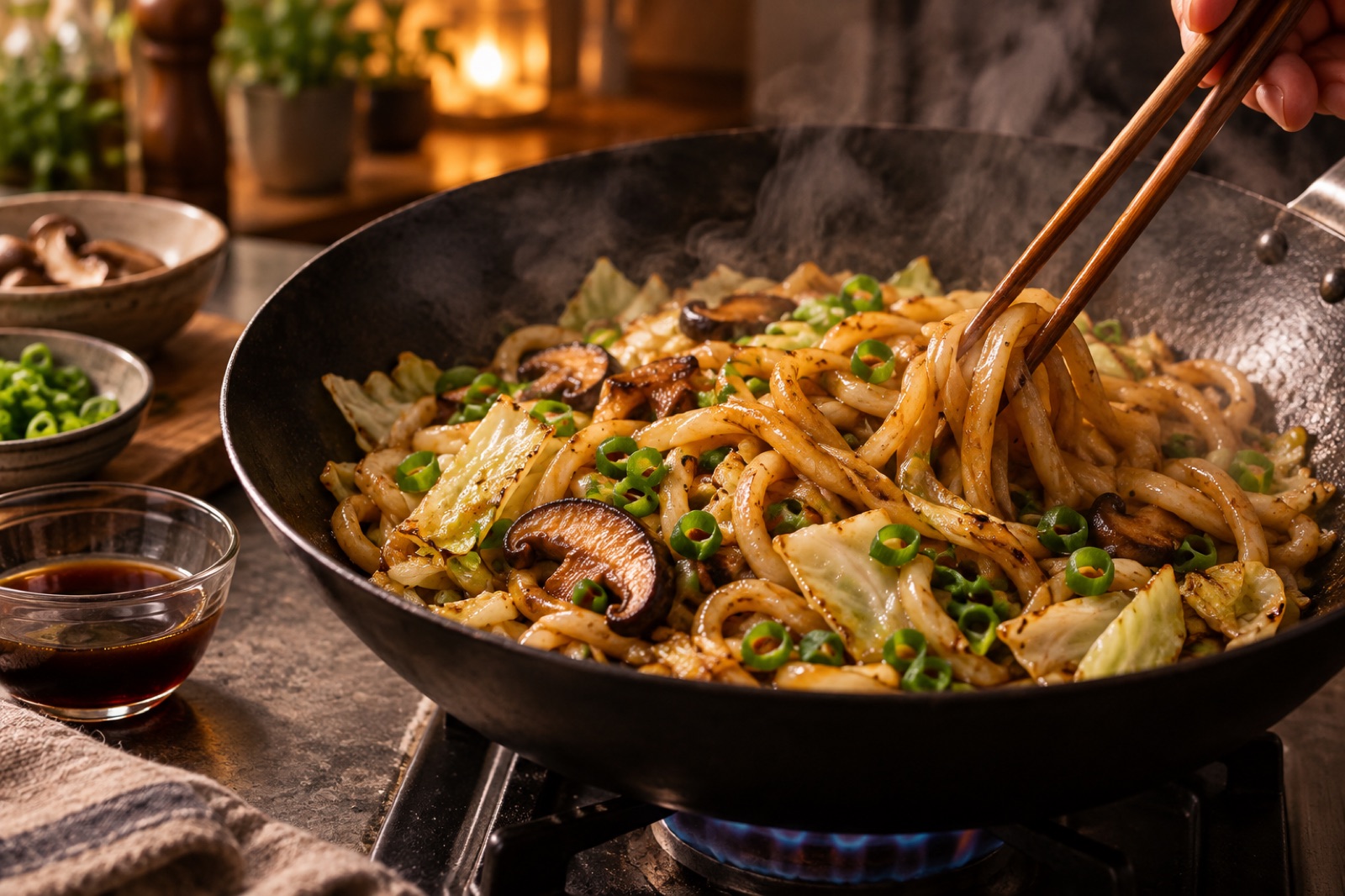
With a stir-fry, the liquid is there to season and help bring the ingredients together, not to fill a soup bowl. This makes it especially important to distinguish a concentrated seasoning from a fully diluted broth.
Kikkoman’s pork and udon stir-fry uses already-boiled noodles and a combination of soy sauce, sake and mirin, adding them after the pork and greens begin cooking. It is one specific yaki udon recipe, not proof that every version must use pork or the same sauce. It also demonstrates that bottled mentsuyu is not mandatory for every udon dish.
When adapting a recipe, change one major element with care. Replacing a cooked noodle with a dry one changes preparation. Replacing a concentrate with a diluted sauce changes liquid volume. Replacing a modest quantity of vegetables with a large bowlful changes what must cook in the pan. Several substitutions at once can make the original instructions a poor guide.
Start by preparing the noodles in the state the recipe requests. If a packet needs boiling or microwave heating first, complete that step. Do not force a rigid block apart with vigorous stirring and assume broken strands are inevitable. Follow the product’s loosening method before expecting the pan to coat separate noodles evenly.
Next, look at the vegetables before adding more sauce. Have you drained them after washing? Is there already liquid collecting in the pan? If so, the question is not automatically “Which stronger sauce should I buy?” You may first need to follow the recipe’s cooking sequence and let the ingredients reach the intended state before adding noodles.
A practical distinction helps: too much liquid and too little seasoning can happen together, but they are not the same problem. Adding more diluted sauce addresses neither cleanly. Adding a large dose of concentrate may increase seasoning while leaving the excess liquid. Stop and identify what changed from the recipe before stacking further adjustments on top.
For a vegetarian adaptation, choose an appropriate vegetable-based recipe or a clearly specified substitution, then check the finishing ingredients too. Bonito flakes are fish, even when they look like a decorative garnish. Do not remove the pork from a recipe and overlook everything sprinkled over the finished noodles.
The question “Is udon vegetarian?” is too broad for a particular meal. Plain noodles, broth, sauce and toppings are separate things to check. A vegetable stir-fry can use a fish-containing seasoning; a tofu-topped soup can contain fish stock.
A concrete label makes this clearer. Kikkoman Australia’s Dashi Tsuyu product lists fish powder and declares soy and fish, despite being described as gluten-free. That is information about that particular sauce, not an Indian availability claim or a description of every tsuyu. Nor does a gluten-free sauce make ordinary wheat udon gluten-free. See the manufacturer’s ingredient listing.
When ordering, identify your actual restriction and ask about the prepared sauce: “Does the broth or stir-fry seasoning contain fish, seafood or meat ingredients?” If you avoid egg, alcohol-containing seasonings, onion or garlic, ask about those separately. Vegetarian, vegan, Jain and halal requirements should not be silently treated as equivalent.
For home cooking, read the noodle packet as well as the bottle. If you need a particular dietary assurance, an attractive image of mushrooms or seaweed cannot replace the full ingredients and relevant certification. Formulations may differ between markets, so the pack you will use matters more than a photograph of another country’s version.
Our Japanese vegetarian food guide goes further into hidden ingredients and restaurant questions. For this meal, keep the check focused: noodle, sauce or broth, topping and finishing garnish. That is enough structure to avoid losing an important ingredient between the shopping basket and the table.
If you want to understand the noodle itself, a chilled dipping preparation provides a useful starting point: the noodle and sauce remain separate, so you can adjust how much sauce accompanies a mouthful. If you want a comforting broth-based meal, begin with hot udon and a restrained topping. If you want a seasoned noodle plate, choose a yaki udon recipe matched to the packet you have.
Keep a short note of what actually matters: noodle product and preparation, serving style, sauce product, concentrate and water amounts, and any strongly seasoned topping. That record is more useful than “add more flavour next time,” because it tells you what you can change without guessing.
On the next attempt, change one decision: perhaps the topping, the amount dipped per mouthful, or the draining step you previously rushed. You do not need to replace the noodle, sauce and cookware together. The point is to learn which part of the meal caused the result you noticed.
Udon’s range is the reward for that attention. A hot broth, a cold dipping cup and a glossy stir-fry can all begin with udon, yet offer quite different ways of eating it. Choose the experience first. Then let the package instructions, sauce dilution and final assembly support that choice.
AUTHOR OF THIS ARTICLE
SoJapan
SoJapan India Pvt. Ltd. is a Japanese-founded company based in Gurugram. We bring Japanese food, anime goods and apparel materials to Indian businesses, with a sister company in Kyoto that works directly with makers in Japan.