A bowl of water can be part of preparing wakame without being part of dinner. That distinction matters when you move from a packet of seaweed to a soup or a small dressed salad.
The first question is not how many minutes every kind of wakame needs. It is which preparation your product requires. A salt-preserved ingredient, dried pieces and a soft seasoned product do not arrive at the same starting line. Their instructions can differ without one of them being wrong.
This guide follows the water: what is used before the meal, what needs to be drained, and what belongs in the finished bowl. It compares identified products and complete methods rather than combining their quantities into an untested recipe. For shopping in India, the examples clarify preparation; they do not establish local stock or prices.
Maruya Wakame describes salt-preserved wakame as seaweed that has been blanched and salted. Its illustrated method washes off the salt, soaks the portion in water, then drains and squeezes it before cutting. The maker gives dried cut wakame a separate method with water or hot-water options and further draining. Read the two preparations side by side.
That distinction is worth resolving before following a recipe headed simply “wakame salad.” The recipe may be naming an ingredient whose preparation is described elsewhere. Check the ingredient list, the preliminary instructions and any linked basics page together.
Do not treat an unfamiliar packet as plain dried seaweed merely because it contains wakame. Riken’s Aeru Wakame-chan, namul-style savoury-salt flavour, is a soft, seasoned product that the manufacturer explicitly says needs no water rehydration. Its cucumber preparation mixes the product directly with the vegetable. The maker explains this ready-to-mix format here.
The implication is specific: this product supplies seasoning as well as seaweed. It is not evidence that you should skip preparation for an ordinary dried or salt-preserved product. Nor should a soaking routine for plain wakame automatically be imposed on it.
Keep the original product name and directions in view while choosing a method. “Wakame” tells you what seaweed is involved, but not everything that has happened to it before you opened the pack.
There is a small label trap here. Riken’s Hokkaido Fueru Wakame-chan is a dried product, yet its ingredient list names blanched, salted wakame. Its product page also says it can be used without washing. The ingredient line and the preparation directions are not contradictory: do not infer the finished product’s handling from the raw-material name alone. Check the manufacturer’s product description and ingredient list together.
If you use a translation tool on Japanese packaging, translate the preparation panel as well as the ingredient panel. Keep qualifiers such as “dried,” “after rehydration” and “no washing required”; a translation that reduces all three to “seaweed” has removed information you need.
Riken’s demonstration starts with 4g of its Fueru Wakame-chan and states that its weight increases more than tenfold after water rehydration. The page illustrates it returning in about five minutes. Those observations belong to that maker’s demonstration, not to every form of wakame. See the original weight comparison.
The useful lesson is about the label beside a number. A recipe asking for dried wakame and one asking for already-prepared wakame can give different masses without calling for different-sized finished portions. You cannot compare the numbers until you know the state being weighed.
As a hypothetical arithmetic example, an instruction specifying 2g of a dried product would require 4g for twice that batch. That doubles the ingredient; it does not predict a precise drained yield.
Before cooking, note whether each quantity means the contents as purchased, the portion after soaking, or the portion after draining.
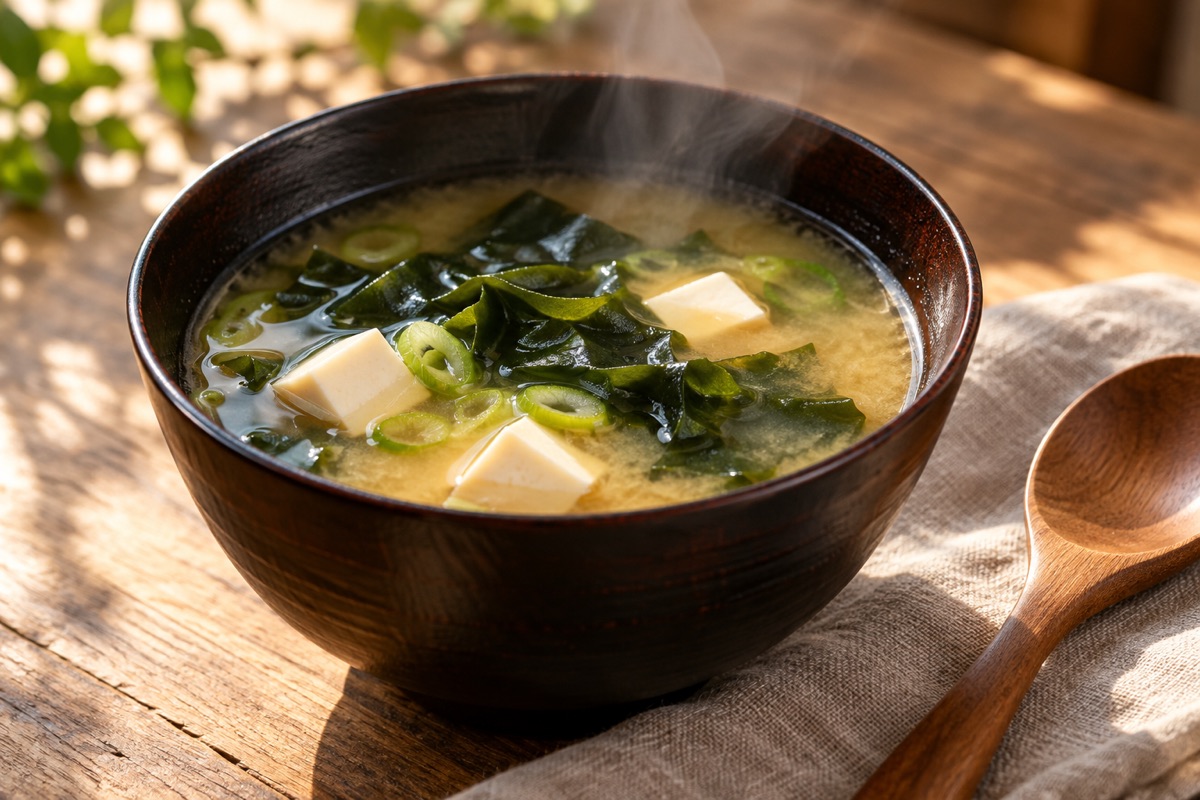
Some dried cut products genuinely allow a direct route. Kurakon describes its Tegaru Wakame as dried, cut seaweed that can go directly into soups and simmered dishes. For salads, vinegared dishes and other dressed preparations, the same page instead gives a five-minute water rehydration. That contrast is within one product’s instructions, not a disagreement between cooks. See Kurakon’s two uses.
“No separate soak” is the useful reading. It does not mean that the dry seaweed remains dry in the meal. The hot dish provides the liquid; a cold preparation needs its seaweed prepared before dressing. For a product that permits direct addition, follow the accompanying cooking directions rather than borrowing the cold-use timer as a soup cooking time.
Riken offers another concrete example: its cooking-hacks page adds dried wakame to a cup of noodles before pouring in hot water. On that same page, its cold olive-oil wakame dish starts by rehydrating according to the packet and draining well. The cold recipe includes tuna, so it is not a vegetarian meal merely because wakame appears in its name. Read both methods in the manufacturer’s collection.
The contrast helps answer a practical question: why prepare wakame separately if it will eventually be wet anyway? Because the eventual liquid has a different job. In the hot-noodle example it is part of preparing and serving the dish. In the cold example, the seaweed is ready before it meets the dressing. Treat those sequences as deliberate, not as interchangeable shortcuts.
Suppose you have a miso-soup recipe and a packet that explicitly permits direct addition. Read the recipe’s ingredient wording before changing its sequence. If it already specifies prepared, drained wakame, adding the same numeric weight dry would change the ingredient quantity. If it specifies dried wakame, a separate soak is a different intervention again.
Start with a recipe that names the form you have. It removes two uncertainties at once: what quantity to measure and when to add it.
Wakame also does not replace the broth or the miso. If your real question is why the soup tastes thin, excessively salty or unlike the version you expected, our guide to miso paste, dashi and soup flavour addresses those separate choices. Changing the seaweed’s soaking routine is not a complete diagnosis of the bowl.
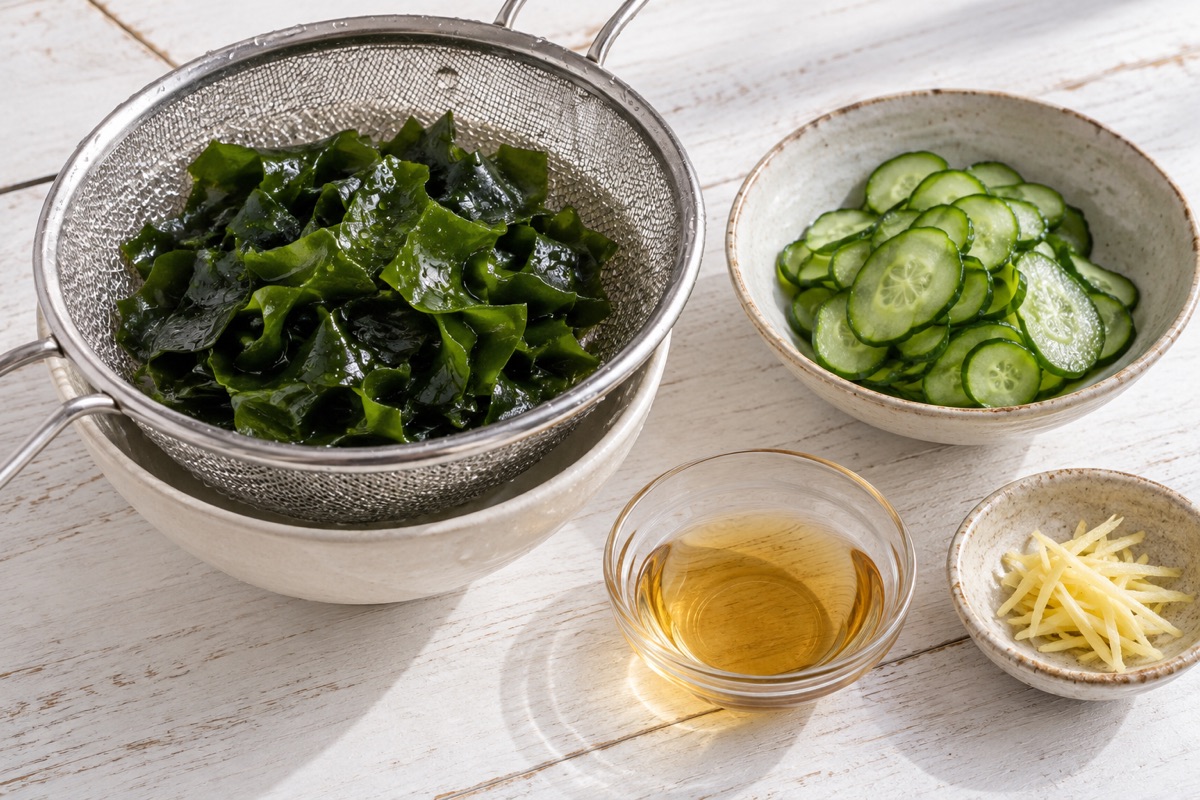
A vinegared wakame dish is a useful place to see why “wet” is not one preparation state. In Kikkoman’s sunomono lesson, cook Makiko Oda uses salted wakame, washes and soaks it, then completes further preparation and dries off the moisture. Cucumber is prepared separately. Crucially, the dressing is used in two stages: a small portion first, followed by light draining, then the remaining dressing and ginger. The lesson explains the first stage as removing moisture and giving an initial seasoning. Read Oda’s complete cucumber-and-wakame method.
This is more precise than “mix seaweed with vinegar.” There are two ingredients to prepare and an intentional drain between dressings. Do not collapse those steps into one toss while expecting to reproduce the lesson. Equally, it is one complete method, not proof that every wakame salad requires two dressings.
For a simple illustration, imagine 30ml of prepared dressing in a bowl. If you add another 10ml of plain water, there are now 40ml of liquid. The original dressing accounts for three quarters of that liquid. This is hypothetical arithmetic, not a tested salad ratio, an estimate of water retained by wakame, or a prediction that perceived flavour falls by exactly 25%.
It does explain why correcting the dressing first can send you in the wrong direction. If the preparation calls for drained ingredients but you transfer them with extra water, you have changed the mixture before considering its seasoning. Adding more soy sauce would make a different correction from reducing that unintended water.
Set up the bowl, strainer and any drying step before you start. Then follow the chosen method’s instruction: “drain,” “squeeze” and “pat dry” are not identical wording. Do not invent a universal squeeze strength for every product. The aim is to reach the recipe’s specified starting point for dressing, not to remove every possible trace of moisture.
It is tempting to concentrate on the unfamiliar seaweed and skim past a familiar cucumber. That gives the unfamiliar ingredient all the attention, even when the recipe assigns both ingredients preparation work. Read the vegetable steps with the same care as the wakame steps.
For an untested combination of your own, separate two decisions: how each ingredient becomes ready to eat, and how the ready ingredients are combined. A listed ingredient with no preparation step, or a soaking bowl with no drain instruction, is a gap to resolve before mixing.
Maruya’s salted-wakame method gives a short two-to-three-minute soak after washing, with a little longer for a softer result. Oda’s Kikkoman lesson gives 15–30 minutes for its salted wakame. These are different published methods. Taking their midpoint would create an instruction neither source gives.
Use the directions for the product in your hands and read the complete recipe around any timing advice. If a recipe’s assumed ingredient and your packet do not match, find a compatible method before beginning. A search result for “wakame soaking time” is not enough information to resolve that mismatch.
| What is uncertain? | What to check before cooking | What not to assume |
|---|---|---|
| The packet says “wakame” | Finished product format and preparation panel | That the seaweed name supplies the whole method |
| The recipe gives grams | Whether the amount is dry, soaked or drained | That equal numbers mean equal finished portions |
| Soup permits direct addition | The same product’s instructions for your dish | That a separate cold salad needs no preparation |
| Two timers disagree | Product identity and both complete methods | That averaging them produces a reliable instruction |
Keep the product name, the quantity’s state and the preparation sequence in your cooking notes. “Five minutes was wrong” is much less informative than a record of which product and method you actually used.
For a first purchase, the most helpful product photograph may be the preparation panel rather than the front of the bag. A retailer’s short English title can omit the distinction this entire cooking decision depends on. If the directions are not shown, ask for a clear photograph of the actual pack you would receive.
Look for the product name, format, ingredient list, preparation directions and storage instructions. Keep them together. A photo of a different size or flavour is not automatically a reliable substitute, and a maker’s current website can describe a revision that differs from older stock. The actual pack needs to be legible enough to use.
For storage, distinguish the unopened product from a portion you have already prepared. Riken’s Hokkaido product page gives room-temperature storage away from heat, moisture and direct sunlight for the unopened pack. That is not a storage instruction for rehydrated seaweed or a finished salad. Follow the relevant pack’s after-opening directions; do not extend its dry-product date to a wet leftover.
If you eat vegetarian meals, check the whole product and the whole recipe, including the soup base and dressing. Seaweed as the named ingredient does not establish the composition of a seasoned mixture or a finished bowl. For a different use—seasoned toppings intended for rice—our furikake ingredient and preparation guide explains why the mix, not just its most conspicuous ingredient, matters.
There is no need to choose among the Japanese examples above as if they were a verified Indian shopping list. They demonstrate differences to recognise. If the packet available to you has clear directions for the meal you want, that information is more useful than a familiar brand name accompanied by an incomplete listing.
Before starting, be able to finish this sentence: “I am measuring this wakame in this state, preparing it by this method, and adding it to this dish at this point.” If one part is missing, solve that gap before guessing at a timer or a quantity.
For soup, establish whether the particular dried product permits the cooking liquid to do the work. For a dressed salad, establish how the seaweed and its partner ingredients reach the mixing bowl. A soft seasoned product may have a different route altogether.
The useful skill is not memorising one soaking time. It is knowing which water prepares the ingredient and which liquid you intend to eat.

AUTHOR OF THIS ARTICLE
SoJapan
SoJapan India Pvt. Ltd. is a Japanese-founded company based in Gurugram. We bring Japanese food, anime goods and apparel materials to Indian businesses, with a sister company in Kyoto that works directly with makers in Japan.