Fresh panko can be fine. Dried panko can be coarse. That small correction is a useful starting point if you have been treating Japanese breadcrumbs as a choice between two complete opposites.
Frystar sells a fresh-panko range in coarse, medium and fine versions. Its dried household range also includes a coarse-particle product. Moisture and particle size are separate descriptions, even when a familiar packet happens to combine them in one particular way.
There is another decision beneath those crumbs: how they will attach to the food. A recipe may ask for separate flour and egg stages, use a mixed coating liquid, or specify a product with its own method. Buying the crumb you want does not settle that part.
This guide treats those as practical cooking choices. It is not a ranking of Japanese brands, a claim about Indian stock or a promise that one change will explain every failed coating. The useful aim is to know what you are changing before the oil is hot.
The word nama can be confusing on a food label. With panko, do not picture raw dough waiting to become bread in the frying pan.
Frystar’s manufacturing explanation shows bread being baked, cooled and made into crumbs. The process then divides: dried panko goes through a drying stage, while fresh panko is packed without that stage. That distinction explains the name without turning it into a claim that fresh crumbs were made in your local shop that morning.
For a home cook, the immediate consequence is a better question to ask of a packet. “Is this fresh or dried panko?” identifies a kind of ingredient. “How should I keep this after opening?” identifies an instruction you still need. One word on the front cannot replace the second answer.
Nor should the word fresh become an automatic quality score. If a recipe is written for the dried crumbs you have, a different packet is a change of ingredient, not an upgrade that requires no other thought.
A useful producer example comes from Kyoei Food’s product guide. It organises moisture and particle size as different categories. For its crumb sizes, it associates coarse particles with a fuller-looking coating, while fine particles are suited to smaller or softer ingredients.
Those are the maker’s selection descriptions, not measurements of the packet in your kitchen. They suggest a more precise way to choose: ask whether you want a conspicuous crumb outside a substantial piece, or a coating suited to a smaller or softer item. “The biggest crumbs must be best” is not a useful answer to both questions.
Suppose, as a hypothetical shopping comparison, one listing says only “fresh panko” and another says “coarse dried panko.” The second listing has answered a particle-size question that the first has left open. You cannot fill in the missing detail by assuming fresh always means large.
This is also where the filling matters without becoming the whole subject. Our korokke guide distinguishes mashed and white-sauce centres. Once you know which preparation you are making, crumb choice can serve that dish. It does not need to imitate the thickest crust in a photograph of something else.
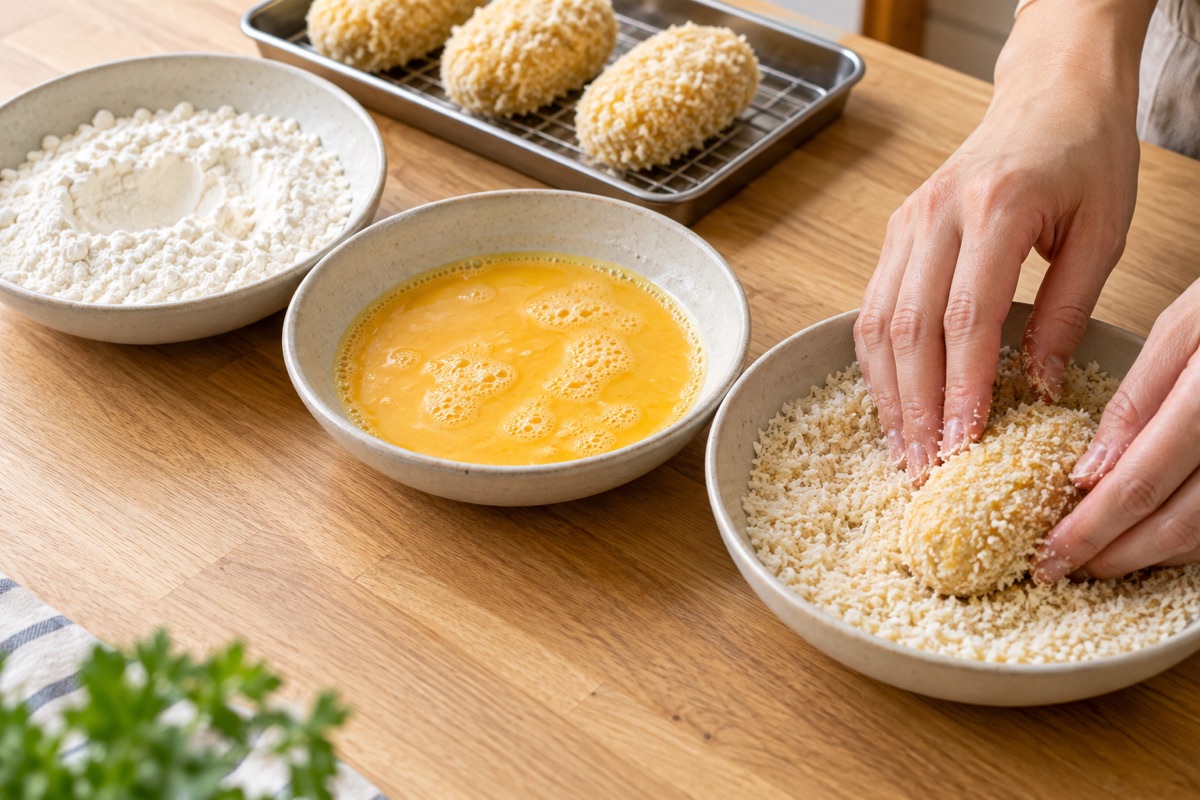
Hokuren’s breading guidance sets out a flour–beaten egg–breadcrumb sequence. It calls for a thin, even flour coating, removal of the excess, then egg and crumbs, with a light press to settle the coating.
Read that as a sequence, not three items to put on the food in any order. Our practical suggestion is to check each stage before moving to the next. If the flour coverage is uneven, piling more crumbs on top does not tell you whether that earlier instruction was followed.
The sides deserve attention too. In Yokoyama Foods’ tonkatsu guidance, the maker explicitly includes the edges when applying panko. The food has more surface than the broad face visible from above. Turning a piece over once may still leave you overlooking the narrow surfaces around it.
That observation is not a diagnosis of your last batch. Coating trouble needs the actual recipe and handling details. It does, however, give you something specific to examine on the next attempt instead of immediately replacing the breadcrumbs.
A different preparation can build the underlying layer differently. Kikkoman’s Japanese tonkatsu lesson uses a flour dusting followed by an egg-and-flour coating mixture, then panko. It explains the dusting as helping the coating adhere and stresses even coverage, including the sides.
So “use a batter” does not necessarily mean “skip every separate flour step.” Read the actual sequence. A combined liquid in one recipe is not permission to remove a stage from another.
Yuko Ihara’s English-language Kikkoman tonkatsu lesson takes another route: it mixes water into beaten egg before coating the floured pork. The explanation is that the smoother mixture spreads more evenly and helps the crumbs adhere. This is not the egg-and-flour mixture in the Japanese lesson above.
That difference is worth noticing before you arrange your bowls. “Egg mixture” is shorthand, not an ingredient specification. One recipe’s liquid may contain something the other uses at a separate stage. Copying the number of bowls without reading their contents can conceal a change in method.
For example, imagine reading the Japanese lesson for the dusting step, then switching to the English lesson for the egg bowl because the photographs look similar. You have now selected parts of two recipes. The sensible next step is to go back and choose one complete version, not to assume that the photographs establish equivalence.
There are real exceptions to the familiar layered method. Frystar’s Karikari Shokkan Soft Panko, marketed for cooking with less oil, says that it can be pressed directly onto bite-sized meat without separately using flour and egg.
Both qualifications matter: the named product and the bite-sized meat. This is not evidence that any panko will attach directly to a whole cutlet, a soft croquette or a vegetable. Nor is it a universal instruction to delete ingredients from the recipes above.
The maker also places this “soft panko” in its dried-panko category. Soft therefore should not be used as your translation of fresh. It is possible for the marketing language and the ingredient category to describe different aspects of one packet.
Here is the practical comparison. These are descriptions of the linked methods, not three interchangeable recipes.
| Method in the source | What precedes the crumbs | What to preserve |
|---|---|---|
| Hokuren’s basic breading | Thin flour coating, then beaten egg | The separate stages and removal of excess flour |
| Kikkoman’s Japanese tonkatsu lesson | Flour dusting, then an egg-and-flour mixture | The dusting still happens before the mixed liquid |
| Frystar’s named direct-coating product | Direct application to bite-sized meat | The product and ingredient conditions of the exception |
On a phone, swipe the comparison sideways. Keyboard users can focus the table region and use the arrow keys.
A preparation instruction tells you what to add. It does not supply the complete ingredient or allergen information for the packet itself. If you need an egg-free meal, the omission of an egg bowl is only one part of the question.
For vegetarian cooking, the direct-meat example is not a tested vegetable adaptation. Look for a complete method designed for the food and coating you intend to use. Our Japanese vegetarian food guide gives the broader ingredient-checking context; here, the important point is not to turn a convenient cooking claim into a dietary guarantee.
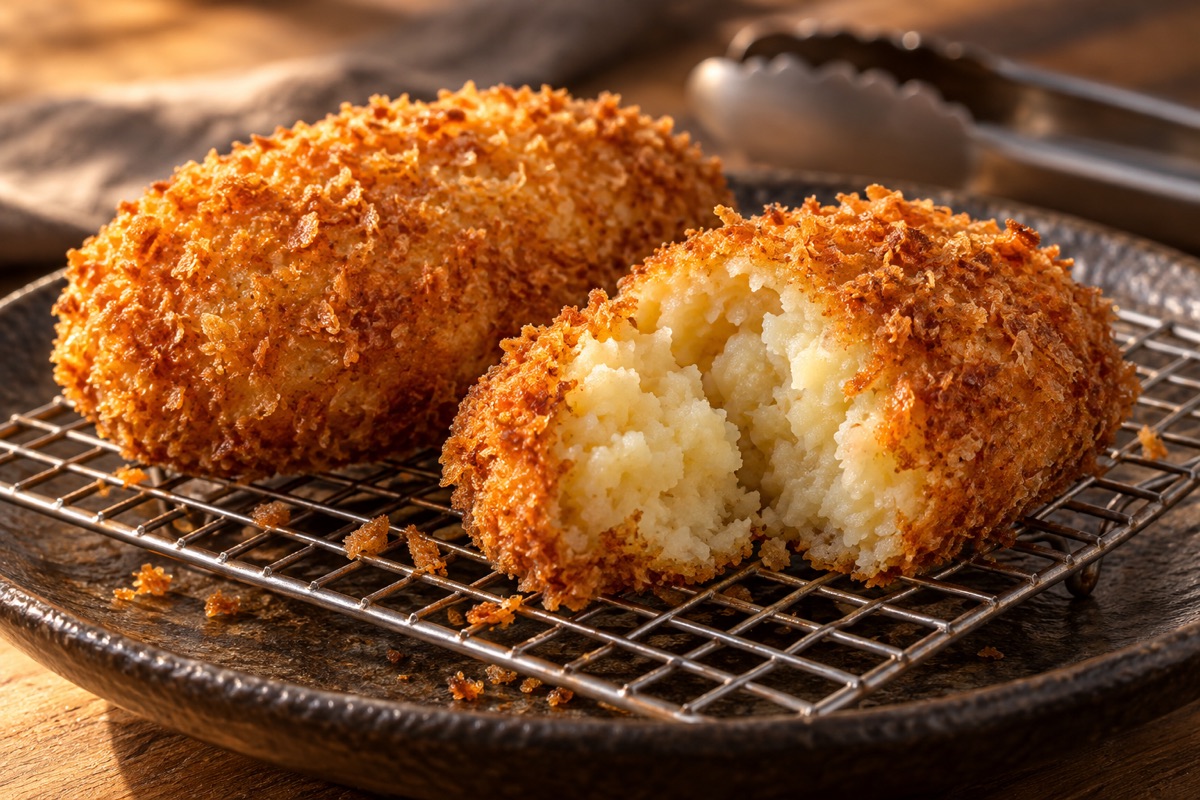
The first useful observation is when the problem appears. Did you struggle to cover the food before frying? Did the coating come away while you moved it? Or did it remain attached but give you a different bite from the one you wanted?
Those observations describe different problems. Our suggested troubleshooting approach is to write down what happened before choosing a remedy. “The panko was wrong” is too broad to help with all three.
Return to the layers and edges described earlier. Check whether you followed the chosen method’s thin dusting, liquid coating and crumb application, where those stages are required. Record any ingredient you omitted or replaced.
The purpose is to identify a specific departure, not to accuse the cook of being careless. A shortened recipe note such as “bread the pieces” can hide several actions from a beginner. Finding a fully illustrated method may be more useful than buying another brand.
Avoid changing crumb type, wet coating and the food’s shape all at once in the next attempt. If several things change together, even a better result will tell you little about which change helped. That is an editorial recommendation for learning from the attempt, not a claim that only one variable ever matters in cooking.
In Ihara’s Kikkoman lesson, the breaded pork rests before frying, and the instructions caution against touching it immediately after it enters the oil because the coating can come off. Follow the complete handling sequence in that recipe if it is the one you choose.
This gives you another question to ask of an unsuccessful attempt: did you move the food at a point when your method said to leave it alone? A crumb-size comparison cannot answer a timing-and-handling question.
Do not interpret “leave it alone” as leaving heating oil unattended. It concerns moving the food, not abandoning the cooker. The FDA also cautions that colour and texture are unreliable safety indicators: use a food thermometer and the appropriate safe internal-temperature guidance for the food inside, not the colour of its crumbs. FDA safe food handling
Now particle choice becomes a more useful subject. Compare the actual crumb description with your intended result rather than treating successful attachment as proof that you should like the texture.
For a deliberate comparison, make a short note of the packet and recipe before you start. Afterward, describe what you wanted to change: a less prominent coating, for example, rather than simply “better panko.” That gives you a clearer question to take to the next recipe or product description.
Our tempura guide covers a different coating and its serving formats. A crumbed coating does not become failed tempura because it has a more obvious breadcrumb structure; the preparations should be understood on their own terms.
The fresh–dried distinction becomes practical again after you have taken out the amount needed.
Frystar’s current FAQ gives different after-opening directions. For its dried crumbs, it says to close the bag and keep it in a hard, sealed container at room temperature. For fresh crumbs, it says to remove the enclosed oxygen absorber or similar quality-preserving sachet, close the bag securely and store it in the freezer. It also warns against microwaving the oxygen absorber.
These are the manufacturer’s directions, not a storage rule for every product in every climate. Follow the actual pack in your kitchen. Check whether its instructions refer to the unopened product, the opened product or both; those are different situations.
Our practical suggestion is to read this part before opening, while the wording is still easy to find. Keep the label with the stored ingredient so you do not lose the identification and handling instructions when transferring or folding the bag.
An opened bag of unused crumbs and crumbs that have been used to coat raw food are not the same situation. The manufacturer’s bag-storage directions should not be read as permission to return used breading to the packet.
The FDA’s food-safety guidance calls for separating raw meat, poultry, seafood and eggs from other foods, and cleaning utensils and surfaces. Applied to a breading station, that means keeping the clean supply separate. Do not put crumbs that have contacted raw meat or raw egg back into the original bag.
This is another reason to distinguish “left in the packet” from “left on the worktop.” The two may look like the same ingredient, but they have not been handled in the same way.
Start with the finished item you want to make, then choose a complete method that suits it. You do not have to buy the brands used as examples here; the links show what their makers or recipe authors actually instruct. They do not establish Indian availability, a local price or a tested substitution for an item in your shop.
Before shopping, identify the missing answer. If the recipe specifies fresh panko and the listing merely says breadcrumbs, the question is about the ingredient. If you already have the specified crumbs but do not understand the egg mixture, another packet will not explain the method.
If a recipe only says panko, look for additional guidance or photographs from that author rather than inventing a more specific requirement. You can ask whether a fine or coarse crumb is intended without assuming there is one correct particle size for every Japanese fried dish.
And if the preparation does not meet your dietary requirements, choose another complete recipe before beginning. The pork recipes here make their coating sequences easy to compare; they are not a suggestion that every reader should cook pork or that replacing it with any other ingredient preserves the same cooking method.
The distinction to carry away is small enough to remember at the counter: choose the crumb, follow the attachment method, and keep the packet’s handling instructions with it. Freshness, size and adhesion answer different questions. Once you stop asking one label to settle all three, panko becomes a much more manageable ingredient.

AUTHOR OF THIS ARTICLE
SoJapan
SoJapan India Pvt. Ltd. is a Japanese-founded company based in Gurugram. We bring Japanese food, anime goods and apparel materials to Indian businesses, with a sister company in Kyoto that works directly with makers in Japan.