Pumpkin sounds like a clear answer to “What is inside this croquette?” It is less clear than it looks. Kikkoman publishes a croquette recipe built around cooked kabocha squash. Japanese producer Toumei Foods includes kabocha in its cream-croquette range. The same vegetable name can point towards two different kinds of centre.
That is the useful distinction when choosing korokke, Japanese croquettes: what forms the filling, and what is added to it? A potato mixture containing meat is not the same proposition as a meat cutlet. A crab-flavoured cream croquette is not simply a piece of crab wearing breadcrumbs.
For a newcomer reading a Japanese menu in India, recognising the word is only the beginning. You may want a mashed filling with some body, or you may be curious about a thick white-sauce centre. You cannot reliably make that choice from a golden exterior or a vegetable name alone.
This guide uses named Japanese recipes and a producer’s descriptions to explain those differences. It is a way to read a menu or recipe more intelligently, not a taste test, a list of Indian stockists or a universal frying method.
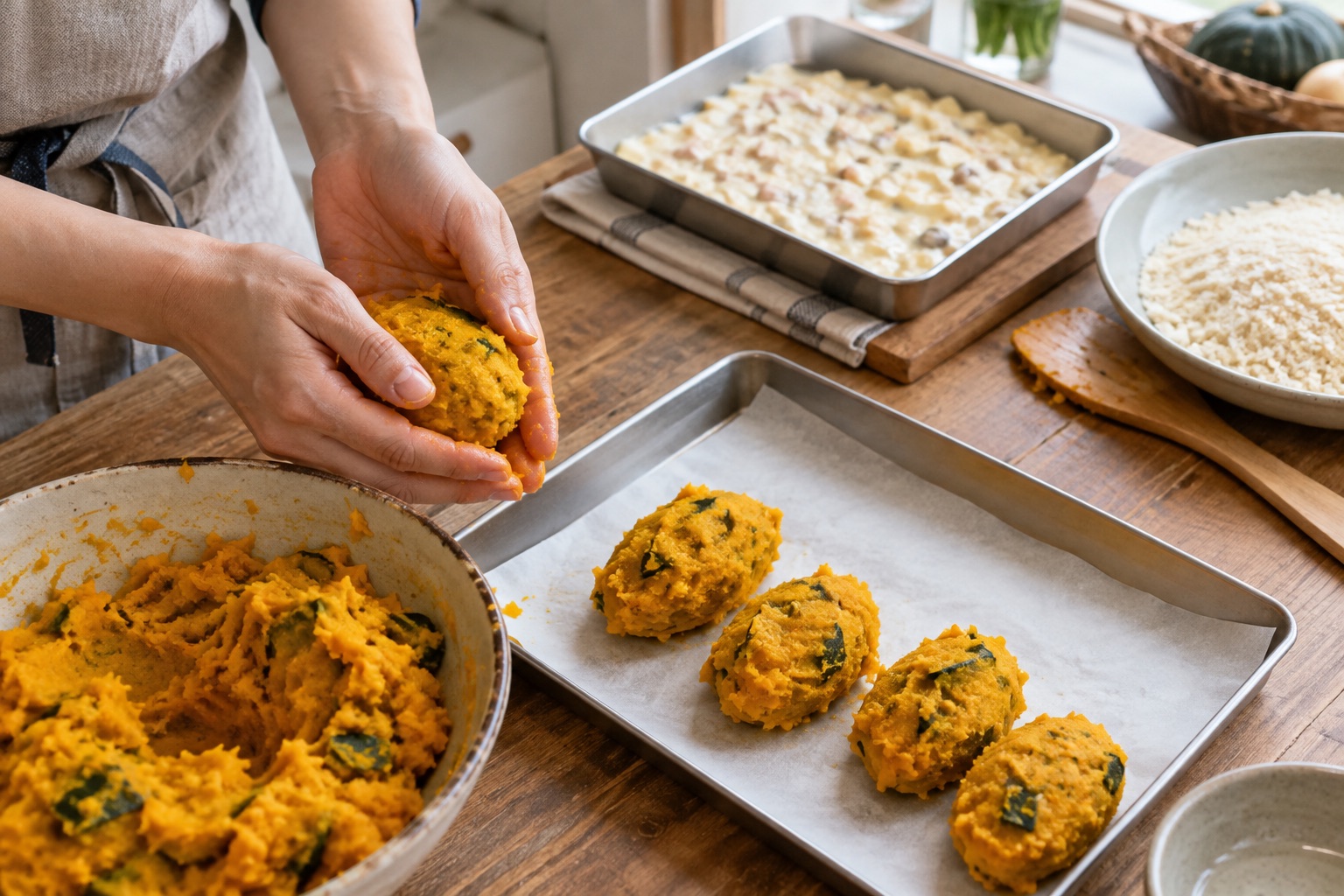
The two pumpkin examples are useful precisely because neither needs to be declared the correct one.
In Kikkoman’s Kabocha Squash Croquettes, cooked squash is combined with a separately cooked mixture of ground pork, beef and long onion, then shaped and breaded. The squash forms the substantial vegetable part of the filling. It is not a meat-free recipe despite the vegetable-led title.
Toumei Foods, by contrast, describes a milk-based béchamel cream-croquette range with variations including kabocha, corn and crab. Here, kabocha appears within a cream-style category. The maker’s own description is evidence of its product approach, not a guarantee about every item called pumpkin korokke elsewhere.
Our reading of that comparison is straightforward: a flavour label and a structural description do different jobs. “Pumpkin” identifies an ingredient. “Cream” gives you a different clue about the kind of filling surrounding or incorporating it. Asking which of those questions a menu has answered prevents a fairly ordinary misunderstanding.
This matters even when you have no dietary restriction. You might like pumpkin but specifically want a mash-like centre. Someone else might want the white-sauce style and be happy with several different additions. Both preferences are more precise than asking which pumpkin croquette is “best.”
The table below is a reading aid, not a claim that these are the exact words used on a particular restaurant’s menu. The named preparations are discussed and linked in this guide.
| Description | What it helps identify | What still needs checking |
|---|---|---|
| Potato korokke | A potato-led centre | Meat, onion and other additions; the name is not an ingredient list |
| Kabocha or pumpkin croquette | The featured vegetable | Whether it is a squash-based mixture or a cream-style filling |
| Crab cream croquette | A cream-style centre with crab | The actual dairy, coating and sauce ingredients |
| Menchi katsu | A minced-meat cutlet, rather than potato merely containing meat | The meat mixture and other ingredients used |
If a menu already says “mashed pumpkin filling,” it has answered more than “pumpkin croquette” alone. If it says “pumpkin cream croquette,” do not silently translate that back into a ball of mashed pumpkin. Read the extra word as useful information, not decoration.
Kikkoman’s Potato Croquettes combine mashed cooked potatoes with fried pork and onion. The mixture is cooled and shaped before receiving flour, egg and panko breadcrumbs. This is a concrete example of a potato-led filling with meat dispersed through it, rather than a coating wrapped around a whole piece of meat.
For choosing purposes, keep two descriptions separate: potato-based and plain potato. The first says what gives the filling its identity. The second suggests a much narrower ingredient expectation and should not be assumed from the first. That distinction is especially useful if a short English menu has compressed a longer dish description.
Potato variety can add another clue. House Foods’ potato guide describes Danshaku as floury and suited to preparations such as mash and croquettes. It contrasts this with May Queen, which is firmer and resists breaking apart in stews. Those are culinary texture distinctions, not a ranking in which one potato is better for everything.
If you see Danshaku named on a product, then, it is worth reading as information about the potato choice. It is not an instruction that an Indian home cook must obtain an imported Japanese variety before attempting korokke. For cooking, look for guidance that explains the required potato behaviour and gives a workable recipe for the ingredients you can actually obtain. Do not invent a one-to-one equivalence between local and Japanese variety names.
There is a useful limit to what labels can tell you here. “Floury potato” helps describe an ingredient; it does not specify the final balance of potato, meat, onion and seasoning. Nor does it tell you how finely the cook has mashed the filling. If a menu gives more detail about a smooth or textured centre, that is additional information, not something that follows automatically from the word potato.
For a first choice, favour a clear filling description over an unexplained claim of premium quality. You do not need to rank every potato cultivar to decide whether the centre sounds right for you.
The cream version requires a different mental picture. Think of a prepared white-sauce filling, not a hollow breadcrumb shell into which liquid cream has been poured.
In Meiji’s crab cream croquette recipe, butter, onion and flour are cooked before milk is added and thickened; canned crab is incorporated. The filling is spread out and cooled until firm enough to divide and shape, then coated with flour, egg and panko. Cooling is therefore part of making a manageable filling, not merely a pause after the dish is finished.
There is also a naming trap: the centre here uses milk; whipping cream is in the accompanying ketchup sauce. The dish name is not a formula specifying pouring cream. Other recipes may use it differently.
Why does that distinction help someone who is not cooking? Because “creamy” can otherwise become an unhelpfully vague promise of richness. The more useful contrast here is between a sauce-based centre and a mashed-vegetable centre. Neither is automatically the more luxurious choice. They offer different things to someone deciding what they want inside the coating.
If you are comparing two cream croquettes, ask about their additions after identifying that common base. If you are comparing a potato croquette with a cream croquette, settle the base question first. Changing both the base and the featured ingredient at once makes it harder to know which difference you care about.
For example, suppose you are choosing between a clearly described potato-and-onion version and a crab cream version. This is a hypothetical choice, not a report of a restaurant menu. You are comparing more than potato with crab: you are also choosing between mash and white sauce. If the crab is the only attractive part of the description but you do not want a sauce-based centre, the name has already given you a reason to ask for another option.
This is where the question “Does it contain meat?” stops being enough. It is essential for some ingredient checks, but it does not fully identify the dish.
The earlier potato recipe contains pork. Yet the potato mixture remains the starting point for understanding its centre. In Toumei Foods’ descriptions, menchi katsu is made from a pork-and-onion mixture, while its pork-loin katsu uses slices of loin. That gives us three different arrangements: meat added to a vegetable mixture, a formed minced-meat cutlet, and a whole slice of meat.
These are useful distinctions before discussing sauce, size or shape. If someone recommends a breaded meat item, ask which arrangement they mean. Otherwise, two people can agree that a dish contains pork while imagining quite different things beneath the crumbs.
We would not use the exterior shape as a substitute for that explanation. A photograph can show that something is oval, round or barrel-like. It cannot establish a complete filling or ingredient list. The shape may help you match an item to its label in a particular display; that does not turn it into a universal code for Japanese fried food.
The same caution applies to a photograph of a cut-open croquette. It can be helpful evidence of the broad structure, especially when paired with a description. It still cannot identify every seasoning or distinguish all ingredients by colour. Treat a cross-section as one piece of information, not the entire answer.
If your interest is specifically a cutlet with curry and rice, our Japanese curry guide explores that meal format. Do not carry the expectation of a sliced meat cutlet over to every item with a similar crumbed exterior.
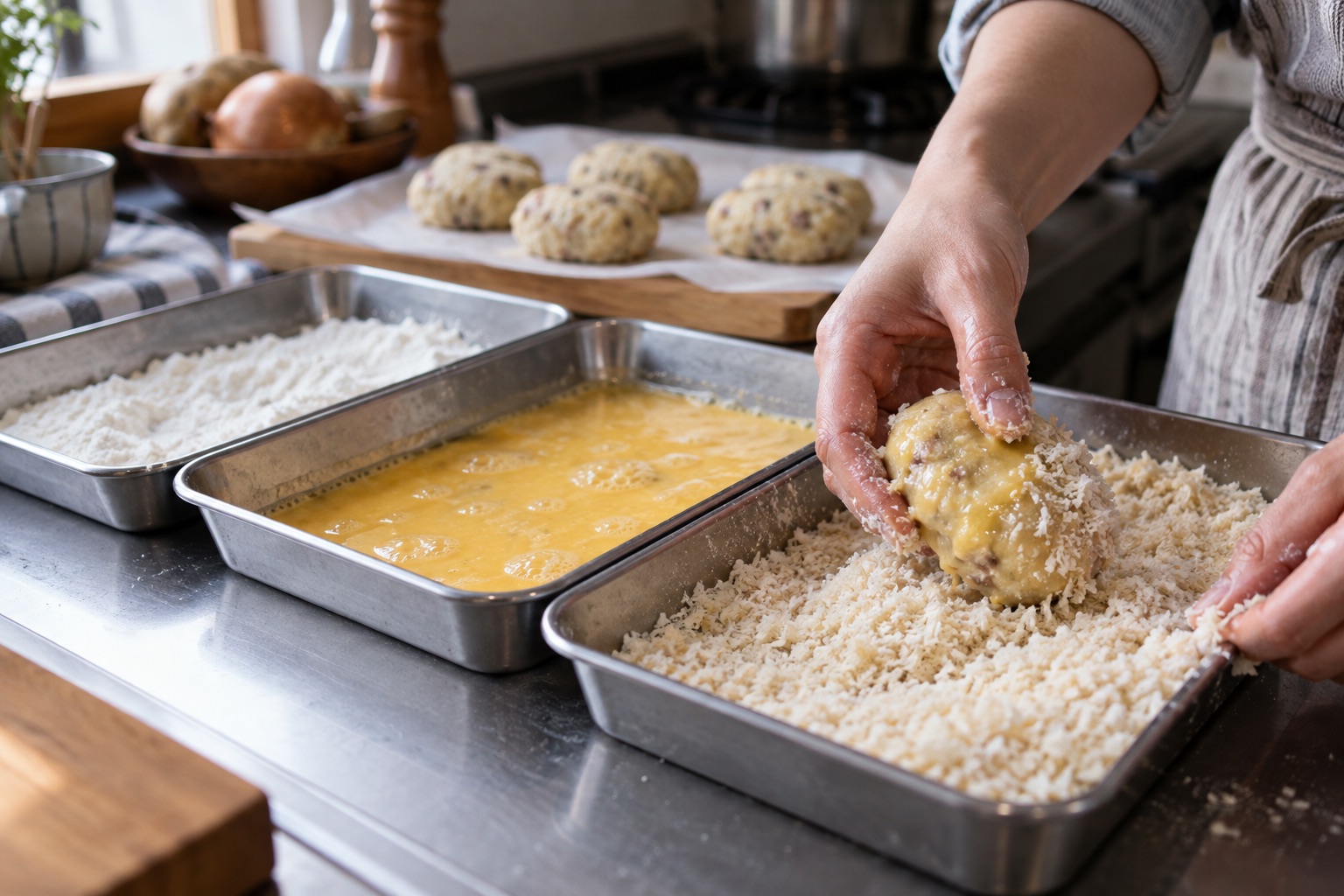
A useful way to assess a korokke recipe before shopping is to find the point where it asks you to form the filling. Then read backwards: what has to happen before the mixture reaches that state?
This is an editorial planning method, not an extra cooking technique. It helps reveal work that a photograph of the finished croquette hides. The potato and cream recipes linked above arrive at shaping through different preparations. Neither begins with the final coated object ready to drop into a pan.
Separate the recipe into three kinds of work: preparing the centre, making it ready to handle, and coating and frying it. Keep the original instructions within those stages. Do not take the centre from one recipe and assume the quantities or timings from another will still fit.
The practical question is not simply “How long does frying take?” It is “When will the filling be ready for the next step?” Meiji explicitly excludes cooling and setting time from its displayed cooking-time estimate. Reading that note matters more to planning dinner than copying the headline number into a schedule.
Before starting, check whether you have space for the filled tray or plate the recipe requires, the ingredients for the coating, and time for the stages that cannot be skipped. These practical constraints help you decide whether to make that recipe today or choose a different one.
Ingredient substitutions deserve the same care. A recipe name is not a substitution chart. Replacing a mash-based centre with white sauce changes the preparation you need to follow; it is not equivalent to changing one named addition. For a dietary adaptation, use a recipe designed for that adaptation instead of deleting ingredients and assuming the remaining method has been tested.
That is also why this guide does not provide one universal frying temperature or time for all korokke. Use the full recipe for your chosen preparation, including its size, coating and cooking directions. This article helps you select and understand that recipe; it does not replace it.
For a comparison with a different Japanese coating, our tempura guide explains batter and ingredient preparation. Breadcrumb-coated croquettes and tempura need not be forced into a single set of instructions just because both are fried.
Korokke need not be approached only as an isolated snack. In his October 2012 Food Forum essay, historian Yo Maenobo places korokke within yoshoku: Western-influenced dishes adapted to Japanese meals, including rice-based eating and bento. This is historical context, not evidence of what any particular shop serves today.
For a present-day order, the useful follow-up is simply to ask what comes with the item. Are you ordering individual croquettes, or does the listing describe a meal? Decide that before comparing prices or portions across unlike menu entries. This guide does not assume an Indian restaurant’s serving size or inclusions.
Accompaniments are another reason to read the full description. Kikkoman’s potato recipe serves cabbage and tonkatsu sauce; Meiji’s crab version uses the different sauce described earlier. Neither example establishes a compulsory sauce for the entire category. If you have a strong preference, check the actual serving rather than treating one recipe photograph as the rule.
For vegetarian or other ingredient requirements, make the question concrete. The recipes above show why a vegetable-led name is inadequate, but they do not establish what another kitchen uses.
Check the centre, the coating and the accompaniments separately. If you need to avoid a particular ingredient, name it clearly and ask about the actual preparation. For an allergy, shared equipment and handling also need confirmation from the maker or kitchen; a dish name or a general article cannot provide that assurance. An unclear answer is not a basis for calling the food suitable.
Keep the two decisions in order. First, identify a preparation that meets your ingredient requirements. Then choose the filling structure you would enjoy. No texture preference can resolve an unanswered suitability question, and no vegetable-led name should be asked to do the work of a full ingredient check.
Once those questions are settled, choosing korokke becomes much simpler. You do not need to recognise every shape in a display or memorise a catalogue of variations. Find out what forms the centre, what has been mixed into it, and how it is served. The crumbs may look similar; the filling is where your choice becomes specific.

AUTHOR OF THIS ARTICLE
SoJapan
SoJapan India Pvt. Ltd. is a Japanese-founded company based in Gurugram. We bring Japanese food, anime goods and apparel materials to Indian businesses, with a sister company in Kyoto that works directly with makers in Japan.