Before the knife touches an omurice, ask one question: what is inside that yellow oval? Rice, or the interior of an omelette sitting above the rice?
The distinction explains why two dishes that look similar in a photograph can involve different cooking tasks. It also explains why searching for a “fluffy omurice recipe” does not necessarily lead to the version you had in mind.
Omurice brings together egg and seasoned rice. If you first recognised it through anime, our guide to Japanese foods from anime gives the broader introduction. Here, the question is more specific: how does the egg get into its final position, and what should that tell a beginner choosing a recipe?
The examples below come from Japanese food makers’ published methods and a documented restaurant presentation. They are not a taste test or a claim that a particular version is available in India. Nor is this a complete cooking recipe: the linked methods supply their own ingredients and instructions. The purpose is to help you choose the task you actually want to learn.
Kewpie provides a useful counterexample to the idea that fluffy egg must mean the knife-reveal version. Its recipe titled Fluffy Egg Omurice mixes mayonnaise into the egg, places rice in the centre, brings the egg edges over it and turns the serving onto a plate. The maker describes a soft texture, but the construction still wraps rice. Kewpie’s recipe
That is the first distinction worth making: an adjective describes an intended eating quality; an assembly instruction describes a physical action. They answer different questions. Neither word should silently stand in for the other.
When reading a translated recipe, look beyond the title to the verbs. Does the cook put rice into egg, put egg onto rice, or cut an omelette after plating? You do not need to know specialist terminology to identify those actions. A short ingredient list, by contrast, may leave the answer completely unclear.
This matters when choosing what to practise. If the part that interests you is enclosing a filling neatly, search for a method that actually encloses one. If you want the dramatic opening, make sure the instructions include that stage. Otherwise you may follow a perfectly reasonable recipe and still judge the result against a different dish.
Here is a compact way to compare the three descriptions used in this article. The final column is an editorial reading aid, not a difficulty score.
| Description | Egg and rice relationship | What to look for in the method |
|---|---|---|
| Wrapped | Rice becomes the enclosed filling. | Rice placement, folding and transfer to the plate. |
| Topped | Egg is added over the rice. | How the topping is cooked and transferred; no opening is necessarily involved. |
| Cut-open | An omelette sits above the rice before opening. | Formation of the closed omelette and the separate finishing cut. |
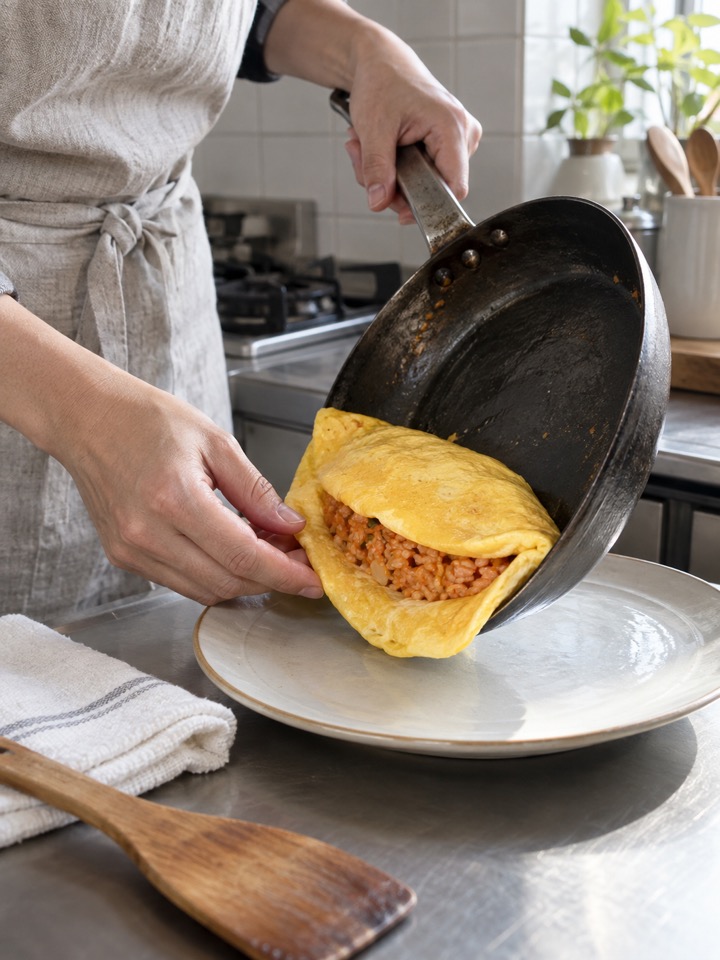
Kagome’s VEGEDAY tutorial makes the wrapped construction explicit. Prepared rice goes in a line across the centre of the egg in the pan. The egg is brought around it, and the serving is inverted onto a plate. The tutorial allows the shape to be refined with kitchen paper after transfer; it does not demand a perfectly tight enclosure before leaving the pan. Kagome’s illustrated wrapped-omurice tutorial
The important observation is where the filling enters the process. This method joins rice and egg before plating. Its shaping problem is therefore different from placing a separately made omelette on top of a finished mound.
For a beginner, the tutorial is worth viewing as a sequence of changing positions rather than as a photograph to copy. Identify the filling, the surface being folded and the final transfer. Those are the stages to understand before treating the finished outline as the sole measure of success.
There is also a useful difference between learning a form and reproducing a performance. You might want the compact, enclosed serving you recognise from a drawing. That is a clear goal in its own right. It does not need an additional table-side trick to become worthwhile.
A second method on Kagome’s omurice recipe page takes a different route. It plates portions of chicken rice with sliced cheese, then adds a separately cooked soft egg mixture over them. A demi-glace-style sauce finishes the dish. There is no closed omelette to slit open in that sequence. Kagome’s omurice recipes
“Topped” is a useful English description here because it describes the relationship without inventing an extra step. Calling it “draped” could suggest a single sheet that the particular method does not require. Calling it “cut-open” would imply an action that is absent altogether.
If you are comparing recipes on a phone, it helps to find the first instruction that mentions the serving plate. Then read what happens to the egg afterward. This is a navigation shortcut, not a substitute for reading the full method before cooking: it lets you identify the construction without guessing from a translated title.
For someone whose immediate goal is simply to serve egg over seasoned rice, a topping method is worth considering on its own terms. The editorial reason is straightforward: it may remove enclosure from the task you are choosing. That does not prove every topping recipe is easier, faster or more forgiving, and it does not guarantee a particular texture. Those claims would require more than the category name.
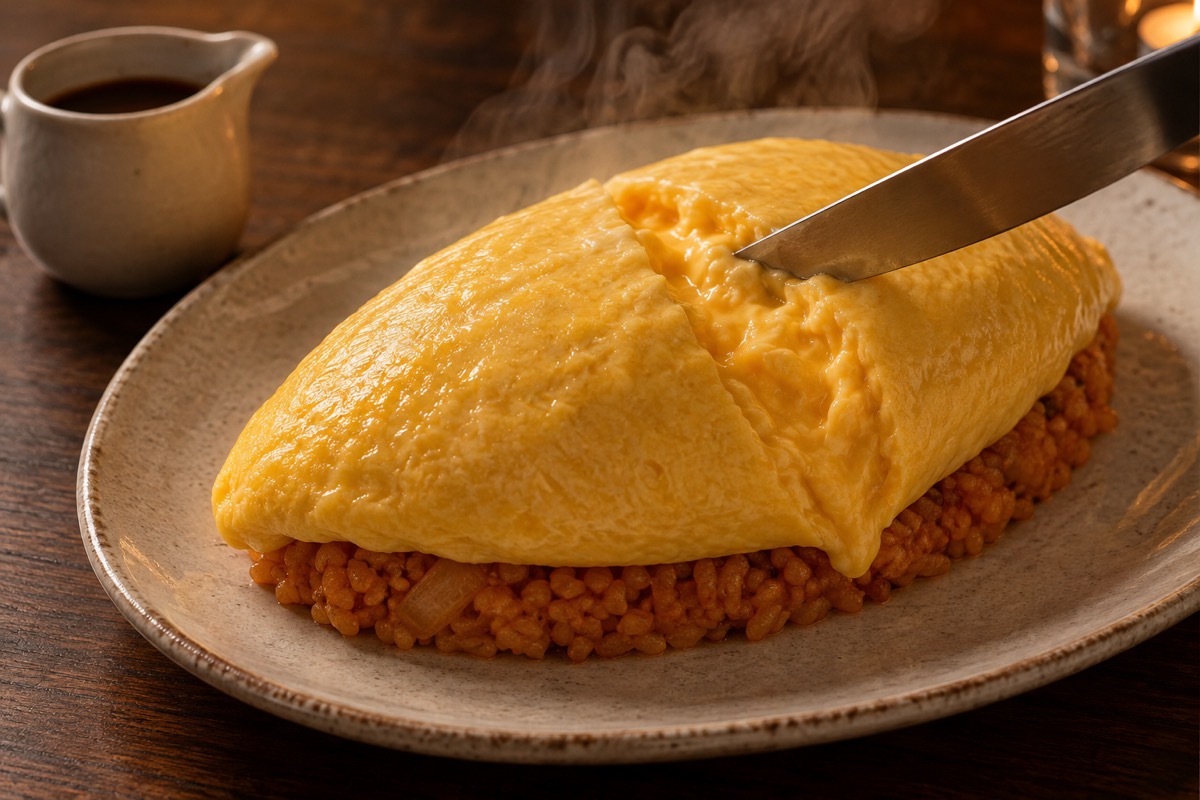
A documented example helps separate the reveal from a generic soft topping. In a release dated 10 April 2023, Kagome described Santa’s competition entry as chicken rice topped with a hamburger and an omelette. The omelette was made thin enough to open naturally under its own weight when cut. This is a historical example of the construction, not confirmation of today’s menu or an invitation to book a meal. Kagome’s 2023 description, page 3
Here, opening is part of finishing. Compare that with cutting into a parcel simply to eat its filling: the knife may appear in both situations, but it is not doing the same job.
If this is the presentation you want to learn, seek instruction that shows the omelette being made as well as opened. A clip that begins with the assembled plate cannot, on its own, explain how the object on that plate was constructed. Watching the final motion repeatedly will not fill in an omitted preparation stage.
That is not a criticism of the clip. A reveal can be enjoyable as food theatre without being a lesson. Trouble begins only when the viewer expects entertainment to supply everything necessary for reproduction.
There is a naming trap worth noticing before treating English search terms as precise categories. Kagome also publishes a recipe called Open Omurice in which rice is gathered in the middle of a pan and egg is cooked around it. Vegetables and a cheese sauce complete the arrangement. Its “open” presentation is not the act of slitting a closed omelette. Kagome’s Open Omurice
The lesson is modest but useful: names are clues, not diagrams. Check the actual placement of the ingredients before assigning a method to a style you already know. This example does not need to become a fourth compulsory category; it shows why the categories should remain flexible descriptions.
A sauce name leaves another gap. Even when it tells you something useful about the accompaniment, it does not explain the egg’s construction. If a menu or recipe photograph is all you have, keep the unknown part unknown rather than completing it from memory of another dish.
For ordering, a direct question is clearer than an elaborate style label: “Is the rice wrapped inside the egg, or is the egg on top?” If the reveal matters, ask whether the omelette is opened as part of serving. These are suggested questions, not a claim about what any Indian restaurant offers.
Soft-egg demonstrations need a safety distinction, especially before trying to reproduce them at home. An attractive exterior is not evidence that the egg inside has been thoroughly cooked.
The US FDA’s consumer guidance notes that fresh eggs with clean, uncracked shells can still contain Salmonella. It advises cooking yolks and whites firm and not leaving scrambled eggs runny. For recipes served with raw or undercooked egg, it specifies eggs treated to destroy Salmonella, such as pasteurized shell eggs, or pasteurized egg products. This is US consumer guidance, not a statement of Indian law or local product availability. FDA egg-safety guidance
For a straightforward home introduction, choose a fully cooked egg preparation rather than treating a flowing centre as a requirement. If the exact reveal is the part you want, do not treat this explanatory article as a validated method for achieving it safely. Follow appropriate ingredient and food-safety guidance as well as culinary instructions; a recipe’s appealing photograph is not a safety assurance.
Appearance is equally limited as an ingredient guide. If you eat egg but avoid meat, you still need information about the rice and sauce. If you avoid egg itself, the preparations discussed here are not suitable merely because a meat filling has been removed. That dietary question is separate from which construction you prefer.
The most useful first choice is not “traditional or modern?” or “ordinary or impressive?” Those labels encourage a ranking before you have identified the task.
Try writing a one-sentence brief instead. “I want to learn to enclose the rice” points towards wrapping. “I want an egg topping without making a parcel” points towards a different assembly. “I want to understand the knife reveal” means looking for the complete construction behind that finishing action, with particular care about egg safety.
Then decide how you will assess the attempt. Is your interest in shape, the egg’s eating texture, the seasoning of the rice, or the contrast with the sauce? You can care about several of these, but naming them separately prevents a photograph from making every decision for you.
This is especially helpful if your starting point was a scene rather than a recipe. You do not have to recreate every visible detail to explore the food that caught your attention. Choose the detail you actually want to understand, and use a method that teaches it.
For the next recipe you open, look for the moment when egg and rice meet. That small observation will tell you more about the task ahead than the word “fluffy” ever could.

AUTHOR OF THIS ARTICLE
SoJapan
SoJapan India Pvt. Ltd. is a Japanese-founded company based in Gurugram. We bring Japanese food, anime goods and apparel materials to Indian businesses, with a sister company in Kyoto that works directly with makers in Japan.