Shinichi Chiaki encounters Nodame through music that catches his attention. That is a better starting point than the familiar shorthand of a chaotic genius meeting a perfectionist. Before deciding what sort of person she is, he has heard something worth listening to.
The puzzle is that an impressive musical ear does not make every later task easy. How can someone reproduce music after hearing it, yet have difficulty with a score or with another performer? And why should the apparently more disciplined musician need to change anything about his own playing?
Nodame Cantabile becomes more interesting when these are separate questions. Learning music by ear, understanding written musical information and deciding how to perform it overlap, but none automatically settles the others. The story’s appeal lies partly in moving the characters between those demands.
This guide is for anime fans who want to follow that movement without taking a notation course. It discusses the original television anime’s premise and selected setups from episodes one, two, ten and eleven. It leaves the solutions, later competitions and ending untouched. Official story links may disclose more; musical explanations and viewing suggestions are our interpretation, not claims about the creators’ intentions.
Megumi Noda, nicknamed Nodame, studies piano at Momogaoka College of Music. The licensed series introduction describes her difficulty reading scores alongside an exceptional ability to reproduce music she has heard. Chiaki also studies piano, but wants to become a conductor. The playing that draws him towards her is a distinctive Beethoven sonata. Bandai Channel’s introduction and character profiles.
Notice how much disappears if those details are compressed into “she is natural; he is trained”. Nodame is attending a music college, not being introduced as someone who has never encountered musical education. Chiaki has an ambition beyond the course he is taking, not a settled position as the person who knows everything.
Their starting contrast concerns what each can access readily. A sound can give Nodame a route into a piece that the written page does not provide as easily. That is different from having no musical understanding. Conversely, a person who reads well still has to turn the information into a performance somebody can hear.
For an ordinary listener, three questions help keep that distinction clear:
These are questions about activities, not three boxes into which all musicians can be sorted. The anime’s exaggerated gift should not become a claim that learning by ear is effortless for real people, or that reading music is unnecessary. Nor does the description justify attaching a technical or medical label to Nodame’s ability.
The first episode’s official setup places Chiaki’s encounter with her against his frustration about his own future. That context matters. He is not a neutral examiner arriving to grade an unknown student; something unusual reaches a person who is already dissatisfied with where he is going.
Our reading is that attraction to a performance can precede agreement about how it works. Chiaki does not have to approve of everything about Nodame to find her playing compelling. Equally, his interest does not remove the difficulties the story has established. The productive question is what he has heard that his existing picture of her cannot explain.
The easiest wrong turn is to imagine a score as a list of correct notes and expression as whatever the performer adds by ignoring it. That would make the whole series a choice between obedience and personality. It is too narrow a picture of the page.
Piano educator Dr Diana Dumlavwalla explains that score details extend beyond pitch and rhythm to such things as dynamics, articulation, pedalling and tempo indications. Her point is that attending to this information helps bring out character and expression, rather than leaving expression until after the supposedly real work is done. Yamaha’s “Observing Score Details”.
For this guide, the practical consequence is modest: reading and feeling need not be enemies. A request to attend more closely to a score may concern the character of a passage, not just whether a finger lands on the expected key. This musical context does not establish the exact fault in any particular anime scene; the scene must supply that evidence itself.
Consider a deliberately invented listening example. Two versions of a short phrase can use the same sequence of notes while one sounds like a continuous thought and the other like a series of separate assertions. A listener might prefer either version, but “the notes are the same” would not describe everything they heard. This is an illustration, not a transcription of Nodame’s playing.
The following is a listening aid, not a scoring system for the characters. Its purpose is to keep a direct response separate from a technical conclusion you have not established.
| A question you can begin with | What it does not settle |
|---|---|
| Does the passage feel continuous or interrupted? | Whether that effect agrees with the particular score. |
| Where does my attention move? | Whether the performer intended exactly that response. |
| What changes when another instrument enters? | Who is technically responsible for every change. |
| What does the character object to? | Whether every part of that character’s judgment is correct. |
On a phone, swipe the table sideways if needed. Keyboard users can focus it and use the arrow keys.
Start with one question, not all four. Trying to identify every detail on a first viewing can make the performance disappear behind your own checklist. If the story draws attention to a disagreement, return to that passage with the disagreement in mind.
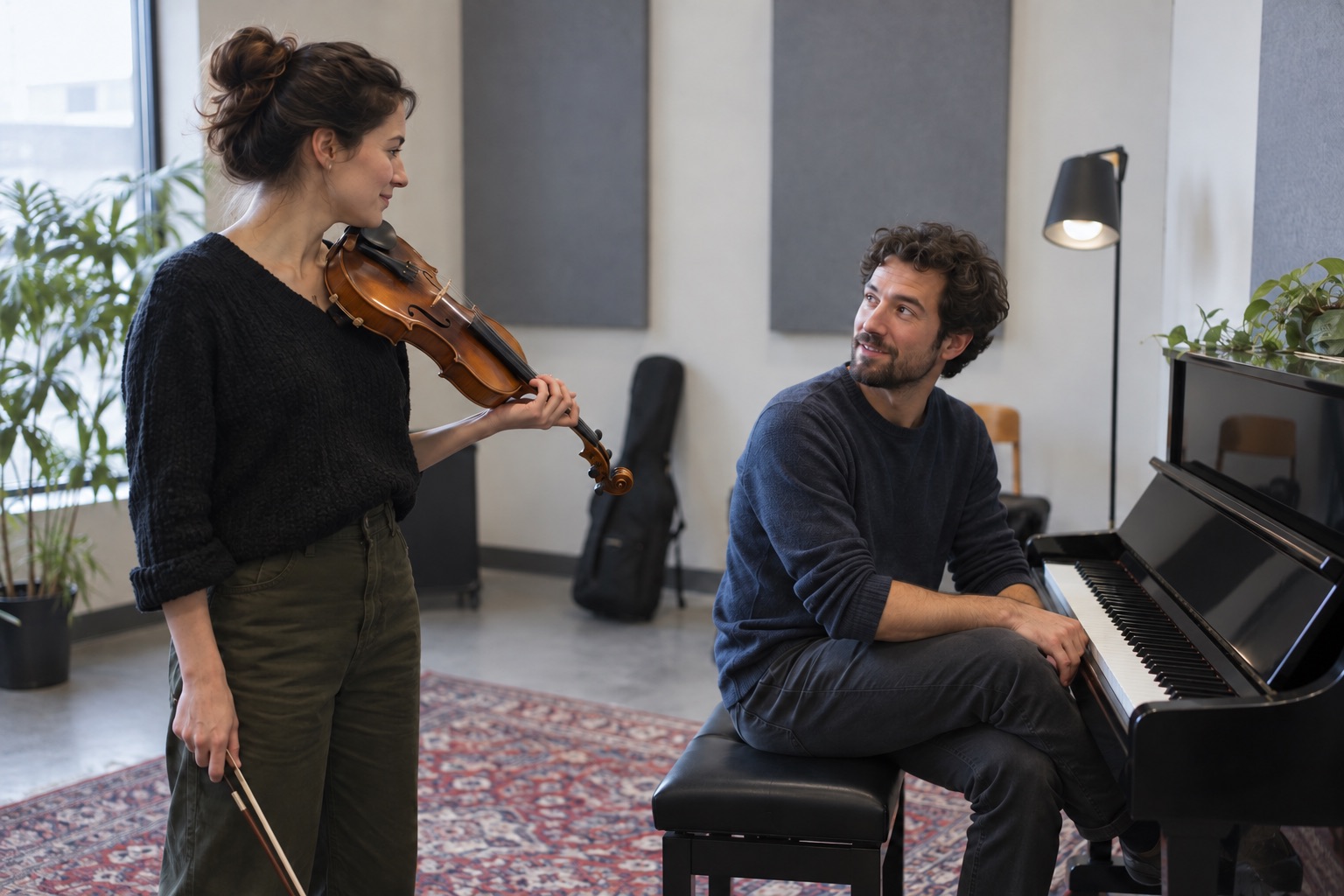
Ryutaro Mine brings the problem into a concrete musical situation. In episode two, his resistance to classical precision and his distinctive violin approach lead Chiaki to refuse the piano-accompanist role for an examination. Mine then asks Nodame. Their personal compatibility seems promising, but the official synopsis describes a disorderly performance with which Mine alone is satisfied. We will leave Chiaki’s intervention and the result to the episode. Fuji’s anime Lesson2 synopsis.
The revealing detail is Mine’s satisfaction. From his position, finding someone congenial can feel like finding confirmation that his approach works. For the viewer, those conclusions remain separable: enjoying a partnership tells us something about the experience of playing, but not everything about what is being produced.
This is more specific than a generic lesson that musicians must cooperate. Mine is not simply refusing contact with another player. He has found one and is pleased. The difficulty concerns what he accepts as evidence of a successful performance.
An examination sharpens that question because there is a task beyond pleasing oneself. The article does not need to invent the college’s marking scheme to recognise the pressure. A performance can be enjoyable for its maker while still failing to address the demand that brought the maker into the room.
There are two unhelpful ways to take sides too quickly. One is to dismiss Mine’s pleasure as irrelevant because an assessment is coming. The other is to treat pleasure as proof that assessment must be wrong. Neither explains the musical disagreement. It is more revealing to ask what Mine believes Nodame’s involvement has solved.
Keep Nodame’s role visible, too. Being the person a player gets along with does not make her a guarantee that his interpretation will work. Her gift has not become a service that can automatically turn another person’s preferred approach into a convincing result.
The episode therefore gives a useful test for later scenes: when someone approves of a performance, what are they approving? The player’s personality, the excitement of taking part, a recognisable tune and the musical result can all attract approval for different reasons. A story about performers has room to let those reasons collide.
Our Sound! Euphonium guide explores another source of tension: supportive bandmates competing for places. Here the immediate problem comes earlier than selection. It is whether the people making the music even agree about what is working.
If episode two leaves you treating Chiaki as the permanent standard against which everyone else will be measured, keep that conclusion provisional.
In episode ten, he is preparing a piano concerto with A Orchestra under Franz von Stresemann. The conductor finds his playing lacking in expressive allure, and Chiaki does not readily accept the criticism. Meanwhile, Mine and the S Orchestra players are preparing a costumed festival performance. The official setup places these activities alongside each other; it does not require us to disclose what Chiaki subsequently realises. Fuji’s anime Lesson10 synopsis.
This reverses the direction of scrutiny. The person who can identify a problem in somebody else’s approach now faces a demand that his own preparation has not satisfied. His earlier judgment does not become worthless, but it ceases to function as proof that his playing needs no further thought.
Reading Chiaki as a machine waiting for an eccentric person to supply a soul would flatten him before the musical question has begun. Wanting control over a performance can itself involve intense feeling: concern about the result, frustration when it falls short, investment in what the music might become.
What interests us here is the limit of his current answer. He has been practising, but the criticism concerns something that the conductor still does not hear. The story can make that uncomfortable without claiming that disciplined work and an engaging performance are opposites.
The festival contrast also invites care. A costume or theatrical gesture is readily visible; musical conviction is harder to reduce to a single object. It would be rash to decide that showmanship alone is the missing ingredient. Watch what the episode makes Chiaki notice, instead of deciding in advance that spectacle wins the argument.
For a newcomer, this is a particularly good place to distinguish a musical issue from the language used to express it. A metaphorical criticism can be forceful while remaining open to interpretation. You can follow Chiaki’s resistance without pretending that one English adjective supplies a complete technical diagnosis.
That keeps the scene alive as an encounter. The conductor wants something; the pianist does not yet accept or understand the request in the same way. The performance, rather than a general speech about hard work, is where their disagreement has to become audible.
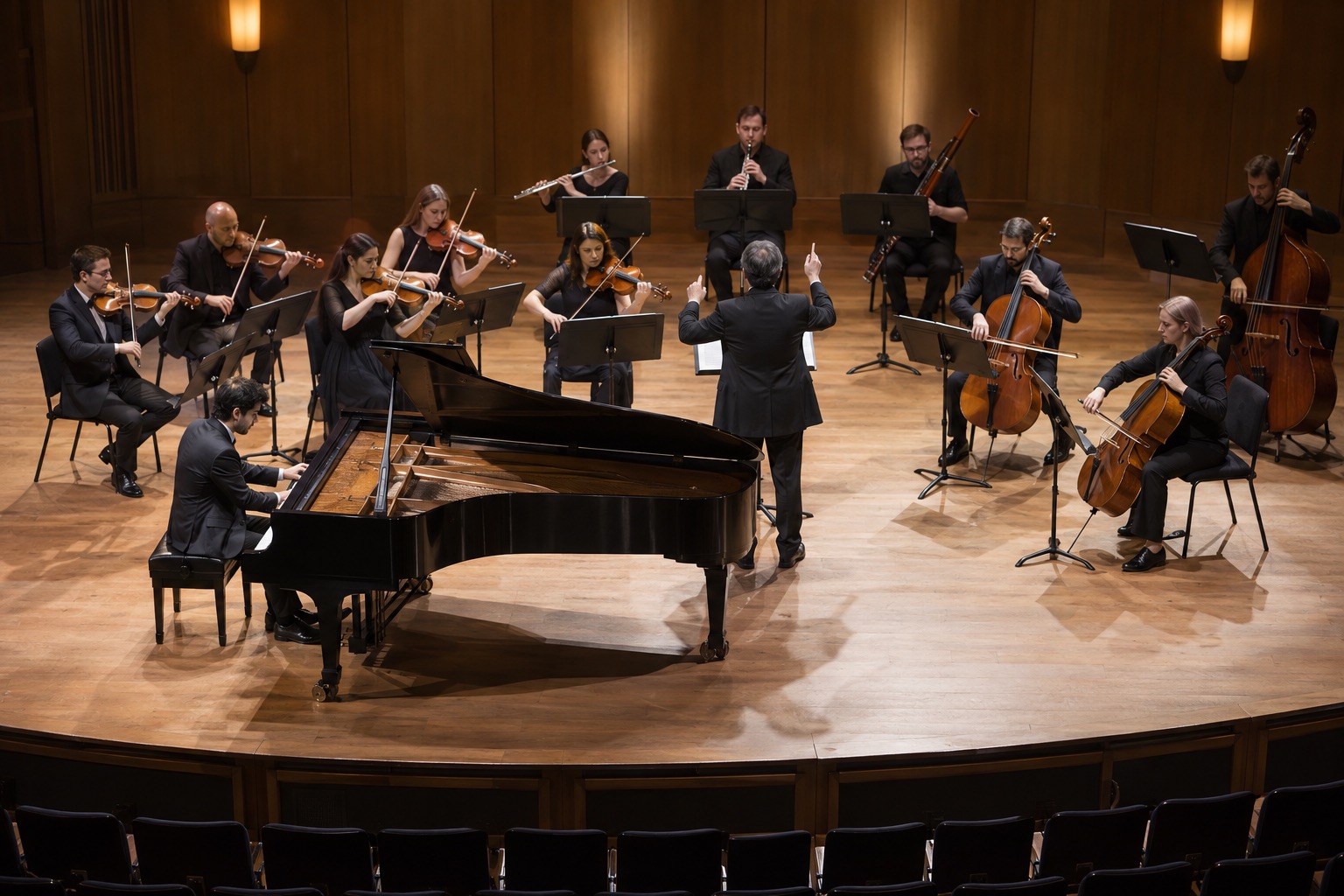
Episode eleven moves the listener’s position again. Nodame is deeply affected by hearing Chiaki with A Orchestra and responds with intense piano practice. Stresemann then tells her that her playing, as it stands, cannot work with an orchestra. This is the later episode setup discussed here, not a reveal of how she responds or where it leads. Fuji’s anime Lesson11 synopsis.
A little musical context makes the stakes clearer. In a solo concerto, an individual instrument is foregrounded in relation to an orchestra. The London Symphony Orchestra’s introduction emphasises contrast between the soloist and the larger group. A piano concerto is therefore not simply a solo piano recital with extra people visible behind it. LSO’s concerto introduction.
Our interpretation is that Nodame’s response raises a question about entering the relationship she has heard. Reproducing something memorable on the piano is one achievement. Participating in a performance whose shape also depends on other musicians asks something further.
This is not a reason to demote the ear. Listening is precisely how the desire has reached her. The tension comes from wanting to do something with that experience that is not exhausted by privately recovering its sound.
To follow a concerto passage, listen for the moments when your attention passes between the piano and the surrounding instruments. Does an entrance feel like an answer, a new direction or a continuation? Those descriptions are invitations to listen, not a fixed code that every concerto obeys. There is no need to count how many seconds the soloist is prominent.
Then return to Nodame’s situation. What has she heard that she now wants to be part of? That question is more revealing than asking only whether she can play something technically difficult. It gives the admiration a direction without deciding its outcome for her.
The distinction also prevents a romantic shortcut. Admiring Chiaki’s music does not make every musical disagreement between them a disguised confession, or every request for change a measure of affection. Their connection involves music with demands of its own. Let those demands retain their meaning even when personal attachment intensifies them.
Nor should the extremity of the fictional practice response become advice. Neglecting ordinary needs is not a requirement for taking music seriously. The story can communicate urgency through exaggerated behaviour without providing a routine readers should copy.
If the concerto idea catches your interest outside the anime, the LSO page is a useful next step because it places the explanation beside identified performances. Those are independent recordings, not the anime soundtrack. Keep the work, the performers and the particular recording distinct when following a piece you like.
The musical argument should not make the series sound like a sober sequence of lessons. Its exaggerated personalities are part of the experience, and the anime’s voice acting has to make them more than labels attached to instruments.
In a 2009 interview looking back while working on Finale, Ayako Kawasumi describes the difficulty of making Nodame’s eccentric behaviour appealing while also suggesting her talent. Tomokazu Seki discusses restraining how far he pushed Chiaki into comic performance. These are the actors’ accounts, not a claim that the two characters represent opposing musical philosophies. Mynavi’s cast and director interview.
Kawasumi’s recollection offers a helpful correction to watching only for a switch between “silly Nodame” and “real Nodame at the piano”. The performance challenge was to let the unusual person and the gifted musician remain one character. Musical seriousness need not cancel the comic presence that surrounds it.
For a first encounter, choose the 2007 television anime, beginning with episode one. Fuji’s original broadcast archive identifies that version, based on Tomoko Ninomiya’s manga, with Kenichi Kasai directing and J.C.STAFF producing the animation. It is separate from the live-action adaptation, and later titles such as Paris and Finale should not be mistaken for alternate names for its opening season. Fuji’s original anime page.
For readers in India, the Japanese source links in this article do not establish local streaming access. Before subscribing, check the exact adaptation, regional episode availability and language options in an authorised listing. We have not verified an Indian service or price here.
The series is a promising choice if the idea of hearing the same performance differently intrigues you, and if you enjoy character comedy alongside musical ambition. It is a less direct match for an evening when you want only uninterrupted concerts or a gentle instrument tutorial. The disagreements are part of the attraction, not obstacles that this guide suggests skipping.
Begin with the thing Chiaki hears, then let the other questions arrive. What does the page ask? What does another player expect? What effect reaches the listener? Keeping those questions apart gives Nodame’s gift room to be remarkable without making it an answer to everything—and gives Chiaki room to keep learning without making his discipline a mistake.

AUTHOR OF THIS ARTICLE
SoJapan
SoJapan India Pvt. Ltd. is a Japanese-founded company based in Gurugram. We bring Japanese food, anime goods and apparel materials to Indian businesses, with a sister company in Kyoto that works directly with makers in Japan.