You want the band to improve. You also want a place in its competition ensemble. What happens when helping the people around you makes them stronger candidates for the same selection process?
That is a useful way into Sound! Euphonium, also known as Hibike! Euphonium. Its school musicians are not simply waiting to face an opposing school. They have to work out what their shared ambition asks of the people already in the room.
The attraction is not that friendship turns out to be fake whenever competition appears. It is that support and personal desire can remain genuine at the same time. A student can want another person to play well without becoming indifferent to their own chance to perform.
For viewers in India who are curious about the anime but unfamiliar with concert bands, no music-theory homework is needed. This guide explains the first season through membership, rehearsal and selection, then looks at how the production makes musical performance part of the drama.
Spoiler boundary: selected first-season premises through episode nine, including the introduction of auditions. No audition results, later competition outcomes or personal resolutions are revealed. Linked official archives and interviews may contain further spoilers. Story facts are sourced; the connections we draw between them are editorial interpretations.
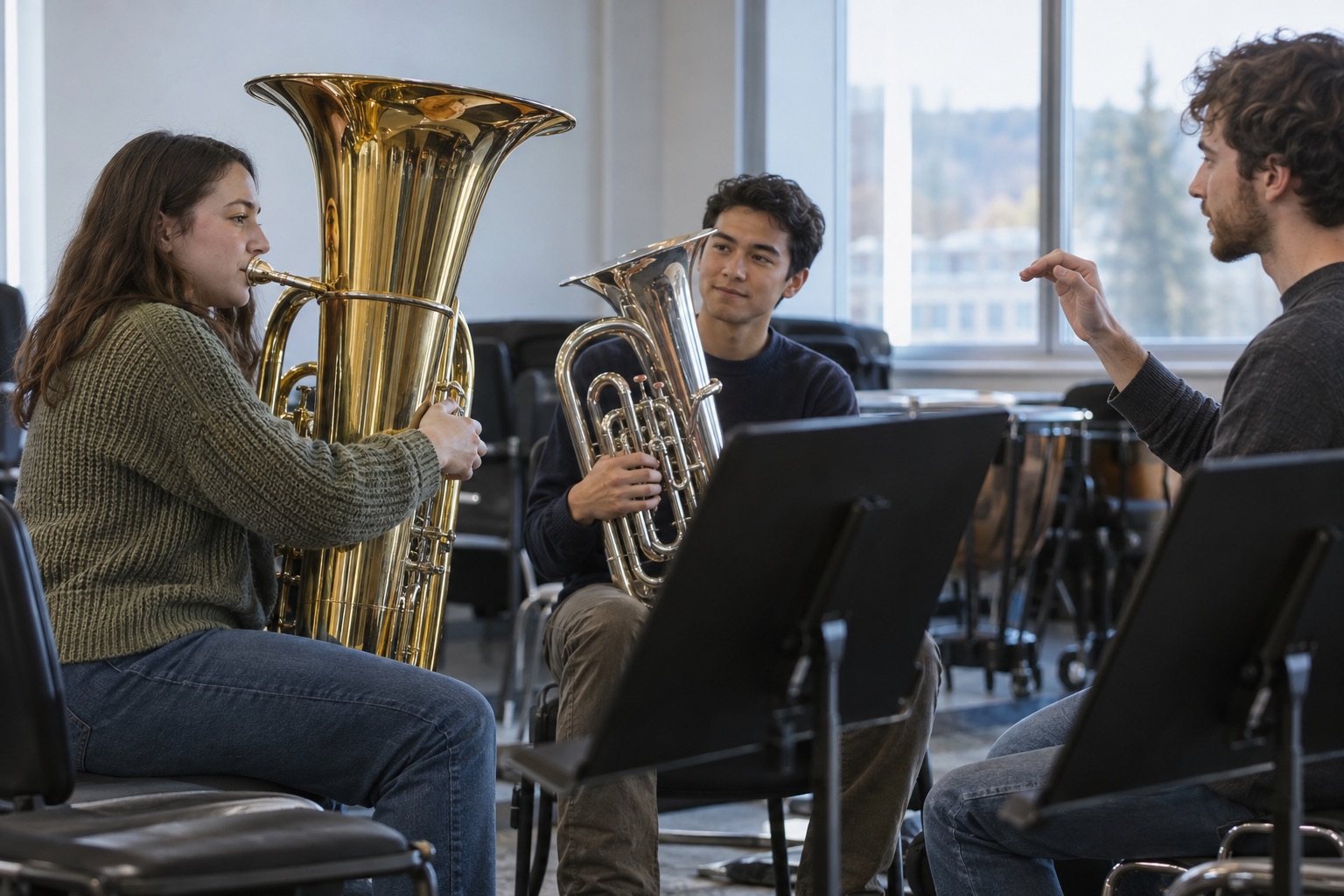
An audition can be a doorway into an unfamiliar institution. Here, it changes the relationships within a club whose members are already practising together.
The official episode-six synopsis establishes the change: competition members will be chosen by audition that year, giving first-year Hazuki a chance to take part. As she works to improve, the bass section supports her. The episode-nine introduction then places first- and third-year members before the same selection process.
Read those setups together and the tension becomes more specific than “music is competitive”. The people helping a learner are part of an organisation that will not treat membership alone as a performance entitlement. The ordinary club and the selected competition ensemble are related, but they are not the same category.
This does not mean every player is competing for one interchangeable seat. Different instruments have different places in an ensemble. Nor does it mean a friend must secretly want another friend to fail. It means the group has introduced a decision that encouragement cannot settle by itself.
There are three different questions worth keeping apart:
Confusing those questions makes the drama look harsher or simpler than it needs to be. Not being automatically entitled to a competition place does not mean a member has contributed nothing. Equally, being helpful or well liked cannot by itself demonstrate readiness to play a particular part.
As a viewer, you are allowed to feel the pull of both sides. Wanting a capable ensemble does not oblige you to stop caring about someone who is nervous. Caring about that person does not oblige you to pretend an assessment has no musical purpose. The series becomes more interesting when those sympathies are allowed to coexist.
If you know our Bocchi the Rock! guide, notice the difference from a band auditioning for a venue. There, the group seeks permission to perform together. Here, selection also asks which members of an existing group will represent it. The shared word “audition” hides two different arrangements.
The opening is not the discovery of music by somebody who has never played. Kumiko Omae was already in a concert band at junior high school. When she visits her new school’s club with Hazuki Kato and Sapphire Kawashima, she encounters former classmate Reina Kosaka. Her companions decide to join, while Kumiko hesitates, remembering an earlier competition-related encounter with Reina. That is the official first-series premise.
Experience therefore does two jobs. It makes the activity familiar, but it also means the new room is not free of old associations. Kumiko cannot encounter every musical question as if nobody had ever disagreed with her before.
This is a useful alternative to the usual beginner’s route into a specialist setting. A newcomer to the school can still understand the activity. What she has not settled is how she wants to participate now, with these people. The viewer can learn the setting through her without assuming that every hesitation must come from technical ignorance.
Hazuki provides a different starting point. In the episode-three production comments, instrument designer Hiroyuki Takahashi identifies her as a beginner and associates her with the tuba, Kumiko with the euphonium and Sapphire with the contrabass. He also notes that the instruments are school equipment. This is not a story that needs each new member to arrive after an individual instrument-shopping trip.
For the names, a small map is enough:
| Instrument | A useful first distinction |
|---|---|
| Euphonium | A middle-to-low-register brass instrument; this is the instrument named in the title. |
| Tuba | A lower brass voice, associated here with Hazuki. |
| Contrabass | A low string instrument, associated here with Sapphire; the band is not composed only of wind instruments. |
| Trumpet | A higher brass voice, distinct from the euphonium and tuba. |
These basic descriptions follow the official instrument guide. They are orientation, not a ranking of importance or difficulty. You do not need to identify every sound by ear before understanding a rehearsal scene.
Try learning the association between a person and an instrument before memorising the entire ensemble. That keeps the objects attached to the people using them. “The large instrument” becomes part of Hazuki’s particular learning task, rather than another unfamiliar item in a catalogue.
It also prevents one misleading shortcut: assuming that a common school year means a common level of experience. Kumiko and Hazuki can be new to the same club without being new to music in the same way. An assessment of their playing will encounter different histories, even when both are called first-years.
Wanting to compete nationally sounds like a destination. Its immediate effect, however, is on what happens during practice long before the destination is in sight.
The episode-three synopsis and director’s comments place the club’s national ambition beside a less organised reality: sectional practice includes members leaving early or playing around, and adviser Taki imposes a condition. By the episode-four setup, the instruction is demanding enough to bring some students to tears, while participation in the Sunrise Festival is at stake.
Our reading is that the goal makes existing habits newly consequential. An afternoon cannot be assessed only by whether people enjoyed spending it together. The club has asked its activity to produce something that will be heard and judged beyond the room.
There is a difference between choosing an impressive aim and understanding the working day associated with it. A goal can be attractive at a distance, while the repeated tasks needed to approach it feel frustrating or dull. That gap is not unique to teenagers, and it does not require the viewer to know how to play brass.
The move between sectional practice and playing together gives the problem a musical shape. Working on a part is not yet the same event as bringing parts into an ensemble. The question is not just whether somebody has been busy, but what that work makes possible when others are involved.
An original comparison may help: imagine a group preparing a short film for a college screening. One person can spend an afternoon improving an individual shot while the group still lacks a usable sequence. That does not make the shot worthless. It means personal work and collective readiness are different things. This is an analogy, not an incident from the anime.
Taki’s presence should not turn the article into a verdict that strictness automatically produces worthwhile art. The episode descriptions establish pressure and demanding instruction; they do not establish a universal teaching method. It is more useful to ask what a particular demand is trying to change, and how the students respond to it.
For a first viewing, distinguish a response to the standard from a response to the person enforcing it. Disliking an interaction does not necessarily mean rejecting musical improvement. Agreeing with the ambition does not necessarily mean feeling comfortable with every step towards it. Those distinctions leave space for actual disagreement instead of sorting everyone instantly into serious and unserious students.
This is also where Sound! Euphonium separates itself from the central pleasure of K-ON!. Our K-ON! article explores how playing shares time with an appealing social routine. Here, a competitive objective changes the expectations placed on that routine. That is a difference in dramatic emphasis, not a claim that one series respects music and the other does not.
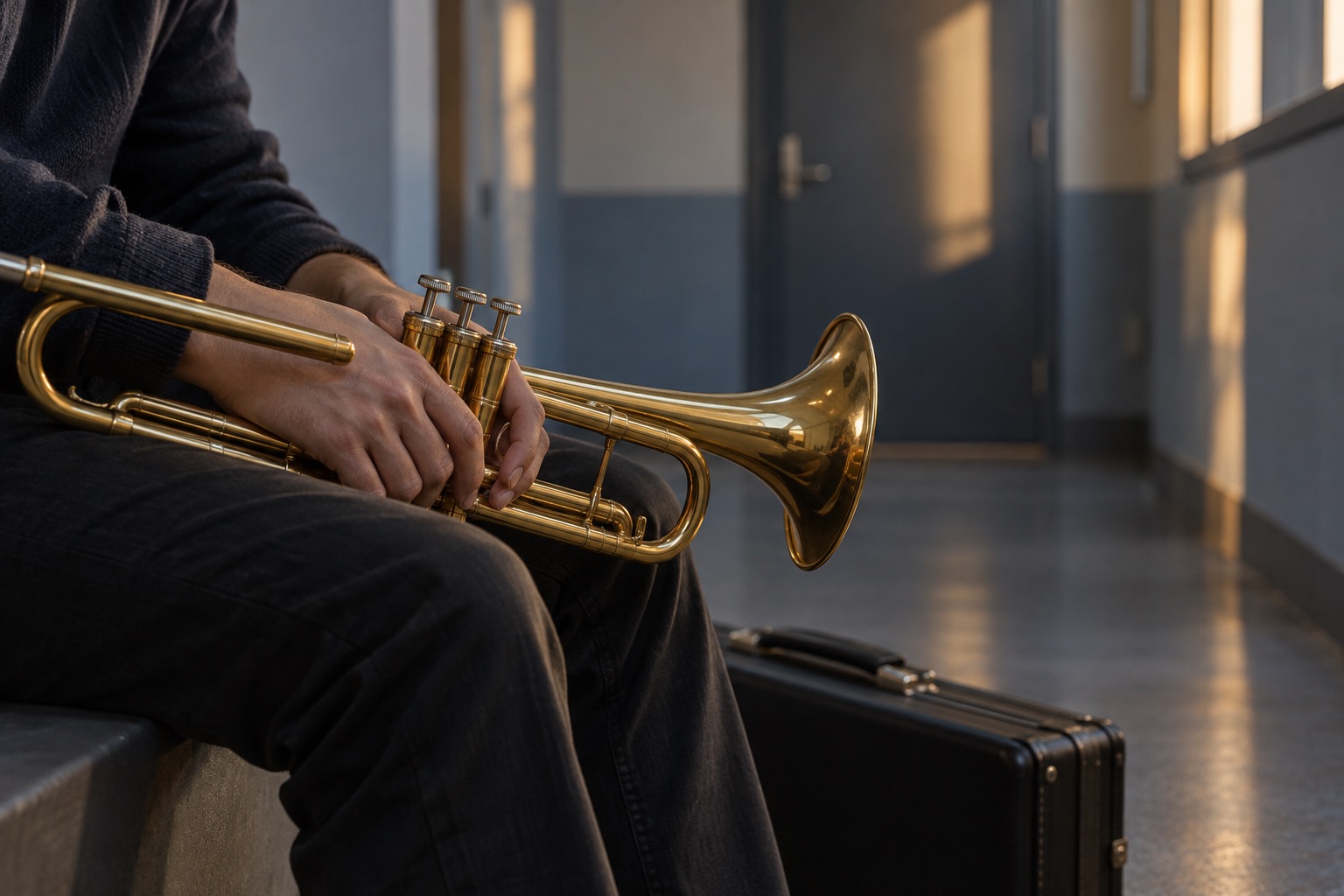
The audition’s appeal is easy to understand from a newcomer’s position: arriving later need not mean waiting automatically behind everyone who arrived earlier. But changing the basis of selection also changes what established members can rely on.
The episode-nine archive explicitly describes assessment without a first-year-versus-third-year exemption. Animation director Rie Sezaki’s production comment on that page singles out the tension of competing with the companions who have practised beside you. This is a stated production perspective, not merely a fan reading imposed on a neutral contest.
Seniority and present playing ability answer different questions. Time in a club can bring familiarity with people and routines; it is not a substitute for demonstrating a performance. Conversely, a musical assessment does not measure every form of knowledge or care someone has contributed over that time.
That is why the emotional stakes cannot be reduced to whether the new procedure sounds fair in one sentence. A rule can make sense to someone before that person experiences its consequences. A viewer can understand the reason for assessing ability and still care about the uncertainty it creates.
There is no need to make older members into a block of threatened obstruction or younger members into a block of deserving renewal. Those are convenient categories, not complete characters. The more revealing question is what each person believes they have been working towards, and what they thought would count when the decision came.
Keep opportunity separate from a promise. Hazuki’s chance to audition makes her effort relevant to a possible outcome; it does not tell us that the outcome is assured. Treating an opportunity as an implied guarantee would remove much of the uncertainty that gives the preparation its force.
Support can still matter inside that uncertainty. Helping somebody prepare may be an expression of what you want the band to become, even when no helper can control the eventual decision. The help is not exposed as meaningless merely because it cannot guarantee a place.
A useful viewing question is therefore: what is this act of help offering? Instruction, encouragement, companionship and reassurance are not identical. None needs to be a secret bargain for the relationship to matter. Watch for the difference between helping someone face a test and pretending the test no longer exists.
The episode-seven premise brings preparation down to a pointed exchange. As practice intensifies, Taki asks Aoi when she will be able to play what she is struggling with. We will leave her answer and its consequences to the episode.
The question changes the terms of the discussion. Wanting to improve is an intention. Saying when something will be ready is a commitment other people may organise around. The second can be harder to offer honestly, even when the first is sincere.
For an ensemble, that distinction has an obvious practical weight. Other members cannot hear a future intention; they have to rehearse with what can be played now. Yet the person being asked has a life and an understanding of their own limits that are not captured by the group’s wish for progress.
This makes the exchange worth attending to without turning it into a slogan about pushing harder. Does a request clarify what is needed? Does the person understand how to get there? What would an honest answer require them to acknowledge? Those are questions the setup opens, not answers that can be supplied from a short synopsis.
Notice, too, how different this is from the initial invitation to join a club. At that earlier point, a person may be deciding whether the activity appeals. Now the question concerns what their participation can deliver within a shared project. The demand has become more specific.
When a story asks you to care about musical readiness, it has a production problem: the audience needs some way to experience the difference, not merely be told that one performance is better.
The first-series credits identify Ayano Takeda’s original novel, Tatsuya Ishihara’s direction and Kyoto Animation’s animation production. They separately credit Akito Matsuda’s music, Senzoku Gakuen College of Music’s music-production cooperation and the Freshman Wind Ensemble’s performance cooperation. These are distinct contributions to the finished programme.
Tomoyo Kurosawa, Kumiko’s Japanese voice actor, offers a helpful account in an official retrospective interview. She describes a character being made across animation, spoken performance and instrumental performance. She also places important emotional changes in playing and nonverbal exchanges, with the voice work carrying the circumstances before and after those moments.
That perspective changes what it means to “follow the acting”. Dialogue is only one part of the character’s presence. A musical passage is not necessarily a pause in the story while the soundtrack takes over. It can be where something the conversation has prepared becomes perceptible in another form.
There is a particular difficulty in representing imperfect playing. In a pre-second-season official roundtable, Ishihara discusses asking capable musicians to perform less well deliberately. The intended differences had to register for a general anime audience without becoming implausibly exaggerated. The performers were constructing a fictional level of ability, not simply delivering their own best performance every time.
The implication for a listener is useful: a polished recording and a dramatically appropriate performance are not necessarily the same goal. In a scene about uneven preparation, smoothing away every roughness could remove information the story needs. Imperfection can be part of a carefully made result.
You do not have to pretend to hear a technical flaw that you cannot identify. Start with the context the scene gives you: what has been requested, who is listening and what responses follow. That is different from announcing that you can independently judge the ensemble’s intonation or balance.
The point is not to give yourself a judging sheet. It is to let the musical performance contribute to your understanding of a character, alongside what that character says.
A large ensemble can easily look like a few protagonists surrounded by chairs that happen to be occupied. The production comments suggest a different starting assumption.
In the episode-two staff notes, Ishihara explains that the other band members are named characters rather than anonymous extras. Animation director Kayo Hikiyama likewise describes individual names and personalities. That does not promise equal screen time, but it gives a reason to attend to the room beyond the most familiar faces.
Selection makes that attention especially valuable. The immediate question may concern who will perform, but the club’s life is larger than the selection announcement. A person standing nearby has also been practising, listening or living with the changing expectations of the group.
For a newcomer, this does not mean pausing every scene to study a character chart. Follow relationships as they become relevant. Notice whether someone is being addressed as a beginner, a senior, a fellow player or a friend. The same person may occupy more than one of those positions, and a disagreement can bring one to the front.
There is room for pleasure here, not only pressure. A shared musical activity gives people reasons to pay close attention to one another. The difficulty of selection matters because playing together is something worth wanting. If the band were merely an obstacle course, the relationships around it would have far less weight.
For this guide’s story, begin with the 2015 television series, identified in Kyoto Animation’s English work catalogue. That recommendation is about meeting the characters in context, not a complete franchise viewing order or a claim about current streaming access in India. Check the exact title and licensed availability for your own region before subscribing.
The series is a promising choice if you enjoy characters whose admirable wishes can conflict: wanting a stronger group, wanting a chance, caring about a friend and wanting to be heard yourself. If you currently want only uninterrupted concert performances, the negotiations around rehearsal may not be what you are looking for.
As you watch, return to the person helping someone else prepare. What can they offer, and what remains outside their control? That question keeps the friendship and the competition in the same picture. Sound! Euphonium gives you a reason to care about both before any result can settle the immediate contest.

AUTHOR OF THIS ARTICLE
SoJapan
SoJapan India Pvt. Ltd. is a Japanese-founded company based in Gurugram. We bring Japanese food, anime goods and apparel materials to Indian businesses, with a sister company in Kyoto that works directly with makers in Japan.