A professional title is an easy thing to recognise. Feeling at home is harder to measure. That difference is a useful starting point for March Comes in Like a Lion: a story in which being good at something does not settle what the rest of a person’s day should mean.
Rei Kiriyama is a seventeen-year-old professional shogi player living alone in Tokyo. He lost his family in an accident during childhood. His connection with three sisters, Akari, Hinata and Momo Kawamoto, gradually changes his isolated life. That is the premise given by the official anime introduction, not a promise that one friendly household will instantly put everything right.
For a newcomer, the most helpful question is not simply whether Rei will win. It is what being a player, a visitor, a rival or a person doing a favour allows him to do—and what each role leaves unresolved.
This guide discusses selected setups from the first season’s opening six episodes, without revealing match results or later character outcomes. A short, explicitly labelled manga comparison uses the opening chapter. Family loss and loneliness are central to the material discussed; the presence of meals and humour should not be mistaken for a guarantee of undemanding viewing.
The reading approach here is straightforward:
There is a reason to pay attention to these three settings. In a pre-broadcast conversation with manga creator Chica Umino, director Akiyuki Shinbo described wanting different atmospheres for Rei’s inward-looking room, the competitive shogi hall and the Kawamoto household, which was still warm and gentle at that point in the story. Umino also discussed the nearby bridge as a transition for Rei. This was an account of production intentions, rather than a rule that every room or crossing must mean exactly one thing.
It offers an accessible way into the adaptation: notice a transition before trying to explain a character’s entire personality. Ask what kind of participation the new place calls for. Is someone waiting for a move, expecting company, or relying on an ordinary practical task?
The distinction is more useful than assigning each location a permanent emotional label. A workplace can contain people who care about you. A welcoming household can contain disagreement. A private room can give you independence without making solitude feel easy. Those possibilities should remain open when judging an individual scene.
That distinction matters particularly in a story with a specialised activity at its centre. The board presents an obvious task to concentrate on. Scenes away from it may have no equivalent announced objective. Their lack of a scoreboard is not the same as a lack of purpose.
The sixth episode’s official account links Rei’s professional career to making ends meet and becoming independent. He turned professional while still in middle school, but reaching his present position has not supplied a clear reason for what comes next. It also mentions a failure to advance to the next level in his second year. The episode-six synopsis therefore gives us something more complicated than either an uninterrupted prodigy story or a simple account of someone who cannot play well enough.
Our reading is that a route out of one situation need not provide a complete destination. A practical achievement can matter enormously while leaving another question unanswered. That is different from calling the achievement worthless, or deciding that Rei should abandon the thing he has worked to do.
There is another complication in the opening episode. Rei’s opponent is Kouda, the professional player who is also his foster father. After that game, Rei goes to the Kawamoto home, where the sisters welcome him for dinner, but his unease remains. The episode-one outline places work, family history and hospitality close together. It does not ask us to regard them as separate boxes with no influence on one another.
That makes “just focus on the next game” an incomplete viewing approach. The identity of the person across the board matters alongside the competitive encounter. Likewise, arriving at a dinner table changes Rei’s surroundings without necessarily changing everything he carries into them.
A useful first distinction is between understanding the contest’s situation and understanding its technical solution. Who is playing whom, what has already been established between them, and whether either person has something at stake beyond the result are questions a newcomer can follow before becoming capable of judging a move.
This is a viewing recommendation, not a claim that shogi knowledge adds nothing. More knowledge may let you appreciate details that a first-time viewer misses. But uncertainty about a position does not oblige you to suspend all understanding of the people around it.
Nor should every career term become a research assignment. If a detail is necessary to understand the immediate scene, attend to the explanation available there. If it is not, continuing with the character’s situation may be more useful than interrupting the episode to learn an entire competitive system.
Our Hikaru no Go guide approaches a different board-game story through the gap between supplying moves and learning to choose them. Here, beginning with a professional protagonist changes the question. The point of entry is not necessarily how a novice acquires playing strength, but how much—or how little—that strength can tell us about the rest of his life.
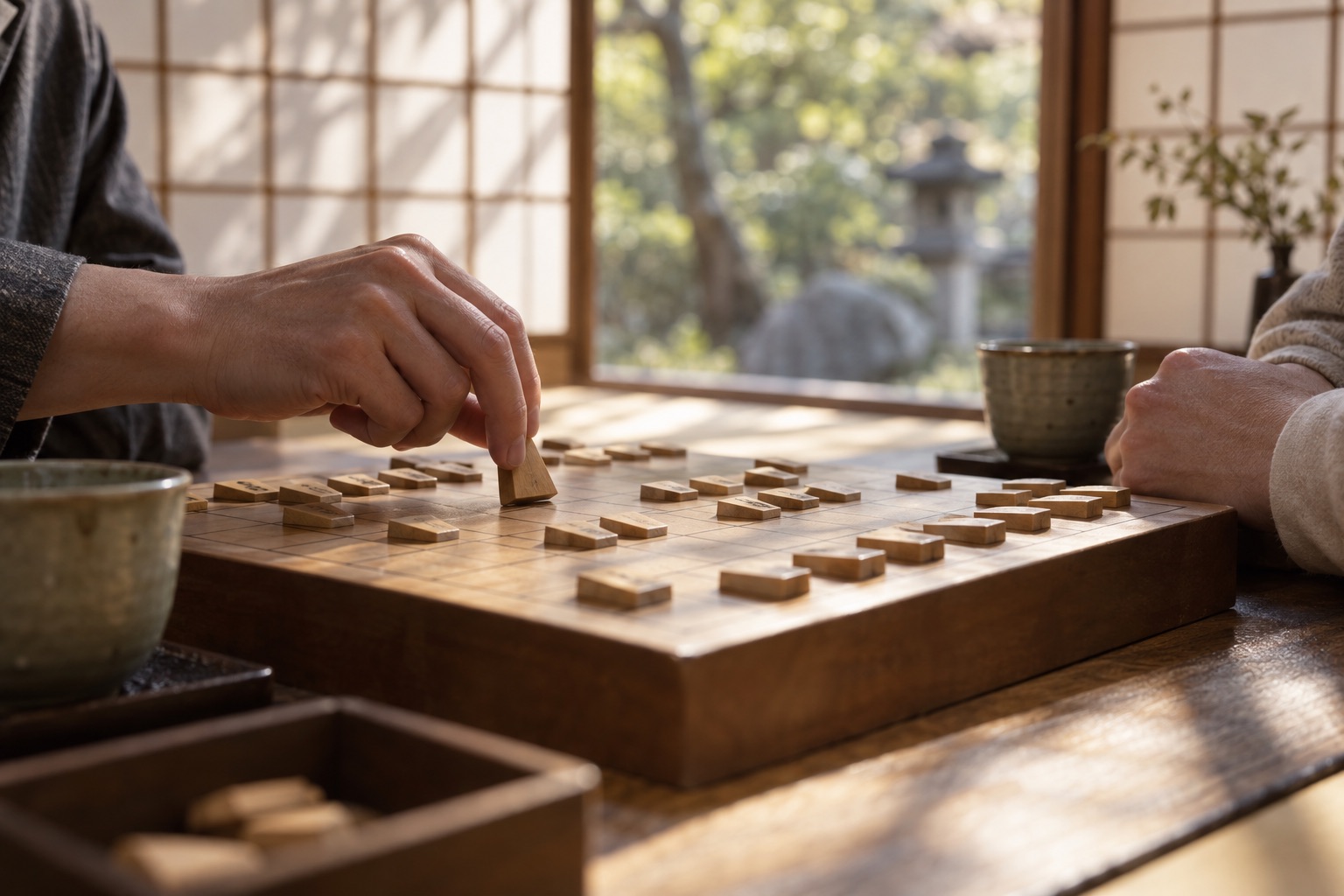
It would be convenient to divide the story into an isolating shogi world and a caring world outside it. Harunobu Nikaido makes that division less convincing.
In the second episode’s setup, he is waiting at Rei’s home and looking forward to their next match. Their rivalry goes back to childhood. His interest does not begin when they sit down opposite each other; he brings the anticipated contest into Rei’s day beforehand.
The third episode then brings them to their first game against each other since becoming professionals. Rei recalls a childhood encounter, and both want strongly to avoid losing. The relevant contrast is not serious competition versus genuine attachment. Their competitive encounter already carries a history between two people.
For our purposes, that is enough to resist reading every opponent only as an obstacle. Wanting to beat someone can coexist with caring that this particular person continues to take part. It does not follow that every rival is a friend, or that competitive pressure is always beneficial. The relationship has to be read from its own evidence.
This is also a reason to be cautious about apparently helpful summaries. “He needs to leave work behind” may sound neat, but it decides the role of an entire part of the story in advance. A better question is which relationships make a demanding activity more than a solitary test, and which expectations make it harder to bear.
The answer need not remain fixed across every encounter. A person may be irritating in one situation and important in another. A useful reading leaves space for both, without making a character’s value depend on whether they deliver a perfectly phrased supportive speech.
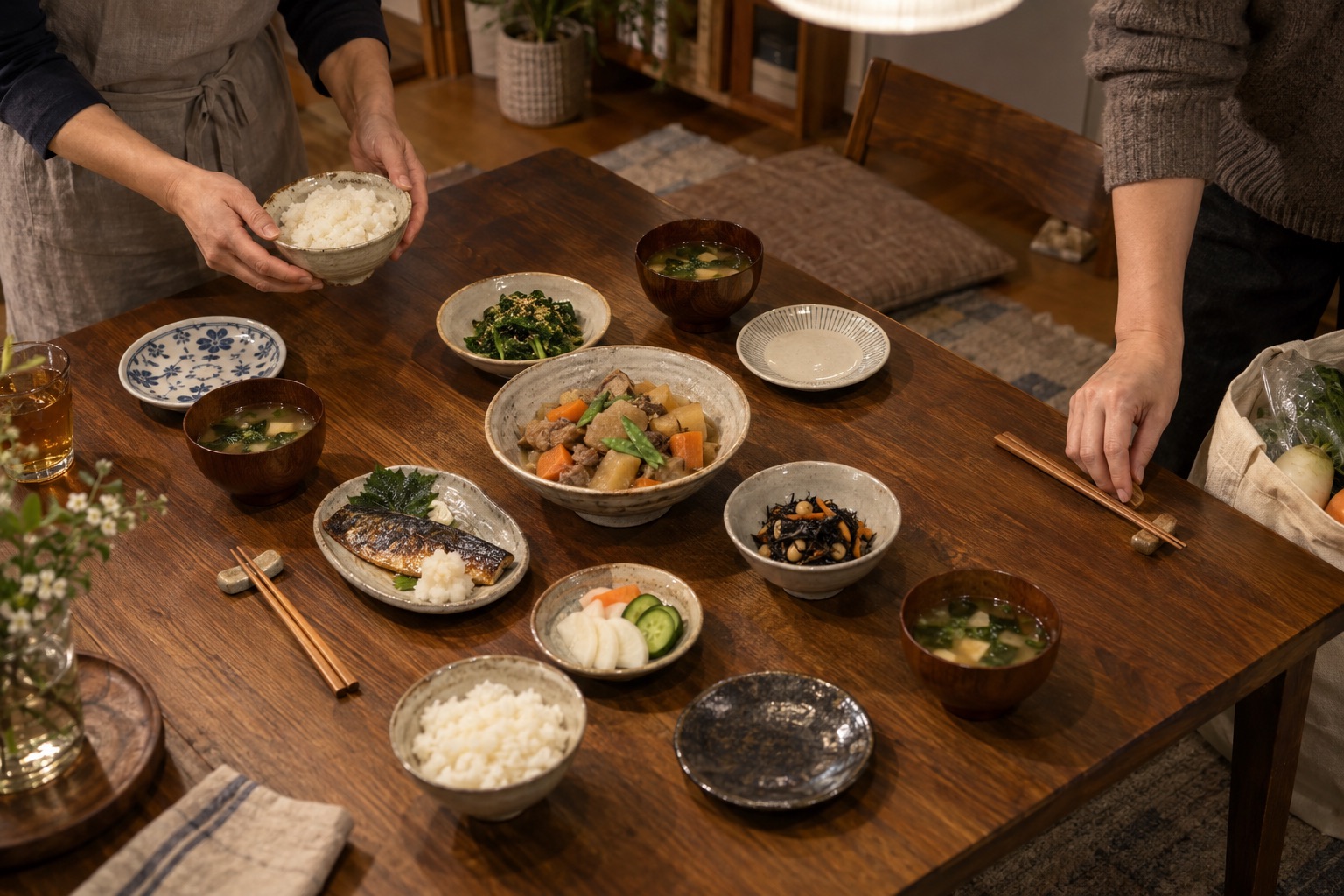
The Kawamoto household becomes less interesting if we treat its members as three interchangeable sources of kindness. The official character profiles identify Akari as the eldest sister and family breadwinner, Hinata as the middle sister attending middle school, and Momo as the youngest, still in preschool. Different responsibilities and ages are part of the household from the start.
That should change the questions we bring to a meal. Who arranged it? Who is concentrating on something else? Who needs help, and who is being expected to provide it? These are not demands that the viewer audit every domestic task. They are reminders that hospitality involves people with their own days, rather than a setting that exists only when the protagonist needs comfort.
The episode-two description also places Akari at work in a hostess bar visited by Rei and fellow players. Cooking and welcoming people at home do not exhaust her role. It is worth retaining that distinction even when a scene invites our attention towards what Rei receives from her care.
Episode four offers a particularly clear change of focus. Hinata wants to make an elaborate, cute lunch for Yusuke Takahashi, the baseball player she likes. Akari favours an ordinary bento instead. Preparing it and deciding what to wear make for a busy morning before the game. These are the details established by the official episode-four synopsis.
The disagreement is revealing without needing to be turned into a lesson about the correct lunch. Practicality and the wish to make an impression are different priorities. Hinata’s plan has a recipient, a deadline and emotional importance of its own. Treating it only as evidence that the household is cheerful would miss the person whose plans are driving it.
It is also a useful check on a familiar critical habit: explaining every supporting character through the protagonist. Sometimes the more attentive response is to let another person’s concern remain their concern. We do not need to establish what Rei learns from it before deciding that it deserves screen time.
Food, in that reading, is not a universal symbol with one meaning. The useful question is the specific job a meal or lunch is doing in a particular exchange. Preparing something for a crush, feeding a child and making a guest welcome are not identical acts simply because they all involve eating.
The opening manga chapter, reproduced in an Agency for Cultural Affairs exhibition, makes a small sequence especially clear. Hinata invites Rei to dinner before the household learns how his match went. Akari’s request that he pick up groceries gives him something practical to do on the way. The meal also remembers the sisters’ mother and grandmother.
This is manga evidence, not a claim about identical staging in the anime. Its order matters to our reading: welcome is not presented as a prize awarded after a result is reported, and the household has losses of its own. Nor is Rei only a passive recipient; the errand gives his arrival a purpose within the preparations.
That is a more precise observation than saying that a meal fixes loneliness. An invitation can make room for someone while the people extending it still have unfinished lives of their own.
The direction of help changes in the fifth episode. Rei collects Momo from daycare as a favour to Akari. When Momo falls and gets scratched on the way home, he tends to her, and memories of his own family return. The episode-five account ties an ordinary responsibility to painful history without requiring either element to cancel the other.
The useful distinction is between being able to do this task and being completely free of distress. Rei can respond to a child’s immediate need without the story having to announce that his own difficulty is over. Equally, the return of memory does not make the practical care unreal.
We would resist turning this into a repayment scene. Receiving kindness need not be followed by an equivalent service before a character deserves further welcome. Looking for reciprocity is valuable when it reveals a fuller relationship; it becomes reductive when it turns affection into an account that must balance.
For the viewer, this suggests paying attention to scale. A specific action can be meaningful without being a turning point that resolves the whole character. A story does not have to choose between a miraculous transformation and nothing happening at all.
That is particularly important when discussing a character’s sadness. Description and diagnosis are different activities. We can discuss isolation, hesitation, memories and the help available within a story without assigning a clinical label, recommending treatment or asking fictional relationships to stand in for real-world care.
For a first viewing, our recommendation is to begin with the people and the immediate situation. Take the shogi seriously, but do not make technical mastery a test you must pass before the rest of the story becomes available. Let a household scene hold attention even if nobody announces a new career goal.
If you mainly want a continuous sequence of contests, that emphasis is worth knowing in advance. If you are looking for something warm, the family-loss premise is equally worth knowing. Neither expectation is wrong; they simply leave out different parts of the material introduced here.
There is no need to track every character with a worksheet. One occasional question is enough: what is this person trying to do right now? It may reveal a practical need, a competitive wish or an attempt to spend time with someone. Crucially, ask it about the people around Rei as well as about him.
For readers who prefer manga, DENPA’s English volume-one listing identifies Chica Umino’s work and credits Jocelyne Allen as translator. That is a publishing reference, not confirmation of delivery, stock or viewing access in India. The exhibition translation linked above is a separate presentation; it should not be assumed to be the wording of that edition.
The most useful way to carry this guide into the series is to leave the categories slightly open. Competition may include company. Hospitality may include disagreement. Being helped may coexist with helping. These are questions to notice in the early story, not a formula that predicts its ending.
A match can tell us who prevailed at the board. It cannot, by itself, tell us whether the rest of a day has become easier to inhabit. March Comes in Like a Lion is worth approaching with room for both questions—and without requiring the answer to one to settle the other.

AUTHOR OF THIS ARTICLE
SoJapan
SoJapan India Pvt. Ltd. is a Japanese-founded company based in Gurugram. We bring Japanese food, anime goods and apparel materials to Indian businesses, with a sister company in Kyoto that works directly with makers in Japan.