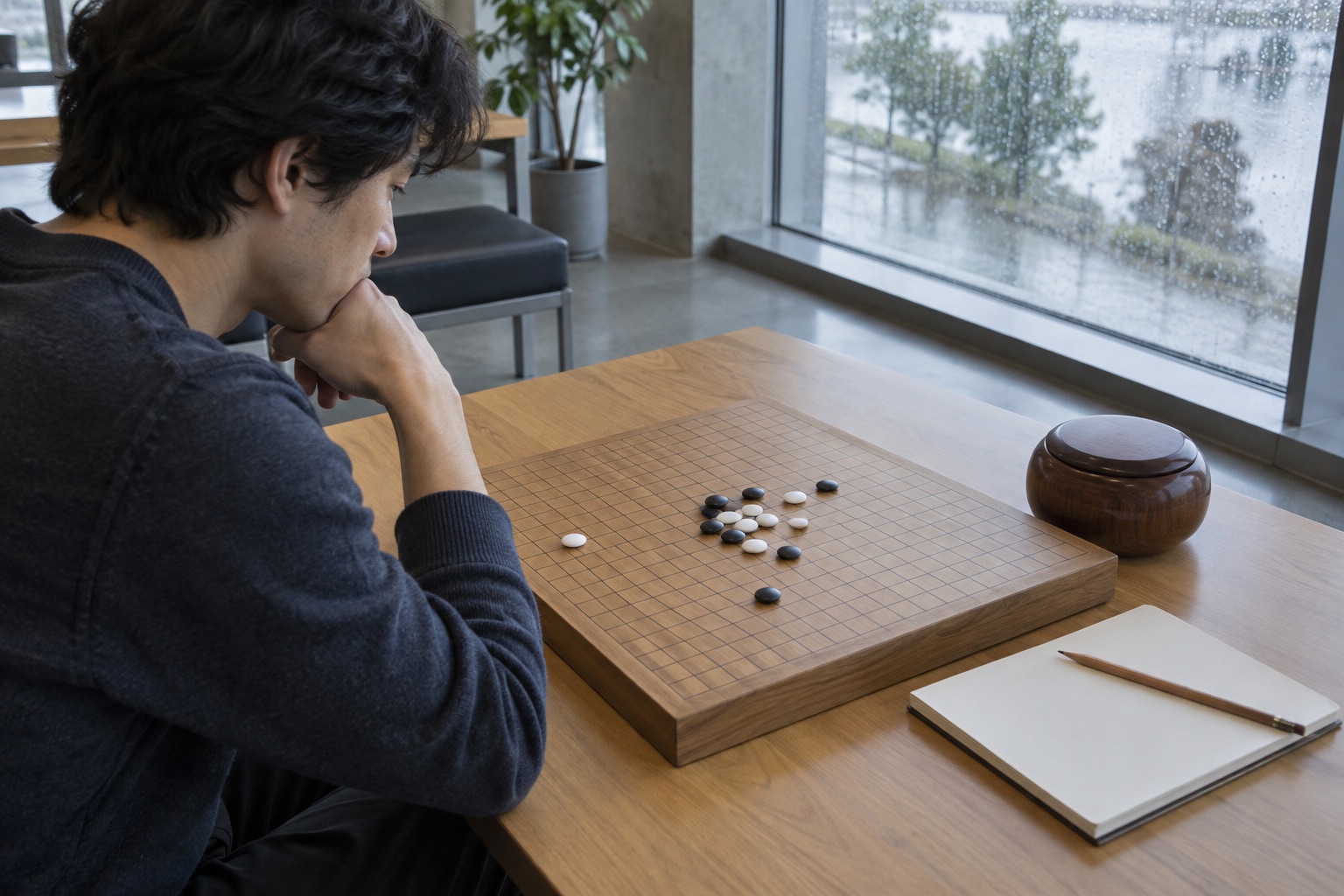
A hand places a stone. The opponent studies it. For a spectator, that may look like enough information to identify the player responsible. In Hikaru no Go, it is the beginning of a problem: the person making the decision and the person carrying it out need not be the same.
Hikaru encounters the spirit of the Go master Fujiwara no Sai through an old board. He is not initially an enthusiastic player himself. That supernatural partnership is the starting premise, not a late reveal. Studio Pierrot’s series introduction establishes it alongside Hikaru’s growing connection to the game.
Receiving an expert’s move is different from learning how to choose one. Keeping that distinction in mind makes the early rivalries easier to follow, even if you have never played Go. It also prevents a misleading question from taking over: why does an apparently excellent player sometimes seem to know so little?
This guide discusses the premise and selected situations through anime episode six. It leaves out match scores, winners, later career milestones and the ending. The linked publisher and broadcaster pages can contain additional spoilers; you do not need to open them while watching.
Three questions will do most of the work:
These are our viewing questions, not official categories of Go players. The short rules section below supplies just enough context to make a stone placement meaningful. It is not a substitute for a beginner’s rulebook.
Akira’s response is a good place to begin. Bandai Channel’s episode-two synopsis describes him as deeply affected by his encounter with Hikaru. A particular move stays in his mind, and Hikaru becomes significant as a potential rival of his own age.
Our reading is that this need not make Akira gullible. He has encountered the evidence available across a board: someone’s play. The viewer knows something extraordinary about its source. Judging his inference with that extra knowledge would give him a test he was never equipped to pass.
Notice the difference between recognising a strong move and correctly identifying the mind behind it. Expertise can help with the first without solving the second. There is no need to invent envy or arrogance to account for the initial disturbance; the situation already gives a serious player something difficult to understand.
For viewers, this is a useful alternative to building an immediate strength ranking. A ranking compresses a person into one label. A conversation or encounter may instead be testing an expectation: is this the player I thought I met? Keep the expectation attached to the person who holds it, rather than treating every assessment as an announcement from the story itself.
One practical habit is to avoid silently correcting characters while they speak. First ask whether their conclusion fits what they have seen. Then ask what they are missing. You can find a conclusion incomplete without finding its owner foolish. That distinction is especially helpful in a story whose audience has privileged information.
The separation becomes concrete in episode five. During a game with Kaga, Hikaru is distracted by Akari passing by and puts a stone somewhere other than the point Sai indicated. That is the setup recorded in the licensed distributor’s episode-five synopsis. We are stopping before its account of the result.
This is an execution error, not evidence that Hikaru has thoughtfully rejected an instruction. The two would be different actions. One changes where a stone lands by mistake; the other would require a competing decision. Calling both “playing for himself” would erase precisely what the scene helps distinguish.
It is also a reason not to treat the partnership as an automatic mechanism. A recommendation still has to reach the board through a person attending to it. That observation does not establish a complete explanation of the game’s outcome, and no reconstructed board position is needed to make the narrower point.
Kaga supplies another perspective. TV Tokyo’s character profile places him in the school shogi club while also describing his Go ability. He recognises Hikaru’s striking strength yet finds his occasional extraordinary mistakes puzzling.
The useful contrast with Akira is not “one understands and the other does not”. Kaga notices inconsistency. That, too, is reasonable evidence to take seriously. A viewer who knows the premise can explain more of the mismatch, but should not turn that advantage into a claim that every error has the same cause.
When discussing an episode with a friend, precise verbs help more than adjectives. “Selected”, “followed”, “misplaced” and “explained” identify different actions. “Brilliant” and “terrible” merely evaluate the impression. Start with the action, especially when two viewers disagree about whether a moment shows improvement.
Here is an editorial distinction for watching learning scenes. It is not a psychological diagnosis or an official teaching standard. A correct answer can establish less than we instinctively credit it with.
| What you observe | What it supports | What it does not establish by itself |
|---|---|---|
| An instruction is followed | The requested action was carried out | The learner could select it without help |
| A reason is explained | The learner can express a reason | The reason works in every similar-looking situation |
| A changed problem is attempted | The learner is making a fresh decision | The decision is correct, or all help is now unnecessary |
The last row is deliberately modest. Independence and accuracy are separate questions. A person can make a poor decision for themselves, or accurately repeat something they cannot yet reproduce unaided. Neither observation, on its own, describes the whole person.
This gives you a way to follow progress without pretending to evaluate expert Go. Listen for the kind of explanation being offered. Does it identify an immediate danger, a purpose, an alternative or only a location? If the situation changes, does the explanation change with it? You do not need to supply the best answer yourself to notice that these are different tasks.
Do not demand a spoken lecture after every move, either. Absence of explanation is not proof of absence of understanding. A scene may simply not show enough evidence to decide. “We have not been shown that yet” is often a better description than “he knows nothing” or “he has mastered it”.
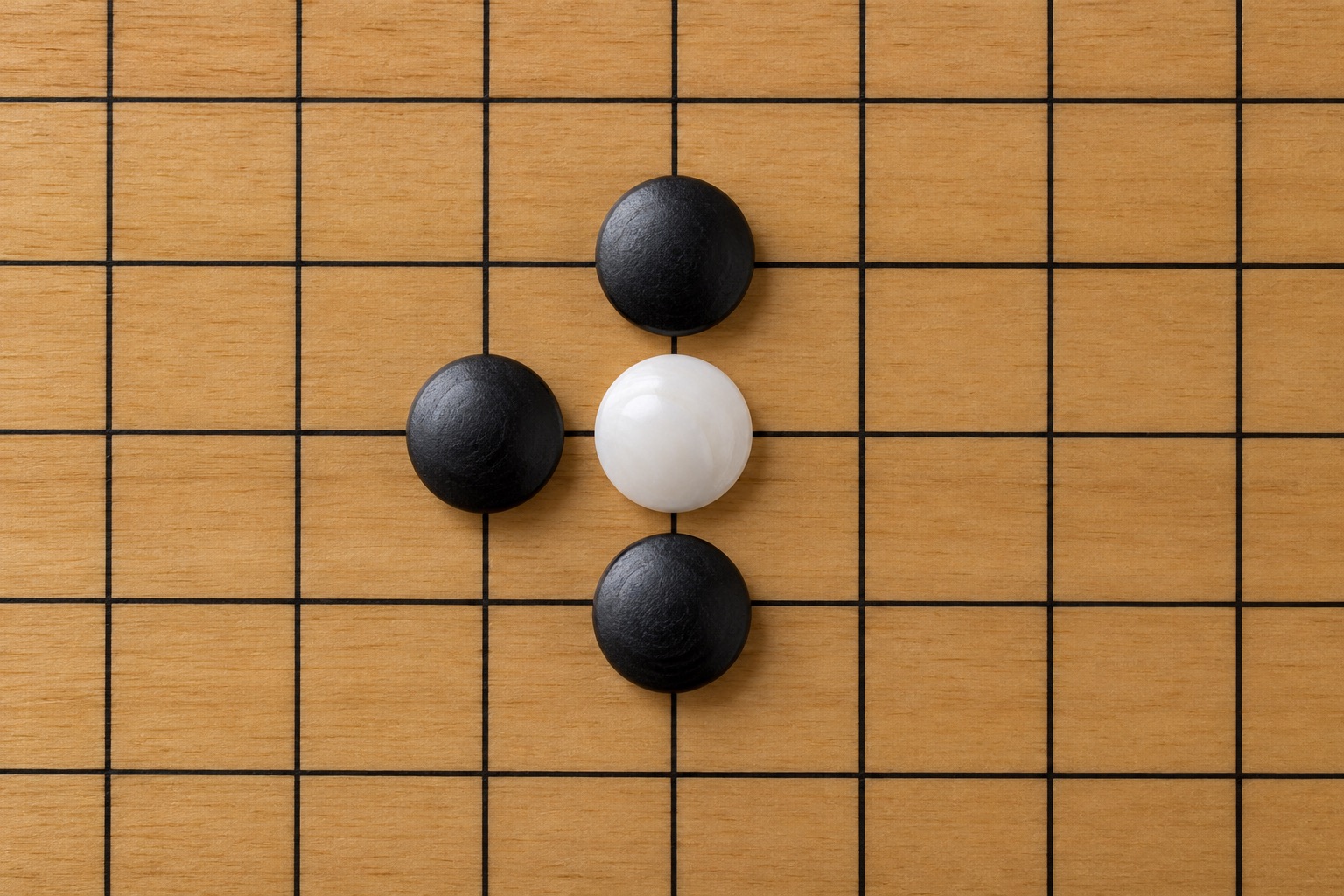
Go uses black and white stones placed on the intersections of the board’s lines, rather than inside its squares. Players ordinarily alternate placing stones. Territory matters; it is not simply a contest to collect the largest pile of opposing pieces. The Nihon Ki-in’s introductory guide is a primary-source starting point for the basic game.
For this article, the important detail is the intersection. “Somewhere near the intended place” is not necessarily the same move. You are choosing an exact relationship to the stones and open points around it. That helps make the distinction between an instruction and its execution concrete without requiring a full tactical explanation.
The Nihon Ki-in separates making territory from surrounding and capturing stones in its lesson on the game’s two elements. It also explains liberties: the open points directly adjacent along the grid lines. Diagonal points do not count as liberties. A stone or connected group is captured when its liberties are gone.
As a small teaching example, not an anime position, imagine an isolated stone away from the edges with its four neighbouring intersections empty. It has four liberties. If opposing stones occupy three of those points, only one remains. That local count says something about the stone’s danger, not who is winning the whole game. Do not use it as a scoring method.
The association’s atari lesson calls the one-liberty situation atari. Its rescue example extends a stone into a connected group with additional liberties. It also shows why placing a stone diagonally nearby does not create the same fully connected group.
That is enough to understand a useful learning distinction: remembering a word is not the same as recognising the relevant position. Being able to say “atari” does not, by itself, supply a sound response. The lesson even notes that stronger players may deliberately allow stones to be captured for another benefit. Consequently, “a stone was lost” is not a reliable universal test for a blunder.
You need not memorise all the exceptions before episode one. Keep the term attached to its narrow meaning, and resist translating it into “the game is over”. This guide does not attempt to teach endgame scoring, ko or the full rules governing legal placement.
The Nihon Ki-in’s connecting-and-cutting lesson demonstrates how joining your stones can also separate the opponent’s, and how an unprotected connection can be cut. Its diagonal examples caution that a visually close arrangement is not necessarily a fully joined group.
For a newcomer, the useful question is “What relationship changed?” rather than “Was that stone close enough?” A small change of point can change a connection. You do not have to calculate every continuation to understand why someone might object to what looks like a tiny displacement.
Treat these explanations as a doorway. If the board is becoming interesting in its own right, follow the association’s diagrams and learn systematically. If you mainly want the character story, you can stop here. A first viewing need not become an examination in terminology.
There is another reason to resist the idea of a simple shortcut to expertise: Sai is a person within the fiction, not merely a store of correct answers. TV Tokyo’s Hikaru profile describes Hikaru’s competitiveness but also his consideration for Sai, who is lonely without opportunities to play.
Our interpretation starts there. Helping someone take part in an activity is not identical to asking them to teach you that activity. Both can be generous, enjoyable or frustrating, but they are different arrangements. A desire to have one’s own turn need not erase concern for the other person.
For a viewing question, distinguish three possible requests: let me participate; show me how; let me try. These are our paraphrased categories, not dialogue from the anime. They direct attention to what is being asked for before you decide whether the answer is helpful.
An explanation may suit someone asking to learn and feel like an interruption to someone simply wanting a turn. An answer may solve an immediate problem while leaving the learner’s question unanswered. Neither observation requires a verdict that help is always harmful or that refusing help is always admirable.
Notice, too, whether your own preferred outcome is quietly deciding your interpretation. If you want the strongest possible play, assistance looks attractive. If you want to see an unaided attempt, the very same assistance may feel frustrating. Those are different viewing preferences. Naming yours can make a discussion more interesting than insisting that every character ought to want the same thing.
This is not a claim about the creators’ private intentions. It is a way of reading the relationship without turning one participant into equipment for the other’s development.
Episode six introduces a concrete pressure. According to Bandai Channel’s synopsis, Kaga tells Hikaru that winning the tournament is necessary for the Go club to receive recognition. Frustrated by being unable to win on his own, Hikaru asks Sai to play. That is this fictional school’s situation, not a general rule for Japanese school clubs.
Our reading is that the request cannot be understood only as a private choice about learning speed. Other people’s immediate goal is involved. A choice that produces more opportunity to practise personally may not be the choice a team wants at that moment.
This explains a pressure; it does not settle every objection to the response. You can understand why help is requested without treating that request as proof of independent improvement. Nor does understanding a character’s reason require approving every consequence. We are leaving the tournament outcome aside.
When you reach a scene with shared stakes, try identifying the deadline. Is someone trying to understand a problem eventually, or meet a demand now? Those timeframes can favour different choices. Then identify who bears the cost if the attempt goes badly. It is harder to call a risk purely personal when other people have a stake in it.
The Nihon Ki-in’s beginner etiquette guidance tells spectators not to advise players. The supernatural premise is therefore not a model for offering uninvited suggestions over someone’s real game. No tournament penalty or universal sanction is being asserted here; an actual event has its own rules and officials.
If the anime makes you want to learn with a friend, agree on the activity first: a teaching exercise or an unaided game. For an exercise, you could ask for an explanation after attempting a problem, instead of requesting the next point immediately. That is an optional learning approach, not a requirement to imitate the characters or a claim that one method suits everyone.
For identification, Pierrot’s archive lists the television anime as a 75-episode series originally broadcast in Japan from October 2001 to March 2003. The manga credits divide story and art between Yumi Hotta and Takeshi Obata; VIZ’s English volume-one listing is a useful edition reference.
Begin at the start of whichever format you choose. Do not use anime episode numbers as if they were manga chapter numbers. Shueisha’s Japanese volume-one contents and the episode listings organise their material differently. A search for a numbered instalment without specifying the format can take you to the wrong point in the story.
For readers in India, these links document the work and its publication, not local streaming rights, book stock or prices. Check the exact title and language in a service’s Indian catalogue before paying. A Japanese rental listing or an English publisher page is not, by itself, confirmation that its offer is available to your account.
If spoilers matter, avoid complete character profiles and all-episode summaries until later. Even an official page may describe a character at a stage you have not reached. Searching for a rule by its general name is safer than searching for an explanation of a specific match, where the answer may reveal its result immediately.
Our suggestion for a first viewing is simple: watch a complete exchange before looking up its vocabulary. Afterwards, decide what actually confused you. Was it the physical rule, the speaker’s intention, or the reason someone reacted strongly? A rule guide helps with the first. Replaying the conversation may help more with the other two. You do not need to interrupt every unfamiliar word to remain an attentive viewer.
If this leads you towards another competitive anime built around an unfamiliar game, our Chihayafuru viewing guide explains the different demands of competitive karuta. It is a useful next step for readers who enjoy learning enough of an activity to understand its participants, rather than memorising a list of recommended titles.
For Hikaru no Go, carry one distinction forward: an impressive action can reveal a great deal about the move while leaving a question about the person behind it. Follow that question patiently. The point is not to withhold all credit until someone becomes self-sufficient, but to notice exactly what kind of credit the evidence supports.

AUTHOR OF THIS ARTICLE
SoJapan
SoJapan India Pvt. Ltd. is a Japanese-founded company based in Gurugram. We bring Japanese food, anime goods and apparel materials to Indian businesses, with a sister company in Kyoto that works directly with makers in Japan.