Two instructions can both say “powdered kanten” and still ask you to do different things. Kanten Honpo’s basic jelly guide gives one powder a shorter boil and another a longer one, with different amounts of water. The powder’s name alone has not told you how to use it. See the maker’s comparison.
That matters when you find a Japanese dessert recipe, have a packet of agar at home, and want to know whether you can substitute it. A conversion can look reassuringly precise while leaving the preparation unresolved. Does your product need soaking? Does it dissolve in hot water or require boiling? Is it pure kanten or a formulated jelly mix? When does the recipe add its other liquids?
Start with the exact product and its method, then check the dessert recipe. This guide explains how those two sets of instructions fit together. It is not a universal agar-to-gelatin conversion chart, and the product examples below are teaching references—not claims about stock, price or availability in India.
If you are still identifying the sweet rather than making it, our guide to Japanese sweets and wagashi is the better starting point. Here, the question is narrower: how does kanten become a useful setting ingredient, and where can a substitution change the process?
Kanten is a seaweed-derived setting ingredient, commonly called agar in English. It is not animal gelatin. Kanten Papa’s manufacturer explanation distinguishes the seaweed ingredient from gelatin, an animal protein, and describes different setting and melting behaviour. The two can fulfil a similar culinary purpose without being the same material. Read the manufacturer’s explanation.
For an Indian reader avoiding animal-derived gelatin, that distinction is useful. It answers the question about the setting ingredient, not every ingredient in the finished sweet. A milk dessert still contains milk; a ready-made mix needs its own ingredient check. There is no need to turn a preparation decision into a claim that every dessert called jelly is suitable for the same diet.
The next distinction is less obvious: the word on the front may describe a form, a package or a blend.
Matsuki sells powdered kanten in a product named “stick type”. In this case, the sticks are small packets containing powder, not solid bars that you break up. Its directions explicitly say the powder needs no preliminary soaking in water; it is heated in the measured water to dissolve. Matsuki’s powder product and handling instructions.
That is a useful translation warning. If an English recipe says “one stick”, do not decide what that means from the word alone. Look at the specified form and weight. A narrow sachet and a solid bar are different objects, even if a shop description happens to use similar language. A photograph of the unopened outer box may not settle the question either; the preparation panel is more informative.
Ina Agar L provides a concrete example. Its current Japanese ingredient list names glucose, kanten and gelling agents described as thickening polysaccharides. The manufacturer identifies it as a powdered jelly base, rather than simply a packet of kanten. Its method begins by mixing the product with sugar in a dry container before gradually adding it to water. Ina Agar L’s ingredients and directions.
This does not mean that the English word agar always describes a blend. It means a branded Japanese agā product should not be identified by an English-language shortcut. Nor should we guess the exact additional gelling agents when that product page does not name them individually.
The practical consequence is modest but important: do not transfer a pure-kanten recipe to this blend merely because both can produce jelly. Keep the product’s own instructions attached to it. The same caution works in the opposite direction—directions designed for a formulated jelly base are not automatically directions for an unrelated agar powder.
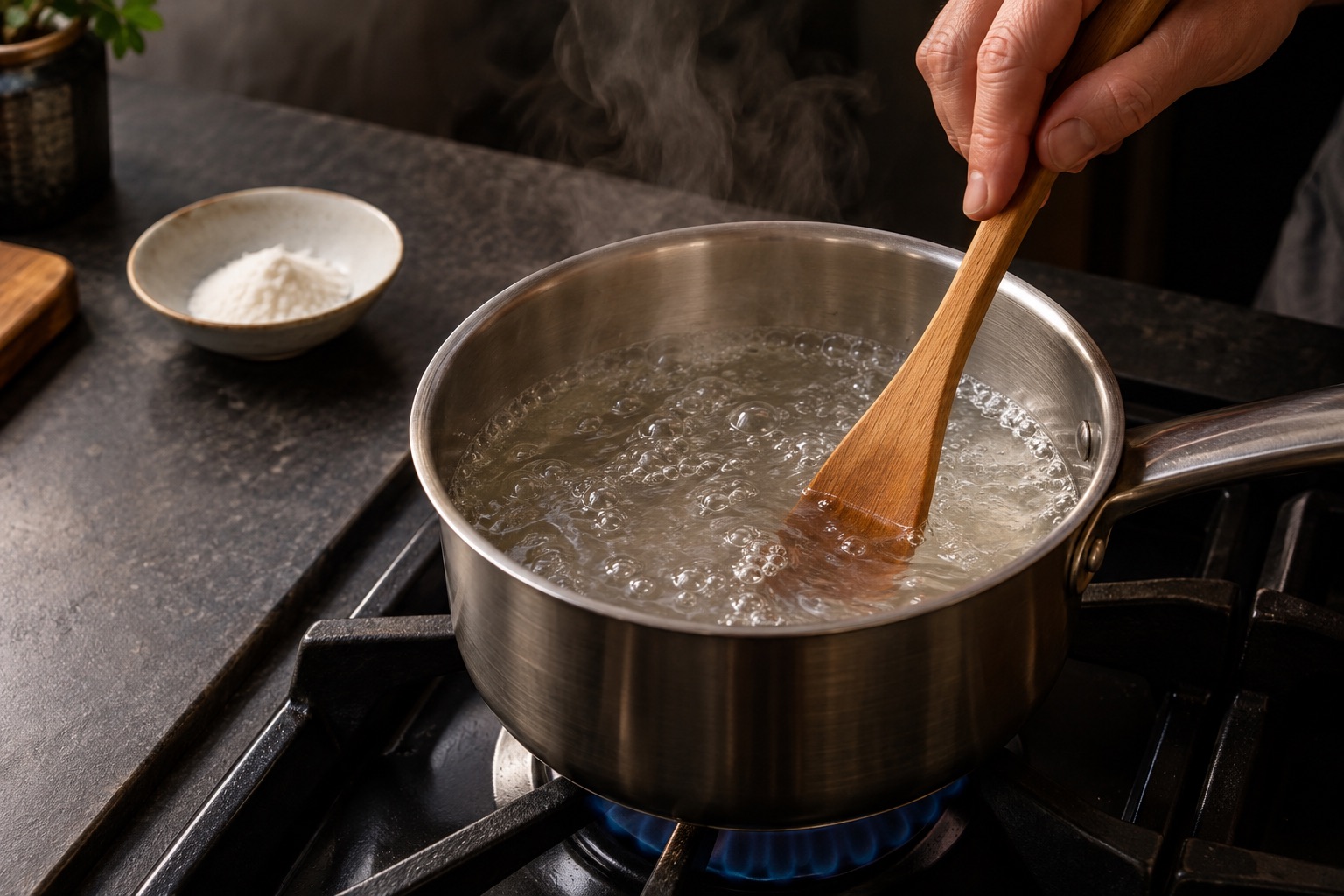
“Put it in water” can describe more than one stage. Soaking prepares a dry form for the next operation. Dissolving makes the setting ingredient part of the liquid used for the dessert. Setting is what you want from the prepared mixture afterwards. A recipe can require all three, while another product may omit the preliminary soak.
Kanten Honpo’s bar and thread methods illustrate the distinction: they call for soaking, squeezing out water and then boiling the kanten in the recipe water until it is no longer visible. The soak is not presented as a substitute for the later heating. Its two powder methods, meanwhile, differ as follows:
| Powder in the maker’s guide | Kanten and water | After reaching a boil |
|---|---|---|
| Ordinary powder | 4 g with 500 ml | Lower heat; cook for 1–2 minutes |
| Powder described as having stronger elasticity | 4 g with 700 ml | Lower heat; cook for about 5 minutes |
These are Kanten Honpo’s product-specific examples, not interchangeable options for an unknown packet. The comparison does not promise an identical texture, or establish that every powder sold elsewhere belongs to one of these two types. Source: Kanten Honpo’s basic kanten-yose guide.
Weighing accurately does not compensate for following the wrong product’s method.
For a first attempt, choose a recipe that identifies the product or provides preparation guidance that agrees with your packet. If the packet and recipe genuinely conflict, look for the manufacturer’s version of that dessert or ask the maker about the substitution. Averaging two different instructions would create a third, untested method.
There is also a difference between preparing kanten to make a new jelly and using a kanten product as an ingredient you eat in its existing shape. Kanten Papa’s types guide includes thread-shaped products used in soups and salads, sometimes after rehydration. Instructions for that use should not be mistaken for instructions to dissolve a dessert-setting ingredient. See the manufacturer’s overview of forms and uses.
You do not need to memorise every commercial form. You need to know which job your packet was designed to do. If a listing gives only a name and a picture, the missing preparation instructions are a reason to investigate further, not an invitation to guess a spoonful.
A common-sounding instruction—“agar must be boiled”—needs qualification when applied to actual Japanese products. Ordinary Kanten Cook and Kanten Cook Granules have different preparation methods, despite both listing kanten as the ingredient.
For ordinary Kanten Cook, the manufacturer says to add the powder to water and heat while stirring. Once it boils, continue boiling for one to two minutes at a level that avoids boiling over. That time begins after the liquid reaches a boil, not when the cooker is switched on. Ordinary Kanten Cook directions.
Kanten Cook Granules has a hot-water method. The maker places the product in a bowl first, then adds the specified hot water and calls for immediate stirring. Its example uses 2 g, about 250 ml of water at least 80°C, and about one minute of stirring. It specifically warns that putting the product into the hot water instead can create lumps. Kanten Cook Granules directions.
The order is worth noticing. “Combine powder and hot water” is an incomplete summary of that instruction. It removes which goes into the bowl first and when to start stirring—the very details the maker has chosen to specify.
Neither example should be exported to every similar-looking packet. A product labelled merely “agar powder” has not thereby been verified as the hot-water-soluble granules used here. Equally, it would be wrong to insist that the granules must follow the ordinary product’s saucepan method simply because both are kanten.
When translating instructions, preserve verbs and sequence as carefully as numbers. “Add”, “sprinkle”, “stir immediately”, “bring to a boil” and “continue boiling” describe actions, not decorative wording. A translated ingredient list without the method can leave you with a correct quantity and the wrong preparation.
A useful reading habit is to mark where each timer starts. Does the instruction measure from adding water, reaching the specified temperature or beginning a boil? Do this before starting, when you are not also trying to hold a packet, handle hot liquid and read a small screen.
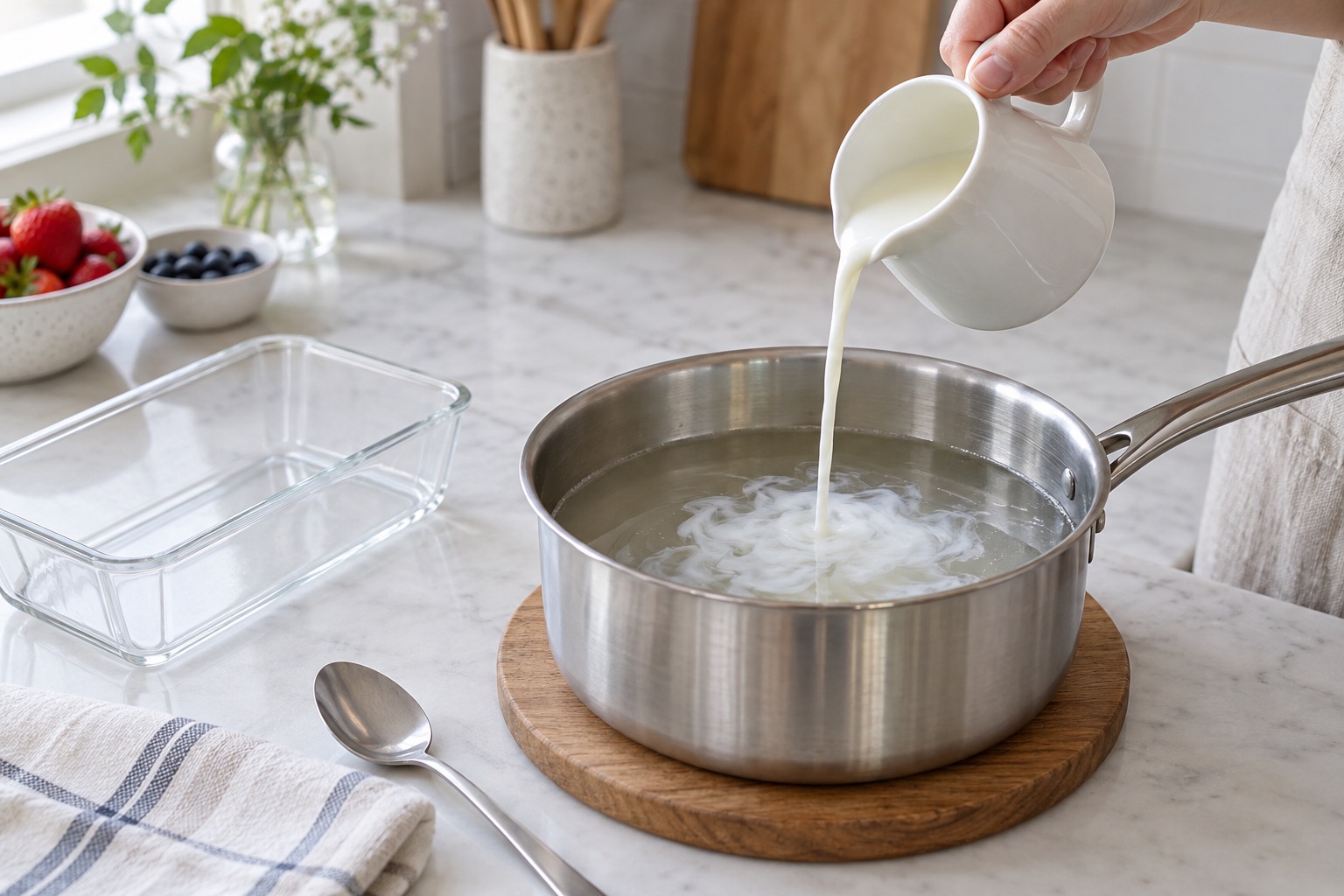
Once the kanten has dissolved, the process is not finished. A recipe may reserve part of its liquid for a later addition, and that liquid still belongs in the overall formula.
Matsuki’s milk-kanten recipe makes this visible. It lists 200 ml of water and 200 ml of milk, with a powder alternative of 2 g. The bar-oriented method dissolves the kanten in the water first, then adds milk warmed to roughly body temperature. The maker also instructs readers not to boil the mixture after the milk addition. Read the complete Matsuki milk-kanten recipe.
The arithmetic is simple: those listed liquids total 400 ml. But it would be a different instruction to put all 400 ml into the initial saucepan stage as water and then add milk as well. This is a reading example, not a revised recipe or a prediction of how firm an altered batch would become.
Separate two questions on your notes: how much liquid is used, and when is each liquid added? Recording only the final total loses the sequence. Recording only the initial water loses the later addition. Both errors can happen even when the quantity of kanten itself has been copied correctly.
The distinction also matters if you want to replace dairy milk. The cited recipe does not establish that every plant-based drink can be substituted without adjustment. For an egg-free or dairy-free dessert, choose a recipe developed for your intended ingredients rather than treating a change of liquid as merely a change of name. That is a recommendation about selecting evidence, not a promise of a particular result.
Kanten Papa’s troubleshooting guidance identifies two separate problems. A large cold addition can interfere with even setting; for juice added in a quantity at least equal to the prepared jelly liquid, the maker advises warming it to roughly body temperature. It also warns that boiling acidic fruit or juice together with the mixture may prevent setting, and advises preparing the jelly liquid first before adding the juice. The manufacturer’s troubleshooting page.
One warning concerns the temperature of what you pour in. The other concerns heating an acidic ingredient with the setting mixture. They should not be collapsed into “fruit is difficult” or “boil it longer”. The useful action is to identify the relevant step in the recipe you are actually following.
If you want a fruit dessert, start with a tested fruit-dessert method for your product. A plain-water demonstration proves much less than a complete formulation for the dessert you want. It does not tell you how much juice to add, whether to replace some water, or how the intended fruit should be prepared.
Follow the linked full recipes when cooking; the selected measurements here explain a distinction, not a complete method.
Kanten is especially interesting in Japanese confectionery because the setting stage works alongside other ingredients and techniques. Yokan is a useful example: the goal is a finished sweet, not simply proof that a liquid can turn into a gel.
Toraya’s account of one type of yokan describes dissolved kanten combined with azuki bean paste and sugar, then worked over heat. Its artisans judge consistency by watching how the mixture flows from a spatula before it is moulded and chilled. Toraya explicitly notes that this is one method within a range of yokan, not a definition of every variety. How Toraya makes yokan.
That account supplies a helpful boundary for the home cook. A professional description can explain what the maker is assessing without giving you a complete, reproducible home recipe. “Watch the consistency” becomes useful only when your chosen recipe tells you what endpoint to seek. It should not be turned into a guessed heating time on someone else’s cooker.
Matsuki’s mizuyokan recipe shows a more explicit finishing sequence. After combining and heating the ingredients, it calls for cooling the bottom of the pan in water while stirring until the mixture thickens, then transferring it to the mould. Pouring immediately after the earlier heating would skip a stated step. Matsuki’s mizuyokan method.
Our practical reading is that a recipe can control the mixture before moulding as well as during heating. The cooling stage is part of the method, not dead time between “cooked” and “ready”. That does not license us to invent a universal cooling temperature or to claim the same sequence applies to every bean jelly.
The bean paste deserves its own attention too. If that ingredient is unfamiliar, our anko texture and sweetness guide explains why “smooth” is not a complete description of a paste. Here, the relevant habit is simply to use the kind of paste your chosen recipe specifies. Changing the paste and the setting product at once makes any comparison harder to interpret.
Before beginning a dessert with several stages, arrange the method in its real order: prepare the setting ingredient, incorporate the other ingredients, reach any stated pre-mould endpoint, then mould and chill as directed. Do not stop reading at the point where the powder has dissolved. The remaining instructions may be the ones that make this particular sweet different from a plain jelly.
“It did not set” describes an outcome, not a diagnosis. It does not tell us whether the product, quantity, dissolution or later additions were responsible. Adding more powder next time may change the result without explaining the original problem.
The following are hypothetical reading checks, not tested rescue procedures:
These checks deliberately stop short of telling you to reheat or salvage a batch. Without its exact ingredients and handling history, a reliable fix cannot be inferred from the appearance of an unset dessert. The aim is to find the missing instruction so the next attempt starts from a coherent recipe.
Keep the packet and the recipe together until you have finished. If you ask the manufacturer for help, a precise account is more useful than “I used agar”: identify the product, the quantities, the order of additions and the step where the result differed from the instructions. Describe observations—visible lumps, the mixture’s state when poured—without assuming they prove one cause.
One last distinction is important in a warm kitchen: a product’s ability to hold its shape is not a food-storage instruction. Do not infer that a finished milk or fruit dessert may be left unrefrigerated merely because its setting ingredient can gel without chilling. Follow the finished recipe and applicable storage guidance; this article does not establish a homemade dessert’s safe shelf life.
The most useful question is not “How many teaspoons replace one stick?” It is “Which product and complete method am I trying to replace?” Once those are identified, a manufacturer’s conversion or alternative recipe has a context in which to make sense.
For your first kanten dessert, our recommendation is to choose a maker-supported recipe that matches the packet you actually have and the dessert you want. Read through the additions and cooling stage before measuring anything. If you change a product or ingredient later, record that change rather than silently combining instructions from several recipes.
Kanten becomes less mysterious when the stages stay distinct. A packet tells you how to prepare a setting ingredient. A dessert recipe tells you what to do with it. You need both—not a more confident-looking ratio detached from either.

AUTHOR OF THIS ARTICLE
SoJapan
SoJapan India Pvt. Ltd. is a Japanese-founded company based in Gurugram. We bring Japanese food, anime goods and apparel materials to Indian businesses, with a sister company in Kyoto that works directly with makers in Japan.