← JOURNAL29 Sep 2026
Japanese Folklore in Anime: Yokai, Oni, Kitsune and Shrine Symbols Explained
 By SoJapan
A fox appears beside a red gate. A swordsman’s teacher wears a long-nosed mask. A creature that looks terrifying turns out to be lonely, while an ordinary-looking visitor knows far too much about a family’s past. Anime becomes more interesting when you recognise these patterns—but less interesting if every pattern becomes a rigid rule.
Japanese folklore in anime is not a single mythology with one official list of creatures and powers. It is a changing collection of stories, images, local traditions and religious associations that artists can borrow, combine or deliberately overturn. A fox character, for example, might evoke a folktale without representing a deity. A shrine setting can matter even when nothing supernatural happens there.
For Indian viewers watching through English subtitles or a regional-language dub, several different Japanese words may arrive as the same word: spirit, monster, god or demon. Those translations help a scene move quickly, but they can hide distinctions. This guide restores some of that detail without turning your next episode into homework.
Expect explanations of eight useful terms, close-looking prompts and four anime entry points. Plot discussion stays near the premise or early character introductions. Religious explanations are descriptions of particular traditions, not claims that every person in Japan shares the same beliefs.
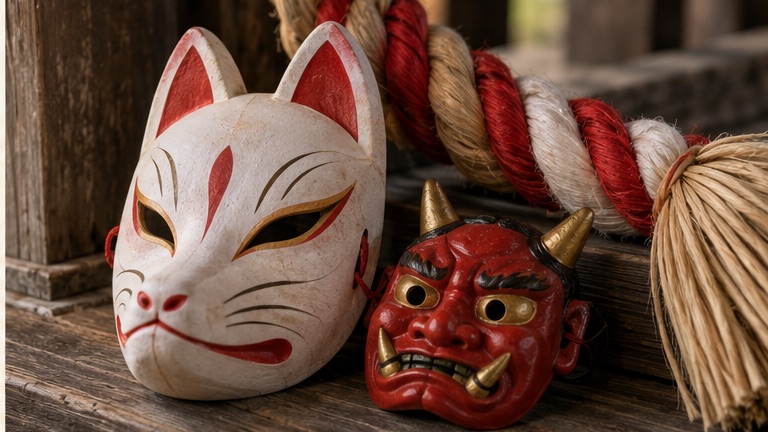
Use this table as an orientation map, not a biological classification. Some categories overlap in stories, and different authors use the same word differently. The useful question is what a term contributes to the scene you are watching.
| Term | Useful starting meaning | What to notice in anime | Assumption to avoid |
|---|---|---|---|
| Yokai | A broad label for uncanny beings and phenomena in Japanese folklore | The creature’s relationship with people and places | Every yokai is evil |
| Kami | A term central to Shinto for revered divine presences | Reverence, a named shrine, offerings or a relationship with a place | Every supernatural character is a kami |
| Oni | Often translated as demon or ogre | How the particular story defines the being | One series supplies universal oni rules |
| Kitsune | Fox; in folklore, foxes can have supernatural roles | Whether it is an animal, transformed figure or shrine-associated messenger | A fox statue is automatically the deity itself |
| Tanuki | Raccoon dog; folklore includes transforming tanuki | Tricks, transformations and the gap between appearance and identity | Tanuki are simply another name for foxes |
| Tengu | Beings associated with mountain folklore, with birdlike or long-nosed imagery | Masks, mountain settings and martial associations | A person wearing a tengu mask is literally a tengu |
| Kappa | Water-associated folkloric beings | Rivers, local stories and animal-like features | All kappa share one colour and temperament |
| Tsukumogami | Spirits associated with old tools or objects | An object’s age, treatment and connection to an owner | Every talking gadget belongs to this tradition |
The distinctions are practical. If the plot concerns a dead person’s unresolved relationship, you need a different set of questions from a plot about a fox impersonating a stranger. If villagers maintain a shrine, reverence may matter more than whether the visitor looks frightening. Visual similarity is a beginning, not a verdict.
The easiest mistake is to understand yokai through a modern game’s enemy catalogue: identify the species, learn its weakness, defeat it. That model fits some fictional worlds, but it misses the variety that makes yokai stories appealing.
The Japan Foundation’s Yokai Parade exhibition follows these beings across picture scrolls, woodblock prints, toys and film. Its overview describes a history in which frightening presences also become charming or friendly figures. That gives a better starting point than treating every strange creature as the same sort of villain. Explore the Japan Foundation exhibition.
An anime can introduce a yokai as a visual joke, a threat, a neighbour or an interruption to ordinary life. None of those roles alone explains the whole category. A tiny, ridiculous-looking character may carry emotional weight, while an enormous one may be part of the scenery rather than the main conflict.
Try replacing “Is this creature good or evil?” with “What does it want from this person?” The answer might be food, recognition, a returned possession, privacy or help keeping a promise. That question directs attention to a story rather than a checklist of supernatural powers.
Then ask who is frightened. A child, a professional exorcist and an elderly neighbour might react very differently to the same encounter. Those reactions tell you about the human characters too. A viewer who automatically takes the most confident explanation as the correct one can miss a deliberate conflict between ways of seeing the world.
This is also why cuteness does not settle whether a series is suitable for younger viewers. Designs and subject matter are separate choices. Check the title’s actual age guidance and content description; a soft-looking creature can belong to a story about grief, abandonment or violence.
In Shinto, kami is a religious term, not a level in a fantasy power ranking. Jinja Honcho describes kami associated with natural forces and places, and also discusses the reverence of certain people and ancestors. Its account does not reduce kami to one all-powerful creator. This is an institutional explanation of Shinto, not a survey of every Japanese person’s beliefs. Read Jinja Honcho’s introduction to kami.
For an anime viewer, the useful shift is from “How strong is it?” to “What relationship do people maintain with it?” A name, an offering, a festival or a carefully protected space can carry information that a spectacular transformation does not.
That does not make a fantasy series a source of religious doctrine. Writers can invent divine offices, rivalries, contracts and bureaucracies for their fictional worlds. Learn the rules the work establishes, then keep those rules separate from the cultural vocabulary it uses.
You may recognise broad storytelling situations: a sacred place, a vow, an offering, a powerful being who cannot be judged from appearances. Familiarity can make a scene easier to enter. It should not turn into a translation equation such as “kami means exactly this Indian religious category.”
India contains many religious and storytelling traditions, just as Japanese practice is not uniform. Compare a specific motif or scene if it helps, but keep the Japanese name when a direct substitute would erase a distinction. Similarity is an invitation to look more closely, not proof that two traditions are interchangeable.
Oni are familiar to many anime fans through Demon Slayer: Kimetsu no Yaiba. Yet one successful franchise should not become the definition of every oni in every older tale, festival image or later comedy.
Outside anime, the word appears in seasonal customs too. Web Japan’s account of annual events describes Setsubun bean-throwing as a way to drive out misfortune and harmful demons while inviting good fortune. That domestic or ceremonial context is quite different from a serialised battle narrative. See Web Japan’s annual-events fact sheet.
If an episode suddenly uses a horned mask, beans and a family joking at a doorway, identify the seasonal activity before assuming that a new supernatural battle system has appeared. The same broad imagery can function as ritual, play or dramatic danger depending on the setting.
The official character introduction describes Tanjiro’s wish to restore his sister Nezuko to humanity and identifies her transformation as the reason for that quest. The conflict therefore begins inside a family relationship, not just between two opposing creature categories. See the official character introduction.
One useful reading of that premise is that the label “demon” cannot answer every moral question for the viewer. What matters is how a particular character acts and how other people respond. That is an interpretation of the drama, not a claim about the creators’ stated intentions.
Keep the series’ explanations of transformations, abilities and combat inside its own fictional world. They are not a handbook for identifying oni in museum paintings. Enjoying a precise fictional system and understanding its cultural references are compatible; confusing the two makes both harder to appreciate.
A fox image is easy to recognise. Its role is harder to identify. Start with the least elaborate possibility: kitsune is the Japanese word for fox. The surrounding story determines whether a particular fox has supernatural significance.
For shrine imagery, there is a particularly useful correction. Fushimi Inari Taisha explains that foxes are messengers associated with Inari Okami and explicitly distinguishes the deity from a fox. It also distinguishes these invisible messengers from ordinary wild foxes. Read Fushimi Inari Taisha’s own explanation.
That means a fox statue beside an Inari shrine should not immediately become “a statue of the fox god” in your notes. Nor should every fox-eared anime character be assigned to Inari worship. The latter might belong to an entirely invented society with its own rules.
First, check whether the work actually names the connection. A character calling a place an Inari shrine is stronger evidence than a general red-and-white colour scheme. Next, ask what the fox does: guard an entrance, deliver a message, mislead someone, reveal a hidden identity or simply pass through the landscape.
Finally, distinguish appearance from status. A fox mask is an object worn by a character. Fox ears are a design feature. A transformation is an event. A messenger role is a relationship. They can occur together, but one does not automatically establish the others.
The same restraint helps with multiple tails. Count them if they matter to the scene, but do not import a fan-made age or power chart from another franchise. If the story gives a rule, follow it. If it does not, “a striking fox-like design” is a more accurate observation than an elaborate certainty.
Tengu imagery offers a good example of how much history a mask can compress. The Metropolitan Museum of Art’s account of an eighteenth-century tengu armour mask discusses both bird-headed and long-nosed human-faced forms. It connects tengu with mountain woodlands and notes that their attributes changed over time, including threatening and protective roles. It also discusses associations with mountain ascetics and martial skill. Examine the Met’s tengu mask.
Those details help explain why a long-nosed mask on a remote mountain can feel loaded with meaning even before the wearer speaks. They do not prove that every detail of a character’s design comes from the same tale.
The Demon Slayer character page identifies Sakonji Urokodaki as a trainer who wears a tengu mask. That is enough to establish the visible reference; it does not require describing him as a literal supernatural tengu.
As a viewing exercise, consider what hiding his face does. You must read his posture, pauses and actions without access to an ordinary facial expression. The mask creates a stable surface while the relationship beneath it changes. That is film criticism about the effect of the design, separate from the historical description of tengu.
The distinction is worth keeping: an older image supplies recognition, but animation, performance and storytelling decide how the image works in this scene. A reference can be culturally meaningful without being a one-to-one adaptation.
Tanuki are raccoon dogs, not foxes. Pom Poko, directed by Isao Takahata, gives anime viewers a particularly clear entry into their transforming folkloric image. The film’s premise places a tanuki community in conflict with development threatening its woodland home. See the distributor’s description of Pom Poko.
What makes this useful alongside fox imagery is the chance to compare storytelling functions rather than build another powers chart. In Pom Poko, transformation belongs to a community’s efforts to respond to a shared problem. It is not merely a flashy ability that makes one individual stronger.
Watch how scale changes the feeling of an image. A small trick can be comic; a mass display can become overwhelming. A familiar-looking human shape can also make you reconsider which characters get to define what an ordinary landscape should look like.
Those are suggested interpretive questions, not claims that a historical tanuki tradition has one fixed environmental message. The film makes its own argument through editing, tone and the events it chooses to show.
Do not choose it for a family screening solely because its animals look playful. It includes stylised anatomical humour and distressing conflict around habitat loss. Check local age guidance and the needs of the people watching with you.
Kappa are useful precisely because a single standard image can be misleading. JNTO’s Tono guide describes the area’s kappa as red creatures with shells and a plate-like feature on the head. It connects their stories with the danger of approaching water and mentions cucumbers as a favourite food. The same page points readers towards local places and the Tono Municipal Museum. Read JNTO’s Tono folklore guide.
A fan who has only seen green cartoon kappa now has an interesting question: which version is this artwork using? The variation is not necessarily an error. Local stories and later visual conventions do not have to agree in every detail.
In an anime scene, place may tell you more than colour. A creature beside a river, a warning from an older resident or a story attached to a particular pool directs your attention to the relationship between a community and its surroundings.
That is different from declaring that every water scene secretly refers to a kappa. Look for several connected clues before making the identification. A river by itself is a river; the extra context creates the reference.
The idea of tsukumogami concerns spirits associated with old tools and objects. A Japan Foundation performing-arts report describes the concept in terms of tools acquiring spirits after many years. That concise starting point is more useful than assuming every sentient machine or magical weapon has exactly the same origin. See the Japan Foundation project report.
An object-centred story invites a different sort of attention. Ask who used the object, who discarded it, what marks remain on it and whether its value changes from one owner to another. A repaired handle or worn surface can matter as much as a dramatic speech.
For fans who enjoy animation craft, this is especially rewarding. An object has an existing shape that can become part of its performance: a hinge suggests a joint, a lid suggests a mouth, a bend suggests a posture. Turning those features into personality is a design decision worth noticing even when the story never names a folkloric category.
Do not turn the idea into a universal countdown. If a particular tale gives an age threshold, that belongs to that account. If an anime does not, inventing an exact birthday for every talking umbrella adds false precision rather than understanding.
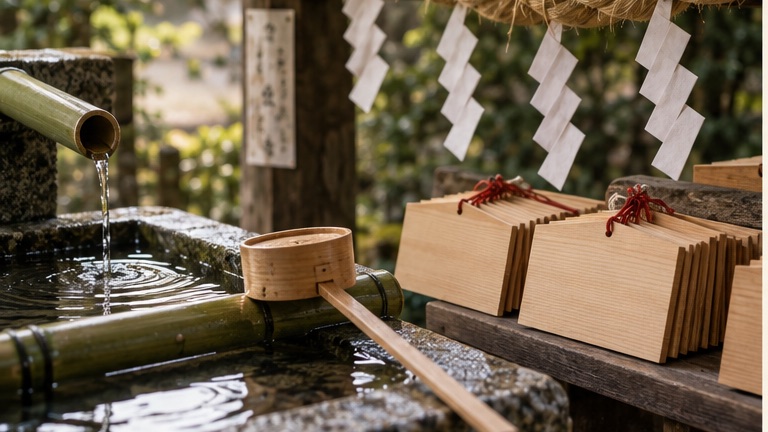
Not every cultural reference arrives as a creature. A change in space can matter just as much. Jinja Honcho explains that a torii marks the boundary between the everyday world and the sacred precinct of a jinja, or Shinto shrine. Its visitor guidance also asks people to respect worshippers and restricted spaces. Read the guidance on entering a jinja.
This makes the torii a useful visual cue in anime, but not an automatic portal. A character may cross it to pray, meet someone, take shelter or enter a supernatural encounter. The story supplies the event; the architecture supplies part of the context.
When a scene moves from a crowded road to a quiet approach, listen as well as look. Does traffic fade? Do footsteps become more distinct? Does the camera stop following the group and hold on one person? These are observable filmmaking choices, and you can discuss them without claiming that every quiet shrine scene has the same hidden meaning.
Also avoid treating shrine and Buddhist temple as interchangeable English labels. Real histories can be complex, and a fictional setting can combine influences. When identification matters, use the name the work provides and consult the actual institution’s information rather than deciding from one decorative element.
If an anime inspires a real visit, the place remains a place of worship. Follow its own photography and access rules, keep entrances clear and do not copy a dramatic pose in a restricted area. Fiction can prompt curiosity without deciding how visitors should behave.
These are not a ranking of cultural authenticity. They are four ways to start looking. The films and series differ in tone, intensity and commitment, so choose according to what you want from the evening—not according to which title seems most educational.
| Start with | Why it fits this guide | Question to carry into the viewing |
|---|---|---|
| Natsume’s Book of Friends | Relationships between humans and yokai | Does understanding a being change how someone treats it? |
| Spirited Away | A richly imagined world of spirits and unfamiliar rules | What must Chihiro learn through attention rather than force? |
| Pom Poko | Transforming tanuki and a community under pressure | Who gets to decide what happens to a shared landscape? |
| Demon Slayer | Oni in a tightly defined action-fantasy world | Where does this story distinguish identity from behaviour? |
The official introduction describes Takashi Natsume inheriting the Book of Friends from his grandmother and returning the names bound within it to yokai. That is the premise to know; you do not need an episode-by-episode explanation before starting. Read the official series introduction.
The viewing question here is whether recognition changes responsibility. What happens when someone can perceive a presence that others cannot? How much of a misunderstanding comes from fear, and how much from not sharing the same experience? Let the episode answer before deciding what sort of creature you have met.
Choose this route if you want character relationships to lead your cultural exploration. Expect moments of sadness and unease alongside warmth; “gentler than a battle series” is not the same as emotionally weightless.
Hayao Miyazaki’s film places Chihiro in a spirit world where she works in a bathhouse while trying to return to ordinary life. The distributor’s synopsis provides that basic frame. See the official distributor page for Spirited Away.
You do not need to name every background figure to follow the film. Try watching how Chihiro learns who to trust, when to speak and how to respond to an unfamiliar demand. The ability to notice becomes a form of action.
Resist online charts that confidently assign every original design to one ancient being without evidence. Some comparisons may be insightful, but resemblance and documented inspiration are different claims. Enjoy an interpretation as an interpretation unless a reliable production source confirms it.
Here, the most useful preparation is remembering that the tanuki have a community rather than a single uniform personality. Watch disagreements, changes in strategy and shifts between playfulness and anxiety.
A spectacular transformation is enjoyable on its own. Asking what the characters hope it will accomplish makes it more meaningful. That keeps the cultural reference connected to the film’s stakes instead of treating it as an isolated visual Easter egg.
This is the strongest option here for viewers who want action, training and clearly articulated fictional rules. It also has substantial violence, so it is not an interchangeable alternative to a quieter supernatural drama.
Use the vocabulary in this guide to recognise masks and labels, then let the series establish its own world. Cultural literacy should make the viewing richer, not become an argument that an invented character is “wrong” for failing to behave like a figure from a different source.
These are viewing suggestions, not claims about current Indian streaming catalogues. Confirm the title, season, language track and local availability before subscribing. Our guide to legal anime viewing in India explains how to make that check.
Choose one short scene you have already watched. Rewatch it once without searching for an explanation. Write down three observations: a visible detail, a sound detail and an action. “There is a fox mask” is an observation. “The character must be Inari’s messenger” is an inference that needs more support.
Next, identify what the dialogue actually names. Does the subtitle say spirit, demon or god? Does the Japanese audio use a more specific term you can reliably identify? If you are unsure, leave the uncertainty visible rather than filling the gap with a confident guess.
Finally, separate three layers: what appears on screen, the cultural association you have verified and your interpretation of the scene. For example, a tengu mask may be visible; a museum source can explain historical tengu imagery; your claim that the hidden face makes the teacher intimidating is a reading of the direction.
This method makes fan discussion better because disagreement becomes more precise. Someone can accept the cultural reference and still read the emotional effect differently. You are no longer arguing over a single unsupported claim that a symbol “always means” one thing.
The pleasure of recognising folklore is not that every image becomes solvable. It is that you notice more: the distinction between a messenger and a deity, the difference between a frightening appearance and a harmful action, or the way an old object seems to carry a relationship after its owner has gone.
You can follow the seasonal side through our guide to Japanese festivals in anime, or choose a self-contained next watch from our beginner-friendly anime film guide. If you prefer discussing a scene with other viewers, the India anime events and communities guide offers ways to find a group and assess a meetup before attending.
Start with one image that genuinely interests you. Learn enough to ask a better question, then return to the story. Folklore is most rewarding here when it opens up the scene—not when it replaces the scene with a list of definitions.
AUTHOR OF THIS ARTICLE
SoJapan
SoJapan India Pvt. Ltd. is a Japanese-founded company based in Gurugram. We bring Japanese food, anime goods and apparel materials to Indian businesses, with a sister company in Kyoto that works directly with makers in Japan.