A dango recipe can contain a surprising instruction: cook the dough, then knead it again. Another recipe has you shape the small dumplings first and drop them into boiling water. If you expected every rice-flour dumpling to follow the same route, those instructions seem to disagree.
They need not. The flour and the order of working the dough belong together. A finished skewer hides most of that work, leaving the sauce and round shapes to catch your attention.
For anime fans in India who recognise dango but have not yet understood the texture, this is a useful place to look beneath the picture. You do not need a confectionery qualification. You need to distinguish which rice flour is being used, what happens before the main cooking step, and what still happens afterwards.
This is an explanation of documented methods, not a recipe we have tested or a claim that one method is the only authentic one. The linked recipes provide the complete quantities and instructions for cooking. Our comparisons explain how to read them.
Three points make the rest easier:
The first distinction is between non-glutinous rice and glutinous rice. The second is the method used to turn that rice into flour. Keeping those questions separate is more helpful than arranging every flour on a single imagined scale from “ordinary” to “extra chewy”.
Japan’s Ministry of Agriculture, Forestry and Fisheries identifies joshinko as non-glutinous rice flour. Its classification describes mochiko as glutinous rice processed by a similar milling route, while shiratamako is made from glutinous rice using wet milling. Dangoko combines non-glutinous and glutinous rice. These are listed as flour products without prior heat treatment, distinct from other rice materials that undergo cooking before further processing. See MAFF’s rice-flour classification.
The useful conclusion is that neither “all rice” nor “all glutinous rice” establishes that two bags will behave identically in a particular recipe.
For shopping or reading a recipe, retain the exact flour name rather than mentally translating all of them to the same English ingredient. You can recognise the family without erasing the distinction the recipe writer chose to make.
The Japanese labels are useful even if you cannot read the rest of the package: 上新粉 for joshinko, 白玉粉 for shiratamako, もち粉 or 餅粉 for mochiko, and だんご粉 for dangoko. Use them to ask a more precise question about the item in front of you, not as a substitute for its full ingredient and preparation information.
Dangoko deserves particular care. The name refers to a blend intended for dumplings; it is not a promise of one universal blend ratio. In its own FAQ, Tamasan gives a 50:50 glutinous-to-non-glutinous rice ratio for its dangoko. That is a manufacturer’s answer about its material, not a definition that can be applied to every other brand. Read Tamasan’s flour FAQ.
If a recipe specifies a particular blend, identify it rather than guessing its proportions.
Shiratamako presents another possible surprise: the dry material can look noticeably granular. It is tempting to interpret that appearance as a preview of a coarse finished texture. The manufacturer’s account tells a different story.
Shiratamaya Shinzaburo describes soaking its glutinous rice, grinding it with water in stone mills, then filtering and pressing the material into slabs. Those slabs are cut and dried. The company specifically connects the granular appearance of its flour with that cutting stage. The visible pieces are therefore a result of processing a wet-milled material, not simply little fragments of rice waiting to remain intact in the dessert. Follow Shinzaburo’s manufacturing explanation.
The practical lesson is modest: do not judge a flour’s intended cooked texture only by how fine it looks in the packet. Nor does the sight of granules mean you should invent an extra grinding step. First read how the recipe tells you to add water and work the flour.
Descriptions such as firm, smooth or springy also need context. Tamasan describes its joshinko as producing dumplings with a definite bite and rice flavour. That is useful information about the maker’s intended result, but it is not a verdict that a firmer dumpling is better or that every finished product using the flour will feel identical. See its joshinko description.
For someone encountering dango for the first time, “chewy” can be too broad a word to do much work. A recipe explanation becomes more useful when it shows where the dough is softened, worked and shaped. That is also where two instructions that initially look contradictory become understandable.
Read each method below as a sequence. These are three published examples, not three compulsory categories covering every dango made in Japan. The important comparison is where the finished portion takes its shape relative to the main cooking step.
| Published example | Main sequence | What to notice |
|---|---|---|
| Ajinomoto shiratama | Mix and knead → form small pieces → indent and boil → cool and serve | The serving portions are shaped before boiling. |
| Tamasan joshinko mitarashi | Mix with hot water → steam larger pieces → pound and knead → shape smaller dumplings | There is substantial dough work after steaming. |
| MAFF Tokyo mixed-flour kushi-dango | Combine prepared doughs → boil larger pieces → knead → divide and round → skewer and brown | Boiling does not mean the final small dumplings were shaped first. |
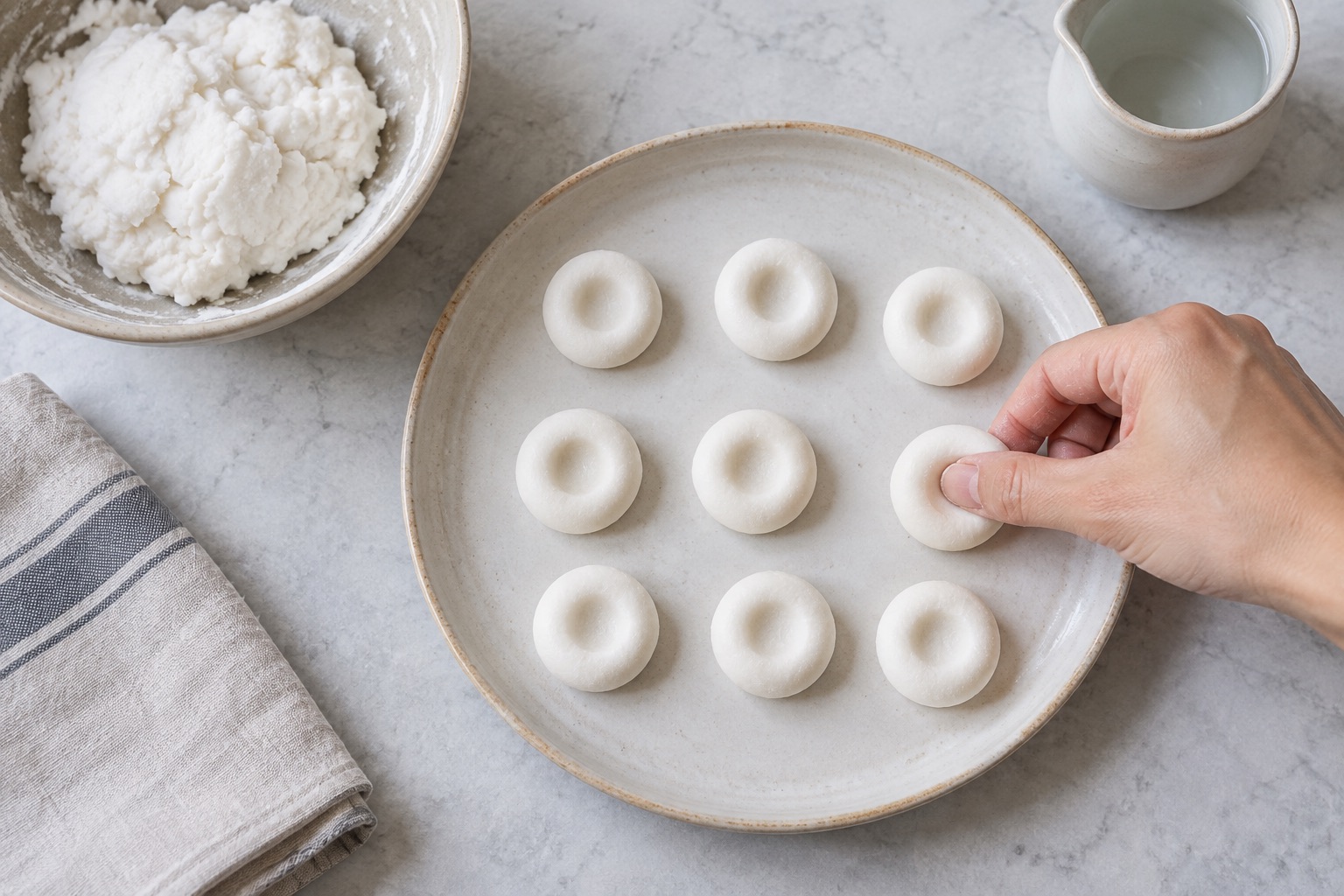
Ajinomoto’s shiratama recipe gradually combines water with shiratamako and kneads it before making twenty pieces. The centres are indented as the pieces are put into boiling water. Its instruction is to boil for about five minutes, transfer to water, then drain for serving with bean paste. Read the complete Ajinomoto recipe.
Here, the work of portioning is done before the main cooking stage. You can read ahead and see that no later instruction asks you to gather the cooked pieces back into a single dough and start again.
That makes the shape instruction important rather than decorative. If you follow this recipe, follow its portioning and cooking instructions together. “They are floating” should not silently replace a different instruction the author actually gives. The existence of another recipe using a floating cue does not rewrite this one.
Tamasan’s mitarashi recipe starts with joshinko and hot water. It steams larger portions, pounds them, and then calls for kneading and smaller final shapes after some heat has subsided. The maker explicitly notes that thorough kneading softens the dough. Read Tamasan’s joshinko mitarashi method.
The small round pieces on the skewer are not simply the larger steamed portions served unchanged. That distinction is easy to miss if you skim from “steam” straight to “sauce”. Post-cooking work is part of producing the dumpling, not an optional styling exercise added after the food is finished.
Tamasan’s FAQ links hot-water mixing and post-steam pounding to the properties of its non-glutinous rice flour. It contrasts that route with its dangoko, which it recommends kneading with water and boiling; it warns that unnecessary hot-water or steaming treatment of that blend can become sticky. The point is not to memorise a rule about all white powders. It is to understand why this maker provides different handling advice for different materials.
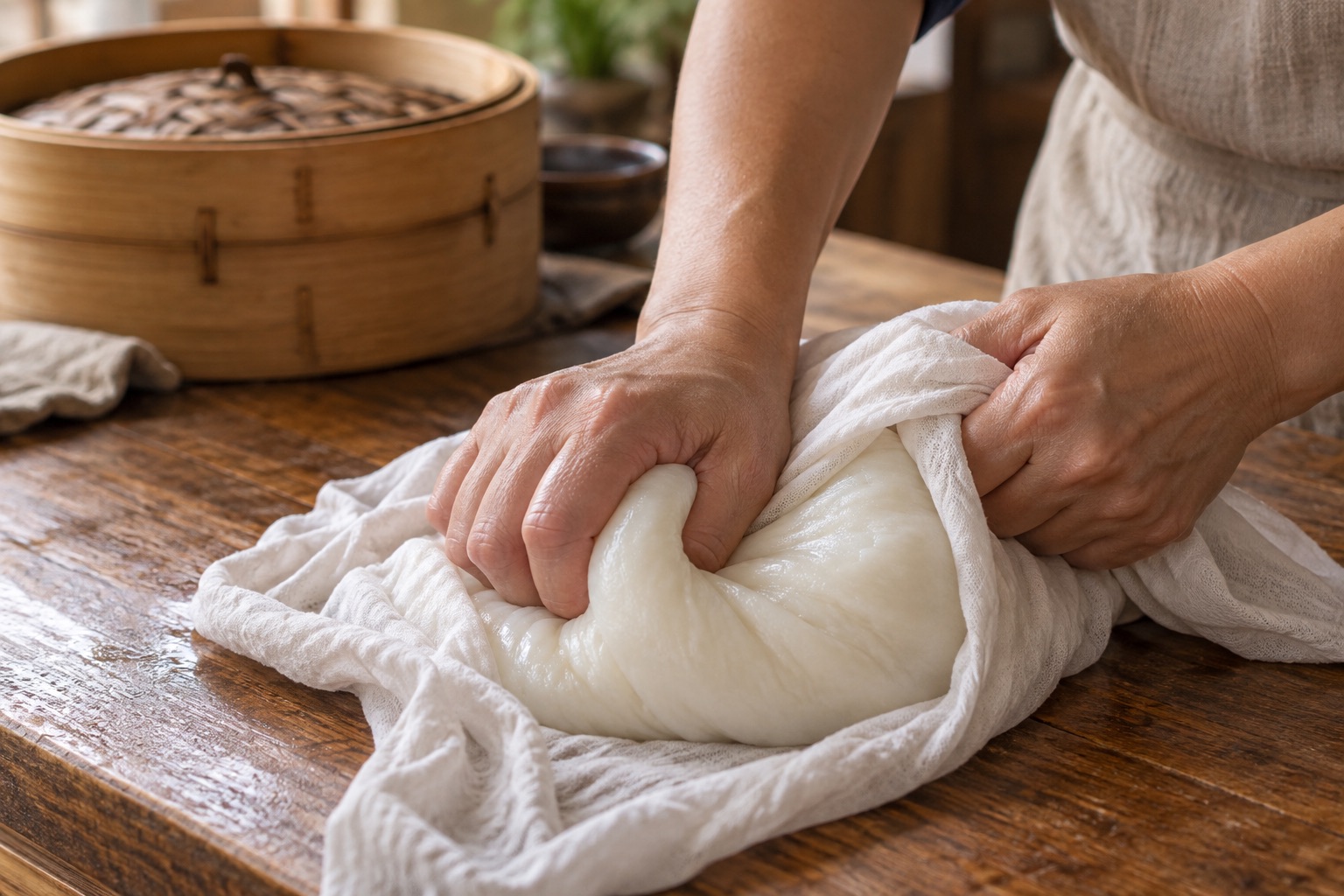
MAFF’s detailed Tokyo kushi-dango recipe uses joshinko and shiratamako. They are hydrated separately—hot water for the former, water for the latter—before being combined. Larger pieces are boiled, transferred to a damp cloth and kneaded. Only then is the dough divided into sixteen portions, rounded, skewered and lightly browned. Read the numbered MAFF recipe.
This example is worth keeping beside the other two. A shorthand rule such as “joshinko is steamed, shiratama is boiled” misses a documented mixed-flour method. An equally tempting shortcut—“boiled dango are always rolled into their final little balls beforehand”—also fails here.
The better reading habit is to follow the verbs and their objects. Is the recipe asking you to boil a few larger pieces of dough or the final serving portions? When it says knead, does that refer to mixing the raw ingredients or working already-cooked dough? When it says divide, has the main cooking step already happened?
Those questions are more useful than looking only for the name of the cooking vessel. They also explain why editing a recipe down to “make balls and boil” can remove the very step that distinguishes its method.
In the MAFF sequence, browning comes after the dough has been cooked, worked and shaped. It is a later surface treatment. By contrast, the Tamasan recipe above finishes its shaped dumplings with sauce without specifying a grilling stage.
Those two instructions should keep you from treating a browned photograph as a complete method. The colour on the outside does not show you every earlier stage, and the absence of that colour does not by itself establish that a dumpling was prepared incorrectly.
There is a useful distinction between making the dumpling and finishing the serving. Water mixed into flour, the principal cooking step, and a final browned surface are not interchangeable operations simply because heat or water appears in more than one of them.
For a beginner reading a recipe, this matters at the moment you are tempted to skip ahead. A sauce instruction assumes that the preceding dough preparation has been completed. It does not compensate for a missed kneading or cooking stage.
It also matters when comparing ready-made sweets. Two sellers can use similar-looking finishes without giving you the same information about the centre. If the texture is what interests you, ask about the dumpling itself as well as what coats it.
Our broader guide to Japanese sweets seen in anime covers dango toppings, neighbouring sweets such as daifuku, and ingredient questions for dietary needs. Here, the useful next question is narrower: what flour and preparation produced the part underneath that finish?
The following are hypothetical reading and shopping situations, not reports of kitchen experiments. They illustrate how to use the distinctions above without pretending that an untested substitution has been proven to work.
A recipe asks for shiratamako, but the bag in your kitchen supplies only the broader English name. That is incomplete information, not evidence that the bag is unsuitable for all Japanese sweets—and not evidence that it is equivalent to the requested flour.
Look for a more specific product description or ask the manufacturer which rice and processing method it uses. The useful answer identifies the material. “Good for desserts” does not answer the same question.
If you cannot identify it, choose a recipe written for that actual flour instead of renaming it to fit the recipe you hoped to make. This is particularly relevant when comparing an Indian product listing with a Japanese recipe: the shared English category may be broader than the recipe’s ingredient name. We have not verified a local substitute or an Indian seller for this guide.
Now the bag has a specific name, but it is not the one in the ingredient list. This is where knowing that both can make dumplings becomes misleading: the shared destination does not establish an identical route.
Tamasan’s dangoko product page explicitly presents kneading with water and boiling as the preparation for its blend. See the manufacturer’s dangoko information. That is a clearer starting point than borrowing the hot-water and steaming stages of a different flour’s recipe.
Changing only the flour would be an experiment. A suitable adapted recipe needs its own support.
If your aim is simply a manageable first cooking project, choose the whole method that matches the material you have. If your aim is specifically to understand the steamed-and-worked joshinko approach, find the specified flour and equipment. Those are different aims; acknowledging that difference makes the choice easier.
Not every packet bearing a familiar dumpling name begins at the mixing stage. Tamasan lists both a prepared cut-and-microwave shiratama product and another instant version whose directions are to remove the film, cut and boil. Neither starts by asking you to measure flour and knead in water. Compare the manufacturer’s instant shiratama products.
The key question has changed from “Which flour do I have?” to “Which preparation stages have already been done for me?” A flour recipe is not automatically the finishing instruction for a prepared product.
Keep the exact product’s directions with it. Do not transfer a heating time between a microwave-ready version and a boil-to-finish version merely because the front names look similar. The distinction is the starting material and its specified treatment, not which appliance you happen to prefer.
The next time you read a dango recipe, find the final shaping step first. Then look backwards to the flour and forwards to anything that still has to happen before serving.
That small change in reading order exposes what the finished photograph conceals. You can tell whether the neat portions were cooked in that shape, whether a cooked mass was worked and divided afterwards, and whether browning belongs to the finish rather than the main cooking method.
You do not have to predict an exact texture from a flour name or declare one sequence superior. Being able to explain why the instructions differ is already a substantial improvement over treating every chewy white dumpling as the same thing. The sauce can still be the first part that attracts you. It no longer has to be the only part you understand.

AUTHOR OF THIS ARTICLE
SoJapan
SoJapan India Pvt. Ltd. is a Japanese-founded company based in Gurugram. We bring Japanese food, anime goods and apparel materials to Indian businesses, with a sister company in Kyoto that works directly with makers in Japan.