The noodles are ready, but the dipping sauce is still in the cupboard. Someone is looking for bowls. The garnish needs chopping. A bowl of ice water seems like a convenient place for the somen to wait.
That is the moment worth planning for. Cold somen can involve very little time at the stove, yet several jobs immediately afterwards. Cooling, washing, chilling and draining are different jobs. Treating them as one long soak makes the meal harder to control.
This guide is about that short journey from pot to table: what should be ready before cooking, what the water is doing at each stage, and whether you want separate dipping portions or a dressed bowl.
For a first attempt, my recommendation is modest: one batch that everyone can eat now, drained noodles, and a sauce already prepared for dipping. Once that feels comfortable, try a more elaborate presentation. The cooking guidance below comes from Japanese noodle makers and food companies; the proposed kitchen arrangements are editorial suggestions, not claims of a tested recipe.
Ibonoito’s cooperative gives an approximate boiling time of 1½–2 minutes in its basic method, using about a litre of water for 100 g of its somen. It tells the cook to remove the bundle bands while the water heats, add the separated strands to boiling water and adjust the heat when it returns to the boil. Those figures belong to that guidance; use the instructions for your particular packet. Ibonoito, basic cooking method
The practical implication is easy to miss: the cooking window may be too short to double as your preparation window. Do not count on getting the sauce, table and sink organised while the noodles cook.
Start by deciding where the hot pot will go. Put a suitable colander securely in place, with a clear route to it. Have a clean bowl for the final cold-water stage and a serving dish nearby. Use water and ice suitable for direct food contact; they touch the cooked noodles and are not subsequently boiled away.
Then decide where the finished meal will go. For dipping somen, put out the small sauce bowls as well as the noodle plate. Set out the utensils people will actually use. A fork is entirely useful here, including for the portioning idea below; chopstick confidence need not determine whether someone enjoys lunch.
Nisshin Seifun Welna’s dried-noodle guide specifically places sauce and condiment preparation before cooking. It also notes that warm summer tap water can call for ice at the chilling stage. That is a useful consideration in an Indian kitchen too: assess the water coming from your own tap, rather than assuming that running water necessarily means cold water. Nisshin Seifun Welna, dried-noodle basics
For a first attempt, one or two accompaniments leave you fewer things to finish at the last moment. Put them beside the sauce before cooking.
The maker Yamamichi gives a helpful sequence for its hand-stretched somen: drain promptly, use running water to take away the initial heat, then briefly wash the cooled noodles with both hands in cold water. Drain afterwards; the maker also recommends ice-water chilling for a firmer bite. Yamamichi, somen cooking instructions
That order makes the unfamiliar instruction “wash the noodles” less mysterious. You are not meant to plunge your hands into a freshly drained, scalding bundle. The first water makes handling possible; the subsequent washing is an active step.
Read the transition carefully: hot noodles first need to lose their initial heat. Arrange the colander so that you can rinse without holding an unstable vessel full of hot food. Once the noodles are cool enough to handle, use clean hands for the washing stage described by the maker.
Ibonoito likewise distinguishes taking away the heat from washing under clean running water. Its instructions do not end at pouring the noodles into a colander. Ibonoito, basic cooking method
If you are accustomed to draining pasta directly into sauce, this is a different finishing sequence. Follow the somen method you selected; do not stop at the familiar-looking draining step simply because the noodles have finished boiling.
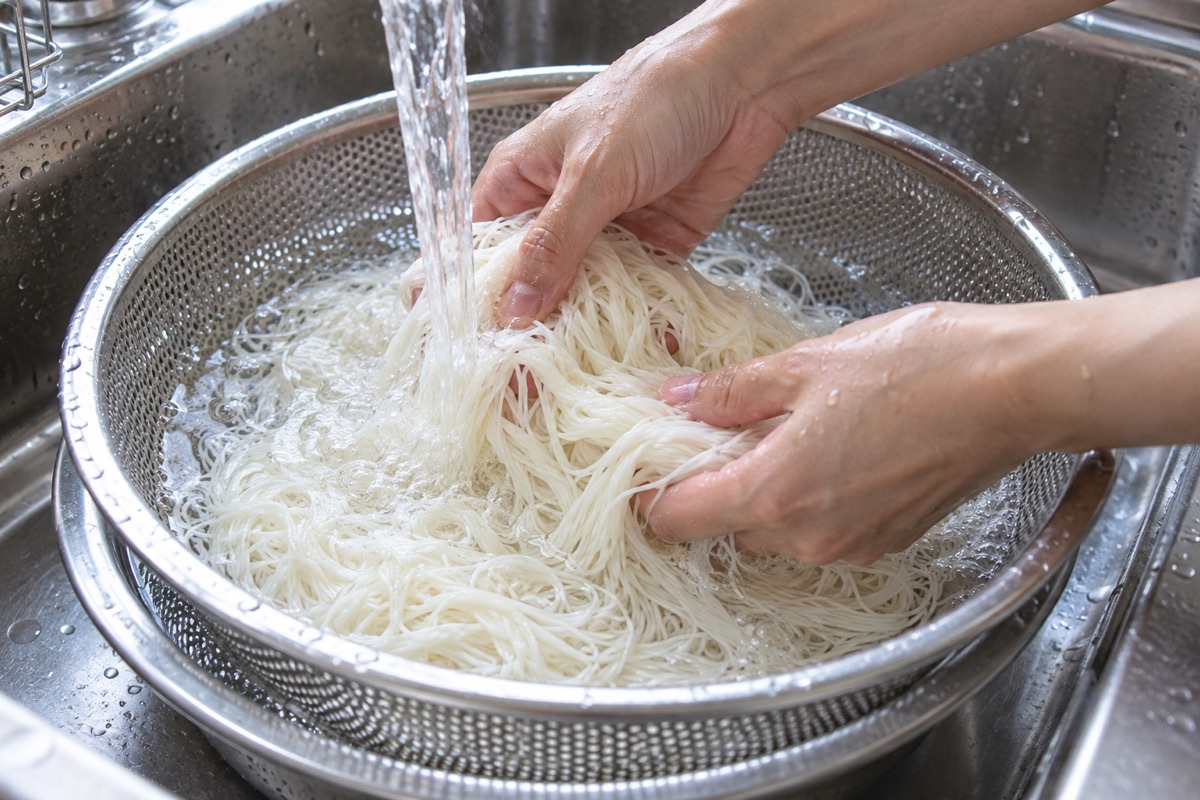
The Japanese instruction momiarai refers to washing with a rubbing or kneading action. Kikkoman’s guide, supervised by cooking researcher Hideyo Noguchi, describes rinsing while gently working the noodles between the hands to remove surface sliminess. A cold noodle can still need this washing step. Kikkoman, somen preparation guide
Think of the action as working through the strands with water, not wringing out a cloth. The photographs in the linked guide help explain what the single English word “rinse” can miss.
The short ice-water finish is about serving temperature and texture. Draining is about the water that accompanies the noodles onto the plate. Do not judge both by the same question. “Are these cold?” does not answer “How much water am I carrying into the sauce?”
Here is a compact way to remember the sequence. It is a reading aid for the linked methods, not an additional set of cooking times.
| Stage | What you are attending to | Do not confuse it with |
|---|---|---|
| Initial cooling | Removing the heat before handling | Completing the wash |
| Washing | Working through the strands with clean water | Leaving them motionless in a cold bowl |
| Final chilling | Getting the noodles ready to eat cold | Finding somewhere to park them |
| Draining | Removing water before plating or dressing | Making warm noodles cold |
An ice bath and an ice-filled serving bowl can look almost identical in a photograph. Their purposes differ. One is a finishing step; the other keeps water in contact with the noodles while people eat.
Mizkan’s guide, written and supervised by Somen Jiro, recommends ice-water chilling after washing, followed by draining and immediate serving. It warns against prolonged immersion because the noodles absorb water and lose bite, while water carried into the dipping sauce dilutes it. It also advises chilling the sauce beforehand. Mizkan and Somen Jiro, finishing guidance
That does not mean a few ice cubes on a serving dish are a culinary mistake. Kikkoman’s guide allows ice during the meal while also advising against leaving the noodles with it for a long time; it notes the effect of melting ice on sauce strength. The useful distinction is duration and water transfer, not a blanket rule that ice must never appear at the table. Kikkoman, serving with ice
For a beginner, a drained plate is the simpler arrangement to observe. You can see the portions, pick one up, and dip it without first lifting it out of a bath. It also makes it easier to compare your first mouthful with later ones. That is why I would start there—not because every household should serve somen identically.
If you choose an ice-water presentation, make it part of an active meal rather than preparation for one that has not begun. There is a meaningful difference between seated diners eating and a bowl waiting while someone cooks another dish. The sources above do not give a universal minute-by-minute threshold for that distinction, so this guide does not invent one.
Prepare the sauce to its product’s dipping instructions before the noodles are ready. For concentrated tsuyu, that means the specified dilution; for a ready-to-use product, follow its own directions. Our udon and tsuyu guide covers the distinction between dipping and soup uses in more detail.
Taste a little prepared sauce before adding condiments. Then taste it with a portion of noodles. These are two useful observations: one checks what you mixed, the other checks the meal. If the sauce seems weak from the first bite, the starting mixture deserves attention. If it changes as you eat, consider the water arriving with the noodles before deciding that you bought the wrong bottle.
Avoid making a deliberately over-concentrated first bowl on the assumption that melting ice will eventually correct it. My preference is to start with the intended dipping strength and manage the serving arrangement. You can then make a deliberate adjustment, rather than asking the earliest bites to compensate for the latest ones.
How much somen belongs on a plate depends partly on what the plate is meant to do. Three examples from the Ibonoito cooperative show why “a serving” is not simply another word for “a bundle.” They are meal formats to compare, not nutritional prescriptions or promises that a particular quantity will satisfy everyone.
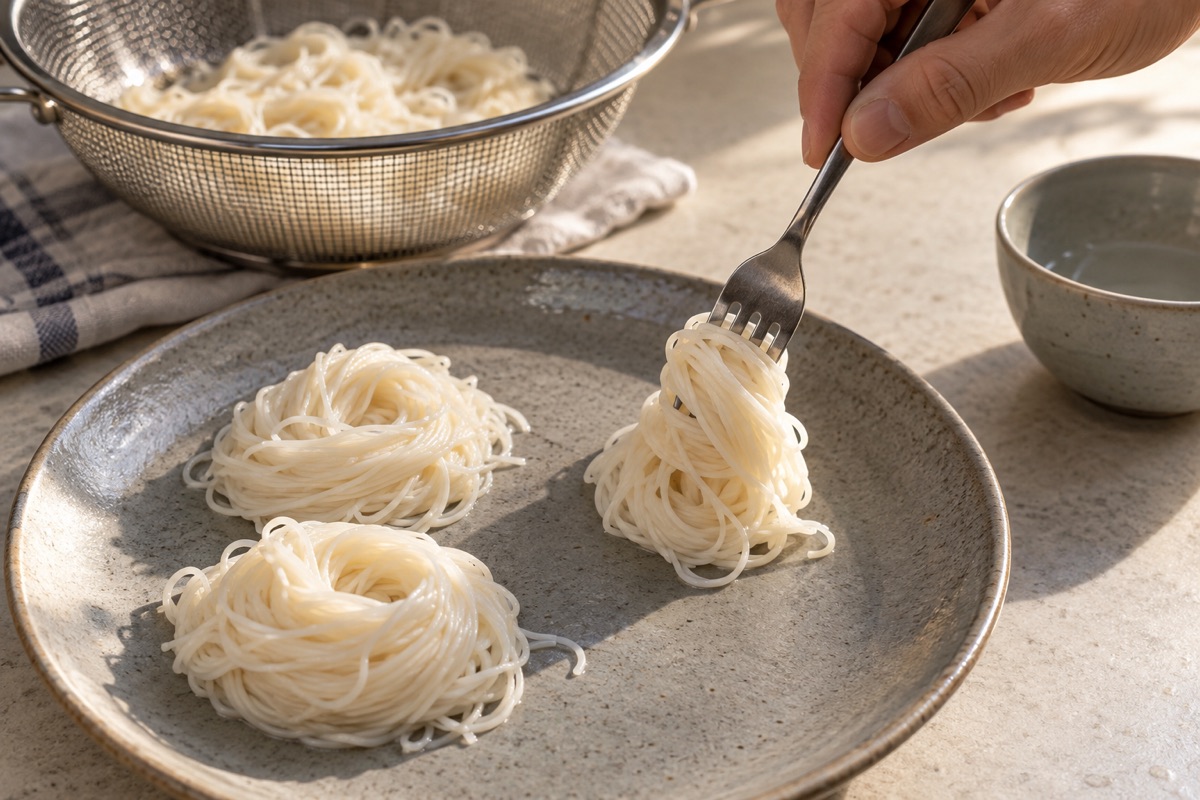
In one cold-somen recipe, the cooperative briefly chills the washed noodles in ice water, drains them and winds small amounts around a fork before plating. Its ingredient list uses three bundles for two people, with ready-to-use tsuyu and separate accompaniments. Ibonoito, fork-portioned cold somen
This is an approachable presentation because the tool creates manageable portions after cooking. You do not have to make the whole plate look like one perfectly aligned curtain of noodles. Lift one small portion, wind it, and set it down without pulling the rest of the batch across the dish.
For a first shared meal, I would leave a little visible space between the coils and use serving utensils. The aim is convenient lifting, not identical spirals. If arranging them becomes a lengthy craft project, simplify the plate. A small coil that reaches the table promptly serves this meal better than an elaborate design that delays everyone.
The cooperative also has a hand-roll somen recipe. It sets out drained, briefly chilled noodles with nori and assorted fillings, for diners to assemble and dip. Here, three bundles are listed for four people, alongside substantial other ingredients. The original includes seafood, meat, egg and cheese; it is not a vegetarian recipe. Ibonoito, hand-roll somen
The contrast is useful even if you never make that particular menu. In the dipping plate, noodles occupy most of the attention. In the hand-roll arrangement, they share each mouthful with fillings and a wrapper. Copying the bundle count from one into the other without considering the rest of the meal would miss that change in role.
A shared assembly meal also asks a different organisational question: are the fillings already prepared when the noodles arrive? Decide who is doing the assembling. If the cook must build every portion individually, it is not the same workload as putting components on the table for diners to choose.
Ibonoito’s tomato-and-mozzarella somen recipe prepares and chills its tomato, cheese, basil and olive-oil mixture first. Only then are the noodles boiled, washed, chilled, drained and mixed into it. That recipe lists two bundles for two people. Ibonoito, tomato and mozzarella somen
The useful lesson is the order of assembly. A dressed bowl is not an excuse to omit the cold-noodle preparation. It simply changes what happens after draining: instead of keeping sauce separate for each bite, the recipe combines the components before serving.
You need not locate every Japanese garnish in the first recipe to practise portioning. Start with the serving technique; the linked recipes remain options to explore, not a compulsory shopping list for India.
Imagine making a simple dipping lunch for two. This is a planning example, not a newly tested recipe or a fixed serving recommendation.
First, agree on what else belongs in the meal. If there is a cooked accompaniment, finish the work it requires before beginning the noodle batch, while following its own storage and serving instructions. Put the dipping bowls, prepared sauce and chosen garnishes in place. Clear the sink route. Check the packet’s cooking directions while the noodles are still dry.
Only then start the short, attention-heavy part: boil according to the packet, transfer to the prepared colander, and carry out the finish. The point of the earlier work is that you can now attend to the noodles without simultaneously finding a knife or opening a sauce bottle.
At the table, serve the amount people are ready to eat. If you expect a second round, decide in advance whether you want to cook a separate batch. That is a workload choice: a fresh second batch needs someone to return to the stove. It may suit an informal meal, but not a host who wants to sit down uninterrupted.
If diners are arriving at different times, the problem has changed. A dish designed around prompt finishing cannot become a make-ahead buffet simply by adding more ice. Consider a different menu or smaller separately timed meals. This guide covers immediate service; it does not establish a safe holding time, lunchbox procedure or storage life for cooked noodles.
A disappointing result does not tell you which stage caused it. Before changing the cooking time, separate what you actually noticed.
These are prompts for the next attempt, not diagnoses from a distance. Keep the packet, note the preparation you followed, and change one part of the arrangement at a time. A useful note might be “sauce ready before cooking; drained coils; ate immediately,” rather than a verdict that a whole brand is good or bad.
Cold somen asks for a little coordination, not a complicated performance. Give the cooked noodles somewhere to be cooled and washed, give the chilled noodles somewhere to drain, and have people ready to eat. The most valuable thing to prepare before the timer starts is the end of the meal’s cooking sequence.

AUTHOR OF THIS ARTICLE
SoJapan
SoJapan India Pvt. Ltd. is a Japanese-founded company based in Gurugram. We bring Japanese food, anime goods and apparel materials to Indian businesses, with a sister company in Kyoto that works directly with makers in Japan.