Tatara is holding Mako, but he has been practising with someone else in mind. His hand is in the wrong place. That small mismatch is a useful entrance into Welcome to the Ballroom: remembering a dance does not mean recognising the person sharing it with you.
The scene appears in episode 5. Broadcaster MBS describes Tatara’s imagined practice with Shizuku carrying over into his hold with Mako, followed by his realisation that he had failed to notice the partner in front of him. It is a wonderfully specific problem for a sports protagonist. More determination alone will not solve it. MBS, episode 5 scene notes
This guide follows the change from wanting to look like a dancer to taking responsibility for a dance made by two people. You do not need ballroom experience to follow that change. Watch what each partner asks for, what Tatara thinks he is providing, and where those two things fail to meet.
Spoilers: The opening sections discuss events through episode 11, including an award. The clearly marked later section covers partnership developments through episode 23. The final competition result is not revealed. Linked broadcaster archives contain additional scene spoilers.
Production I.G introduces Tatara Fujita as an ordinary junior-high-school student who does not know what he wants to do. An encounter draws him into ballroom dancing; he wants something he can genuinely call a passion. The anime adapts Tomo Takeuchi’s manga, with Yoshimi Itazu directing and Production I.G handling animation. Production I.G, official work introduction
That modest starting point matters. Tatara is not initially trying to defend a title or prove that his childhood training was worthwhile. There is room for embarrassment, fascination and uncertainty before a competitive goal takes over. The first question is whether he can choose to begin.
Episode 1 makes that choice physical. MBS’s scene notes describe him repeating the box step through the night, damaging both his feet and the borrowed shoes. When Sengoku ends the exercise, Tatara is excited at the possibility of learning something else. He asks to be taught despite his concerns about the expense. MBS, episode 1 scene notes
Read this as a dramatic statement of appetite, not a sensible training schedule. The striking detail is his response to the lesson ending: he wants the next instruction. He has found an activity that makes a future lesson imaginable. It is a smaller, more convincing first change than suddenly possessing a complete life plan.
Effort has brought him into the studio. It has not yet taught him how to read the people already there.
At the competition in episode 2, he sees Shizuku’s leader, Kiyoharu Hyodo, and finds his gaze intimidating. The broadcaster’s description puts Tatara in the position of an observer confronted by an intensity he cannot yet comfortably read. MBS, episode 2 scene notes
Tatara’s reaction tells us how far away that world feels. Someone can be inspiring precisely because they are difficult to understand. Admiration is an invitation to learn, but it is not an explanation of how a partnership works.
Episode 3 separates recognising music from handling a shared dance. Tatara moves to a waltz heard from the venue, finding a rhythm he can use even though the Latin dancing he has just seen remains beyond him. Elsewhere in the episode, completing a waltz with Banba earns encouragement from Tamaki and the others, but a harsh response from Sengoku. MBS, episode 3 scene notes
Those reactions need not cancel each other. Getting through something unfamiliar can be a real achievement while the result remains technically weak. For a newcomer watching the show, that distinction prevents every criticism from sounding like proof that the previous breakthrough was fake. Tatara has acquired an entry point, not mastery.
The story also complicates the idea that influence travels only from expert to beginner. In episode 4, Hyodo tells Tatara that he enjoyed the tango and that Tatara helped him recognise how far he could go. His unusually forceful dancing unsettles Shizuku. MBS, episode 4 scene notes
My reading is that imitation becomes more interesting here because the admired dancer is not a fixed object. Tatara may want to catch up with a stable image of excellence, but Hyodo can change too. And the change is not experienced only by a spectator: Shizuku must share it. Excitement for one dancer can create a new demand for the other.
By episode 7, Shizuku explicitly draws Gaju’s attention to Tatara’s influence on Hyodo, while Tatara dances a routine associated with Hyodo and Shizuku. This is a concrete reason to take his observational ability seriously. Borrowing can give him material with which to enter a conversation among much more experienced dancers. MBS, episode 7 scene notes
Yet a routine has a history. It comes from particular people, not from an empty collection of impressive movements. As a viewing question, ask what survives the borrowing and what has to be rediscovered with a different person. The useful comparison is not simply original versus copy; it is remembered shape versus present response.
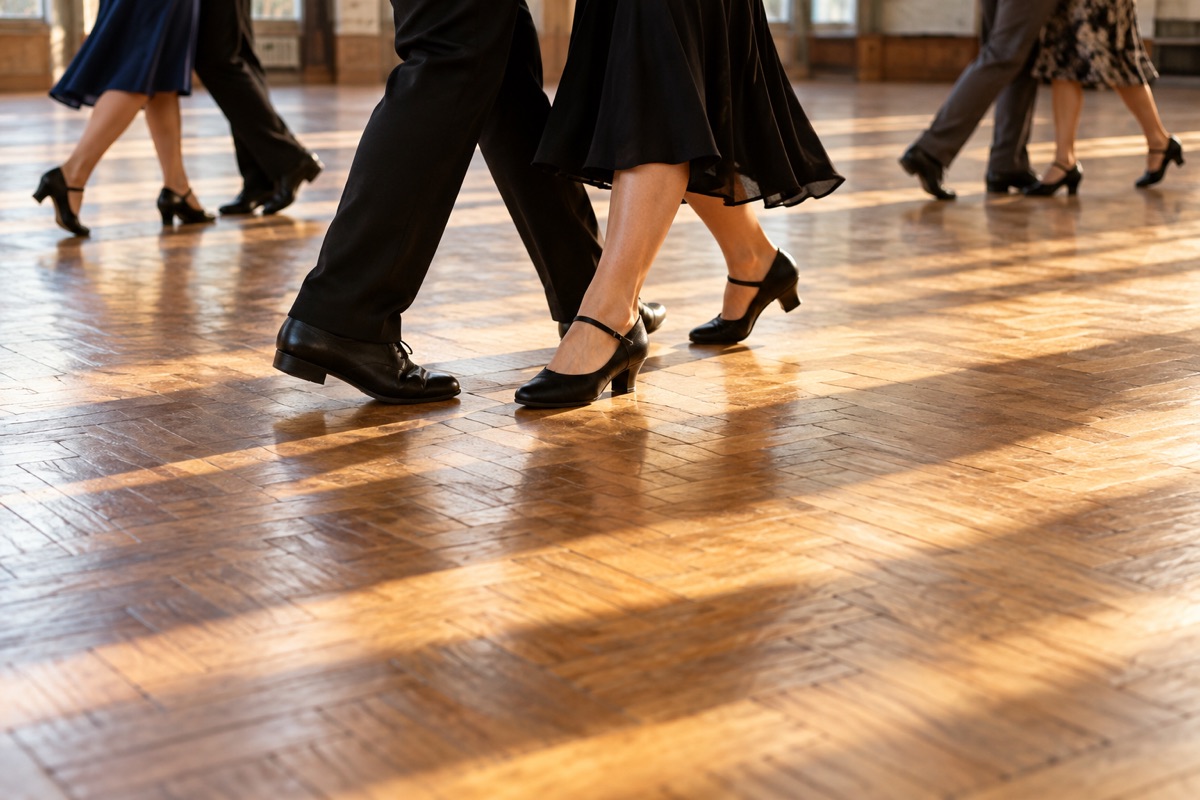
Episode 6 adds another pressure. Tatara initially struggles with a floor where many couples move at once. The broadcaster then describes a change in his attitude: even collisions no longer drive him away, and Sengoku recognises a dancer’s expression in him. MBS, episode 6 scene notes
This widens the viewer’s attention beyond the couple. A practice sequence imagined in isolation now occupies space with other people. The dramatic point is his growing insistence on being there. That is different from having solved every practical difficulty of moving there.
The same source describes Shizuku learning Gaju’s new routine readily and responding to improvisation. It offers a useful contrast in experience: she is not merely reproducing a stored sequence. She can deal with something that changes. The ability to continue when another person does something unexpected deserves as much attention as an impressive memorised passage.
The hand-position problem in episode 5 exposes a limit to Tatara’s imagination. Someone can be physically close and still be treated as an outline inherited from someone else. The corrective question is intimate but practical: is he responding to Mako, or to the version of dancing already in his head?
That is why this arc is more useful than a general lesson about being considerate. Consideration can remain a feeling about oneself—“I am trying to be helpful”—without becoming help the other person can use. The next stage gives Mako a request of her own.
After a poor performance in episode 8, Tatara blames his exhaustion and having rushed ahead alone. Mako also blames herself. When he asks what he can do for her, she asks him to make her the flower. MBS, episode 8 scene notes
The change from mutual apology to a request is decisive. Apologies establish that neither wants to hurt the other, but they do not yet identify a shared task. Mako supplies one. She is not merely reassuring the nervous protagonist or waiting for him to improve; she articulates how she wants to appear in their dance.
Her request also changes how we should read Tatara’s attention. He cannot solve it by deciding, privately, that he is a good partner. There has to be an effect visible beyond his intention. The dance now has something to accomplish for Mako.
Episode 9 develops the image of Mako as the flower and Tatara as the frame. MBS describes his dedicated lead making her presence expand in the audience’s eyes. After the dance, applause and praise directed at Mako bring smiles to both of them. MBS, episode 9 scene notes
The metaphor makes an unusual kind of protagonist achievement readable. Tatara can contribute to a stronger performance without becoming its most conspicuous person. The evidence of his progress is partly that our attention can move away from him.
There is a limit to the metaphor, however. A frame is an object; Mako’s partner is a person making choices. Treating his role as simple disappearance would miss the work of creating the effect. Nor should the image become a rule about how women and men ought to behave outside this particular story. It is an interpretation of a dance partnership at this stage of the anime.
Episode 10 makes Mako’s initiative harder to overlook. Before the final quickstep, she encourages Tatara to dance wholeheartedly. He receives Sengoku’s go-ahead for the variation, and the pair take their hold with relaxed expressions. The episode’s selected scenes also recall her determination to attend dance classes with her brother. MBS, episode 10 scene notes
These details keep her from becoming merely a recipient of Tatara’s generosity. She has her own attachment to dancing, and she can urge him forward. A useful reading of their partnership leaves room for both directions: he can make space for her, and she can ask more of him.
In episode 11, Mako receives the Ballroom Queen award, described in the broadcaster’s notes as recognising the partner who shone most among the placed couples. The same page records Shizuku crying in frustration. MBS, episode 11 scene notes
The award gives Mako’s visibility a concrete acknowledgement. It does not require us to turn every other dancer into a failure. Shizuku’s response is a reminder that recognition belongs to a competitive setting where another person’s success may be painful.
Keep the claim local: this is the award as presented in this fictional competition, not a statement about the prizes or judging rules at every real ballroom event. For understanding Tatara, the important distinction is between a couple’s overall result and the particular effect their dancing can have. An outcome can answer one question without answering all of them.
Stop here if you have not reached the later partnerships. This section discusses episodes 14–23, without revealing the final result.
The Mako arc could encourage an overly tidy conclusion: Tatara becomes good when he adjusts to his partner. Chinatsu gives that idea a harder test. Adjustment can enable another dancer, but it can also become an excuse not to make a decision.
In episode 14, Tatara knowingly settles for following his partner one-sidedly, judging it the best option available at that moment even while recognising the awkwardness of the arrangement. Chinatsu responds with confidence about their result. MBS, episode 14 scene notes
The interesting words are “at that moment.” An arrangement can get two people through a situation without providing a durable way to work. This is a useful complication for anyone who has been treating visible harmony as proof that the underlying problem is solved. Success can conceal a compromise that will become costly later.
In episode 15, Marisa makes Tatara confront the leader’s responsibility. He tells Chinatsu that she can blame him if they lose and asks her to come with him. MBS, episode 15 scene notes
This is a move from adapting after the fact to offering a course of action. It does not automatically make him right. What changes is that he is willing to put a choice in front of her rather than waiting for her to supply everything he needs to respond to. In the story’s terms, taking responsibility has become part of communicating.
The next episode refuses an easy resolution. While practising a new variation, their movements fail to fit together. Tatara asks Chinatsu to rely on him; she says she cannot because she does not understand him. MBS, episode 16 scene notes
This is the most useful later scene to place beside the opening hand-position error. Early on, Tatara has to notice whom he is holding. Here, noticing her is not enough: she needs to understand him as well. The partnership demands that information travel both ways.
For a viewer, it is tempting to decide which character is being unreasonable and leave the argument there. A more revealing question is what each person lacks. Tatara wants trust; Chinatsu describes an absence of intelligibility. Those are related, but demanding the first does not necessarily supply the second.
Episode 17 brings emotional and bodily uncertainty together. Chinatsu fears that a loss might be her fault and that Tatara could dissolve the partnership. In another selected scene, Hyodo explains an eyes-closed dance exercise with Shizuku as a way of concentrating on bodily communication. MBS, episode 17 scene notes
The juxtaposition is valuable without turning the anime into a lesson plan. One scene concerns fear of losing the relationship; the other concerns information conveyed through movement. Neither is solved simply by telling a person to stop worrying. The exercise is described here as something the characters do and explain, not as a recommendation to practise blind dancing at home.
Episode 21 gives the problem an emphatic door image. Tatara is told that opening it is the leader’s job, but makes only a narrow gap and keeps asking Chinatsu to do it. She responds by kicking it open. MBS, episode 21 scene notes
The image makes hesitation visible. It is possible to want shared movement while still expecting the other person to create the entire opportunity for it. The force of Chinatsu’s response also stops the metaphor from becoming a serene picture of perfect agreement. Their way through is contentious.
By episode 23, Chinatsu’s words and Sengoku’s advice begin to connect in Tatara’s understanding. During the final waltz, he experiences a sensation the broadcaster distinguishes from the earlier four-legged image. MBS, episode 23 scene notes
The distinction matters more here than inventing a technical explanation for the sensation. The series can revise its own images of togetherness. A metaphor that helped describe one breakthrough need not describe the next one. Watch for the change rather than treating the first memorable image as the anime’s final definition of partnership.
There is a practical production story behind translating these dances to animation. In a 2017 original interview with Anime Herald, director Yoshimi Itazu described using videos made by dancers, attending competitions and taking weekly lessons for six months. He also discussed adding dance movement in adaptation and choosing music that the silent manga could not supply. Animation director Takahiro Chiba spoke about smooth hand and foot movement and graceful lines. Anime Herald, interview with the production staff
Those comments establish research and artistic choices, not a guarantee that every animated pose is an instructional model. Their relevance to this guide is simpler: movement, line and music give the adaptation several ways to make a relationship legible. You can watch how those elements direct your attention without deciding that stylisation is a literal account of anatomy or that every pause describes real competition timing.
This is also a useful place to separate three questions that can get mixed together in discussion. Did a scene communicate the character’s feeling? Did its movement convince you? Did it help you understand the relation between the dancers? A viewer can answer those differently. Being moved by a sequence does not oblige you to defend every visual choice, and noticing a visual limitation does not erase the dramatic idea.
For Indian fans arriving from other performance anime, no imported vocabulary test is necessary. Begin with the problem the scene establishes. If a word for a figure or dance style is unfamiliar, you can still follow who proposes a movement, who struggles to read it and whose presence the scene emphasises. Technical curiosity can follow from that attention rather than becoming an entrance requirement.
On a rewatch, resist making every scene prove that Tatara is steadily improving. Instead, follow the changing job he thinks he has. Early admiration, responsiveness and initiative can each be useful, but none answers every partner’s needs on its own.
Try these three prompts at the points discussed above:
The linked episode notes support the events; the connections between them are the reading offered here.
If the interest is in performance learned through another person, our Nodame Cantabile guide considers the different problem of hearing, notation and musical collaboration. Ballroom’s particular challenge is more immediately physical: the partner is present within the movement being attempted, not simply an example to reproduce.
The question to take away is therefore not just whether Tatara can dance better. It is whether the person dancing with him has become more real to him—and whether he has become clearer to that person in return.

AUTHOR OF THIS ARTICLE
SoJapan
SoJapan India Pvt. Ltd. is a Japanese-founded company based in Gurugram. We bring Japanese food, anime goods and apparel materials to Indian businesses, with a sister company in Kyoto that works directly with makers in Japan.