A whole sheet and a handful of fragments can both be useful yuba. They cannot necessarily do the same job. If you want an edible wrapper, a continuous piece matters. If you want pieces in a bowl of soup, preserving a large rectangle may achieve nothing. For a coating, breaking the sheet can be the point.
That is the most useful starting question: what shape and texture does this dish need the yuba to have? Asking only whether it is fresh or dried leaves too much unanswered. Some dried products are intended to soften directly in hot liquid. Other preparations call for rehydration first, while a dry coating takes a different route altogether.
This guide follows those three jobs—pieces, wrappers and coatings—through instructions from Japanese manufacturers. It is a way to understand and choose a method, not a new recipe made by combining several makers’ timings. The examples identify particular products or guidance; a different packet may require different handling.
If you need the short version:
Yubasho’s manufacturing explanation follows soybeans through washing, soaking, grinding, heating and squeezing. The resulting soy milk is heated, and the film at its surface is lifted to make yuba. The maker then shows different handling for fresh and dried products, including drying on bamboo supports and forming rolled or tied shapes. This is a sheet created during production, not the outer layer removed from an already finished tofu block. Yubasho’s production process
The distinction helps when you encounter the English name “tofu skin.” It suggests a relationship with tofu, but it is not an instruction to use the two identically. A tofu recipe may depend on a block holding its shape or on removing water before cooking. A yuba wrapper poses another question: is there a sheet you can actually use to surround the filling?
Nor does “edible wrapper” identify one interchangeable ingredient. Inari sushi uses a fried tofu pouch with an opening to fill. A sheet wrapped around something has to create that enclosure. Our inari sushi guide explains the pouch and its preparation; it should not be used as a yuba-sheet method.
For shopping or recipe matching, look past a broad translated name. A photograph of cut pieces, a folded sheet or a formed roll gives useful information, but the preparation directions still matter. In particular, do not assume that every imported item called bean-curd skin, tofu skin or a soy sheet has the same thickness, shape or intended use as the Japanese examples here.
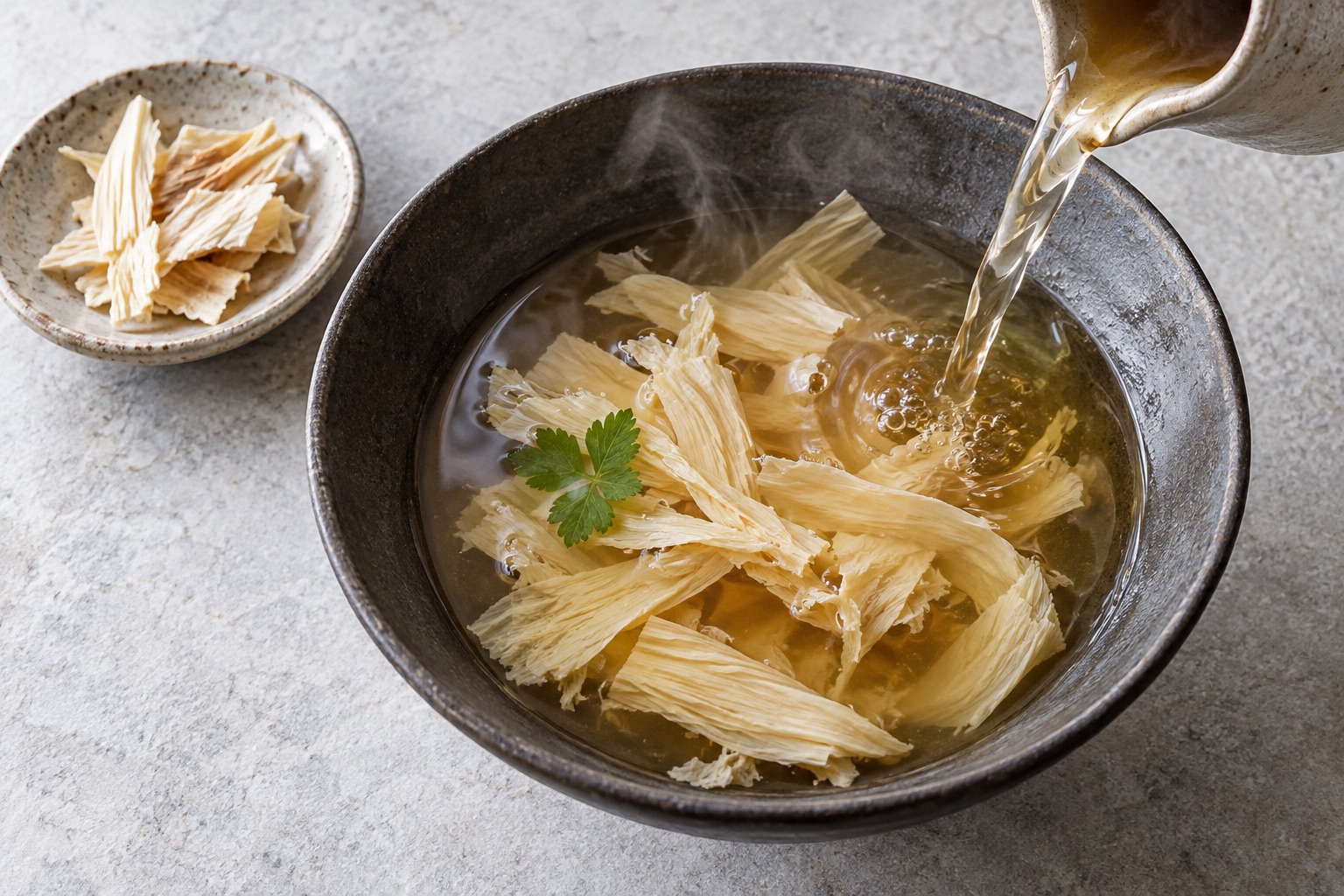
Hiei’s broken dried yuba is a concrete exception to the idea that a dry sheet always needs its own soaking bowl. The maker describes this product as quick to soften and says advance rehydration is unnecessary. For soup, it directs the cook either to add the pieces just before turning off the heat or to place them in a serving bowl and pour hot soup over them. Its rice-bowl suggestion instead adds the pieces to boiling dashi. Hiei’s broken dried yuba
The key difference is where the preparation happens. “No advance rehydration” does not mean that the finished dish contains hard, unchanged fragments. In this method, the liquid that softens the yuba is part of what you serve. There is no separate preliminary bath to drain away.
For a beginner, that makes the maker’s soup example a useful first route if this is the kind of product you have. It does not require you to unfold a sheet or judge whether it is large enough to wrap a filling. You can concentrate on the specified addition point and the resulting pieces in the bowl.
Another manufacturer, Yubasho, also describes a bowl method for dried yuba: put it in the bowl and pour over a seasoned bonito broth. The same cooking page treats fresh yuba differently in a hotpot, adding it briefly after ingredients such as vegetables and chicken have had their turn. These are separate preparations with their own ingredient choices and order. Yubasho’s cooking examples
Imagine choosing between intact sheets and pieces for two planned dishes. A filled roll depends on a continuous surface. A soup containing separate pieces does not. The practical value of the shape changes with the dish; an intact sheet is not automatically the better choice just because it looks more complete.
The example here is a maker deliberately selling broken dried yuba for cooking. It is not advice to ignore unexpected damage or deterioration in a different packet.
When comparing recipes, preserve the link between the product and the instruction. Hiei’s directions for its thin broken pieces do not establish a cooking time for an unfamiliar thick roll. Equally, a recipe that asks for separate soaking is not wrong because another maker offers a no-presoak product. The useful answer is not to choose the shortest number: it is to identify which ingredient the number belongs to.
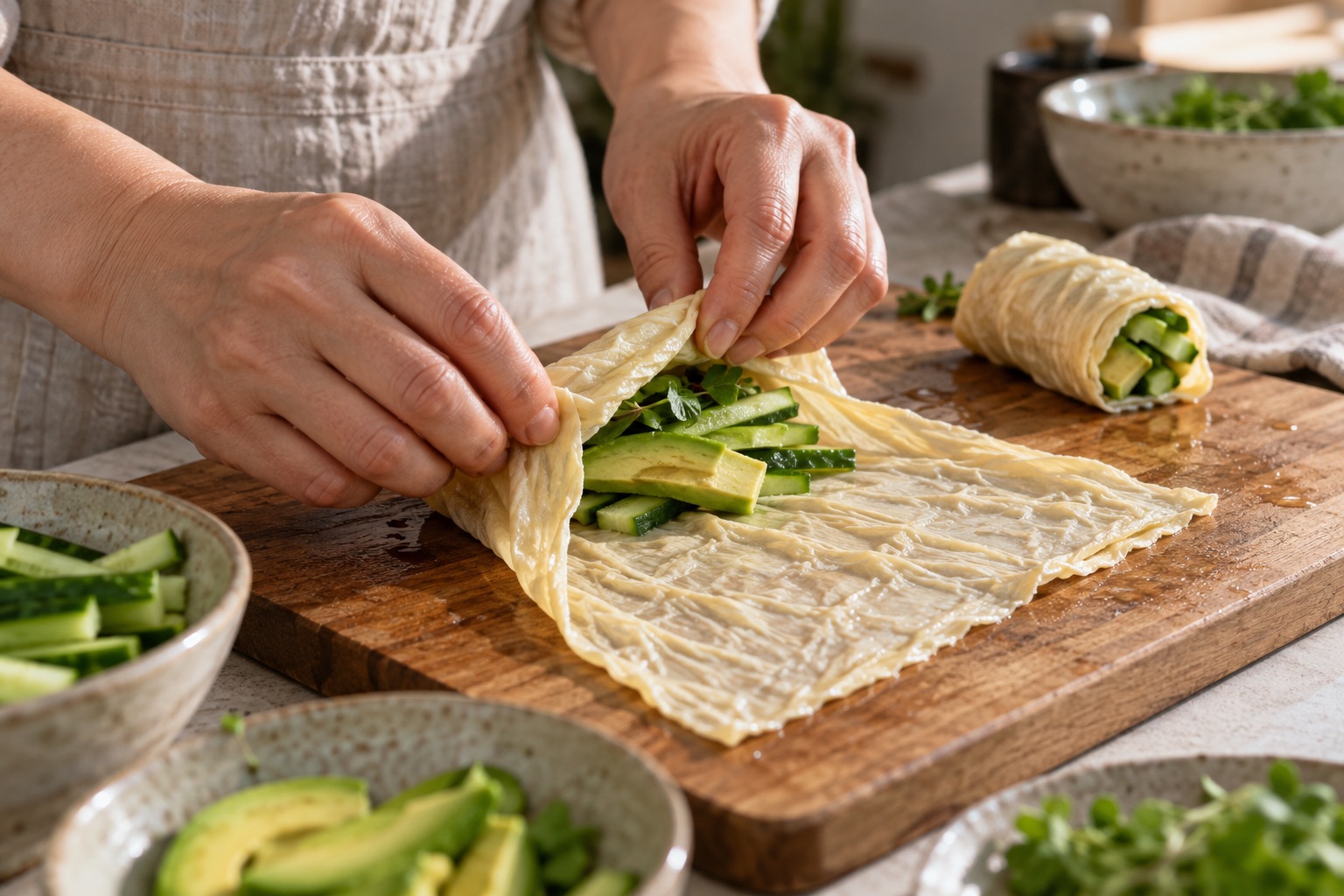
Wrapping asks more of the yuba’s shape than adding it to soup. Before choosing the filling, establish whether you have a usable piece and a method intended for wrapping. Trying to make a bag of small fragments perform like a continuous sheet solves the wrong problem.
Yubatora’s fresh-yuba suggestions include wrapping avocado or cucumber, and using yuba in place of a spring-roll or cream-croquette wrapper. These examples establish a wrapping use for the maker’s fresh product; they do not make every fresh roll or loose piece a ready-made wrapper. Yubatora’s fresh-yuba uses
There are two distinct choices here. First, choose the yuba form that the method expects. Then choose the filling and its preparation. Reversing that order can leave you with all the ingredients for a dish except the thing that must hold them together.
For instance, a cold vegetable roll and a filled item that will be fried are not interchangeable merely because both have yuba on the outside. The complete recipe must explain the filling, assembly and any subsequent cooking. A manufacturer’s short list of possible uses is a good source of ideas, but it is not automatically a full tested method for whatever filling you substitute.
For dried yuba, Yubatora gives rehydration guidance of about 50°C water for two minutes, wetting both sides. It also lists hotpot use directly from dry. Both instructions appear on the maker’s cooking page, so reading only the soaking line misses the role of the dish. Yubatora’s dried-yuba guidance
The number is useful because it is specific and attributable. It is not useful as a rule detached from its source. It does not prove that every yuba sheet sold elsewhere will behave identically, or that a dense formed product is ready after the same treatment. It is also a rehydration instruction, not a temperature standard for safely cooking a filling.
Keep those questions separate when reading a recipe. “How do I make this dry sheet workable?” is one question. “What happens after it surrounds the filling?” is another. A method can answer the first without supplying everything needed for the second.
If the packet’s directions and the recipe seem to disagree, check the form before improvising a compromise time. Confirm that both refer to the same fresh or dried product and the same intended use. If you still cannot establish that match, choose a recipe supplied for the product you actually have. There is no benefit in preserving a planned menu at the expense of knowing how its central ingredient is meant to be handled.
Yubatora also suggests finely crushing dried yuba and using it to coat ingredients such as shrimp, white fish or cheese before frying. Here, preserving an intact wrapper is no longer the objective. The fragments are the outside coating. Yubatora’s dried-yuba frying suggestions
This is a useful correction to the idea that all yuba preparation moves towards one final state: a soft, flexible sheet. It does not. The intended dish determines whether you want continuity, separate soft pieces or a broken outer layer.
For someone choosing a recipe, the distinction between a wrapper and a coating is more informative than a photograph of a golden finished item. Ask how the yuba gets onto the food. Is a sheet folded around it, or are fragments attached to its surface? Those are different assembly tasks, even if both dishes are later fried.
This matters when substituting, too. Replacing a wrap with crumbs changes how the food is enclosed; it is not just a change of brand. Replacing dry coating fragments with a soaked sheet would also change the preparation. A recipe designed for one needs more than a name substitution to become the other.
The comparison below is a decision aid, not a set of cooking instructions. Use it to decide which type of complete recipe to seek.
| Your intended result | What needs to work | Question to settle first |
|---|---|---|
| Pieces in a liquid dish | The specified preparation within or before the soup | Does this product’s method include a separate soaking step? |
| An enclosed filling | A usable continuous sheet and the recipe’s assembly | Is this form actually intended for wrapping? |
| A fragmented outer coating | The coating method, rather than sheet integrity | Does the recipe call for dry fragments, and how are they applied? |
Fresh yuba is not limited to one serving style. Hiei’s rolled sashimi-yuba product is presented in bite-sized portions with wasabi or ginger soy sauce. The maker also suggests briefly moving it through kombu dashi until soft, then serving it with ponzu. The same named product supports different serving choices. Hiei’s fresh sashimi yuba
That example is more helpful than treating “fresh” as a complete recipe. If you have a product sold for direct serving, its maker’s instructions can lead you towards a simple presentation. If you want it in a hot dish, look for that method rather than assuming that direct serving and cooking have identical requirements. A product’s name alone does not confirm that every other fresh yuba can be eaten the same way.
Frozen products provide another reason to keep form and method together. In its hotpot article, Hiei describes individually loose-frozen cut ends of rolled fresh yuba. It says the desired portion can go directly from frozen into boiling soup. It distinguishes these from its flat-type cutoffs, which are not individually frozen. Hiei’s frozen-roll hotpot example
“Frozen” therefore does not answer every practical question. Can you take out just the amount needed? Does the method begin with it frozen or thawed? Are you planning to serve pieces in broth or use a flat wrapper? Those questions are related, but they are not synonyms.
For readers comparing an imported packet with a Japanese recipe, this is the point to resist a visual shortcut. A roll in a photo may be the finished dish, a manufactured form or a cut portion. Establish which it is before treating the image as an assembly instruction. The product description and the sequence in the recipe are more useful than resemblance alone.
Soy-based does not automatically mean that every packaged yuba product meets the same dietary requirements. Senmaruya’s Plus Yuba, a dry topping product intended for use without advance preparation, lists glycerin and a milk-derived emulsifier alongside dried yuba. That is a specific ingredient-list example, not a statement that all yuba contains dairy. Plus Yuba’s official product information
The meal introduces a second check. The bonito broth in Yubasho’s soup example contains fish even though yuba is the featured ingredient. A dipping sauce, filling or coating can likewise be part of deciding whether the complete dish fits how you eat. Do not use the main ingredient’s name as a description of everything on the plate.
For a vegetarian or vegan cook, the practical order is to identify a suitable product, then choose a compatible complete recipe. If allergy safety is the concern, treat that as a separate requirement and consult the actual pack and manufacturer information; a vegetarian or vegan label is not a substitute for an allergen check.
The manufacturer links here explain Japanese products and methods. They are not claims about Indian stock, local prices or delivery availability. You can use their examples to ask better questions of a product available to you without assuming that it is the same item.
Start with one role. For soup, find directions for pieces in the liquid dish. For wrapping, establish that you have the sheet and assembly method required. For coating, find the complete method that uses fragments. Once that match is made, the decision about soaking becomes much less mysterious: it belongs to the product and the dish, not to the word “yuba” on its own.

AUTHOR OF THIS ARTICLE
SoJapan
SoJapan India Pvt. Ltd. is a Japanese-founded company based in Gurugram. We bring Japanese food, anime goods and apparel materials to Indian businesses, with a sister company in Kyoto that works directly with makers in Japan.