The brown pocket around inari sushi is not packaging. You eat it with the rice, and its preparation matters just as much as what goes inside. Thinking of it as a ready-made container misses the part of the dish that needs the most explanation: how fried tofu becomes a seasoned pouch you can fill.
Inari sushi, also written inarizushi, brings together a tofu pocket and sushi rice. For a beginner, the useful distinction is between preparing the pocket and filling the pocket. A packet of plain fried tofu and a packet of prepared inari pockets can leave you with quite different amounts of work.
This guide concentrates on that edible pouch: identifying it, understanding the preparation it may still need, and choosing how to fill and present it. It is not a single recipe assembled from several manufacturers’ quantities. The linked recipes supply their own complete methods; the comparisons here explain what to notice before choosing one.
The ingredient to recognise is aburaage. Kikkoman’s glossary describes thinly sliced tofu that is deep-fried and can be opened into a pocket for sushi rice. Its role here is specific: you need a thin edible enclosure, not simply tofu with a fried exterior. See Kikkoman’s aburaage description.
Atsuage is different. It is made from thick slices of tofu, with a fried outside and a substantial tofu interior. That explains why a thick brown-edged block is not the same ingredient as a thin pouch. Kikkoman distinguishes atsuage here.
For readers shopping in India, English descriptions such as “fried tofu” may not resolve that difference. Look for the actual product form and an explicit inari use, rather than deciding from the colour in a photograph. If the seller’s description leaves the product unclear, ask whether it is a thin pocket intended for stuffing. Do not buy a thick block on the assumption that the recipe will tell you how to turn it into a sheet.
The next distinction is whether the pocket has already been seasoned. Misuzu’s seasoned-inari range is presented as something you fill with rice or sushi rice. That is a prepared component, rather than an instruction to begin the whole process from plain aburaage. See the manufacturer’s seasoned-pocket range.
The practical buying question is therefore quite short: “Is this the pocket I need, and has its seasoning already been done?” It is more informative than “Is this tofu?”
This is also where a recipe photograph can mislead. A finished brown pouch does not tell you which ingredients the cook bought or how much preparation happened beforehand. Match your starting ingredient to the ingredient list, not only to the finished appearance. The named Japanese products in this guide are reference examples, not verified listings of Indian stock or prices.
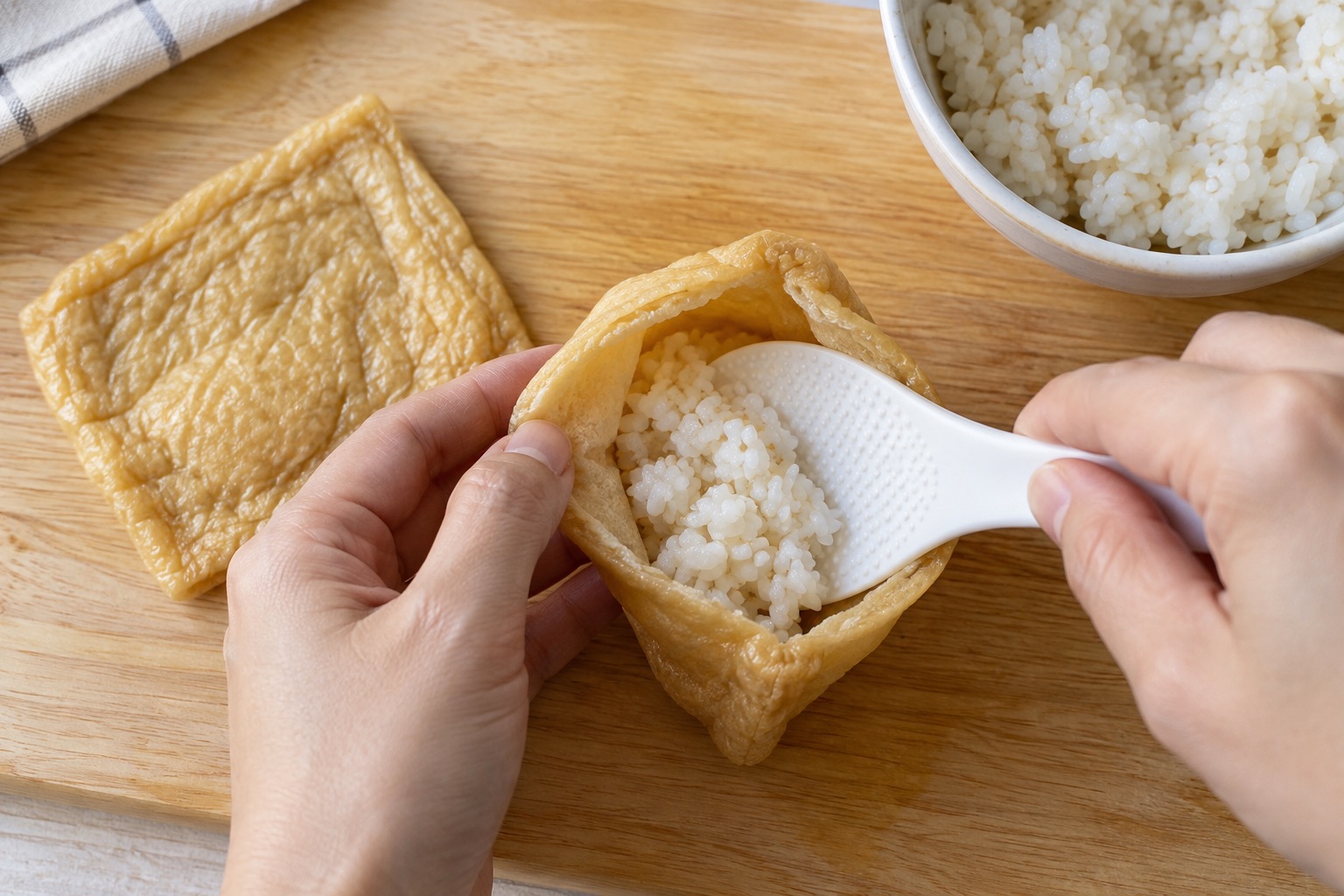
Kikkoman’s detailed lesson by Makiko Oda shows the work behind a folded version. It opens the tofu before seasoning, using a chopstick rolled across the surface to help separate the pocket. The pouches are then boiled and gently washed to remove oil, before being simmered in a soy-sauce, mirin and sugar mixture. Resting is part of that particular method, not an accidental delay. Read the complete illustrated lesson.
For assembly, the lesson lightly drains the seasoned pouches rather than wringing them completely dry. It puts the rice into each pouch in two portions, working it towards the corners, then folds the opening and places that side underneath. The contrast is deliberate: a seasoned outside surrounding vinegared rice.
These steps show why filling plain aburaage is not equivalent to filling prepared inari pockets. The pocket itself has acquired seasoning before the rice arrives. Do not use the lesson’s winter room-temperature storage suggestion as guidance for a warm kitchen; the handling section below gives separate precautions.
If you want to learn the pouch preparation, choose a full recipe that starts with plain aburaage and allow time for its preparation stages. If your immediate interest is shaping and presentation, a prepared pocket lets you concentrate on that part first. Neither choice needs to be a statement about how serious a cook you are. They simply put different tasks on your work surface.
For a first batch, keep the preparation coherent. Choose the pocket recipe or prepared product before deciding how much rice to cook. Decorative ideas can wait until you know what you are filling.
“Sushi rice” is not an instruction to pour any vinegar onto cooked rice. Plain vinegar and a prepared sushi-vinegar mixture do different jobs in the ingredient list.
Mizkan’s preparation FAQ distinguishes plain rice or grain vinegar, to which sugar and salt are added in its sushi-rice formula, from already-seasoned products. The directions also differ between its named prepared seasonings. Read Mizkan’s vinegar comparison.
The important consequence is not that one route is superior. It is that you should not automatically add a plain-vinegar recipe’s sugar and salt to a bottle that already supplies them. Decide which route you are following before measuring the rice seasoning.
There is a useful numerical example on Mizkan’s sushi-vinegar product page: its guideline pairs 30ml with about 320g of warm cooked rice, made from one go of uncooked rice. That is a direction for that product. The 320g refers to the cooked rice, not the dry grain you put in a cooker.
As a hypothetical scaling exercise, half of that stated cooked-rice amount would be 160g, paired proportionally with 15ml. That arithmetic does not establish a universal inari formula or tell you how many pockets it will fill. It only shows why the state of the rice matters when you read a quantity.
Keep two planning questions separate: how much seasoned rice your method produces, and how much fits the pockets you have. A recipe’s piece count belongs to its own pouch size and filling method. If your package specifies a rice amount per pocket, that is more useful than borrowing the count from an unrelated photograph.
This is a different assembly problem from an ordinary shaped rice ball. With inari, there is an existing pocket to accommodate, and that pocket is part of what you eat. For the first attempt, an uncomplicated rice preparation makes the pouch-and-rice relationship easier to understand; additions can be a later, deliberate choice.
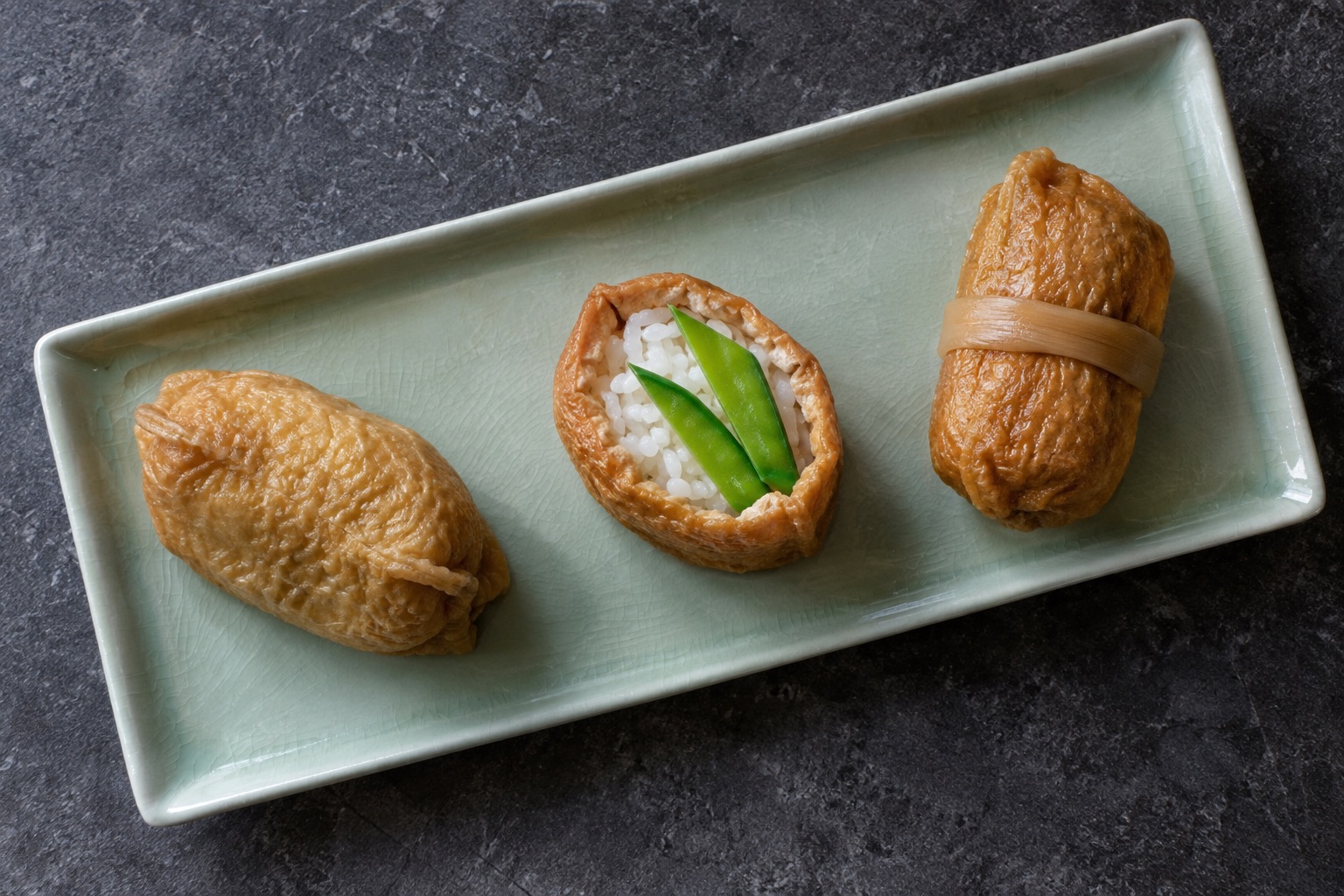
A closed pouch places the folded opening underneath. An open presentation makes the rice surface part of what you see. A tied version introduces another edible element that helps define the shape. These are useful descriptions of assembly, not an official classification of every kind of inari sushi.
In Mizkan’s combined chakinzushi and inarizushi recipe, the rice is seasoned and mixed before it goes into prepared pouches. Some pouches are gathered and tied with mitsuba, a Japanese herb; others are arranged with the opening up and decorated with snow peas. An exposed rice surface can therefore be intentional. It does not automatically mean that the cook failed to close the pouch.
That distinction is useful before you begin decorating. If you want the rice and toppings to remain visible, select an open presentation at the outset. If you want a folded parcel, choose a recipe that demonstrates how its rice portion and pocket close together. Trying to imitate both appearances in the same piece creates an unnecessary problem.
The tie can also be a specific regional ingredient. Japan’s Ministry of Agriculture, Forestry and Fisheries records a Tochigi version in which a rice-filled pouch is secured around the middle with seasoned kanpyo, dried strips of bottle gourd. The page describes a rice-bale-like form and acknowledges variations in household and regional recipes. See MAFF’s Tochigi inarizushi entry.
Here the strip is not just a line in the presentation: it is food with its own preparation. A visible tie is a reason to read the method, not to replace the ingredient with whatever decorative material is nearby. Follow the named recipe for preparing the edible strip.
Choose what the finished piece should show, then follow the assembly that produces it. That gives presentation a purpose instead of making it another last-minute task.
The tofu is only one ingredient in a prepared pouch. Misuzu’s refrigerated Inari Jozu MA square product is a concrete example: its ingredients include bonito, sodakatsuo and kombu flavouring ingredients, alongside soy sauce, sugar, mirin and brewing alcohol. Its allergen summary lists soy and wheat, but the full ingredient list also reveals the fish components. Read the exact product’s ingredient list.
For a vegetarian reader, that is why the allergen summary cannot replace reading the ingredients. It is also why this example should not become a blanket judgement about every product from the same maker. Misuzu explicitly asks customers to check their own packet because the formulation or labelling may differ after revisions.
The rice deserves a separate check. Kikkoman’s sesame-and-small-fish inari recipe includes small fish in the rice and bonito dashi in the pouch preparation. In that recipe, avoiding a fish topping would not answer both questions. There are fish ingredients in two places.
When ordering, a useful question is: “What is used to season the tofu pocket, and is anything mixed into the rice?” It names the parts a cook needs to check. For dietary needs involving alcohol, ask about the actual seasonings as well; do not assume that a cooked dish or a tofu-based dish establishes suitability.
Our Japanese vegetarian-food guide covers the wider ingredient questions. For inari specifically, the key is to treat the pouch as a prepared food with its own ingredients, not as an ingredient-free wrapper.
A sealed packet’s storage instructions and the handling of assembled inari are separate matters. Once you open a pocket package and add cooked rice, you have more than the original unopened product to consider.
Misuzu’s FAQ advises refrigerating opened inner packs and using them that day where possible. It also explains that best-before guidance assumes the stated storage conditions and an unopened product. These are the maker’s directions, not a shelf-life guarantee for every brand or for finished sushi. Check Misuzu’s handling answers.
For packed food, MAFF’s lunchbox-safety guidance stresses clean hands and utensils, a clean dry container, cooling food before packing so steam does not collect, and avoiding warm storage. It advises prompt consumption and cold packs or an insulated bag for longer transport. Plan that cold storage and transport before making food to take out.
Do not read a cool serving style as permission to leave rice sitting indefinitely in a warm room. Nor does adding vinegar establish that your batch is safe without proper handling. This guide does not supply a room-temperature holding time or a method for rescuing badly stored rice.
For a first attempt, serving at home removes the extra task of arranging transport. If the plan is a packed lunch or a gathering, decide in advance where the finished food will be kept and how it will get there. A recipe’s final photograph cannot answer those questions for your kitchen.
Inari becomes much easier to plan once the pouch stops being an afterthought. Identify the thin pocket, decide whether you are seasoning it yourself, prepare the rice with the vinegar you actually have, and choose an assembly that suits the presentation. The rice goes inside, but the outside is part of the dish from the beginning.

AUTHOR OF THIS ARTICLE
SoJapan
SoJapan India Pvt. Ltd. is a Japanese-founded company based in Gurugram. We bring Japanese food, anime goods and apparel materials to Indian businesses, with a sister company in Kyoto that works directly with makers in Japan.