Finding horseradish in a wasabi ingredient list can feel like discovering that the product name has concealed the answer. But the next question matters more than the surprise: are you looking at a plant, a blend of plant ingredients, or a finished condiment?
Those are different things. A prepared paste can contain both wasabi and horseradish. Another paste can list wasabi without horseradish, yet still include oil, salt and other ingredients. Powder is not automatically pure dried wasabi, either. The container does not settle the recipe.
For example, S&B’s current Prepared Wasabi in Tube 43g, European version, lists horseradish at 31.7% and wasabi at 4.5%. That is a specifically identified blend, not evidence that every product bearing the word wasabi has the same formula. The maker’s page separates several regional versions. See the Europe-labelled ingredients.
This guide helps you read such differences without turning them into a contest between knowledgeable and supposedly fooled diners. It follows exact maker descriptions checked in October 2026, not a tasting test or a survey of Indian shops. The examples do not establish local prices, stock or which product a restaurant serves.
Japanese wasabi, often called hon-wasabi to distinguish it from horseradish, and horseradish are different plants. Kinjirushi identifies horseradish as Armoracia rusticana and gives the Japanese names seiyo-wasabi and yama-wasabi. Both plants belong to the cabbage or mustard family, Brassicaceae. Horseradish is used in processed wasabi products, but it also has its own culinary uses; it is not merely a name for fraudulent wasabi. Kinjirushi’s plant explanations describe those distinctions.
Two further terms can confuse the picture. Water-grown and field-grown hon-wasabi describe cultivation methods. They do not divide Japanese wasabi from horseradish. Likewise, a plant’s Japanese name does not tell you where the particular crop in a packet was grown. Species, cultivation and origin belong to different parts of the description.
The familiar knobbly piece grated into a condiment is a rhizome: a stem, not simply a root. The Japan Wasabi Association’s explanation of plant parts makes that distinction. You do not need to memorise botanical vocabulary to enjoy a meal, but it helps when a seller describes a whole piece of wasabi and another describes a paste made with wasabi ingredients.
Nor is the plant used only in that grated form. MAFF’s producer feature on wasabi discusses other edible parts and gives a stalk preparation. Its example combines the stalks with salted kombu and bonito. That is a separate dish, not another tube recipe, and the bonito matters if you are looking for vegetarian food.
This is the first useful change in how to read a label: do not make the product name carry every piece of information. “Wasabi” on the front may identify the kind of condiment you are being offered. The ingredients explain the plant materials and other components used to make that particular version.
If your purpose is to encounter freshly grated hon-wasabi, a blended prepared condiment answers a different request. If your purpose is to add a convenient wasabi-style seasoning to a meal, a clearly described blend may be exactly the product you intended to buy. The important distinction is whether the description matches your purpose, not whether someone else approves of your choice.
The examples below are deliberately specific. They are not a ranking, a recommended shopping basket or a claim that four products represent the entire category. Each reveals a different limit to a common assumption.
For the first row, use the European 43g version, not an ingredient list for a similar-looking regional pack. For the premium paste, the product code shown on the maker’s page is 074880020038. The powder example uses the listed version with code 074880001013. These identifiers help avoid comparing the name of one product with the ingredients of another.
| Maker example | What the page establishes | Shortcut it challenges |
|---|---|---|
| S&B Prepared Wasabi 43g, Europe | Horseradish and wasabi are both listed, with different percentages. | A wasabi-labelled tube need not contain only wasabi. |
| S&B Premium Wasabi Paste 43g | Wasabi is listed; horseradish is not. Other ingredients are present. | Not every tube is a horseradish blend. |
| House Tokusen Honkaori Nama Wasabi 42g | All the wasabi used is described as hon-wasabi; the finished formula has other ingredients. | A 100% claim need not mean a single-ingredient paste. |
| S&B Wasabi Powder 30g | A blend containing horseradish, mustard and wasabi; the maker says no artificial colours. | Neither powder form nor absence of artificial colour proves purity. |
The S&B Premium Wasabi Paste page starts its ingredient list with wasabi and also names ingredients including modified starch, sorbitol, sugar, rice-bran oil and salt. Saying that this list does not name horseradish is accurate. Saying that the tube therefore contains nothing but grated wasabi would overlook the rest of the list.
That distinction is useful when product descriptions use “real” as if it were a complete recipe. Ask what the word is meant to establish. Plant identity? Absence of a particular ingredient? A particular preparation? Without that follow-up, two people can agree on the word while imagining different foods.
An ingredient list is not a tasting score. It cannot tell you whether you will prefer the product or how much to put on a bite.
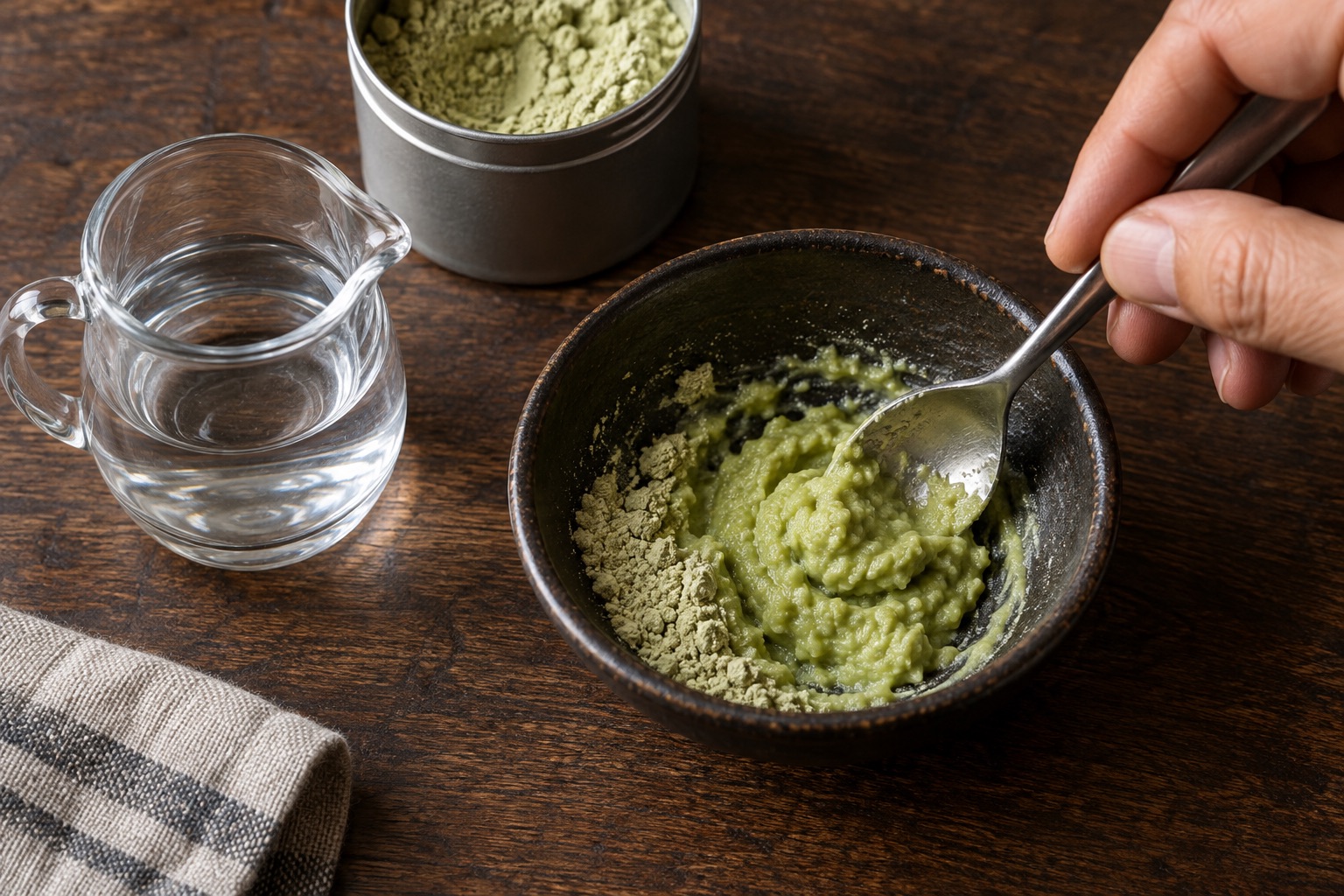
The S&B Wasabi Powder 30g page lists horseradish, mustard, modified food starch and wasabi for the code identified above. The maker describes its pale-green colour as coming from the plant blend and states that it uses no artificial colours.
This is why colour is a poor substitute for reading. A claim about colouring answers a colouring question. It does not erase the other named ingredients. Nor does drying something into a powder tell you whether it began as one material or a formulation.
When checking a product photograph online, look for a legible back-of-pack image that belongs to the exact size and version. A front image from one market beside a translated ingredient list from another is not a reliable comparison. If the information does not match, asking for the correct panel is more productive than trying to identify the contents from the shade of green.
A percentage always describes a share of something. The easy mistake is to read the number and silently supply “of everything in the tube” as that something.
House’s 42g Tokusen Honkaori Nama Wasabi gives a concrete counterexample. The maker describes the wasabi it uses as 100% hon-wasabi. Its ingredient panel nevertheless includes vegetable oil, salt, starch and other components. The claim concerns the wasabi used, not the absence of every other ingredient in the finished condiment.
The same page names Indonesia and China as origins of its hon-wasabi ingredient. Thus hon-wasabi identifies the plant material here; it is not a promise that this crop was grown in Japan. That observation is about the named product’s current information, not a judgment about either origin.
This leaves two independent things to check. If you want a particular plant, examine the plant ingredients. If you want a particular growing origin, examine the origin statement. One answer cannot be substituted for the other.
S&B’s Japanese customer FAQ on tube labels explains an industry convention attributed to the Japan Processed Wasabi Association. Under that convention, hon-wasabi shiyo (本わさび使用) is used when hon-wasabi makes up at least 50% of the wasabi ingredients. Hon-wasabi iri (本わさび入り) applies below that threshold.
The denominator is essential. These are not statements that at least, or less than, half of the whole tube is hon-wasabi. Nor should this explanation of Japanese wording be treated as an Indian labelling rule or a universal definition for English packaging.
Here is an invented arithmetic example, not a manufacturer’s recipe. Imagine a 50g prepared condiment made from:
There are 20g of wasabi materials in this example. Hon-wasabi accounts for 10 out of those 20g, or 50% of that group. But it accounts for only 10 out of the full 50g, or 20% of the finished condiment.
Nothing changed in the imagined mixture between those two calculations. Only the denominator changed. That is why a percentage copied without its qualifying words can convey a very different impression.
You do not need to calculate a new percentage for every purchase. The useful habit is to keep the whole claim together: the number, the ingredient it names, and the group it measures. Where a label gives no quantity, leave the quantity unknown rather than estimating it from the position of a word in the list.
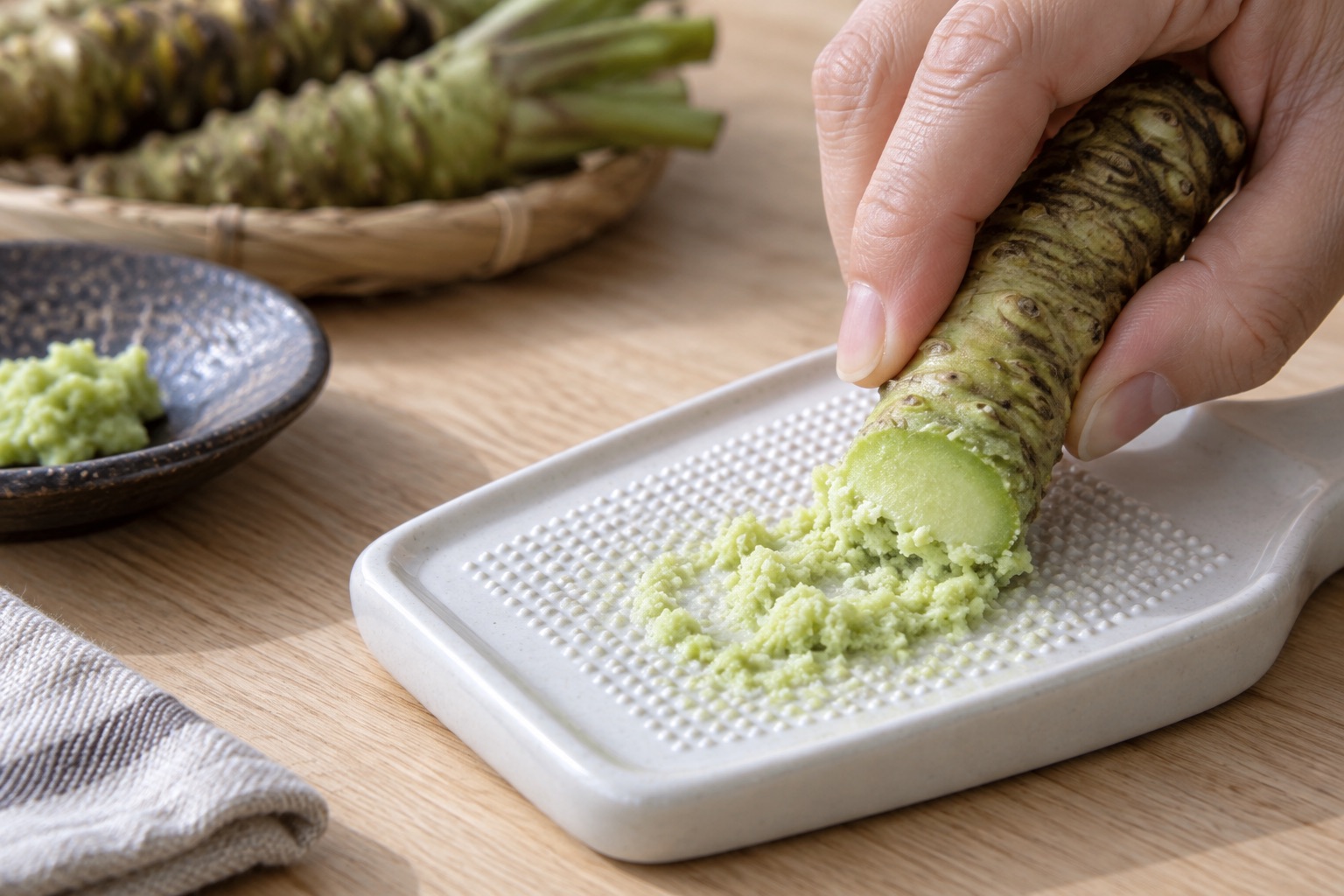
Even after identifying the plant materials, there is another question: what has been done to them before they reach the plate?
The Japan Wasabi Association explains that grating allows an enzyme to act on a compound in the plant tissue, producing the pungent component allyl isothiocyanate. That component is volatile. In plain language, preparation helps generate the characteristic pungency, and the resulting aroma does not simply remain unchanged indefinitely.
This is different from imagining a fixed quantity of “heat” already sitting in every visible green fragment. It is also a reason not to turn a tasting impression into an ingredient test. A strong sensation is an observation about what you ate in that situation, not a botanical identification.
Kinjirushi’s comparison of the two plants identifies allyl isothiocyanate as a major pungent component in both hon-wasabi and horseradish, while distinguishing their aromas. Shared pungency does not make them the same plant; different aromas do not create an infallible at-home test for the composition of an unknown prepared mixture.
For the named S&B powder, preparation includes adding water and waiting. Its instructions specify five teaspoonfuls of powder to three teaspoonfuls of water, mixing, then inverting the container and waiting one minute. Those are the maker’s directions for that product, with quantities measured by volume. They are not a five-to-three weight ratio or a universal recipe for every powder sold as wasabi.
A ready-to-use paste and a powder you hydrate therefore ask different things of you. If a recipe calls for prepared paste, an equal spoonful of dry powder is not automatically an equivalent ingredient. First establish what form the recipe expects. Then use directions appropriate to your product, rather than guessing that the shared name guarantees an identical substitution.
S&B’s handling FAQ distinguishes shelf-stable paste, dry powder and powder already mixed with water. It advises refrigeration after opening its shelf-stable paste, keeping the cap firmly closed. Dry powder is kept airtight in a cool, dry place away from direct sunlight. Mixed powder is treated separately, with airtight refrigerated storage and prompt use because its pungency changes over time.
Follow the instructions on your actual pack. These form-specific directions should not be stretched into one safe storage duration for all brands, fresh plant material and restaurant portions. In particular, a dry container’s instructions are not necessarily the instructions for the paste you have just made from it.
For a first comparison, record the product and preparation together: ready paste, powder mixed according to its directions, or freshly grated plant material. That note makes later comparisons more useful than a rating of “strong” or “mild” alone.
You might be interested in the plant itself, in a condiment for an everyday meal, or in understanding a product you already own. Those are all reasonable starting points, but they lead to different choices.
If the plant is your main interest, look for a clearly identified hon-wasabi preparation and ask what form is being supplied. Freshly grating plant material is a different experience from opening a prepared formula. A product advertised through an image of a whole rhizome may still be a paste; the image should not do the work of the description.
If convenience is your main interest, read the complete paste label and its handling instructions. You are choosing a finished condiment. An explicitly declared blend is not a reason to abandon that purpose; it is information about what you are choosing. Equally, wanting a product without listed horseradish is a specific preference you can investigate without assuming that every tube fails it.
If you already have a powder, start with its own ingredient list and preparation method. Do not borrow a ratio from an unrelated brand merely because the two containers use the same English name. The mixing step is part of learning the product, not an obstacle to skip.
For a meal, decide whether you want the condiment to remain a separate accent or become part of a larger seasoning mixture. As an editorial suggestion, begin with a small separate portion alongside food you already know, adjusting to your preference. This is a way to make your own comparison manageable, not a tested serving quantity or a claim that everybody should experience the same strength.
You also need not make sushi the only destination. The optional wasabi addition in the tea-based preparation discussed in our ochazuke guide places it in another context: a finishing choice in a bowl whose seasoning has already been planned. Follow the complete preparation there rather than treating the condiment as the whole dish.
If your main concern is dietary suitability, botanical identity is only one part of the answer. Read the finished formula and the ingredients of the meal around it. A green condiment does not certify its accompanying sauce or topping. Our Japanese vegetarian food guide deals with that broader question without assuming all diners share the same exclusions.
For readers in India, the overseas maker examples above are useful reference points, not a promise that a local seller carries those versions. Ask for the information attached to the actual item you are considering. With an unlabelled restaurant portion, you may need to ask staff what preparation they use; its appearance alone cannot supply the missing product details.
The useful outcome is not learning to declare every unfamiliar paste “fake.” It is being able to say precisely what you know: which plant materials are named, what a percentage measures, and how the condiment is prepared. That gives you a much firmer basis for choosing—and enjoying—the wasabi in front of you.

AUTHOR OF THIS ARTICLE
SoJapan
SoJapan India Pvt. Ltd. is a Japanese-founded company based in Gurugram. We bring Japanese food, anime goods and apparel materials to Indian businesses, with a sister company in Kyoto that works directly with makers in Japan.