A bowl of ochazuke can begin with plain hot water and still contain tea. That is not a contradiction: the tea may already be in the seasoning on the rice. Nagatanien’s answer for its Ochazuke Nori is straightforward: the mix contains matcha, and the company recommends hot water to bring out its flavour. Read the manufacturer’s preparation answer.
That small detail makes the dish easier to understand. Ochazuke is cooked rice served with liquid poured over it and accompanying seasonings or toppings. But looking only at the teapot, kettle or jug misses half the preparation. Some flavour arrives with the liquid; some may be waiting in the bowl.
For a newcomer, the useful question is not “Which of these three liquids is the authentic one?” It is “What is already providing the seasoning, and what does this pour need to do?” That question helps whether you are following a Japanese recipe, using an imported sachet or asking what is in a restaurant’s bowl.
This guide follows several specific preparations rather than supplying a universal recipe. They show how the parts fit together, where a short ingredient list can be misleading, and which details deserve attention when you make your first serving. The manufacturer examples are from Japanese-market pages checked in October 2026; they are not claims about availability or prices in India.
An instant ochazuke mix is not necessarily just a garnish that happens to get wet. For Nagatanien’s Ochazuke Nori, the current ingredient list includes seasoning granules containing salt, sugar, matcha and kombu powder, alongside arare and nori. Arare are the small rice-cracker pieces; nori is seaweed. The product is designed for a poured-water preparation. See the exact eight-sachet product.
The maker’s explanation of its green granules is particularly useful. It says they are made to dissolve readily without clumping, including in cold water. It contrasts that behaviour with its furikake granules, which are deliberately made less readily soluble so they do not immediately disappear on warm rice. This is the manufacturer’s account of its product design, not a claim that every dry seasoning behaves identically. Nagatanien explains the granules here.
The practical distinction is between something that remains an addition to rice and something intended to help make the surrounding liquid. Two sachets can look superficially similar when dry but ask you to complete different preparations. “Sprinkle over rice” is therefore not enough information by itself: what happens next matters.
If you already know furikake, resist treating an ochazuke mix as simply a larger serving of it. Nor should you assume that pouring water over whichever furikake you own reproduces a manufacturer’s ochazuke formula. That might be an experiment you choose to make, but it is not the same as following the named product’s instructions. Our furikake guide covers the different dry-seasoning and mix-in uses in their own right.
This also explains why adding an extra seasoned broth is a change, not just a more elaborate way of supplying water. Imagine a packet whose instructions already account for its seasoning dissolving in plain water. Replace that water with an independently seasoned liquid and you are combining two preparations. The result may suit your preferences, but you have lost the original recipe as a reference point.
For a first attempt, keep the specified liquid so you have a clear starting point for later changes.
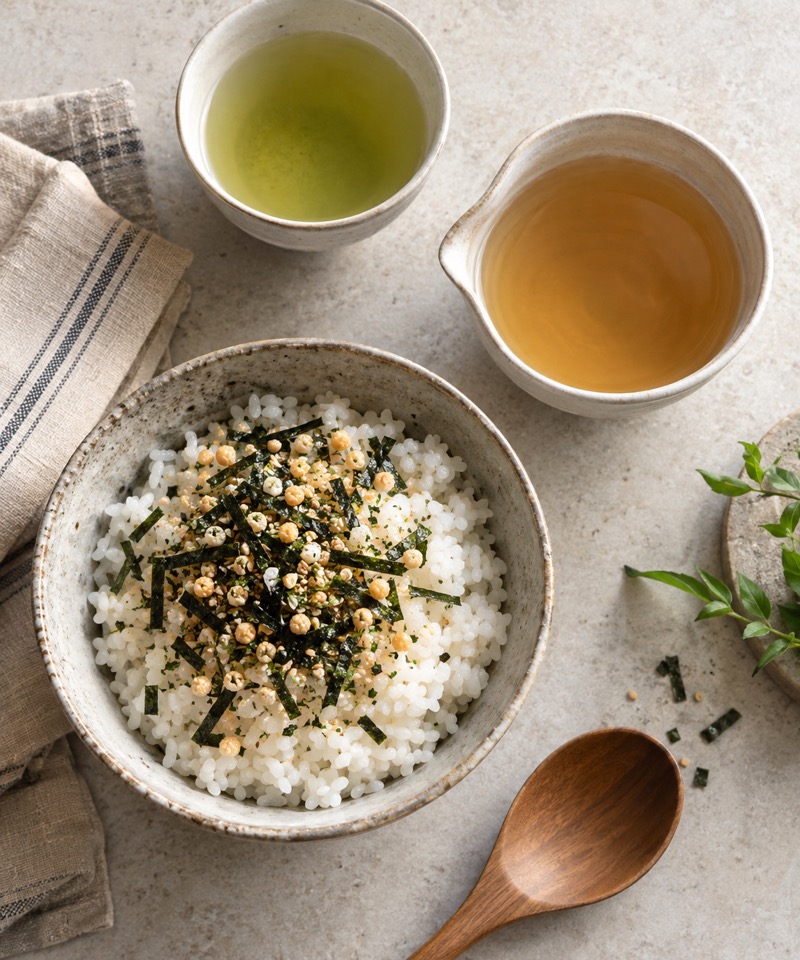
“Tea-based” tells you something about an ingredient. “Instant” tells you something about a product’s form or convenience. They are not opposites. Likewise, a bowl made with tea may still include a separate seasoning; the tea does not have to do every job on its own.
The following table is a map of the examples discussed here, not an official classification of all ochazuke. It separates the thing poured from the place where seasoning enters. Read the full linked recipe for quantities and preparation, rather than using the table as a substitute.
| Preparation | What is poured | Where to look for the seasoning |
|---|---|---|
| Named seasoned sachet | Water, as directed | The mix placed on the cooked rice |
| Ito En’s Koi Chazuke | Separately prepared instant green tea | Kombu tea seasoning is also added to the rice |
| Kikkoman’s salmon version | Prepared shirodashi and hot water | The specified seasoned liquid, alongside the salmon topping |
The distinction becomes helpful when someone describes a bowl simply as “with dashi.” Dashi means stock, but you still need to know what preparation is actually being used. The salmon example below uses a named shirodashi seasoning diluted according to its recipe; it is not an instruction to pour an arbitrary stock concentrate straight from a bottle.
Similarly, “with green tea” does not identify the form of tea. A recipe written for a particular soluble instant product is not giving you a spoon-for-spoon instruction for loose leaves or pure matcha. The sensible substitution question is about the job an ingredient performs, followed by a recipe suited to the ingredient you actually have.
There is also more than one way to assemble a tea-containing bowl. In Ito En’s separate instant-green-tea recipe, its specified instant tea and kombu tea go directly onto cooked rice before hot water is added. Shiso, shirasu and shredded nori finish the dish. Here, tea does not first have to be made in a separate vessel. Shirasu are small fish, so that particular topping list is not vegetarian.
These examples do not ask you to choose a winning method. They let you ask a better question of the method in front of you. Is the recipe dissolving something in the bowl, bringing an already-prepared liquid to it, or doing a little of both? Once that is clear, an apparently missing ingredient may turn out to be present in a different form.
Ito En’s Koi Chazuke recipe contains an easy detail to miss. It lists 300ml of water or hot water for preparing its specified instant green tea, with 100g of cooked rice. But the method does not tell you to empty all that tea onto the rice. It calls for an appropriate amount to be poured, with the remaining tea enjoyed alongside the meal.
The recipe also puts its kombu tea seasoning on the rice separately. Its optional additions include umeboshi, pickles, wasabi and small rice crackers. They are choices, not instructions to include every listed topping.
The specific kombu tea product is a granular mixture containing salt, sugar, ground kelp, starch and seasonings. Ito En explicitly describes using it in cooking as well as as a drink. Here it is a separate seasoning, not simply another name for the green tea. That ingredient distinction explains why omitting it would change more than the tea flavour.
This is why reading the ingredient column alone can create the wrong bowl. A quantity can describe what you prepare in a vessel without saying that the entire quantity ends up in one serving. The method supplies that missing relationship.
For this recipe, there is no reason to reverse-engineer a supposedly compulsory rice-to-liquid ratio from the two numbers. Doing so would erase the instruction that some tea is for drinking. Nor would guessing a new universal waterline solve the problem. The lesson is narrower and more useful: connect each quantity to the step where it is used.
Some of the most important instructions appear inside brackets. In Kikkoman’s shirodashi salmon ochazuke, the salmon is already grilled, or supplied as salmon flakes. The rice is already cooked and warm. The method removes the salmon bones and flakes the fish, prepares the specified liquid separately, then brings the components together with scallion and shredded nori.
That is an assembly recipe. Its short final sequence does not include starting with raw rice or cooking a raw salmon fillet through a quick pour. Those would be different tasks requiring their own preparation. Keeping the word “grilled” attached to “salmon” is more useful than treating it as an incidental description.
For a beginner, it helps to read the ingredient list as a list of states, not just foods. “Rice” might be an item in your cupboard; “warm cooked rice” is something ready for the bowl. “Salmon” might be an uncooked fillet; “grilled salmon with bones removed” is a prepared topping. A recipe’s apparent simplicity often rests on that work already being done.
This changes how you plan the meal. Work backwards from the moment you want to pour. Have the base ready, the topping in the form requested, and the liquid prepared as directed. You can then assemble the dish without discovering that the recipe assumed an ingredient you have not yet cooked.
It also gives additions different roles. A substantial topping is part of what you eat with the rice. A small finishing condiment is something you may adjust. Treating those as the same kind of choice makes it too easy to copy the most visually obvious garnish while missing the part of the recipe that gives the bowl its character.
When adapting, decide which prepared topping your bowl is built around before choosing optional finishing touches. That is a practical suggestion, not an approved formula.
If you are ordering rather than cooking, ask about the assembled bowl. “Does the liquid contain fish?” and “Is fish added on top?” are separate questions. Removing a visible garnish would answer neither question about ingredients already dissolved in the liquid. A tea-based name is not, by itself, a dietary guarantee.
If you are making a vegetarian bowl, check the seasoning mixture as well as the visible topping. The tofu example below shows why both matter.
Cold ochazuke is not merely a hot bowl that has been left to stand. There are recipes that deliberately prepare its components for a cold serving. A useful example is Kikkoman and Hachidaime Gihey’s cold tofu dashi ochazuke.
In that recipe, cooked rice is briefly rinsed and drained, while the specified liquid is combined and chilled separately. Tofu goes onto the rice; ginger, scallion and bonito are added as finishing ingredients, with soy sauce optional. The stated preparation time excludes chilling the liquid. Despite the tofu in the title, bonito is explicitly part of the recipe.
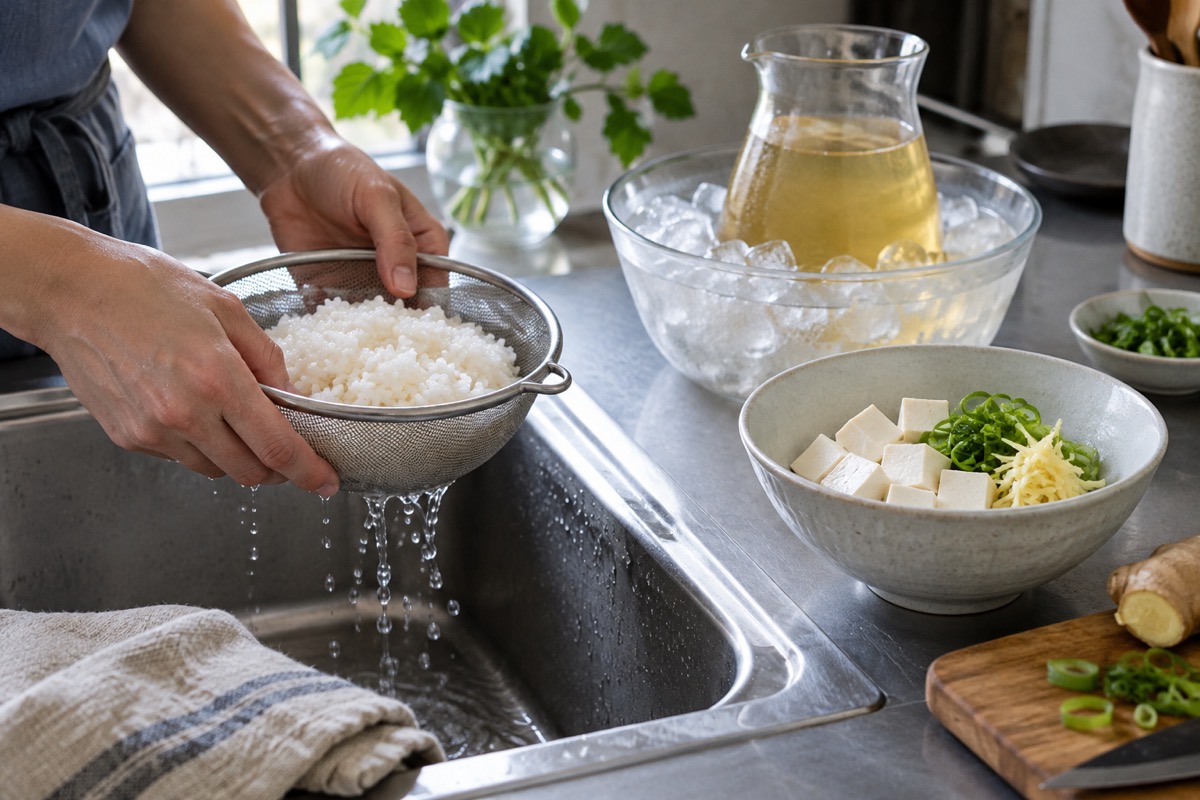
The important point is the coordination. Rice preparation, liquid temperature and topping preparation are already decided before assembly. You are not asked to pour cold liquid onto any version of a hot recipe and assume that the result is equivalent.
Nor does this example establish that every bowl of ochazuke needs rinsed rice. That is a step in this particular cold preparation. Carrying it automatically into a hot recipe would be another adaptation, not faithful following of the original instructions.
For an instant mix, cold use is also a product-specific question. Nagatanien’s Ochazuke Nori page explicitly describes a cold-water version, and the granule explanation above addresses cold-water dissolution. That is useful evidence for the named product, not permission to assume every dry soup or rice seasoning works the same way.
Choose the hot or cold route early enough to complete the stated preparation. If the cold recipe needs a chilled component you have not prepared, its brief assembly time does not make that requirement disappear. A hot recipe with ready components may be the more straightforward choice for that particular meal; a planned cold recipe may suit another occasion.
None of this is advice on storing leftover rice, leaving a finished bowl at room temperature or using a pour to make poorly stored food safe. Serving temperature and food-storage safety are different questions. The examples here explain assembly using components suitable for the recipe, not a rescue method for leftovers.
The most useful first choice is a preparation you can actually follow from beginning to end. If you have a seasoned sachet, begin with its specified water and preparation. If you want to understand tea and seasoning separately, the Ito En example makes those roles visible. If you have the prepared topping and named sauce for the salmon recipe, the dashi route gives you another clear starting point.
For readers in India, the named Japanese products are reference examples, not a requirement to buy every item mentioned. If your available product differs, look for instructions written for that product rather than borrowing a convenient-looking quantity from an unrelated recipe. This guide is not a tested substitution chart for Indian teas, stocks or seasonings.
Ochazuke becomes much less mysterious when you stop watching only the pour. Follow the seasoning from packet, rice or jug into the finished bowl; notice which ingredients are already prepared; and let the recipe tell you how those parts meet. Then the final addition of liquid is not a shortcut you have to guess at. It is a step you understand.

AUTHOR OF THIS ARTICLE
SoJapan
SoJapan India Pvt. Ltd. is a Japanese-founded company based in Gurugram. We bring Japanese food, anime goods and apparel materials to Indian businesses, with a sister company in Kyoto that works directly with makers in Japan.