“Smooth bean paste” sounds as though it should answer several questions at once. You might imagine something soft enough to spread, with a gentle sweetness and no pieces to interrupt the bite. Yet smoothness tells you much less than that. It describes the absence of a particular kind of texture; it does not tell you how firmly a filling holds its shape or how sweet a maker has chosen to make it.
That distinction is useful when a Japanese café offers two bean fillings, and even more useful when you are choosing an ingredient for toast or a dessert at home. Asking for koshian rather than tsubuan can address a dislike of bean skins. It cannot, by itself, settle every other preference.
This guide follows the paste rather than the pastry around it. For Indian readers who first met anko through an anime snack or a Japanese bakery, the aim is to make a few unfamiliar names practical: what has been kept, what has been removed, and what has happened after the beans became a paste. It is an explanation of ingredients and maker examples, not a tested home recipe or a claim that the cited Japanese products are stocked in India.
The short answer: distinguish bean structure, sweetening stage and finished consistency. Once those are separate questions, a smooth paste sold in a jar and a smooth paste sold as a slice stop looking contradictory.
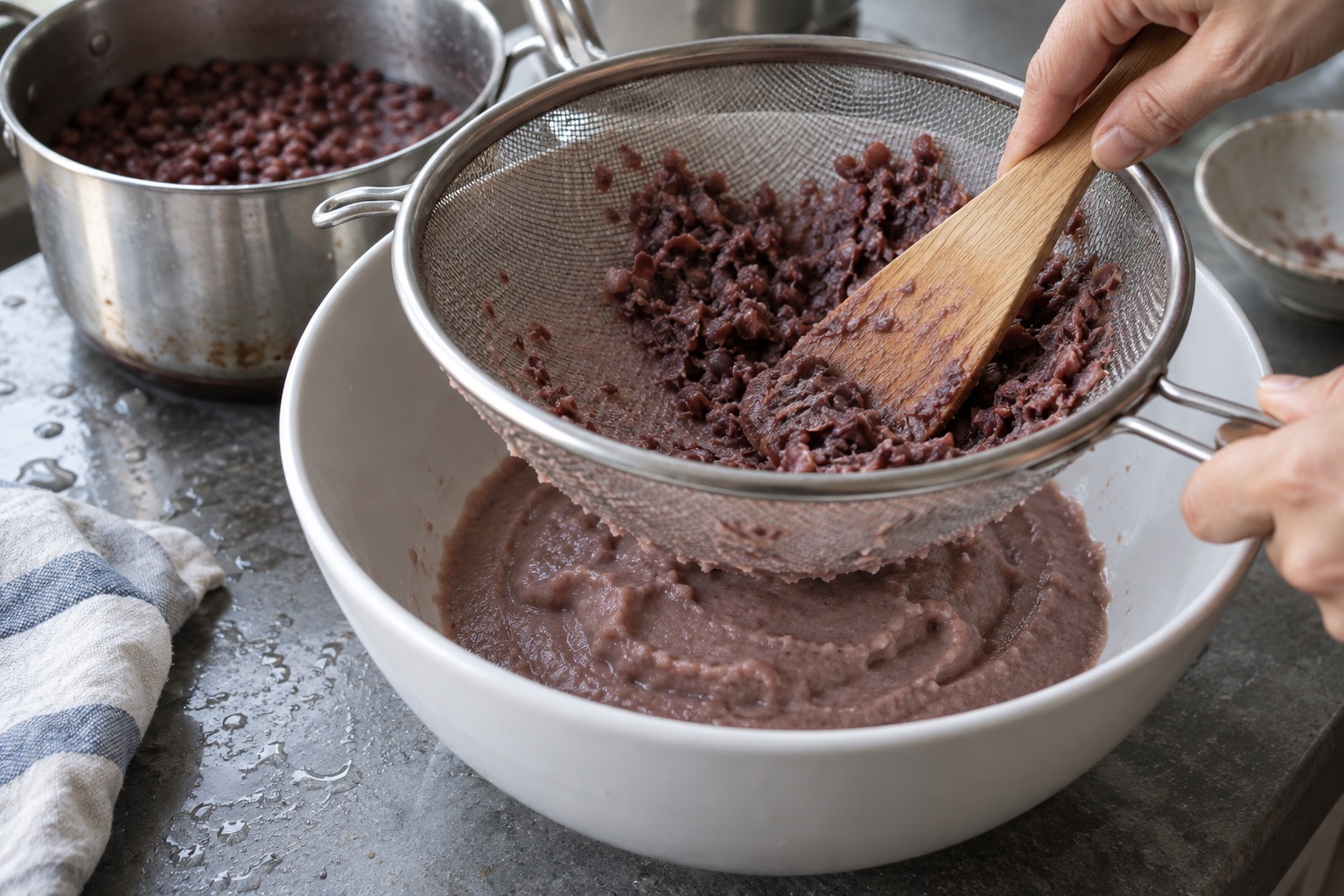
Imuraya describes tsubuan as beans cooked with care to preserve their shape. Its explanation of koshian includes cooking and crushing the beans, then straining to remove the skins before finishing the paste. The useful contrast is therefore not simply “less blending” versus “more blending.” One route retains recognisable bean structure; the other separates out a component. Read Imuraya’s explanation of an.
Imagine two operations on the same cooked ingredient. In the first, everything is broken into smaller pieces and remains in the mixture. In the second, some material passes through a sieve while other material is left behind. Even without a recipe, you can see why the results are not equivalent. Making pieces smaller and removing them are different decisions.
This is why “put the chunky filling in a blender” is an incomplete explanation of koshian. A blender can change particle size, but that instruction does not include separating the skins. It also starts with a finished filling whose sugar and other ingredients may already have been chosen for another use. That may produce a mixture someone enjoys; it is not a neutral way to reproduce every smooth filling described by a confectioner.
Also be precise about what bothered you in a previous sweet. Was it a skin-like piece, the firmness of the entire centre, or the amount of sweetness? Those are different observations. “I did not like the texture” is a perfectly reasonable first reaction, but identifying the part of that reaction helps you choose something meaningfully different next time.
MAFF’s confectionery manufacturing overview describes azuki tsubushian with the skins retained, in contrast to the skin-removal step for koshian. This gives you a way to understand paste that is no longer a collection of neat whole beans but still has a textured character. Crushed does not automatically mean strained. See MAFF’s manufacturing explanation.
The following is a reading aid, not a set of mandatory recipes for every manufacturer:
| Question about the beans | Useful term or distinction | What it does not settle |
|---|---|---|
| Have recognisable beans been preserved? | Tsubuan points towards retained bean texture. | The finished product’s sweetness. |
| Have the beans been crushed without removing the skins? | Tsubushian helps explain a textured paste without intact beans throughout. | Whether the product is firm enough for your particular filling. |
| Have skins been separated from the paste? | Koshian is the smooth-paste distinction. | Whether it is designed to spread, hold a shape or serve another purpose. |
When a menu gives only an English word such as “chunky,” you may not be able to place the product neatly into every row. You can still ask the relevant question in ordinary language. “Are there bean skins or whole pieces in this filling?” is more informative than asking the seller to agree with a technical name they may not use.
There is another distinction that matters especially to someone reading a recipe or an ingredient supplier’s description: nama-an. Hojo Seian defines it as an before sugar or other seasoning is added. In the manufacturer’s own process, the beans have already been cooked, crushed and sieved; the paste is washed and pressed. Its explanation then describes cooking this intermediate with sugar to make koshian for confectionery. See Hojo Seian’s nama-an process.
So do not read the word nama here as an instruction to use uncooked beans. It identifies an intermediate in the maker’s account, not the absence of heat. The stage of manufacture and the final taste are separate pieces of information.
This matters when two recipes appear to disagree about how much sugar to add. Before deciding that one must be excessively sweet, check what each recipe starts with. An unsweetened intermediate and an already-sweetened filling are not interchangeable starting points. The sugar named later in the method may be doing work that has already happened in the other ingredient.
Consider a hypothetical substitution, without pretending to calculate a new recipe. A method asks you to sweeten a paste base; instead, you use a ready-made sweet filling and add all the specified sugar anyway. You have changed the starting composition. Equally, replacing a finished filling with an unsweetened intermediate while leaving the rest of a dessert untouched changes what the finished dessert contains. Matching the weight on the scales does not resolve either mismatch.
The practical response is to find a method written for the ingredient you actually have. It is tempting to “correct” an unfamiliar recipe by intuition, especially if the two pastes look similar in a photograph. But a photograph cannot tell you where the sweetening has already occurred. Understanding the starting stage is more useful than memorising a universal sugar ratio that cannot account for those differences.
If you are simply ordering a filled sweet, this vocabulary can remain in the background. You do not need to ask a café to describe its manufacturing chain. It becomes useful when a packet, recipe or supplier actually uses the term and you need to understand what role that ingredient plays.
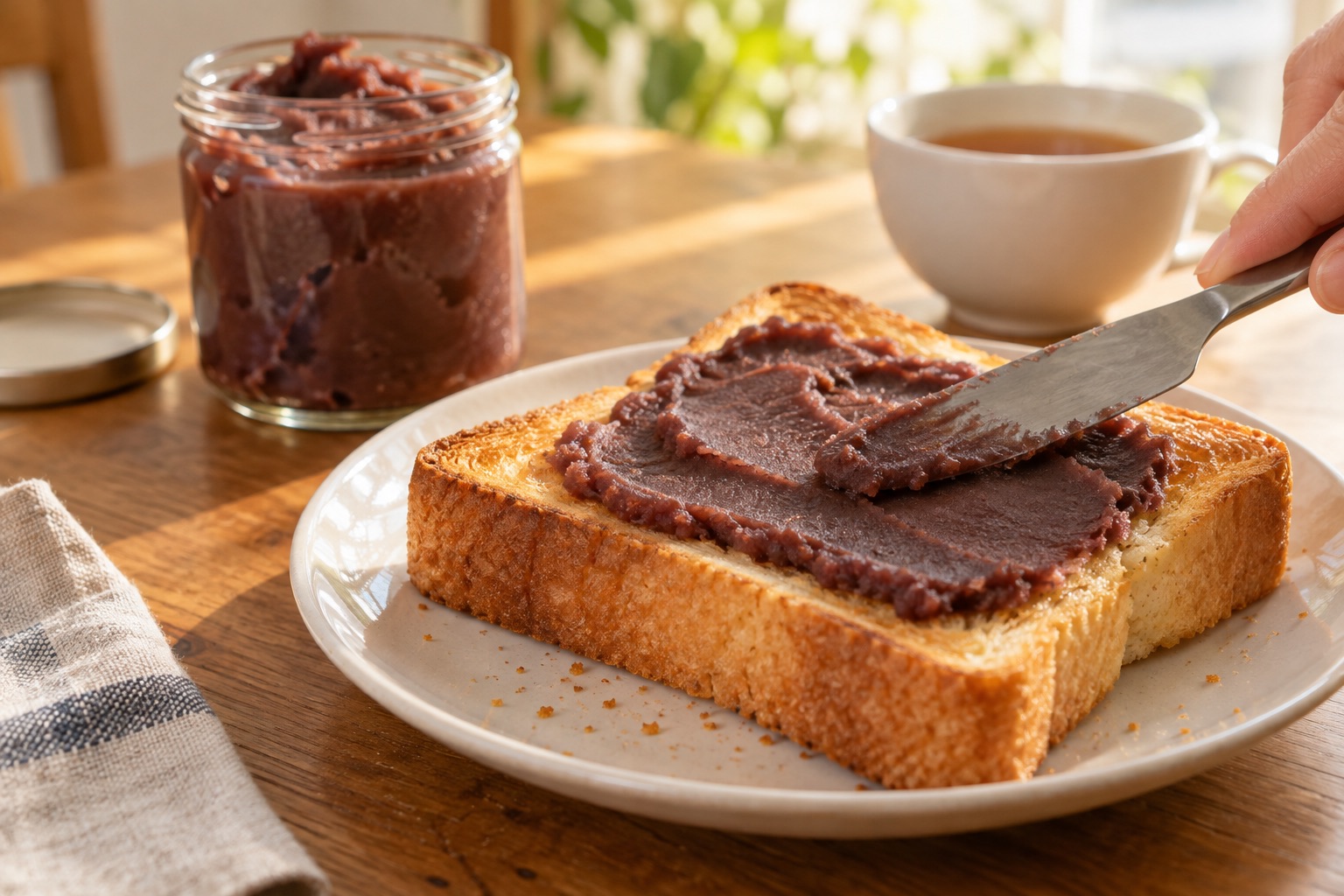
Toraya states that it adjusts the hardness and sugar concentration of an for the confection being made. That is an important qualification to the familiar smooth-versus-textured distinction: the maker is also choosing how the paste should function in a particular sweet. Read Toraya’s account of making wagashi.
A filling that has to stay where it is placed and a topping intended to be spread are doing different jobs. Smoothness alone is not a complete specification for either job. The relevant question is not “Is this real koshian?” merely because its form surprises you; it is “What has this particular product been designed to do?”
Two manufacturer examples make that distinction concrete.
Toraya’s An Paste [Koshian] lists azuki, sugar and agar, and suggests spreading it on toast or bread. Its description also suggests pairing it with yoghurt. That is direct evidence of an intended spreadable use, rather than a guess based on the smooth-paste name. See the Toraya product description.
Hashimoto’s fukujirushi sliced koshian is presented in a different form. The maker describes pieces that can be cut, sandwiched or cut into shapes, and instructs users to remove the film before placing a slice on toast. Its ingredient list includes sugar, azuki, reduced starch syrup, agar and sorbitol. See Hashimoto’s sliced-koshian example.
Both are called koshian. One is explicitly offered for spreading; the other can be handled as a slice. You do not need to have tasted either to recognise that the word describes something other than a universal package form or firmness.
There is a useful limit to what the ingredient lists prove. Both examples contain agar, so “this one has agar” does not, on its own, explain their different forms. The published lists do not give a complete formulation or all processing conditions. It would be an overreach to identify one ingredient as the sole cause, calculate how much to add at home, or promise that copying the list would reproduce either product.
These examples are not a buying contest. The point for a reader in India is transferable even if neither product is available locally: look for a stated use that matches your plan. A product described as a toast spread answers a different practical question from a photograph of smooth filling inside a sweet.
The maker’s separate adjustment of sugar concentration is also why koshian should not be treated as shorthand for “less sweet.” Removing noticeable pieces is a texture decision. How a particular finished filling is sweetened requires information about that filling.
Nor should the converse become another rule: a textured filling is not automatically the less-sweet choice. If sweetness is your concern, switching names without learning anything about the actual products may leave the concern unanswered.
When ordering, describe the preference directly. Ask which of the fillings on that menu is less sweet, if the staff can make that comparison. If their answer concerns texture instead, clarify which question you mean. This is more useful than assuming a universal ranking that the names themselves do not provide.
Once tsubuan and koshian are familiar, it is tempting to put every filling into just those two boxes. Ogura is a reason to leave some room for a more specific description.
In MAFF’s interview with the head of the Japan Anko Association, Ogura an is described as smooth paste combined with syrup-cooked Dainagon beans. The same discussion distinguishes tsubushian from tsubuan. These are useful accounts of preparation, not merely alternative spellings for a single texture. Read MAFF’s anko discussion.
A smooth component and recognisable beans can therefore belong in the same explanation. You need not decide that the visible beans make every part of the filling “not smooth,” or that a smooth background makes the beans irrelevant. The mixture is the point of the distinction being described.
Use that account to understand the term, rather than as a guarantee of the exact method behind every commercial item with Ogura in its name. A maker’s description of the product remains the appropriate place to establish its composition. The vocabulary helps you ask a better question; it does not give you access to an unpublished recipe.
A change of colour can represent a different base, an added flavour, or both. It should not be forced into the smooth-versus-textured comparison.
In its manufacturing overview, MAFF describes white an made with ingen beans and uguisuan made with green peas. It also describes matcha an made by working matcha into white paste. Toraya’s wagashi account includes white azuki among its materials, a reminder not to turn one white-paste example into a rule about every maker. These descriptions identify ingredients and methods; they are not a reliable colour chart for an unlabeled dessert.
An Foods Niigata provides a particularly clear example of base plus flavour: its strawberry an combines strawberries with the company’s white paste. Its edamame version likewise combines a textured edamame paste with white an. The named flavour does not necessarily account for the whole filling. See the maker’s descriptions of its pastes.
That is useful if a flavour sounds familiar and you are trying to imagine the result. A strawberry-named bean filling is not necessarily the same thing as strawberry jam. The flavour word may identify what has been added to a base that still contributes to the dessert. Conversely, white paste should not be assumed to be vanilla custard simply because the colour looks familiar.
There is no need to treat blending as a defect or a trick. A combination can be an intentional recipe, openly described by its maker. The reader’s task is to understand the combination rather than expect every flavour name to mean a single-ingredient purée.
For dietary requirements, this is also the limit of what terminology can do. Learning which bean or flavour is involved does not replace checking the full ingredients of the item you are considering. Keep that check specific to your requirement; the rest of the dessert may involve a wrapper, cream or another component outside the paste itself.
You can put these distinctions to work without conducting a technical interview at a bakery. Decide which uncertainty actually affects your choice.
If your concern is pieces or skins, describe that. Ask for a filling without noticeable bean pieces and use koshian as a useful starting term. If your concern is sweetness, ask about sweetness separately. An answer to one is not automatically an answer to the other.
If you want something for toast, seek a finished product explicitly intended for spreading or that use. If you are following a recipe, first establish whether its starting ingredient is unsweetened or already sweetened. Then follow a method suited to that ingredient rather than treating all brown bean pastes as equal-weight replacements.
And if the paste is only one part of the sweet you are choosing, our guide to Japanese sweets and wagashi helps with the surrounding pancake, rice wrapper, wafer or other form. That is a different comparison from the one inside the filling.
The useful achievement is not being able to recite every name. It is being able to say what you want more accurately: a continuous texture, recognisable beans, a less-sweet preparation, or a paste that suits a particular use. Those preferences can coexist. Once you stop asking a single word to answer all of them, anko becomes much easier to understand.

AUTHOR OF THIS ARTICLE
SoJapan
SoJapan India Pvt. Ltd. is a Japanese-founded company based in Gurugram. We bring Japanese food, anime goods and apparel materials to Indian businesses, with a sister company in Kyoto that works directly with makers in Japan.