An anime about making anime does not have to put an animator at the centre of every problem. Sometimes the important person is the one trying to discover which drawing is missing, whether a change has actually been approved, or why a request has arrived sounding like an insult.
That is a useful way into SHIROBAKO. Its protagonist, Aoi Miyamori, is a novice production assistant at the fictional Musashino Animation. The original television anime dates from 2014. Her position brings her into contact with other people’s work without making her the person who can decide everything about it. Bandai Channel’s series introduction.
The central question of this guide is what happens between a creative intention and the people expected to carry it out? Follow that gap and the studio’s arguments become easier to distinguish. A new idea, an undelivered piece of work and a badly relayed message may all hold things up, but they need different responses.
You do not need animation-industry experience to follow this. For fans in India approaching the series through a love of finished anime, the adjustment is one of attention: look at what somebody needs to know before looking for somebody to blame.
We discuss selected setups from television episodes one to seven, without revealing how the major disputes resolve. The linked studio material, licensed episode descriptions and cast interview establish the facts; the comparisons and viewing suggestions are our interpretation. Source pages can contain additional spoilers.
Keep three distinctions in mind:
The first episode connects a shared ambition with a much less glamorous activity. Five school animation-club friends promise to make commercial animation together. Two and a half years later, Aoi is doing production work, returning by car after collecting materials. The distance between those situations matters more than a simple contrast between dreams and disappointment. Episode-one description.
Collecting something is a concrete way of participating. The work has to reach somebody else. That makes Aoi’s position useful for a story about collaboration: she can encounter the consequences of a decision made elsewhere before she knows all the reasons behind it.
If a piece of work is unavailable, she needs to find out what that means for the people expecting it. If somebody wants a change, she needs to understand what is being requested. Neither task requires her to become the best artist in the room.
Keep her early role separate from the production desk, Honda’s position. The episode-three synopsis identifies Honda as the desk and shows him asking Aoi about progress. It also introduces senior colleague Yano as someone who helps when Aoi becomes overwhelmed. These are relationships within the story, not interchangeable labels for one person who manages the whole studio. Episode-three description.
There is a similar distinction on the creative side. In her interview about playing Aoi, Juri Kimura identifies Yamada as an episode director who works closely with her. An episode director and the series director should not be collapsed into one vaguely defined “boss”. Kimura’s discussion of Aoi and her colleagues.
You do not have to memorise the complete staff roster before starting. A more forgiving approach is to attach a name to a relationship when it becomes relevant: who is requesting work, who is making it, and who can decide whether it needs to change? That preserves the human connection while giving the job titles somewhere to sit.
Her importance need not depend on taking over somebody else’s craft. Making a difficult conversation possible is a contribution of its own.
In SHIROBAKO episode two, Aoi’s work on the fictional production’s fourth episode is under pressure. She seeks help from Endo, the animation director on its third episode. Later, during sound mixing for that fourth episode, the director and episode director disagree about retakes. A performance prompts the director to ask for changes that extend from sound to pictures. Episode-two description.
Two small clarifications save considerable confusion here. “Episode four” refers to the anime being made inside the story, not the fourth episode of SHIROBAKO. And the sound-stage context is mixing, not the creation of a foreign-language dub.
The interesting development is that a contribution from one part of the work changes somebody’s understanding of another part. A performance can make a moment seem capable of something different. In our reading, this is a more specific creative problem than a director simply demanding “better animation”. The desired result has shifted.
A retake, in the plain sense used here, asks for work to be revised or done again. That word does not, by itself, tell you whether the earlier work was careless. A request may arise because an existing attempt fails its brief, because a brief was unclear, or because the person judging it now wants something else. Those are analytical possibilities, not three additional incidents claimed for this episode.
The distinction changes how you judge the disagreement. If you assume that every request for revision proves somebody did a bad job, you may assign fault before you know what changed. If you assume that every new creative idea must be accepted, you erase the work already committed to the previous direction. The scene is worth approaching without either shortcut.
Here is a deliberately hypothetical example, not dialogue or an event from the series. Imagine an animated pause originally intended to feel awkward. A recorded performance makes the same pause feel tender. Someone may then want the image to linger. The earlier drawing could have answered the original intention perfectly; the new intention would still create another task.
That example does not settle whether a revision is worth doing. It explains why “the artist has already worked on it” and “the creative decision is settled” are different statements. The difficulty begins when different people believe different versions of the intention are current.
For a first viewing, listen for the reason attached to a retake. Is the speaker identifying a problem in the existing work, or describing a newly imagined result? You can recognise the difference without being qualified to approve the shot. You can also appreciate the new possibility while remaining attentive to the people who would have to realise it.
Episode three finds Aoi dealing with work for the fictional fourth and ninth episodes at the same time. Its setup includes key animation that a courier does not bring and cuts from an animator that fail to arrive. The description gives us missing contributions, not permission to invent the reason behind each absence. Episode-three production problems.
For the audience, episode numbers normally describe a viewing order. That expectation can follow us into a studio story: finish all of four, then begin five, and continue. Aoi’s situation asks us to abandon that mental picture. A later episode can already require attention while an earlier one remains unresolved.
This is why a progress conversation can be dramatic without involving a spectacular new disaster. Different pieces of information need to be brought together. Knowing that somebody is working hard does not establish whether the next person has what they need. Knowing that a delivery has not arrived does not establish whether the work itself is unfinished.
The comparison below is an original reading aid. It distinguishes types of uncertainty; it is not a reconstruction of the studio’s paperwork or a claim that the characters use these exact questions.
| What appears to be wrong? | What still needs to be established? |
|---|---|
| The expected material is absent | Does it exist, and where has the transfer stopped? |
| Somebody wants a revision | What changed in the request, and who must decide the next version? |
| A conversation has become a dispute | What proposal was made, and what extra meaning reached the recipient? |
| An artist is struggling to finish | What difficulty is the artist actually describing? |
On a phone, swipe the table sideways if needed; keyboard users can focus it and use the arrow keys.
Calling all four situations “a delay” may describe their effect on the schedule. It does little to explain their causes. The pleasure of following Aoi is partly in learning to notice that difference before the work has become a finished episode.
Use the table when unfamiliar terms make several problems sound identical. Once you can tell a missing item from a changing request, the scene has a shape again.
For a broader explanation of the stages and terminology, our guide to how anime is made supplies that separate background. Here, the more revealing question is what happens when the people involved no longer share the same information.

Episode five makes that problem unusually clear. The director suggests changing a showcase cut from drawn animation to 3D. Taro passes the suggestion to Endo, the key animator responsible for it, but adds an unnecessary remark that angers him. As Taro moves between Endo and 3D director Shimoyanagi, the relayed messages worsen the dispute. Episode-five description.
It is easy to make the technique the whole argument: hand-drawn animation on one side, computer graphics on the other. That leaves out the most revealing part of the setup. A proposal about a cut reaches a person along with something else. The recipient is no longer responding only to the proposed technique.
Our reading is that the message now has two burdens. It carries information about work, and it carries an apparent judgment about the person doing that work. Those burdens can pull the conversation in different directions. One person may think the subject is how to make an image; another may hear a question about whether their contribution is respected.
The exact offending line is not needed for this guide, and we are not supplying an invented quotation. The distinction can be explained without reconstructing dialogue: a change in method does not logically establish a lack of ability in the person using the previous method. Adding that implication would alter the message, not merely its tone.
This is also why a mediator cannot always repair a dispute by repeating the same information louder. If the disagreement has acquired a personal meaning, the parties may no longer agree about what is under discussion. More messages do not automatically mean more shared understanding.
Notice the difference from the earlier retake problem. A creative intention can change even when the people communicating it are careful. Here, the act of relaying the intention introduces another problem. The source of friction matters; otherwise every conflict becomes evidence for the same vague conclusion that creative people are difficult.
The next episode widens the consequences. Endo’s dispute reaches Aoi’s assigned episode too. She consults Honda, while a decision requires the director, who has left the studio. Aoi also asks Misa, her former school collaborator now working at a 3DCG company, about the situation. We leave Misa’s answer and the eventual resolution for the series. Episode-six description.
Consultation and authority are separate here. Asking a person with relevant experience can help Aoi understand a problem. It does not automatically give her the power to settle everybody else’s creative decisions. That limit keeps the conflict from becoming a simple test of whether the protagonist can produce a sufficiently inspiring speech.
The sequence is especially useful if your interest in anime usually centres on comparing techniques. You can still care deeply about the look of drawn movement or computer-generated imagery. Just do not assume that a character’s reaction provides an objective verdict on an entire medium. The story gives you people with a particular history of communication, not two neutral exhibits in a technology debate.
Try separating the concern you can understand from the action you consider unhelpful. You can recognise injured professional pride without excusing a distorted message.
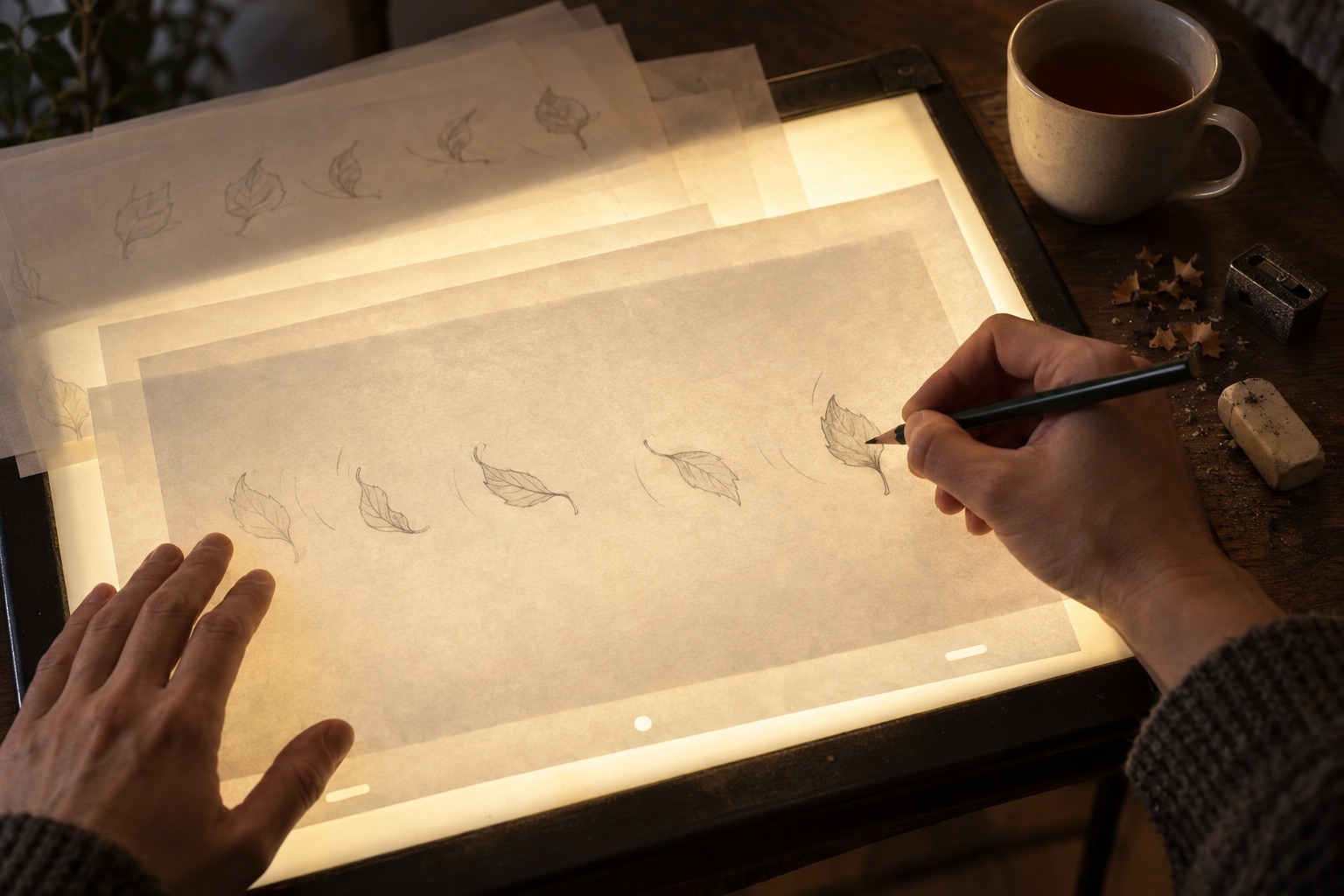
Episode seven offers a quieter account of unfinished work. When Aoi collects Ema’s key animation, Ema explains the pressure she feels between careful improvement and output: spending more time on the drawings reduces how much she produces, while rushing harms their quality. Episode-seven description.
The important addition is Ema’s own explanation. From outside, an observer might see only that work is taking time. Hearing her describe the difficulty reveals a conflict inside the act of making it.
We would resist treating this setup as a puzzle with a motivational answer. “Try harder” does not specify what Ema should change. “Work faster” repeats the pressure she has already identified. And “quality is all that matters” sidesteps the other demand in her account. None of those responses shows that the listener has understood the difficulty.
This is where the series can reward attention to the difference between sympathy and diagnosis. You can care about Ema’s position without claiming to know the correct working method for her. Aoi’s contact with the finished material does not make the artist’s account unnecessary; it makes hearing that account more valuable.
Keep the scale of the claim modest. Ema is a fictional character describing her circumstances. The scene does not establish an industry-wide wage, a normal daily drawing quota, or a rule about how much pressure artists should accept. Enjoying a story about dedication need not mean endorsing every condition under which its characters work.
For the guide’s central question, Ema adds something that the message dispute cannot: sometimes the communication becomes more accurate precisely when it stops reducing the problem to a delivery status. The extra information is the person’s difficulty, not another instruction.
Kimura’s account of playing Aoi offers a useful companion to these scenes. In a December 2014 interview, she describes Aoi as interested in people and in production work, not only in anime. She also recalls receiving direction on unfamiliar terminology and phrasing, with dialogue changing during recording. Juri Kimura’s interview.
That testimony gives a concrete reason to pay attention to how the job sounds. An unfamiliar technical term can sit awkwardly in a performance if it feels like a definition being recited for an audience. The acting challenge, as we interpret it, is to let professional language belong to a conversation between people with an immediate concern.
It also gives a first-time viewer permission to learn gradually. If the performer needed guidance on the vocabulary, you do not need to arrive knowing every term. Let the relationship and the immediate problem carry you, then look up a term if its meaning remains important. Pausing to decode every noun can obscure the conversation you came to understand.
None of this makes the anime a complete documentary or a workplace training course. A performer’s recollection of language guidance supports a claim about that recording process. It does not verify every fictional incident as something that happened exactly as shown in a real studio.
The real animation production is P.A.WORKS, with Tsutomu Mizushima directing and Michiko Yokote handling series composition. Keep that separate from Musashino Animation, the company in Aoi’s story. P.A.WORKS explains the title through a video tape in a plain white box received by creators when a project is complete. This is the title’s historical production image, not a claim that every contemporary studio still distributes work on tape. P.A.WORKS’ introduction and credits.
The plainness of that object makes a fitting contrast with the difficulties explored here. A finished work can look like one coherent thing. The conversations required to get there were anything but a single voice. Our interpretation is that the title directs attention towards the shared result without requiring us to forget the disagreements behind it.
Start with the television story if this is your first encounter with Aoi. A separate SHIROBAKO film is listed as a 2020 production; it is not simply another label for the original television series. This guide is about the television opening, not the film’s later situation. Bandai Channel’s film listing.
The series is a promising choice if you are curious about how people remain involved in a creative work after an idea has been proposed. Its early situations give you changed requests, overlapping responsibilities, pride and uncertain information to follow. You do not have to be considering an animation career for those tensions to make sense.
It is a less direct choice if what you want tonight is a step-by-step drawing lesson or an escape from workplace pressure. This guide’s examples should make that clear before you commit: even an argument about a beautiful image can become an argument about somebody else’s unfinished task. Interest in animation alone does not mean that will be the mood you want on every evening.
For readers in India, the Japanese distributor links above are evidence for the work and its episode premises, not a promise of local streaming access. Before subscribing or paying, check the television title, regional availability and subtitle options in the licensed service available to you. We have not verified an Indian streaming offer here.
You can begin with one manageable habit: when a problem emerges, ask what information has changed since the previous person spoke. Avoid trying to solve the whole studio. Let the answer identify the conversation worth following.
Sometimes a new intention has appeared. Sometimes material has not reached its next destination. Sometimes an opinion has travelled inside what sounded like a practical request. SHIROBAKO becomes more interesting when those differences remain visible. Aoi’s place among them helps make the work understandable without making it hers alone.

AUTHOR OF THIS ARTICLE
SoJapan
SoJapan India Pvt. Ltd. is a Japanese-founded company based in Gurugram. We bring Japanese food, anime goods and apparel materials to Indian businesses, with a sister company in Kyoto that works directly with makers in Japan.