The browned underside gets the photograph. Turn a pan-fried gyoza over, though, and there is more to understand: a folded upper wrapper, a closed edge and a filling you cannot inspect from the outside. Making the base crisp is only one part of preparing the dumpling.
That distinction is useful whether you want to wrap a batch yourself or cook something from the freezer. A homemade dumpling and a formulated frozen product can arrive at a similar-looking plate through different instructions. Even the wrapper is a choice, not just packaging for whatever you put inside.
This guide follows those decisions from wrapper to serving. It draws on Japanese manufacturers’ recipes, a product developer’s explanation and official food-handling guidance. The practical priorities are our editorial interpretation, not the results of our own cooking tests. The named products illustrate particular approaches; they are not claims about stock or prices in India.
If you remember only three distinctions, make them these:
Before comparing wrappers, decide where you want to enter the process. Are you interested in making the filling and learning to close the wrapper, or do you mainly want a cooked plate for dinner? Both are reasonable projects. They require different kinds of attention.
With homemade gyoza, you take responsibility for the combination: the filling recipe, wrapper, amount enclosed and cooking method. A recipe’s shaping instructions therefore belong alongside its ingredient list. They are not an optional artistic stage that can be ignored once you have bought the right vegetables.
With a prepared product, some of those decisions have already been made. Your task is to identify the exact packet and follow its preparation directions. The front photograph is less useful for this than the cooking panel. Similar-looking dumplings can be designed for different appliances or different pan routines.
A third route sits between the two: you make dumplings and freeze some before cooking. That saves the wrapping work for another occasion, but it does not turn your batch into a specially formulated convenience product. You still need instructions appropriate to the recipe and its frozen state.
For a first homemade attempt, our recommendation is to choose a complete recipe with wrapping guidance you can actually follow. Look at its pictures before buying the wrappers. If the method assumes a size or style that your packet does not match, resolve that mismatch before making the filling.
For a first prepared-pack attempt, choose by the cooking facilities you can use, not by an assumed level of authenticity. A product requiring a frying pan is not the right answer to a microwave-only situation merely because its photograph looks appealing. In its FAQ for the Japanese-market Gyoza product, Ajinomoto specifically does not recommend microwave preparation for that item. That is a product-specific instruction, not a statement about every dumpling in its range.
Read the whole method before starting. It should tell you what enters the pan, whether a lid is needed and how the preparation finishes. If those details are missing, find a fuller source rather than assembling a method from unrelated short clips.
It is tempting to treat thin wrappers as an upgrade and thicker ones as a beginner’s compromise. The manufacturers’ own descriptions suggest a more useful choice: how much attention do you want the wrapper itself to receive?
Moranbong’s thin wrapper is described as a response to customers who want the filling’s flavour to take the leading role. Its thick large wrapper, by contrast, is presented as a way to enjoy both the filling and the wrapper’s texture. The maker says the latter is about twice as thick as its regular-size wrapper. That comparison belongs to these named products; it is not a standard measurement for every wrapper sold as “thick”.
These are design descriptions, not our tasting verdicts. Their value is that they give you a question more specific than “Which packet is best?” A person who wants the wrapper to be noticeable may choose differently from someone chiefly interested in the filling.
Keep size and thickness separate. A larger wrapper gives a different shaping starting point; the word “large” alone does not tell you its thickness. Likewise, a thickness comparison does not tell you how much filling to use or how long to cook it. Those instructions must come from the matching recipe.
Moranbong’s mochi-flour-added large wrapper offers another distinction. Its description emphasises a chewy texture, but its ingredient list begins with wheat flour, followed by mochi flour. “Contains mochi flour” is not the same as “made only from rice” or “wheat-free”.
The table is a way to interpret descriptions, not a promise that every brand uses these terms identically.
| What the description emphasises | Your useful question | What it does not settle |
|---|---|---|
| Thinness | Do I want the filling to receive more attention? | Filling quantity or cooking time |
| Thickness | Do I want a more noticeable wrapper? | Whether the wrapper is also larger |
| Large size | Does the recipe match this wrapping size? | Thickness or permission to overfill |
| An added flour or ingredient | What does the full ingredient list contain? | Whether another flour has been excluded |
There is also a difference between a flat sheet and a folded bite. In a September 2026 interview published by Ajinomoto, its product developer explains that wrapper thickness was adjusted in 0.05 mm increments and that differences become especially apparent where the folds overlap. The number describes an adjustment interval, not the finished wrapper’s thickness.
Our takeaway is to think about the assembled dumpling, not just the sheet held up to the light. A wrapper’s role continues through the folds. You do not need to measure it yourself to recognise that “thin sheet” and “little wrapper in every mouthful” are not identical ideas.
For a deliberate home comparison, keep the question modest. On separate occasions, follow suitable recipes for the wrappers you have chosen and notice whether you prefer the wrapper to be prominent. That is a suggested way to explore preference, not a controlled experiment or a claim that one change explains every difference between two meals.
Pleats attract attention because they are visible evidence of the wrapping work. But before counting folds, ask two simpler questions: is the filling enclosed, and does the dumpling have the base the cooking method expects?
Moranbong’s illustrated homemade guide places filling in the centre, moistens the edge and pinches the wrapper closed through folds. It also explains why the bottom is flattened: the dumpling sits more stably in the pan and has more area available for browning. The same page offers more than one wrapping approach.
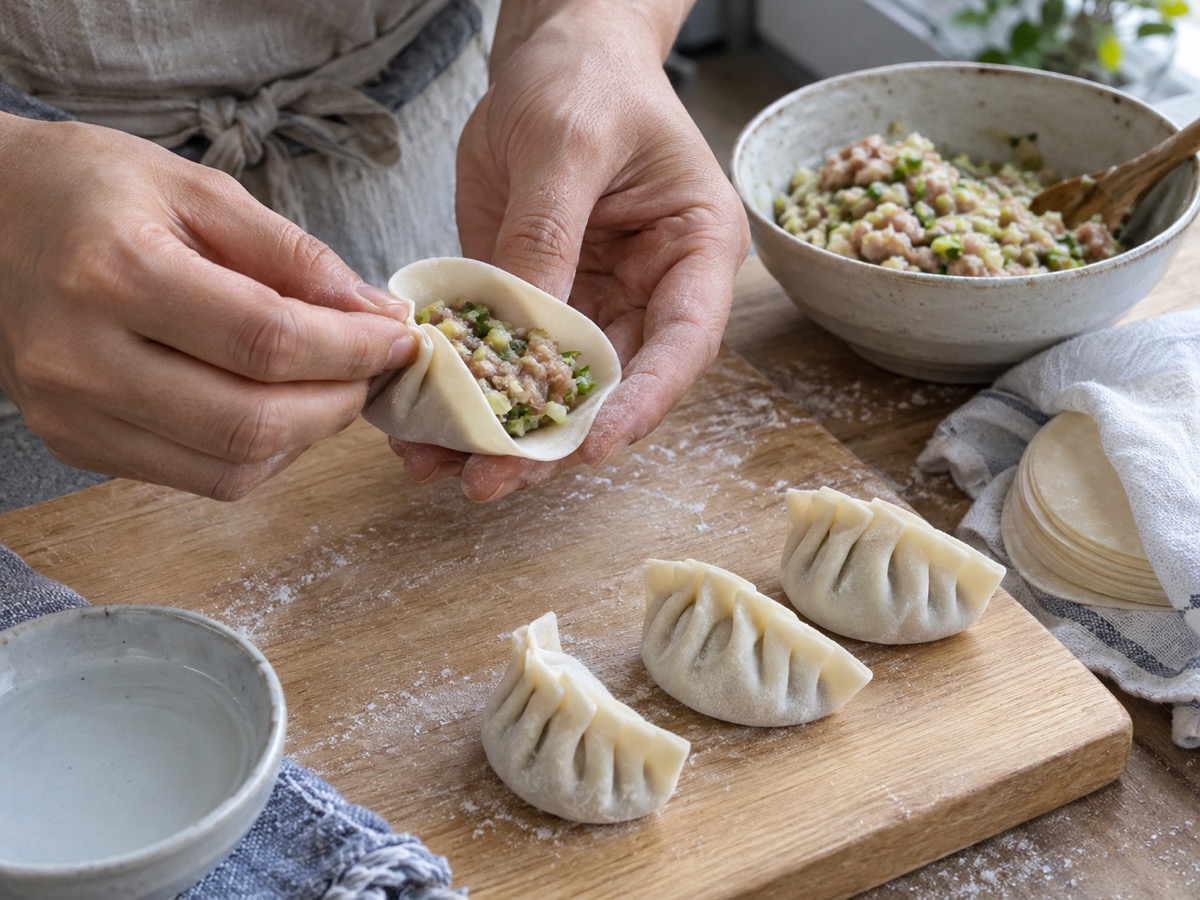
Those details separate appearance from function. A decorative ridge is not the whole purpose of closing a dumpling. Equally, shaping the bottom is not simply a way to make every piece stand neatly for a photograph. It prepares the part that will meet the pan.
For a beginner, that changes the order of priorities. Follow the recipe’s filling portion, close the edge using its demonstrated method, then check the base. Only after those tasks make sense is it useful to worry about whether every fold looks identical.
Consider a hypothetical batch in which you decide to use fewer wrappers while keeping all the filling. The ingredient totals have barely changed, but each dumpling now contains more. This is not merely an economical way of making the same recipe: you have altered the unit that must be enclosed and cooked. The original portion count and shaping example no longer describe what is on your tray.
It helps to arrange the work around that check. Before committing the whole batch, compare the first piece with the source’s illustrated shape. Are you following its closure, or stretching the wrapper into a different form to accommodate your filling? If you cannot see how the method is meant to work, return to the illustration while the problem is still about shaping rather than a pan already on the heat.
Keep raw filling and finished-food handling separate. Preparing a row of attractive dumplings is not a reason to place cooked food back on the tray that held uncooked meat. The food-safety check belongs in the workflow from the beginning, not as a warning remembered after serving.
Pan-fried gyoza need not be uniformly crisp from top to bottom. The contrasting parts are part of what you are choosing: a browned base beneath a wrapper that encloses the filling. Treating the whole dumpling as something to brown on every side misses that arrangement.
In the Moranbong homemade pan method, the dumplings begin with oil and a lid. Water or hot water is added after the wrapper changes colour, followed by covered steaming. Once the water is gone, the lid comes off and a little finishing oil accompanies the browning stage. This is a summary of that recipe’s sequence, not complete instructions for every size of dumpling.
The important distinction is between what the surface shows and what you still need to establish inside. A pleasing browned patch tells you something about that patch. It does not measure the temperature of the filling.
Japan’s MAFF household cooking guidance gives a meat-centre guideline of 75°C for at least one minute, alongside handwashing and separation of raw-meat utensils from cooked food. This is an internal temperature and holding time, not a frying-pan setting or permission to steam any dumpling for just one minute. Follow the complete recipe or product directions and use an appropriate food thermometer to check the centre when preparing raw-meat filling.
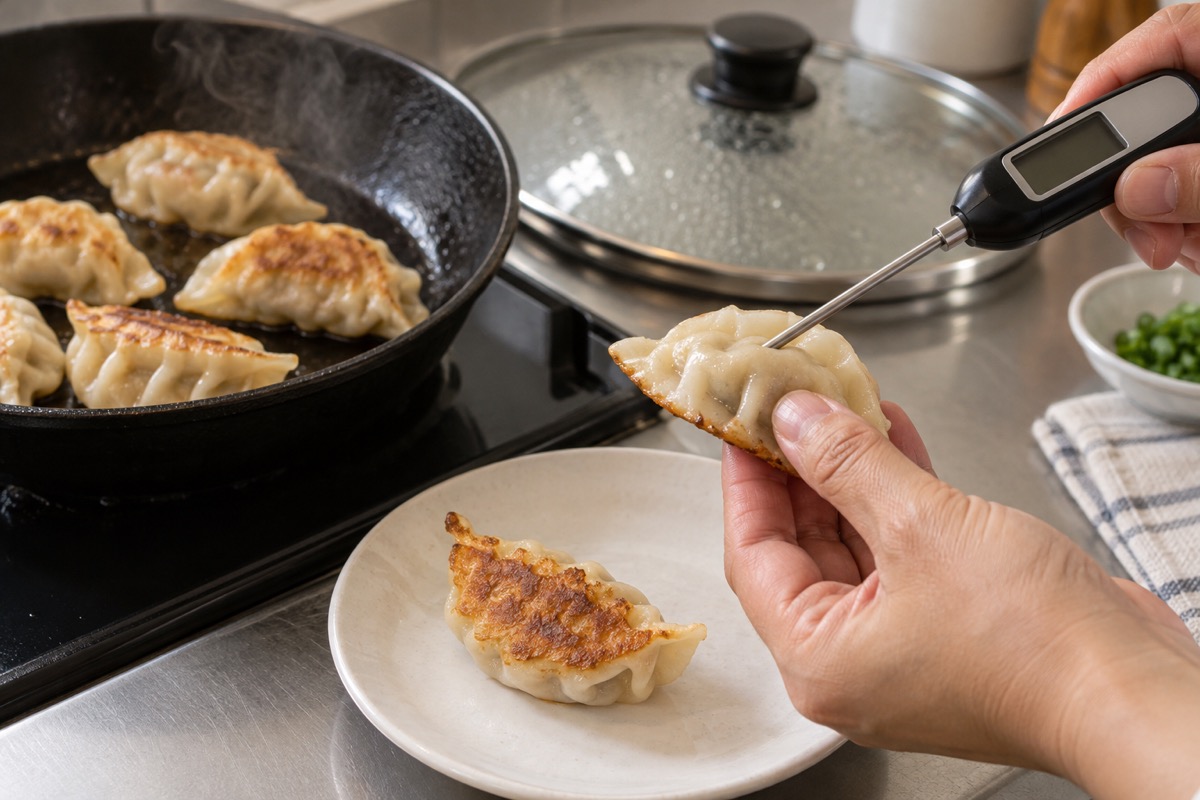
If your dumplings differ substantially in size or filling from a demonstration, its timer is not enough. Nor is making the base darker a substitute for checking the centre.
The same distinction matters when the finished gyoza have a lacy layer connecting them. That layer is often called a wing. It is not the folded wrapper itself, and its attractive colour is not a separate test of the filling. A plate can look impressive while still requiring the ordinary checks associated with its ingredients and preparation.
This is why our suggested first goal is not “make the biggest possible wing”. It is to prepare a properly closed dumpling using a suitable method, with the filling cooked and the intended contrast between base and upper wrapper. The dramatic presentation can wait until the underlying process is familiar.
Freezing a homemade batch can move the wrapping work away from the eventual meal. The useful planning question is what you are saving: prepared individual dumplings, not a new recipe with all the same properties as a factory-made pack.
Moranbong’s home-freezing guide describes spacing wrapped dumplings on a lightly starch-dusted tray, covering and freezing them, then transferring them to a freezer bag once firmly frozen. Its cooking example starts with frozen pieces in an unheated oiled pan, with space between them. The guide warns that touching pieces can tear as moisture affects the wrappers.
Its quantities are explicitly tied to 12 regular-size dumplings in a 26 cm pan, including 70–100 ml of water. It supplies a different water quantity for its large-size example and says to adjust for piece count and pan size. Those numbers explain the scope of the method; they are not an invitation to apply 70–100 ml to whatever happens to fill your pan.
Do not infer a safe freezer life from this article. The linked maker guidance says to consume the homemade batch promptly because it contains raw meat and vegetables; it does not establish a universal number of weeks. Use appropriate food-storage guidance for your ingredients and conditions, and keep the recipe and preparation date with the batch.
On the label, identify whether the dumplings were frozen before cooking. If someone else will prepare them, pass on the actual method too: “cook like the shop ones” leaves the cook guessing about a different product.
Commercial preparation can change the work expected at home. As checked in October 2026, Ajinomoto’s Japanese-market Gyoza product page describes a default method requiring no added oil, water or lid. Pieces are arranged before the heat is turned on, then cooked on medium for about five minutes before the finishing stage. For five pieces or fewer, it specifies low heat. It also advises a little oil for a pan prone to sticking and offers a covered method for a softer, juicier finish.
These qualifications matter as much as the headline. “No lid required” does not mean that using a lid is forbidden. “No added oil required” does not mean the food contains no oil. And the method cannot be transferred to a homemade raw-meat dumpling merely because both are frozen.
The developer interview helps explain why the product should be treated as a designed combination. Alongside the wrapper work, the developer describes testing different starches, oils and proportions for the wing mixture. The convenient preparation is attached to that development; it is not simply a clever omission of steps from an unrelated recipe.
For the home cook, there is no need to choose between admiration for handmade wrapping and appreciation of a prepared product. They offer different control. Making the filling yourself lets you choose that recipe and learn the closure. Cooking a formulated pack lets you concentrate on the method supplied for something already assembled.
Check the packet you actually possess, including its market version. The current Japanese product page is a reference example, not permission to overrule different instructions on another packet. An older video may also describe a previous version, so date and product identity are worth checking before treating conflicting directions as a mystery.
Dietary checks remain specific too. The named Ajinomoto product lists chicken, pork and oyster sauce, as well as other ingredients. A vegetable-rich appearance is not evidence that it is vegetarian. If you avoid particular ingredients, resolve that question before choosing the cooking route; browning technique cannot change what is inside.
A dipping sauce can be enjoyable without being an entrance requirement. Ajinomoto’s product FAQ says its Gyoza is seasoned to be eaten without an accompanying sauce, while leaving dipping to preference. That tells you how the maker intends this particular product to work, not how every restaurant or homemade version must be served.
For a new recipe, a useful first question is whether you want to understand the filling and wrapper together before adding another strong flavour. You can keep a suitable dip alongside and choose how much of a piece to dip. This is a serving suggestion, not a rule about the authentic way to eat.
If your next question is about a citrus-soy dip, our ponzu bottle guide distinguishes plain citrus-and-vinegar ponzu from soy-seasoned versions. The word on the bottle should not be treated as a complete ingredient list any more than “gyoza” on a packet should be treated as a complete cooking method.
For your first batch, success need not mean identical pleats or a single unbroken wing. Choose a wrapper and filling that belong to the same recipe, close the dumplings as demonstrated, and follow the method appropriate to their starting state. Keep the centre’s cooking check separate from the base’s appearance.
Then enjoy the whole dumpling: not only the side turned towards the camera, but the wrapper, folds and filling that the photograph leaves harder to see.

AUTHOR OF THIS ARTICLE
SoJapan
SoJapan India Pvt. Ltd. is a Japanese-founded company based in Gurugram. We bring Japanese food, anime goods and apparel materials to Indian businesses, with a sister company in Kyoto that works directly with makers in Japan.