One set of taiyaki instructions says to wrap the cake before microwaving. Another says to leave it unwrapped. A third version should not go into the microwave at all.
These are not three competing answers to one universal cooking question. They belong to different products. Once you know that, a fish-shaped cake becomes much easier to understand: its appearance identifies a format, but not everything about how it was made or how it should reach your plate.
For an anime fan in India, the familiar silhouette may be the starting attraction. The more useful next question is whether you are buying something ready to eat, a frozen cake designed for heating, or a dessert intended to be served cold. A photograph may not settle that question.
This guide uses published explanations from Japanese makers to connect cooking methods, intended textures and serving instructions. It is not a taste test, a universal reheating recipe or a claim that these particular products are available in India. Our Japanese sweets guide introduces taiyaki and its fillings; here, we investigate why two recognisable fish can require different treatment.
The short answer: identify the exact product and its intended serving state before choosing a heating method. A shop’s manufacturing label, a description such as “crisp” or “fluffy,” and a freezer label answer different questions. None replaces the instructions for the item in your hand.
A food description often compresses several kinds of information into one line. “Frozen,” “thin-skinned” and “single-mould baked” may all sound like competing styles, but they describe different aspects of a cake. Sorting them out prevents some surprisingly practical mistakes.
| Information you encounter | The question it helps answer | What it does not settle |
|---|---|---|
| A cooking-method description | How does this maker cook or form the cake? | Whether you will prefer its texture |
| A shell description | What kind of exterior or bite is the maker aiming for? | How an unfamiliar product should be heated |
| A serving or storage instruction | What should happen to this particular item before eating? | How every other fish-shaped cake should be treated |
The table is a way to read descriptions, not a new classification system for Japanese confectionery. The important distinction is between information that describes the food and information that tells you what to do with it.
For example, a seller could describe a cake as thin-skinned without telling you whether it arrives hot or frozen. You have learned something about the intended proportions, but you still cannot decide whether it is suitable for eating immediately after delivery. Ask the missing question rather than treating the description as complete.
Likewise, “crisp” is a texture claim, not a microwave setting. A maker may intend you to finish a prepared product in a toaster to obtain that surface. Another may sell a cake ready to eat. The word can be useful in both cases while the action required from you differs.
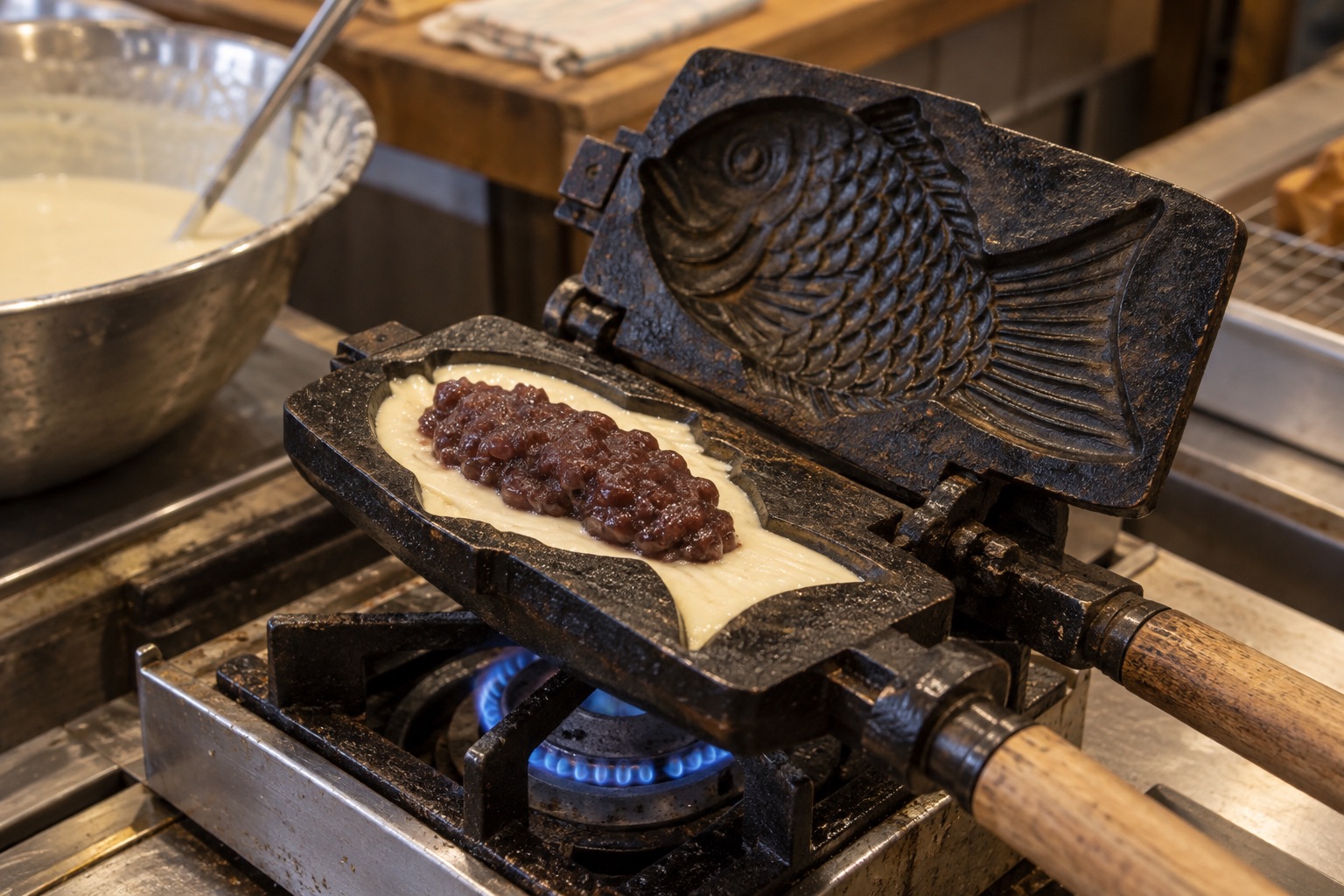
Narutotaiyaki Honpo explains its tennen taiyaki through a method called icchoyaki: cooking individual fish in separate moulds. Its official explanation describes putting batter and filling into the mould and moving it over direct flame. The maker associates this method with a crisp, aromatic surface.
That is useful information about the production method. It is not a reason to translate “natural” into an assumption about organic ingredients, fewer allergens or superior nutrition. The explanation offered on that page concerns how the taiyaki is cooked. It does not establish those other properties.
Nor does the label tell you which texture you personally prefer. If what attracts you is watching a separate mould being handled, the production description gives you a relevant feature to look for. If your main interest is a soft cake, the description of the finished texture matters more than the prestige you might attach to the tool.
This is where a first-time buyer benefits from keeping process and preference apart. A labour-intensive method can be interesting to learn about without obliging you to enjoy its result more than another version. You are choosing a snack, not judging a craft competition.
Kurikoan describes its taiyaki as crisp outside and fluffy inside, with a soft texture that remains moist when cooled. Its main product introduction mentions wheat flour and eggs as part of its approach. These are the maker’s descriptions, not sensations we are claiming to have tested.
The useful word here is “inside.” A description of the surface does not have to describe the entire bite. Before deciding that two descriptions contradict each other, check which part of the cake each refers to.
At a counter, a more informative question than “Is it crispy?” might be “Is the cake thin throughout, or is there a softer layer inside the browned surface?” The seller may be able to explain that more clearly than a photograph can. If there is a cut-open display image, look at the layer between the exterior and the filling rather than only the colour of the outside.
Do not use brownness as a complete texture scale. A product image cannot tell you how the shell feels in the mouth, and a dark colour is not a guarantee of crispness. The image and description together can help set expectations, but neither amounts to tasting the item.
There is a construction difference worth keeping in mind if you know dorayaki. Its two separately cooked cakes are assembled around a filling, whereas taiyaki uses a moulded filled-cake format. Our dorayaki guide explores that sandwich construction in detail. The comparison helps identify what you are looking at; it does not make dorayaki a substitute recipe for taiyaki batter.
It is easy to imagine a frozen product as simply a shop cake put into a freezer. A maker may have done additional development for that route.
Kurikoan’s online-shop FAQ says its delivery batter was adjusted to remain fluffy after freezing and that the cakes are rapidly frozen. That is a specific manufacturer’s explanation of a specific product. It gives a concrete reason not to assume that a counter version and a mail-order version are identical at every stage.
Imuraya offers another example. In its 2024 introduction to Kinsei Taiyaki, it describes a rice-and-wheat-flour blend and a specially designed mould and filling equipment intended to put bean filling into the tail. The design addresses both the cake and where the centre ends up, rather than treating the fish outline as decoration alone.
Those accounts do not prove that frozen is better or worse than freshly sold. They show that it can be a deliberate product format, with its own development and preparation route.
Think about what remains for the person eating it to do. At a counter, the seller may complete the cooking before handing it over. With a frozen product, you may be responsible for a specified heating or finishing stage. Your equipment and willingness to follow that stage become part of the purchase decision.
This is particularly helpful when ordering from a photograph. Ask whether the image shows the product as delivered or after the recommended preparation. A finished serving image can be perfectly reasonable while still leaving work for you. Knowing that in advance prevents disappointment without accusing the photograph of being misleading.
The tail-filling example also changes what a close-up can tell you. A cut through the middle shows the centre at that point; it does not demonstrate how filling is distributed throughout the fish. If that distribution interests you, a maker’s explicit explanation provides information a single cross-section cannot.
One ingredient detail deserves a brief check. Imuraya’s current tsubuan product page lists both rice flour and wheat flour, along with egg and other ingredients. “Made with rice flour” therefore must not be read as “made without wheat.” For an allergy or dietary requirement, use the actual current product information and ask about relevant handling; a prominent ingredient in marketing is not the complete list.
The opening discrepancy comes from published directions. In its eating guide, Kurikoan tells customers to wrap its regular frozen taiyaki before microwaving and describes a subsequent toaster step. Imuraya’s Kinsei Taiyaki preparation instructions begin with the frozen cake on a plate without wrap, followed by an optional toaster finish.
The practical conclusion is limited but important: there is no single wrapping instruction that can be borrowed from the word taiyaki. Each method belongs to its named product. These pages explain what their makers recommend; they do not establish the precise reason for every difference between the formulas.
Resist building a hybrid method from whichever individual steps sound appealing. Keeping the wrapping from one source and the time from another produces a procedure neither source has supplied. It may feel more informed because you have read two pages, but it is less clearly grounded than following the correct one.
Instead, read an instruction as a set of linked conditions:
This is a reading checklist, not a replacement cooking method. When one of those details is missing, find the current packet directions or ask the seller or manufacturer before improvising a setting.
The toaster stage is worth reading separately from the first heating step. Imuraya presents it as a way to add a crisper surface after microwaving. It also warns that excessive heating can harden or burn the product and may cause ignition. “More crisp” is not an invitation to keep increasing the time indefinitely.
Nor should wrapping directions be treated as permission to heat an arbitrary sales packet. “Wrap the cake” and “heat the unopened package” are different instructions. Check exactly what the manufacturer says about the food, its packaging and the appliance you will use.
We have deliberately not supplied one headline number of seconds. The named guides account for appliance power and quantity, and your product may have different directions. A neat universal time would conceal the distinctions this article is meant to make clear.
If you own a microwave but no toaster oven, look for whether the second stage is optional on the actual product. That lets you decide whether its supported preparation route fits your kitchen. Do not automatically translate a toaster instruction into an air-fryer setting: the examples here do not provide that conversion.
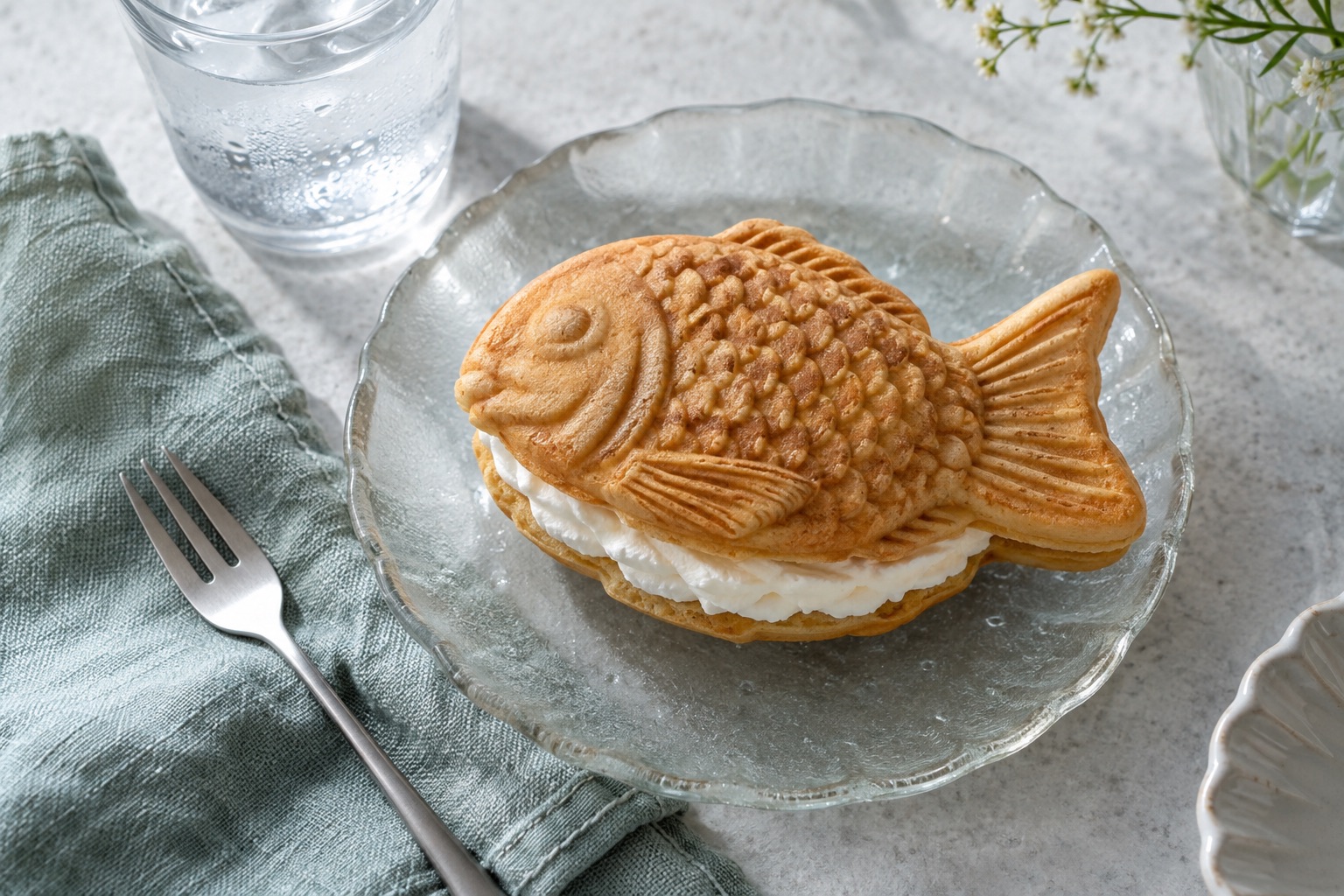
Kurikoan’s same eating guide treats its chilled cream version differently from its regular frozen taiyaki. It expressly says not to use a microwave or toaster because the whipped cream would melt. The cold route is intentional, not an unfinished attempt to make a hot snack.
That is a stronger distinction than choosing one filling over another. Serving temperature belongs to the identity of this product. If you warm it merely because another taiyaki was served hot, you are acting on the shape rather than its instructions.
When a listing mentions a cold dessert, clarify what condition it arrives in and what preparation the seller expects. “Cold” can describe the intended serving experience without fully explaining the delivery state. You still need the actual storage and preparation information.
Do not transfer a Japanese shop’s thawing schedule to a different product or an uncontrolled delivery situation in India. This guide is not setting a general room-temperature holding time for cream desserts. Use the directions supplied for your item and resolve unclear handling information with the seller.
The same principle helps with purchases made for an outing. If you want something to eat immediately, confirm that it is ready to eat. If you want a dessert for later at home, confirm the required storage and equipment before ordering. A cake you cannot prepare or store as directed is a poor fit for the plan, however attractive its photograph.
For an imported item, a Japanese manufacturer’s page is useful for identifying the original product and reading its intended method. It cannot establish what a particular Indian seller has in stock or how that seller will deliver it. Ask for the exact product name and current package instructions rather than accepting a generic fish-shaped-cake description.
There are three sensible starting routes, depending on what you want the snack to do.
For a counter purchase, ask about the intended shell texture and whether the piece is ready to eat as supplied. A cooking-method label can add interest, but the immediate decision is whether you want that style of cake now.
For a frozen purchase, check the full preparation sequence before paying. You are choosing both a food and a small kitchen task. A method that fits the equipment you already use is more valuable than a promise of crispness you cannot reproduce by the supplied route.
For an intentionally cold version, treat the serving instructions as part of the dessert rather than trying to turn it into a hot taiyaki. Choose it because that is the experience you want, not because it happens to share a shape with something else.
Only then move to the filling choice. This order avoids buying an appealing flavour in a format that does not suit your journey, kitchen or plans. It also gives you a more useful way to compare two purchases: did the difference come from the cake itself, the intended serving state or the preparation you were asked to complete?
The fish outline makes taiyaki easy to recognise. The maker’s method and your serving plan tell you what to do with the one you actually have.

AUTHOR OF THIS ARTICLE
SoJapan
SoJapan India Pvt. Ltd. is a Japanese-founded company based in Gurugram. We bring Japanese food, anime goods and apparel materials to Indian businesses, with a sister company in Kyoto that works directly with makers in Japan.