← JOURNAL8 Oct 2026
Tempura Explained: The Coating, the Ingredient and the Way You Eat It
 By SoJapan
A piece of tempura asks you to notice two things at once: the coating and what it surrounds. A crisp edge can be appealing, but a plate of vegetables or prawns is not meant to become an anonymous collection of batter. The ingredient still matters.
That is the most useful starting point if you are encountering tempura on a Japanese menu in India. Look beyond the word “fried.” Ask what is inside, whether the pieces arrive separately or mixed together, and whether they will be served beside a dipping sauce, over rice or in noodle soup. Those choices tell you more about the meal than a promise that every bite will be equally crunchy.
There is another distinction worth making before you cook it. Advice to keep a scratch batter cold and barely mixed does not automatically apply to every packet labelled tempura flour. Some formulated mixes explicitly call for a smooth batter. Following those instructions is not a mistake; combining instructions from different preparations can be.
This guide connects those two decisions: what you want to eat, and which preparation actually produces it. It uses published Japanese cooking guidance and named recipe examples, not restaurant visits or taste tests. It does not assume that a particular imported mix is available in your Indian shop.
Tempura is a Japanese preparation in which ingredients such as vegetables and seafood are coated in batter and fried. In Kikkoman’s washoku lesson, culinary researcher Yuko Ihara explains the importance of a thin coating that allows the ingredient’s flavour to remain central.
“Light” is a useful texture description here. It is not a nutritional claim. An airy-looking crust is not evidence that a dish is low in oil, low in calories or suitable for a particular diet.
For a first order, we would give serving style as much attention as the list of ingredients. If your aim is to compare the coating with what is inside it, separate pieces with seasoning alongside are an understandable starting point. If your aim is a rice meal, there is no reason to treat that format as a lesser version.
Tendon puts tempura on rice. In Junko Ueda’s Kikkoman recipe, the cooked pieces go over warm rice and receive sauce. That is a different arrangement from dipping the edge of an individual piece immediately before eating it.
Tempura can also top noodles in broth. A Kikkoman USA tempura-udon recipe serves fried shrimp over udon and hot soup. The recipe establishes the format; it does not mean that every restaurant uses the same soup or preparation.
The following is a choosing guide, not a ranking of authenticity:
| Serving format | What you can compare | A useful question before ordering |
|---|---|---|
| Separate pieces, seasoning alongside | Individual ingredients and the effect of each dip | Which pieces are included, and what comes in the sauce? |
| Kakiage, a mixed fritter | The relationship between several ingredients and their shared coating | What is mixed into it—not just what is visible outside? |
| Tendon | Tempura, sauce and rice together | Is sauce poured over the pieces, and can the serving be adjusted if needed? |
| Tempura over noodle soup | The topping as part of a broth-based meal | Is the tempura placed in the soup or served separately? |
Ask how the dish arrives rather than assuming from a photograph that the kitchen serves, or can customise, it a particular way.
If noodles are your main interest, our udon guide explains the differences between hot, cold and stir-fried servings. Here, the point is simpler: decide whether the tempura is the item you want to examine or one component of a complete bowl.
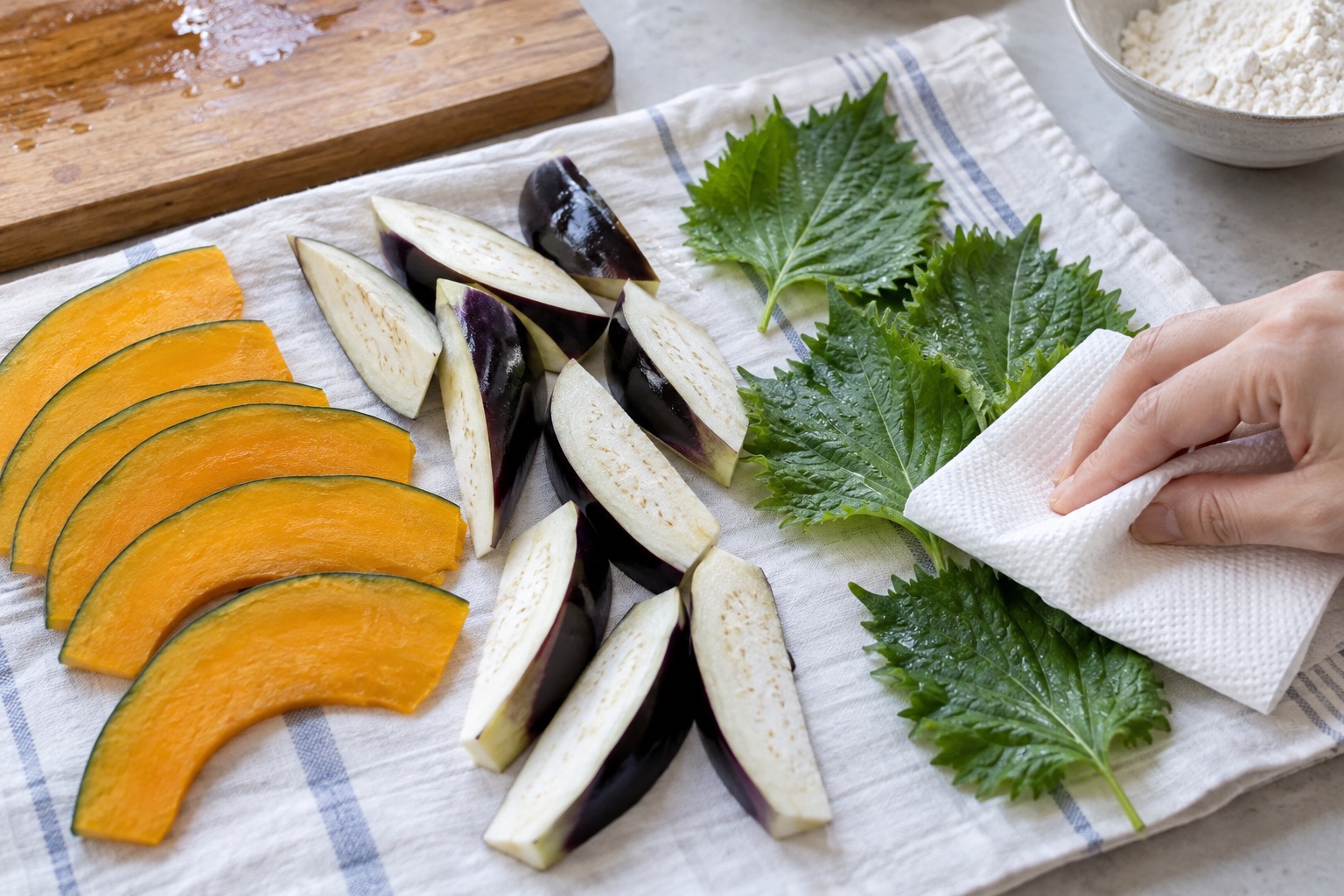
A thicker coating is not the first answer to every cooking problem. Before mixing anything, look at the actual pieces you plan to coat.
Nisshin’s tempura preparation guide treats cutting and surface moisture as separate tasks. It notes that thick slices of pumpkin or sweet potato need longer cooking, recommends wiping surface water from washed ingredients, and describes flour dusting as helpful for coating adhesion. Its advice also distinguishes ingredients: dusting is not presented as compulsory for every potato-like vegetable.
The practical lesson is to stop thinking of a mixed plate as a single ingredient. A leaf, a slice and a whole prawn have different forms before any batter reaches them. If you use a recipe, follow its preparation directions as well as its shopping list. Buying the named vegetable is only the beginning.
Consider a hypothetical home-cooking plan with two vegetables. You slice one exactly as the recipe shows but leave the other in much larger pieces because they look more substantial. You have changed the preparation, even if the batter is identical. Extending or shortening a single frying time for the entire batch does not resolve that difference automatically.
Read the recipe’s photographs and cutting instructions before heating the oil, especially if the ingredient is unfamiliar.
Surface drying is also easy to misunderstand. It concerns water left on the outside after washing or preparation; it is not an instruction to squeeze every ingredient until it becomes dry inside. Keep the ingredient preparation, the dusting step and the wet batter distinct in your mind. They are three operations, not three interchangeable ways to add flour.
A first attempt need not be an elaborate assortment. Our editorial recommendation is to choose a manageable set of ingredients covered by one clear recipe. That gives you fewer changing factors to interpret. A larger selection can come later; it does not make the first plate more instructive by itself.
The apparent argument usually begins because two different materials are both called flour in casual conversation. Plain flour used to build a batter is not necessarily equivalent to a formulated tempura mix.
In Ihara’s Kikkoman lesson, the scratch preparation combines flour with other ingredients, including egg and cold water. The guidance is to mix gently rather than develop a sticky batter. That advice belongs to the preparation being demonstrated. Limiting gluten development is also not the same as removing gluten: a wheat-based batter remains a wheat-based food.
Now compare Nisshin Welna’s recipe for its Kotsu no Iranai Tempurako Agejōzu mix. It specifies 100 g of the named mix with 160 ml of water, then instructs the cook to mix until smooth and free of lumps. Deliberately leaving dry lumps because another tutorial said to do so would override the instructions for this product.
Showa’s official tempura tutorial provides another product-specific example. It says there is no need to chill the components and no need to add an egg to its mix, which already includes ingredients such as egg-yolk powder. It still gives its own mixing directions. “Packaged mix” is therefore not one universal method either.
The useful conclusion is not that a mix is better than scratch batter, or that one manufacturer has discovered the only correct texture. It is that the instruction and the material must travel together.
Before beginning, identify which of these you actually have:
The third situation needs attention. A recipe can be clear and still be wrong for the product in your hand. Check the packet rather than assuming that matching the words “tempura mix” makes every ratio transferable.
Measurements deserve the same care. Grams describe mass; millilitres describe volume. A flour quantity expressed in one cannot simply be read as the same number in the other. Nor should “one cup” be silently replaced with whichever drinking cup happens to be nearby. Use the measuring system specified by the preparation you chose.
These brands are examples, not a shopping requirement. This guide has not tested substitutions using the flour or mix available to you.
If you want to compare methods later, make the comparison deliberate. Follow one complete preparation first and record what you used. On another occasion, try a second complete preparation. Mixing the liquid quantity from one with the flour blend and handling advice from another gives you an undocumented third method, not a fair test of either source.
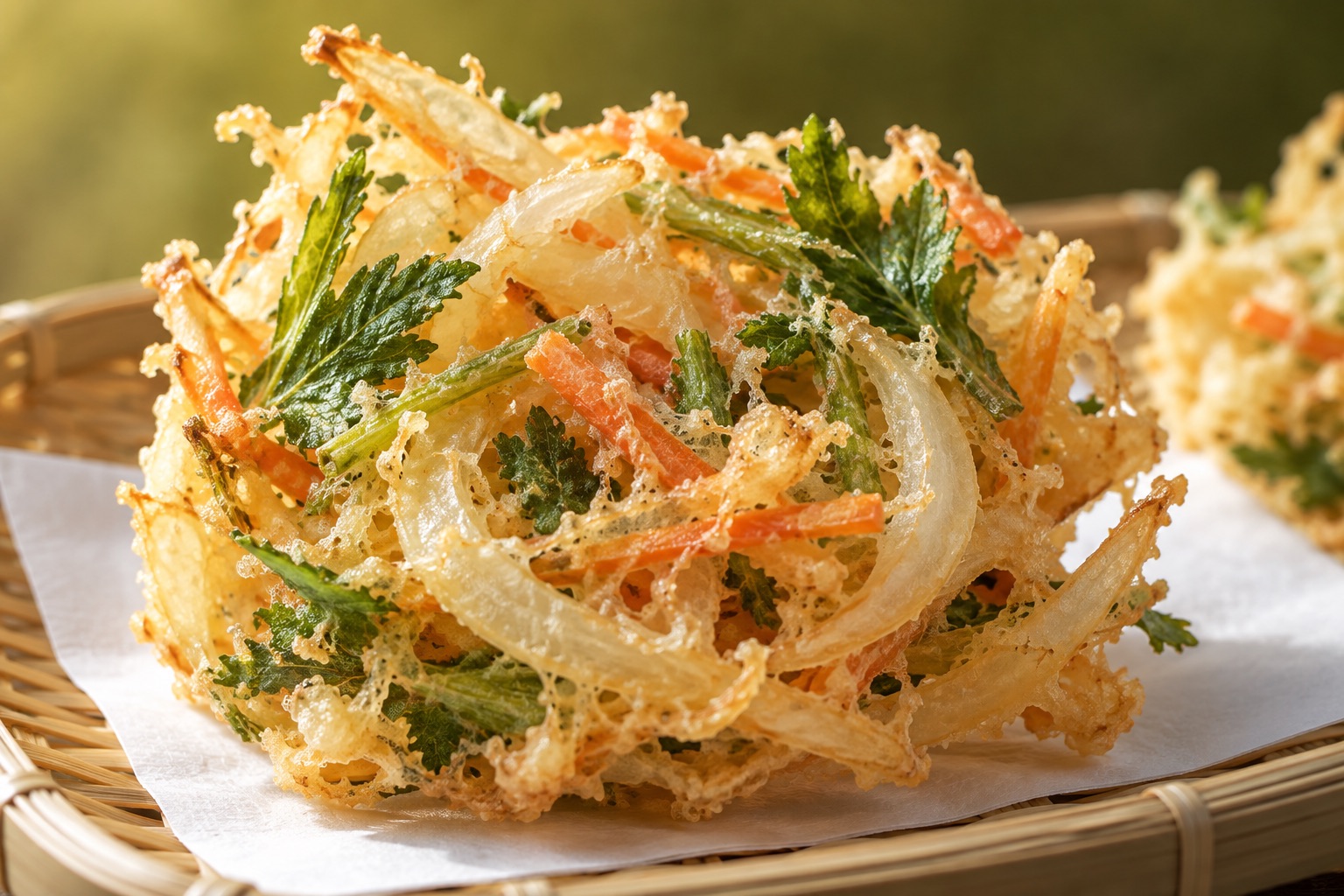
With separate pieces, you can point to the ingredient beneath each coating. Kakiage brings small ingredients together in a mixed fritter, so the batter also has to connect them.
Do not translate that into “a lot more batter.” In Nisshin’s interview with tempura chef Fumio Kondo, he discusses allowing some separation rather than letting the coating set into a heavy mass. He also distinguishes his handling of particularly loose ingredients, such as beans, from other mixtures. These are insights into his approach, not a universal home recipe.
That distinction helps when you look at a kakiage: a coherent piece does not have to resemble a tightly packed disc with every gap filled. The relationship between the ingredients and the coating is the point. For eating, our suggestion is to notice whether you can still distinguish what the mixture contains instead of judging it only by height or diameter.
For cooking, a recipe designed for the particular mixture is more useful than borrowing the temperature from an unrelated demonstration. Kondo’s interview describes changing temperatures during cooking; other manufacturer tutorials describe different arrangements. Do not collapse those into one supposedly perfect number without the ingredients and sequence that explain it.
Nisshin’s basic guide also advises preparing mixed vegetables with cooking consistency in mind and warns that excess water can loosen the coating. This is another reason the cutting stage matters. A bowl of arbitrarily sized leftovers is not automatically equivalent to a recipe’s prepared mixture.
Kakiage is not a dietary category. The mixed fritter in Showa’s tutorial includes shrimp alongside onion and mitsuba. Even when a restaurant’s version looks mostly green or orange, ask about the entire mixture. A small seafood ingredient can be harder to recognise after mixing than a whole prawn on an assorted plate.
There is no need to start with kakiage merely because it appears to save the trouble of coating individual pieces. If the attraction is the combination of ingredients, choose it for that reason. If the attraction is understanding one vegetable’s coating, separate pieces may answer your question more clearly.
A frying temperature may describe a particular batter, cut or just one stage in a chef’s sequence.
For a first attempt, work through the recipe before switching on the heat. Identify where it asks you to prepare ingredients, mix the batter, heat the oil, add a batch and remove it. Notice what must already be ready at each stage. The goal is not to turn dinner into an examination; it is to avoid discovering, beside a hot pan, that the next instruction requires something still unprepared.
Keep a place ready for the cooked pieces. Showa advises draining on a rack, with any absorbent paper beneath it, and arranging pieces without piling them up. Its explanation is that trapped steam can undermine the crisp surface. That is a useful reminder that the work does not end when a piece leaves the oil.
Batch size belongs to the method too. More pieces at once are not simply the same task completed faster. Kikkoman’s lesson cautions that adding too many ingredients lowers the oil temperature. Follow the recipe’s batch guidance and the limits of the equipment rather than scaling a demonstration by filling every available space.
Safety takes priority over an attractive crust. Nisshin OilliO’s oil-handling guidance warns against leaving heating oil unattended and specifies suitable cookware and the prescribed oil quantity for induction cooking. It also warns never to use water on an oil fire. Follow the instructions for your actual cooker and pan; a recipe’s suggested oil amount does not override them.
If you are not comfortable working with hot oil, ordering a prepared serving is a reasonable way to explore the dish. Understanding tempura does not require learning deep-frying first.
This guide intentionally does not give one frying time for every vegetable and every size of seafood. Nor should the outside’s colour be treated as a universal test of what has happened inside. Use a complete, appropriate cooking method, not the appearance of a photograph as a safety standard.
Tentsuyu is a dipping sauce, not simply another name for plain soy sauce. Kikkoman’s lesson describes it through dashi, soy sauce and mirin. That composition matters both to flavour and to ingredient checks.
For a first serving with sauce alongside, you could season a little at a time and compare the bites. This is our suggestion for paying attention, not a rule about correct Japanese manners. You do not have to eat an unseasoned piece to prove that you appreciate the cooking, and choosing sauce over salt does not invalidate your preference.
Think about the part of the dish you want to notice. If you are comparing individual vegetables, keeping the seasoning choice consistent may help. If you want the combined rice-and-sauce experience, a tendon is already arranged around that relationship. Neither decision requires declaring one format superior.
For vegetarian diners, the same sauce needs a different question: what was used to make the dashi? Do not ask only whether there is visible seafood on the plate. Likewise, a mix that needs water but no added egg is not necessarily egg-free, as the Showa example demonstrates.
Keep dietary preference and allergy requirements separate. If an ingredient must be avoided, ask about the batter, sauce and cooking arrangements as well as the main vegetable. Our Japanese vegetarian food guide gives the broader checking framework. A name, photograph or apparently delicate coating cannot provide those answers for a particular kitchen.
For your first order, a concise decision is enough: choose the ingredients you want, check the parts that affect suitability, and choose whether you want them separately or as part of a bowl. For your first cooking attempt, choose one complete method and the actual ingredients it specifies.
Tempura becomes less confusing once you stop asking one idea of crispness to explain everything. The ingredient, the coating and the serving each have a job. Notice how they work together, and even contradictory-looking instructions become easier to read.
AUTHOR OF THIS ARTICLE
SoJapan
SoJapan India Pvt. Ltd. is a Japanese-founded company based in Gurugram. We bring Japanese food, anime goods and apparel materials to Indian businesses, with a sister company in Kyoto that works directly with makers in Japan.