The filling gets most of the attention. It is the part visible between the two brown rounds, the part that makes a first-time customer ask whether the centre is chocolate or sweet beans. Yet a dorayaki also gives you two pieces of cake in every full bite. Treat those as packaging and you miss half the reason one version can interest you more than another.
The useful starting description is a small pancake sandwich. It is not a promise of one fixed pancake recipe. Published Japanese recipes differ in their raising agents, liquid ingredients and flavourings, while makers can pair the cakes with bean paste, butter and beans, or a cream filling. The name identifies a recognisable construction more reliably than a precise formula.
For an Indian fan whose first encounter was an animated snack, that distinction is helpful. You do not need to decide whether you like every Japanese bean sweet. You can ask a narrower question: what combination of cake and centre would you like to try?
This guide follows dorayaki from the two cooked faces to the assembled sweet. The recipes and products mentioned are documented examples, not items we have taste-tested or confirmed for sale in India. Our broader Japanese sweets guide covers the differences between dorayaki, mochi, dango and other sweets; here, the attention stays on the cakes themselves.
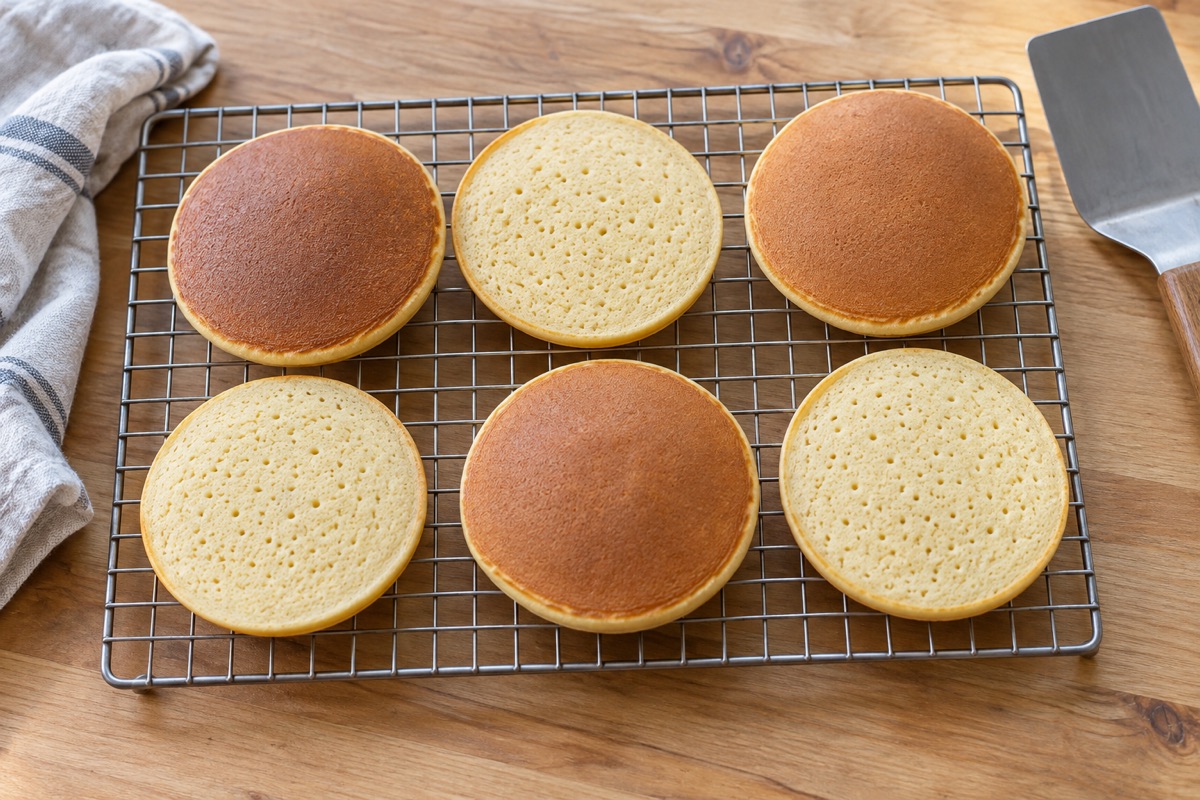
A sandwich has two visible outer faces and two inner faces against the filling. That sounds obvious, but it is a useful way to read how a dorayaki is put together. A photograph usually shows the brown top and a narrow strip of filling. It says much less about the inner surface or how much cake sits above and below the centre.
Kikkoman’s published traditional dorayaki recipe gives a particularly clear assembly instruction: the more browned, first-cooked sides face outward. Its method cooks small rounds in a pan over low heat, turning them when bubbles appear. The result is assembled from two separately cooked pieces, rather than by enclosing the filling in raw batter and cooking everything together.
That is the first distinction worth carrying to a counter. The top is not a lid baked over the filling. In an open sandwich-style presentation, you can see the two separately prepared components before they are brought together.
Look at the side as well as the top. A deep layer of cake and a shallow layer of cake offer different proportions in a bite, even if the visible brown circles have similar diameters. If the seller provides a cut-open photograph, it can be more useful than an overhead image with an elaborate logo burned into the surface.
Do not turn colour into a quality score. A dark top does not by itself tell you whether the whole cake is dry, tender, thick or thin. A product photograph is useful for seeing shape and proportions, not for judging doneness when you cook at home.
The point is to give the outside its own identity. If you take a bite and the filling is not your favourite part, that does not make the purchase a failed introduction. You may have learned that you like this style of small cake and would prefer a different centre next time.
It is tempting to draw a neat boundary: breakfast pancakes use one set of ingredients, and dorayaki uses another. The primary recipes do not support such a tidy rule. They support something more practical: read the formula you intend to make, rather than assembling your own definition from several recipes.
The Kikkoman example uses flour, eggs and sugar with baking soda, soy sauce and mirin. Its ingredient list does not include milk or honey. By contrast, JA Mienaka’s dorayaki recipe includes both milk and honey, alongside mirin and a little soy sauce, and uses baking powder. Both are presented as dorayaki by their publishers.
These differences are not instructions to substitute baking soda for baking powder, or to pour milk into the other recipe. Each ingredient list belongs with its own quantities and method. If you borrow only the ingredient you find appealing, you are making an adaptation; the source can no longer tell you exactly how the changed mixture will behave.
For a first home attempt, use that observation to simplify your decision. Choose one complete recipe whose ingredients you can obtain and use. Check the equipment and the whole sequence before shopping. A shorter ingredient list is not automatically an easier recipe if it requires an ingredient you cannot confidently identify or a step you have not allowed time for.
For someone buying rather than cooking, the same comparison answers a different question. Milk-free and honey-free are not properties you can infer from the word dorayaki. Neither are milk and honey compulsory in every version. Ask about the item, not whether “Japanese pancakes usually” contain something.
Soy sauce may also surprise a reader expecting a purely sugary batter. Its presence in these recipes is a documented ingredient choice, not a reason to imagine a savoury noodle-sauce flavour in the finished sweet. Without tasting a specific product, it would be misleading to promise how prominent that ingredient will be. An ingredient list tells you what is included; it does not provide a complete sensory description.
This is why the breakfast-pancake comparison is most useful as an introduction to the shape. After that, the actual recipe or maker’s description should take over. Familiarity helps you approach the food, but it should not force every version to behave like a pancake you already know.
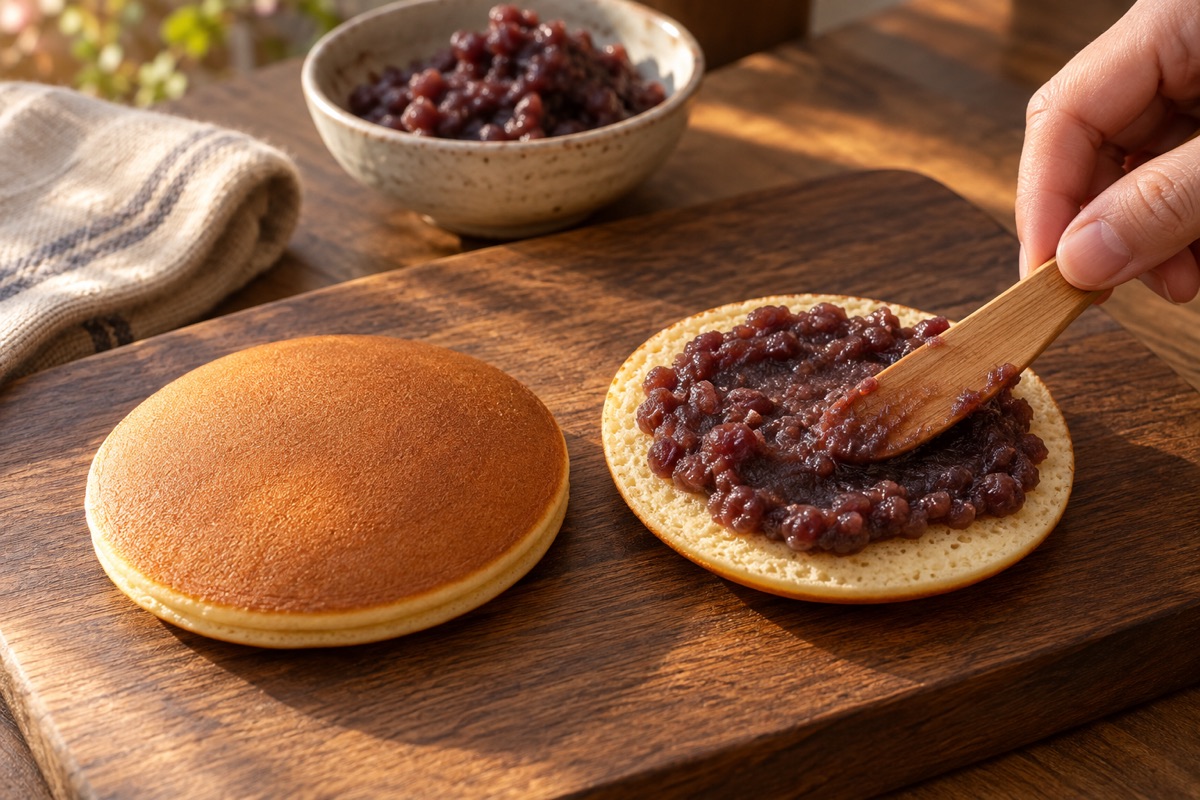
When following a sweet recipe, it is easy to focus on the pan and treat everything before and after it as waiting. With dorayaki, read those stages just as carefully as the cooking instruction.
The JA Mienaka method rests its covered batter in the refrigerator for at least 30 minutes. It also covers the cooked rounds and waits for them to cool before adding the filling. These are directions for that recipe, not a universal storage schedule for any mixture or finished sweet.
A different published example makes the after-assembly stage explicit. In Ajinomoto’s dorayaki recipe, the filled cakes are wrapped and left briefly for the bean paste and cakes to settle together. That recipe uses the company’s branded sweetener as well as sugar, so it should not be mistaken for an interchangeable standard-sugar formula. The useful point here is narrower: filling the cakes is not necessarily the final instant of preparation.
For a first cooking attempt, mark the resting and cooling stages before starting. Have the filling ready when the recipe calls for it, and keep the source’s directions nearby through assembly rather than closing the page once the pan work is finished.
This also prevents a common planning mistake. A short headline preparation time may not tell you how long the whole process will occupy your afternoon. Read whether bean preparation and batter resting are included. If you plan to use a prepared filling instead of cooking beans, check that the recipe permits that route and understand which work you are actually removing.
For a purchased sweet, assembly raises a useful question without requiring you to inspect a kitchen: is this made to order, prepared earlier for sale today, or a packaged product with its own storage instructions? Those answers describe different purchases. “Fresh” on a menu is less informative than knowing how the seller intends you to receive and eat it.
Do not conclude that the newest possible sandwich must always be the best. One source deliberately includes time after filling. Equally, that instruction does not justify keeping a homemade cream dessert out indefinitely. Preparation for texture and storage for later eating are separate matters; one is not a substitute for the other.
Rather than treating every new filling as a novelty flavour, ask what is being combined. Is the centre mainly bean paste, beans with an additional ingredient, or a different filling altogether? That distinction helps you choose a meaningful first comparison.
Bunmeido describes its Shittori Dorayaki as fine-textured, moist cake with its own tsubuan made from Hokkaido azuki beans. Those are the maker’s stated aims, not our tasting notes. They tell you to expect attention to both the cake and the bean filling, rather than a product defined only by a very large centre.
Tsubuan is the textured bean-paste option; if you prefer a smoother centre, ask whether another version is available. More importantly, do not use a single product to answer whether you like all bean-filled cakes. A preference may be about the paste, the cake or their relative amounts.
An uncomplicated bean-filled version is our suggested starting point if your main curiosity is the relationship between those two components. If beans are exactly what you do not want, a clearly explained alternative is a reasonable first purchase.
Eitaro’s Nihonbashi butter dorayaki combines bean filling with butter. Its description allows eating it as it is or warming it moderately so the butter melts into the cake and filling. Follow the maker’s directions for the actual item; this is not a tested microwave method or a recommendation to heat every packaged dorayaki.
This example helps decode a menu name. “Butter dorayaki” need not mean that butter has replaced the beans. If avoiding bean paste is your reason for choosing it, ask first. If you like beans but want to explore a different combination, it answers a more suitable question.
If the appeal is the butter melting into the centre, check the serving instructions before buying it for a journey. A product you plan to eat as supplied and one you want to warm at home make different demands on your plans.
Kikkoman offers a maritozzo-style cream dorayaki recipe with a prominent whipped-cream filling incorporating heated mirin. It is a specific modern variation, not a description of every cream dorayaki sold in Japan. The publisher also warns that alcohol may remain in that recipe.
A cream-centred version can be a sensible choice if cream is what you want to eat. It is less useful as your only comparison when the question is whether you enjoy anko. That is not a criticism of the dessert; it is simply a mismatch between your question and the food chosen to answer it.
Look beyond the photograph here too. A tall centre may change how easily you can eat the sweet by hand. Ask how it is served and whether it is meant to be eaten immediately. A café dessert photographed on a plate is not necessarily designed for the same journey as a compact wrapped snack.
The same recognisable shape can appear in a display case and an individually wrapped packet. Packaging alone does not tell you how long either item will keep, and the filling name does not provide the answer.
The Bunmeido product above is listed for ambient shipment, with instructions to avoid direct sunlight, high temperature and humidity. Its online shelf-life statement refers to remaining time from dispatch. That wording matters: a dispatch-based promise is not a fresh allowance beginning when you open the parcel, and certainly not when you open an individual wrapper. Check the date and instructions on what you receive.
The Eitaro butter example also specifies ambient shipment and avoiding heat, humidity and sunlight. This is a useful counterexample to the assumption that every sweet containing dairy must arrive in exactly the same kind of packaging. It is not permission to apply that product’s instructions to a café’s freshly whipped-cream version.
For a purchase in India, ask the seller which product and instructions apply to your order. An imported manufacturer’s page can explain the original item, but it cannot confirm the condition of a particular parcel or how a local seller has handled it. A locally made version needs its own information rather than borrowed dates from a Japanese product with a similar name.
Before paying for a delivery, settle three practical points: what version will arrive, what storage it requires, and when the seller expects you to eat it. If those details are important to your plans and cannot be confirmed, a different purchase is a better choice than guessing from the word “sealed.”
Ingredient checks can stay brief but specific. Check the cakes as well as the filling for egg and dairy; consider honey and mirin if those matter to your requirements. The cream recipe’s alcohol warning is a reminder not to equate “heated” with a verified alcohol-free claim. It does not establish the alcohol content of any other recipe or commercial product.
For allergies, use current product information and ask explicitly about the allergy and relevant handling. Do not treat the absence of a visible ingredient as confirmation. Our Japanese vegetarian-food guide for Indian readers explains broader ingredient questions; a sweet’s familiar appearance is not a substitute for those answers.
There are two useful first routes, and neither requires buying a whole assortment.
If you want to understand the food, start with one clearly described version that fits your dietary requirements. Notice the cakes before concentrating on the centre: their thickness, how much of the bite they occupy, and whether you enjoy the combination. Then decide what you would change. “A smoother filling” or “less centre in proportion to cake” is a more useful next-step note than simply “good” or “not authentic.”
If you want a home-cooking project, choose one full recipe and follow it as written for the first attempt. The English Kikkoman recipe linked above is one documented route. Read its quantities and method together, including how the rounds are assembled. This article explains differences between sources; it is not a replacement recipe assembled from their most convenient steps.
For a second purchase, change one prominent feature if the available options allow it. Comparing two fillings inside a similar cake asks one question; comparing two makers’ bean-filled versions asks another. You will not isolate every recipe variable, but you can avoid changing everything at once and then having no idea which part you preferred.
Dorayaki is approachable because the format is so legible. Its interest comes from looking a little closer: two cooked cakes, a chosen centre, and a method of bringing them together. Once you notice those decisions, the next order becomes more personal than simply asking for the snack you recognise from a screen.

AUTHOR OF THIS ARTICLE
SoJapan
SoJapan India Pvt. Ltd. is a Japanese-founded company based in Gurugram. We bring Japanese food, anime goods and apparel materials to Indian businesses, with a sister company in Kyoto that works directly with makers in Japan.