A small cup of pale custard can set up the wrong expectation. If you are waiting for caramel, milk or a sweet finish to dinner, chawanmushi needs a different introduction: it is a savoury steamed egg dish built around stock, with ingredients that may be hidden below its surface.
The softness is part of the appeal. This is not an omelette that failed to become firm, and a spoon is a more useful starting point than trying to lift the whole portion. Yet “soft egg” is only half the description. The broth and the pieces inside it matter just as much to the eating experience—and to whether the dish suits your diet.
For an Indian reader meeting chawanmushi through a Japanese menu, a food video or a home-cooking project, three things are worth knowing before anything else:
This guide explains what those differences mean. It is not a replacement for the complete preparation and cooking instructions in the linked recipes, and it does not claim that any particular restaurant or imported product is available in India.
Kikkoman’s Japanese basic-cooking guide classifies chawanmushi as a shirumono, or soup dish, and emphasises tasting the dashi together with the egg. That classification is helpful even when the finished portion does not pour like soup. It asks you to notice the liquid’s flavour rather than treating everything around the fillings as a neutral yellow wrapper. Read the manufacturer’s introduction.
The Ministry of Agriculture, Forestry and Fisheries gives a concrete example: its chawanmushi recipe combines egg and dashi with soy seasoning, shiitake, chicken and prawns. Its stock directions use kombu and dried bonito. Those ingredients explain why the finished dish belongs to a savoury meal without requiring chilli, a dark sauce or a browned surface. See MAFF’s recipe and ingredients.
Our suggestion for a first taste is to take a little of the custard before collecting every filling into the same spoonful. Then try it with one of the pieces underneath. You are making two different observations: the character of the base and the contrast supplied by an addition. You do not need specialist tasting language to decide which you enjoy.
Nor do you have to regard mildness as either a defect or a mark of sophistication. Someone who wants a crisp, strongly spiced snack may simply want something else at that moment. Someone interested in broth and a yielding texture has a clearer reason to choose this dish. Knowing the intended experience is more useful than being told that every Japanese speciality is a must-try.
Our miso soup guide explores stock and seasoning in another setting. The connection is the importance of the broth, not a suggestion to add miso paste to any chawanmushi recipe. Related dishes can teach you what to notice without sharing an interchangeable formula.
Consider a cup described as “mushroom chawanmushi”. That description may identify its most noticeable filling, but it does not tell you whether the broth contains fish, whether there are other pieces underneath, or which seasonings went into the base.
Kikkoman Trading Asia publishes a version with shiitake, enoki and leeks. Its ingredient list still includes an egg and dashi powder. The page does not identify that powder’s full composition, so the mushroom-forward recipe alone cannot establish that a particular finished serving is fish-free. Read the mushroom recipe’s ingredient list.
There is an even simpler preliminary question for many Indian diners: do you eat eggs? Removing chicken or prawns does not remove the egg that forms the custard. If your requirement is egg-free food, a conventional chawanmushi is not made suitable by changing its topping. An egg-free reinterpretation would need to be identified and checked as a different preparation.
For someone who does eat eggs but avoids fish or meat, the conversation can be more specific: “Is the stock made with fish? Are chicken, seafood or fish cake mixed into the cup?” That is more useful than asking staff to agree with an undefined “veg” label. The reply needs to cover the recipe, not just what is visible from above.
Seasoning deserves its own question where it matters to you. The recipes cited here use different combinations, including mirin or a mirin-style seasoning, soy sauce and prepared stock products. Do not turn their shared name into a promise of identical ingredients. Our broader Japanese vegetarian food guide offers more ways to discuss exclusions; for this dish, start by stating your position on egg explicitly.
A useful ordering exchange is short, not encyclopaedic. Identify the ingredient you cannot have, ask about the base and the fillings, and let the kitchen say whether it can prepare the dish accordingly. If it cannot establish what is in the stock, that uncertainty is the answer you have—not evidence that the dish probably meets your requirement.
Online advice often compresses chawanmushi into a ratio. Ratios can help, but a recipe’s definition of the egg, the liquid and the portion is still important.
Kikkoman’s basic guide presents egg to dashi as approximately one to three and specifies two eggs weighing 100 g for its mixture. Notice that it supplies a weight rather than expecting every pair of eggs to be identical. That is a useful starting principle, not proof that every published chawanmushi must use precisely the same proportions. Check the basic mixture.
The following are selected measurements from three actual recipes, not three complete recipes or a recommendation to mix their instructions.
| Published version | Stated egg and stock or water | What the comparison tells you |
|---|---|---|
| MAFF’s chicken-and-prawn version | One egg; 150 ml prepared dashi | The measured liquid is finished stock, not all the water used to make it |
| Kikkoman’s bamboo-shoot version | Two eggs; 200 ml bonito broth | A different ingredient balance can still be published as chawanmushi |
| Kikkoman’s simple nori-and-sprout version | One large egg; 180 ml bonito dashi | Egg size is specified, and the toppings differ again |
Sources: MAFF, bamboo-shoot chawanmushi, and the simple version. Seasonings and fillings are deliberately omitted from this comparison; use the linked instructions to cook.
The table does not rank the recipes by quality. It shows why borrowing an egg count from one page and a liquid amount from another is an uncontrolled change. The recipes do not even specify their eggs with the same precision. Without testing them under matched conditions, we should not claim an exact texture difference between the finished cups.
There is also a distinction between prepared dashi and concentrated seasoning. Kikkoman’s separate Hon Tsuyu recipe uses one egg, 150 ml water and a tablespoon of its specified fourfold-concentrated product. The water is not an instruction to replace an equal volume of finished dashi with undiluted concentrate. See the product-specific method.
For a first attempt, write down the recipe you are actually following and measure its liquid in millilitres. If you change the product, consult that product’s directions instead of assuming every bottle called “dashi” has the same strength. This is particularly useful when buying imported ingredients with different front labels or translated preparation instructions.
Finally, do not confuse “two servings” with “two eggs”. The MAFF example makes two servings with one egg; the bamboo-shoot example lists two eggs for two servings. The number of people fed tells you about that recipe’s intended portions, not a fixed biological unit of custard.
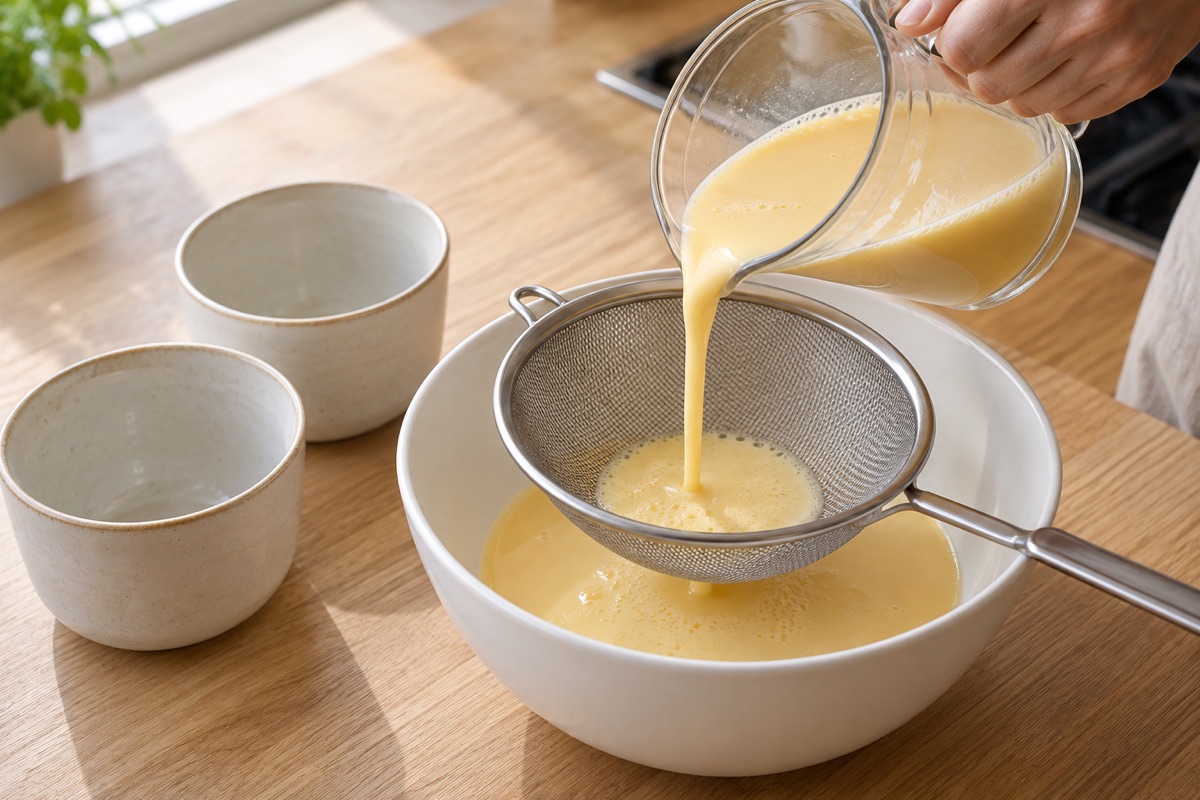
The point of mixing is to combine the egg evenly, not to build a foam. Kikkoman’s large-format chawanmushi guide recommends avoiding bubbles and straining away remaining egg-white lumps and the white cord-like chalaza. These are preparation steps aimed at a smooth result, not decorative refinements reserved for restaurant kitchens. Read the mixing and straining advice.
For a beginner, this separates three actions that can otherwise blur together: mixing the egg, passing the mixture through a strainer, and removing bubbles already floating on top. Doing the first does not mean the other two have happened automatically.
In Kikkoman’s bamboo-shoot recipe, chicken is briefly cooked in the seasoned broth and that mixture is allowed to cool before it is combined with the eggs and strained. The sequence is part of the recipe. A list of ingredients alone would not tell you to do that. Follow the full sequence here.
Our practical suggestion is to assemble the strainer, mixing bowl and cooking vessels before cracking the eggs. You are less likely to skip a small but deliberate step because you discover halfway through that the only suitable strainer is elsewhere. That is an organisational suggestion, not a claim that special branded utensils are required.
A smooth photograph cannot tell you how a mixture was prepared. It also cannot prove that the custard—or any meat inside it—was adequately cooked. Keep the desired eating texture separate from judging whether the complete dish is ready to serve.
You do not have to assume that the word “steamed” requires one particular bamboo basket. The cited recipes use more than one arrangement. What matters is recognising which arrangement a recipe has actually specified.
The bamboo-shoot recipe puts serving cups into a heated steamer and uses low heat. By contrast, MAFF places covered containers in a lined frying pan, with water outside the containers. Kikkoman’s Hon Tsuyu version also uses covered heatproof containers in a pot. Those are specific methods, not permission to put any cup directly on a flame.
In the pan method, distinguish the stock inside the cup from the water outside it. They perform different jobs. Adding extra water to the custard because the outer pan looks shallow would change the food, not simply the steaming arrangement.
Before starting, check that your chosen heatproof vessels fit the cooking pan and that its lid can close as the recipe requires. Do this with empty vessels. A beautifully patterned cup is not enough information about whether it is suitable for the intended heating method; use the vessel maker’s instructions.
The same caution applies when changing portion size. Kikkoman’s large-format guide specifies a bowl 18 cm across and 5 cm high inside a 26 cm frying pan. Its chicken-and-fish-cake version and its unfilled custard with a separate prawn topping use different low-heat time ranges even within that format. Compare those two arrangements in the manufacturer’s guide.
Our conclusion from that comparison is modest: “one big bowl” is not a complete conversion rule for several small cups. Choose a recipe designed for a large bowl if that is what you want to make. Do not multiply a small cup’s timing by the number of portions and call the result tested.
Surface bubbles, holes and a rough texture can be useful observations to note, but they are not a reliable remote diagnosis of everything that happened. Record the mixture, vessels, heat changes and filling preparation before deciding that the solution must be more heat or more time. This guide is deliberately not supplying a universal rescue procedure for an undercooked cup.
It is easy to think of the pieces inside chawanmushi as interchangeable treats. Some changes are less simple than swapping one garnish for another.
Kikkoman’s basic guide warns that ingredients releasing water can change the balance of the egg mixture. Its broader lesson is useful: the custard and the filling are not completely separate systems once they are cooking in the same vessel. A substitution has to be considered as an ingredient with its own behaviour, not just a colour or a dietary label. See its advice on filling choices.
Maitake mushrooms provide a more surprising example. An educational experiment published by the analytical-chemistry college 日本分析化学専門学校 compares egg mixtures with raw maitake, pre-boiled maitake and no maitake. The school explains the raw mushroom’s interference with setting through protein-breaking enzymes, which prior heating inactivates. Its practical advice is to cook maitake before adding it to the egg mixture. Read the school’s experiment and explanation.
That is not our kitchen test, and it should not be stretched into a claim that all mushrooms have the same effect. Nor is it a reason to treat every custard that fails to set as a maitake problem. It is a specific counterexample to the assumption that a filling affects only taste.
If an ingredient is unavailable, choosing a recipe built around what you can obtain is often clearer than making several simultaneous substitutions.
The mushroom recipe discussed earlier, for example, sautés its shiitake and enoki before placing them in ramekins. That preparation belongs to that version; it is not an instruction to substitute any raw mushroom in the same quantity. Likewise, a recipe’s precooked chicken and another’s uncooked chicken are not equivalent starting points merely because both ingredient lists say “chicken”.
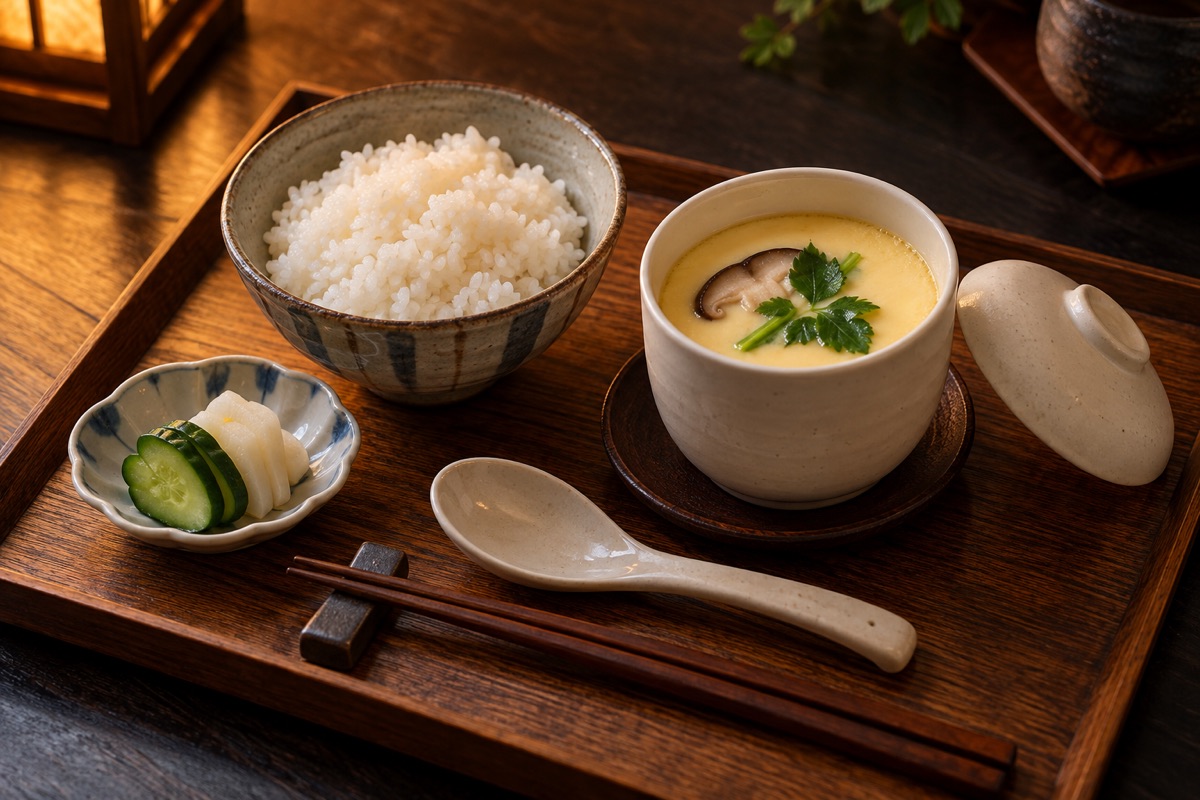
If your first encounter is a small starter, it is tempting to make that serving size part of the definition. Two regional examples show why that is too restrictive.
MAFF describes Osaka’s odamaki-mushi as a larger chawanmushi containing udon. Its account connects the name to noodles resembling wound thread and recalls the dish as celebratory food in merchant households in Semba. The noodles are not merely a garnish; they change what you find underneath the custard. Read the Osaka regional-food entry.
The useful contrast for a diner is not “authentic versus modern”. It is what job the dish is doing in the meal. A noodle-filled bowl asks for a different expectation from a little cup ordered beside several other dishes. The same soft base can sit within a more substantial preparation.
Nagasaki’s Yossou offers another context. In its own history, the restaurant dates its establishment to 1866 and describes its longstanding pairing of chawanmushi with steamed sushi. The rice dish includes grilled conger eel, fish and egg toppings. This is the restaurant’s account of its own tradition, not evidence that every Japanese restaurant must serve the same pairing. Read Yossou’s history.
These examples are worth knowing because they replace a rigid mental picture with a useful question: what comes with this particular serving? Noodles inside, rice alongside and a separate topping all produce different meals. A menu name alone may not tell you the portion size or everything on the tray.
They also explain why removing a visible prawn from a photograph is not enough to imagine a different version of the whole order. The accompanying rice or noodles may bring their own ingredients. Check the complete serving you are choosing, not an isolated piece of custard cropped out of its context.
If you want to order chawanmushi, ask about its stock, fillings and serving size, then decide whether that combination interests you. If you want to cook it, choose one of the complete recipes according to your ingredients and equipment—not merely whichever photograph has the smoothest surface.
The MAFF version gives a fish-stock, chicken-and-prawn reference. Kikkoman’s bamboo-shoot version offers a different ingredient balance and steamer sequence. The simple nori-and-sprout version uses fewer visible additions, but still lists bonito dashi. A short ingredient list is not the same as a vegetarian one, and a mushroom-forward version still needs its stock checked.
For a useful first attempt, preserve the recipe’s measured liquid, filling preparation and vessel arrangement. Make notes about changes you cannot avoid. You will then have something more actionable than “it looked different from the internet” when deciding what to do next.
And for a first spoonful, allow the dish to be itself: savoury, softly set and shaped by broth as well as egg. The most revealing question is not whether it resembles a dessert. It is whether the base, the pieces inside and the meal around it make sense together.

AUTHOR OF THIS ARTICLE
SoJapan
SoJapan India Pvt. Ltd. is a Japanese-founded company based in Gurugram. We bring Japanese food, anime goods and apparel materials to Indian businesses, with a sister company in Kyoto that works directly with makers in Japan.