← JOURNAL6 Oct 2026
Japanese Rice Crackers Explained: Senbei, Okaki, Arare and the Many Ways to Crunch
 By SoJapan
A bag of broken Japanese rice crackers is not necessarily a bag of factory rejects. Kameda’s Waza no Kodawari is deliberately broken so that its soy-based sauce can enter through the exposed edges. The fragments are part of the design.
That is a useful introduction to Japanese rice crackers. Their appeal is not simply that rice has been made crunchy. A maker can change where a piece breaks, how much air sits inside it, where the seasoning goes and whether the finished bite should be dry or moist. Two brown, soy-seasoned snacks can therefore offer quite different experiences. Kameda’s explanation of Waza no Kodawari.
For an Indian reader meeting names such as senbei, okaki and arare on a packet, this guide starts with those differences. It is not a ranking of imported brands or a promise that particular Japanese products are stocked locally. The named products are examples drawn from their manufacturers’ Japanese listings, checked in October 2026. They help explain what to look for on the actual packet available to you.
In the rice-cracker family, senbei generally use uruchi rice, the non-glutinous type associated with ordinary cooked rice. Okaki and arare generally use mochi rice, the sticky type used to make mochi. Arare commonly describes smaller pieces; okaki commonly describes larger ones. These are helpful starting points, not rules that let you identify every recipe from a photograph. Sanko Seika’s explanation of the rice types and names.
Begin with the ingredient, not the silhouette. A large disc may fit the familiar image of senbei, but being round does not tell you whether it is hard, lightly puffed, fried, sweetened or deliberately moist. Likewise, a small crescent does not tell you whether peanuts are included in the packet beside it.
One especially useful exception is Nanbu senbei. Iwateya’s sesame version uses wheat flour, rather than fitting the simple rice-cracker definition. The maker’s English page identifies wheat flour and sesame among its ingredients. The word senbei therefore reaches beyond the rice-based group at the centre of this article. Iwateya’s Obaachan-Goma description.
This is not a naming mistake that you need to correct. Food names carry regional traditions as well as ingredient categories. Use the category to form a question, then let the product answer it: “Which grain is this made from?” is more dependable than “All senbei must be rice.”
There is a second trap for anyone who first met mochi through a soft dessert. Sharing a rice type does not mean sharing the finished texture. A dried, baked cracker should not be expected to stretch like a filled daifuku. The processes between the grain and the mouth matter. Our Japanese sweets and wagashi guide explains that softer side of rice confectionery; here, the interesting question is how the material becomes a structure that breaks.
For a first purchase, memorise less. Read the name, identify the base, then look for the maker’s texture description. That three-part approach leaves room for exceptions without turning the snack aisle into a vocabulary test.
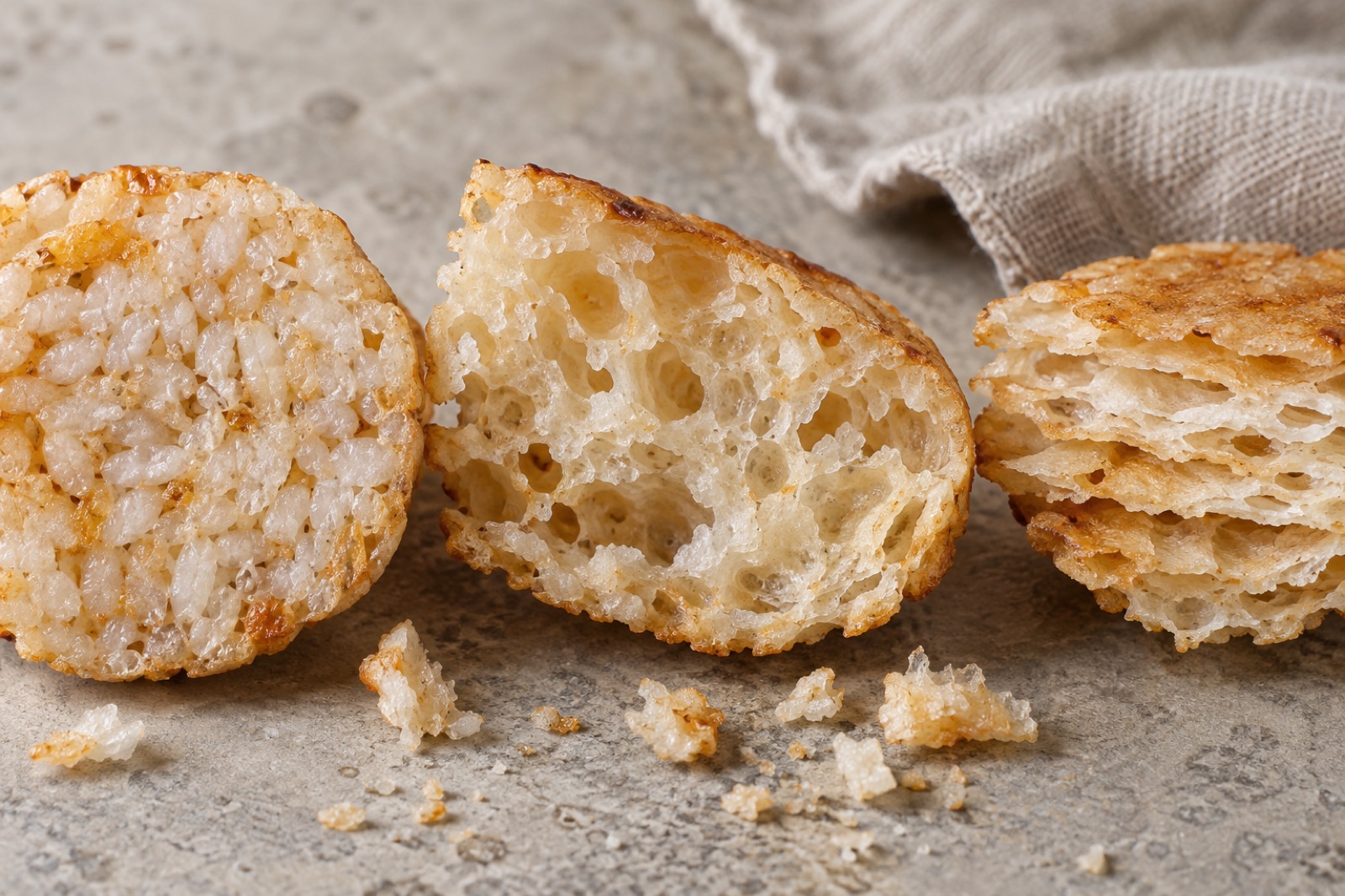
“Crunchy” is a convenient word, but it hides several questions. How much effort does the first bite require? Does the piece break into a few firm fragments or collapse into many small ones? Does the texture disappear quickly, or remain substantial while you chew? Those experiences need not move together.
Kameda describes a hardness study in which it bought 110 commercial rice-cracker products and selected 88 to cover the categories being tested. It compared density, the load needed to break the crackers and people’s sensory assessments. Its report connects harder-feeling products with denser structures containing less air, and discusses a possible five-group classification. These are the manufacturer’s research findings, not a universal hardness score printed on every Japanese snack. Read Kameda’s hardness research.
The distinction matters when someone tells you that a particular cracker is “light.” They could mean a fragile structure, a mild flavour, a small portion or something else entirely. Ask which. A light-feeling bite does not, by itself, describe its ingredients or nutritional composition.
In a separate account, Kameda uses X-ray micro-CT images to examine internal spaces. It links the hollow structure of its kaki-no-tane crackers to their crisp bite, and the larger bubbles in some arare to a softer, readily collapsing texture. It also stresses that rice type, process and seasoning all influence the result. See the manufacturer’s internal-structure research.
You do not need laboratory equipment to use that insight. When you open a suitable snack, notice a broken edge before eating. A cross-section can give you something more specific to look at than the glossy front of the packet. Treat what you see as an observation about that piece, not a scientific measurement or proof of how every product in the category behaves.
If you enjoy a firm, deliberate bite, a maker’s hard-baked description is useful. If that is not the experience you want, look for its softer or airy styles instead. There is no need to graduate from an easy crunch to the hardest available cracker. Texture is a preference, not a test of authenticity.
Kameda’s factory explanation gives a concrete example of the work hidden inside a tiny kaki-no-tane piece. Its dough is mixed with air and water, shaped, chilled and cut. The company describes approximately 18 hours of chilling and a pre-baking cut thickness of about 1.6 mm. Drying and a further rest control how moisture is distributed before baking. Follow the official kaki-no-tane production explanation.
The 1.6 mm figure describes a stage in that manufacturing process. It is not a measurement of every finished cracker, a home-recipe instruction or a specification shared by competing makers. Its value to a curious eater is explanatory: even something that looks like a small casual nibble depends on controlled preparation before it reaches the oven.
That also changes how to read a product description. A maker discussing puffing, cutting, drying or double seasoning may be describing a real difference in the bite, rather than merely adding decorative language. Look for the connection between the technique and the result. If the description never makes that connection, the claim tells you less about what you will enjoy.
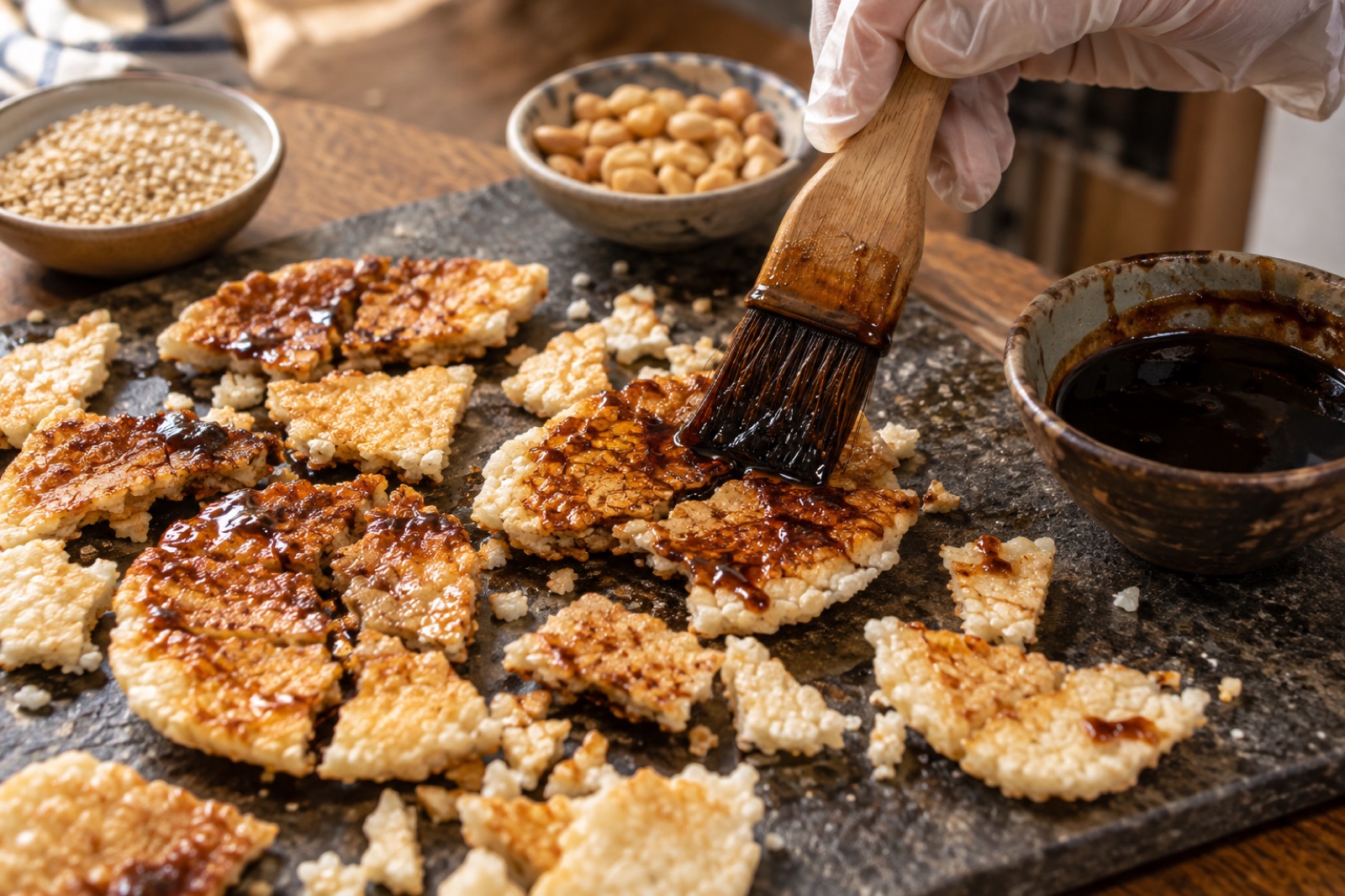
Return to the deliberately broken Waza no Kodawari. The current 110 g product listing describes a hard-baked cracker that is broken and dipped twice in a soy-based sauce. Its irregular form allows seasoning to enter through the fracture. That is a different idea from preserving a neat, unbroken disc and treating every fragment as a defect.
For a reader choosing a snack, the interesting comparison is not “beautiful versus damaged.” It is surface seasoning versus seasoning reaching further into the piece. If you want to understand that difference, pay attention to the flavour after the first contact with the outside, not only to the initial salty impression.
That suggestion is a way to organise your own tasting, not a claim that we have tested these products. A maker’s explanation can tell you what it intended to do; your preference still depends on the actual snack you try.
Nure senbei makes a more dramatic challenge to the expectation that crackers must be dry. Choshi Electric Railway describes its red-label, strong-soy version as having a distinctive moist texture because sauce is soaked into it. This is an intended style, not an instruction to regard an accidentally damp cracker as acceptable. The railway’s current four-piece nure senbei listing.
The two examples should not be collapsed into one category. A hard-baked, double-seasoned fragment and a deliberately moist nure senbei both use sauce as part of their identity, but the eating experiences they promise differ. “Soy flavour” is too broad a description to settle the choice between them.
If a dry snap is exactly what you are looking for, start with a product explicitly described that way. If you are curious about a softer, sauce-soaked bite, nure senbei is a more relevant direction. Buying the second while expecting the first can make an intentional quality feel like a disappointment.
There is an appealing cultural detail here too: the Choshi product is sold by a railway company, not simply by a confectionery brand. Its official account connects the snack with supporting the railway. That gives the packet a specific local story without requiring a claim that it represents all Japanese snacking. It is a food with a place behind it, rather than an anonymous example of “Japanese flavour.”
A flavour word is a useful invitation, but it is not a complete recipe. “Salt” describes the intended flavour emphasis. “Soy” points towards a seasoning. “With peanuts” tells you about another component of the mix. None of these phrases, alone, tells you everything in the food.
Consider Kameda’s 75 g Salad Hope. The maker describes a lightly salted arare and lists mochi rice and vegetable oil, but also bonito extract powder. Its allergen information includes soy and chicken. The simple-looking salt profile is therefore not a vegetarian option merely because rice, oil and salt sound like the main idea. Check the current Salad Hope product information.
If you eat vegetarian food in India, do not limit the check to products with an obvious meat or fish flavour on the front. For an unfamiliar imported packet, the quieter seasoning ingredients can matter more than the largest flavour word. Look at the full ingredients and the information for that specific market’s pack.
Peanuts introduce another kind of difference. Kaki-no-tane takes its name from its resemblance to a persimmon seed; the snack discussed here is a shaped cracker, not a packet of fruit seeds. Sanko’s linked category explanation describes that naming connection. It may be sold as crackers mixed with peanuts or as crackers without those added peanuts. In the mixed version, you are alternating between two components, not simply eating one uniformly flavoured cracker. If you like the cracker but not the mixed bite, that is a reason to look for a different format, not necessarily to reject the entire style.
Kameda’s current 135 g six-bag version explicitly has no added peanuts. However, its ingredient list still includes seafood-extract seasoning, and its factory notice says products containing peanuts are made at the same factory. “No peanuts added” and “suitable for someone with a peanut allergy” are not interchangeable statements. The manufacturer’s peanutless six-bag listing.
For dietary restrictions or allergies, do not try to infer safety by removing visible pieces from a mixed packet. Keep the package information, ingredient declaration and manufacturing warning distinct. If the answer you need is missing, ask the seller or manufacturer before eating it.
The pleasure of a savoury snack and the suitability of its ingredients are separate questions. You can be interested in a product’s texture without recommending it to everyone. That is why the examples here explain mechanisms and labels rather than serving as a universal shopping list.
Here is a small calculation that is more useful than a popularity ranking. Kameda lists a 180 g six-bag kaki-no-tane pack with peanuts and a 135 g six-bag version without added peanuts. Both contain six inner bags, but the total quantities differ. The mixed product’s current listing also confirms uruchi rice flour, illustrating why a general naming guide should not override a particular product’s ingredients. The 180 g mixed-pack specification.
| Japanese product listing | Total declared weight | Inner bags | Average weight per inner bag |
|---|---|---|---|
| Kameda kaki-no-tane with peanuts | 180 g | 6 | 180 ÷ 6 = 30 g |
| Kameda kaki-no-tane without added peanuts | 135 g | 6 | 135 ÷ 6 = 22.5 g |
The averages above are our arithmetic from the declared totals, not a guarantee that each individual bag weighs precisely that amount. The mixed packet’s average is one-third larger by total weight: 30 divided by 22.5 is approximately 1.33. That does not mean it contains one-third more rice crackers. Some of the mixed packet’s weight is peanuts, so a cracker-only quantity comparison would need additional information.
This is the important distinction: the unit that is convenient for sharing is not necessarily the unit that is useful for comparing quantity. Six bags might divide neatly between six people, yet say little about how much each person receives or what proportion of it is the item they wanted.
If you are comparing prices on a local shelf, use the actual local prices and the actual grams on those packs. Divide price by total grams to compare the cost of the whole mix. Do not then describe that result as the cost per gram of rice cracker when one product also contains nuts. We have not supplied an Indian price because these Japanese listings do not establish local availability or retail cost.
For a shared snack break, inner bags have a different value: they let you open only what you plan to serve. For someone who wants mostly crackers, the mix composition may matter more. Neither priority is wrong. The numbers become useful only after you decide what you are comparing.
The food’s base, seasoning and added components each deserve a separate look. A rice base does not cancel wheat in a seasoning; a salt flavour does not cancel fish extract; removing peanuts from a recipe does not remove every other ingredient of concern.
This is not a hypothetical warning. The Waza no Kodawari listing used earlier declares wheat, soy and gelatin. The Choshi red-label nure senbei listing identifies wheat-containing soy sauce and bonito extract. Those products illustrate interesting techniques, but their ingredient information rules out treating them as automatically vegetarian or wheat-free.
For a quick, orderly check, work through the package in this order:
Kameda explicitly warns on its product pages that website and package ingredients can differ after specification changes, and directs customers to check the pack. That is a good reason to avoid treating a screenshot saved months ago as permanent permission to eat a product.
If you ask someone for help translating a label, send a clear photograph of the full back panel as well as the front. A cropped flavour name leaves out the very information you need. For a seller enquiry, a concrete question such as “Does this exact pack contain fish or meat extracts?” is easier to answer than “Is Japanese rice cracker vegetarian?”
There is no need to make every snack choice anxious or complicated. Once you identify an exact product that meets your requirements, you can return to the enjoyable question of taste and texture. The point is to make the ingredient check accurate, not to turn a category name into a promise it cannot keep. Our Japanese vegetarian-food guide explains the wider issue of stocks and less visible animal-derived ingredients.
The factory explanations suggest a more interesting way to approach a suitable snack than asking only whether it is salty enough. Look for the relationship between the piece you can see and the bite you experience. These are optional observations, not a formal tasting protocol or a claim that we tested the products.
Does the first break explain the rest of the bite? A piece might offer a distinct initial snap but leave fragments that remain firm. Another might break less dramatically and collapse more readily. That is why the sound of a single bite is not a complete account of texture. Do not assume that the loudest snack is the densest, freshest or best made.
Does the flavour seem concentrated outside, or continue through the broken piece? The double-seasoned example gives you a reason to ask. There is no need to scrape coatings off or dismantle a snack. Simply notice whether the first salty impression describes the whole experience. A quieter outside with flavour that persists can be interesting for a different reason from an immediate surface hit.
Are you enjoying the cracker, the mixed components or their alternation? With a peanut-and-cracker mix that suits your diet, notice the two components separately before combining them in a bite. This can help explain why you might prefer the mixed product even when a cracker-only version appears to contain more of the thing named on the front. Conversely, someone who mainly wants the cracker has a reasonable reason to choose the other format.
None of those questions requires a competitive score. They locate the source of a preference. If the texture appeals but the seasoning feels too assertive, change the seasoning next time rather than abandoning that style of cracker. If the flavour appeals but the bite feels too firm, investigate a different structure. Changing one dimension gives the next choice a clearer purpose.
For sharing, leave each original packet beside its own bowl instead of pouring several unfamiliar products together. Besides making the comparison easier, this preserves the connection between the food and its ingredient information. Someone should not have to guess which label belongs to the small brown piece they have been offered.
The nure senbei example explains why moistness can be deliberate. It does not establish that any soft or damp cracker is in good condition. Follow the actual product’s storage directions, date and any after-opening guidance. Do not use a texture description from another brand to judge a damaged or uncertain packet.
Nor should a best-before period on a manufacturer’s page be read as a fresh countdown starting when you buy it. Check the printed date on the item in front of you. The Choshi listing specifies avoiding direct sunlight, heat and humidity; the exact pack remains the reference for its storage requirements. There is no single shelf-life number that works for this whole family.
The practical response is modest: choose a pack size that suits how you will eat it, open only what you need and retain its instructions. There is no need to improvise heating or drying methods to rescue an unfamiliar product. For a first encounter, experiencing it as the maker intended is a better starting point.
At the start, the fragments in Waza no Kodawari looked like something a maker might have tried to prevent. Understanding the seasoning method reverses that impression: the break is useful. Nure senbei makes a similar point through deliberate moisture, while the airy interior of an arare shows that the spaces you cannot see from outside can matter as much as the surface.
That is what makes this family worth exploring beyond its familiar packaging. Small changes in preparation can produce noticeably different ambitions for the finished snack. The task is not to decide which ambition is the most authentically Japanese, but to understand which one a particular product offers.
Check the ingredients and format first. Then let the structure, seasoning and mix answer the enjoyable question: what kind of bite did you come for?
AUTHOR OF THIS ARTICLE
SoJapan
SoJapan India Pvt. Ltd. is a Japanese-founded company based in Gurugram. We bring Japanese food, anime goods and apparel materials to Indian businesses, with a sister company in Kyoto that works directly with makers in Japan.