A melonpan can disappoint you before you have even tasted it—if you are expecting a melon-filled bun. Anpan has the opposite problem: its unassuming exterior hides the part that gives the bread its name. And a bag of shokupan marked with a smaller slice number may contain the thicker toast you were looking for.
Japanese bread becomes easier to choose when you separate the outside, the bread itself and anything inside it. A name might describe a filling, an appearance or a broad bread category. It does not always tell you the flavour of every bite.
For readers in India, this guide is a way into Japanese bakery culture without assuming that every product is available locally, every reader eats eggs, or everyone wants the same level of sweetness. The Japanese manufacturer examples explain particular breads; they are not Indian stock recommendations or claims about a local café’s recipe.
Start with four useful distinctions:
The interesting question is not which one is the most Japanese. It is which part of the bread you want to enjoy.
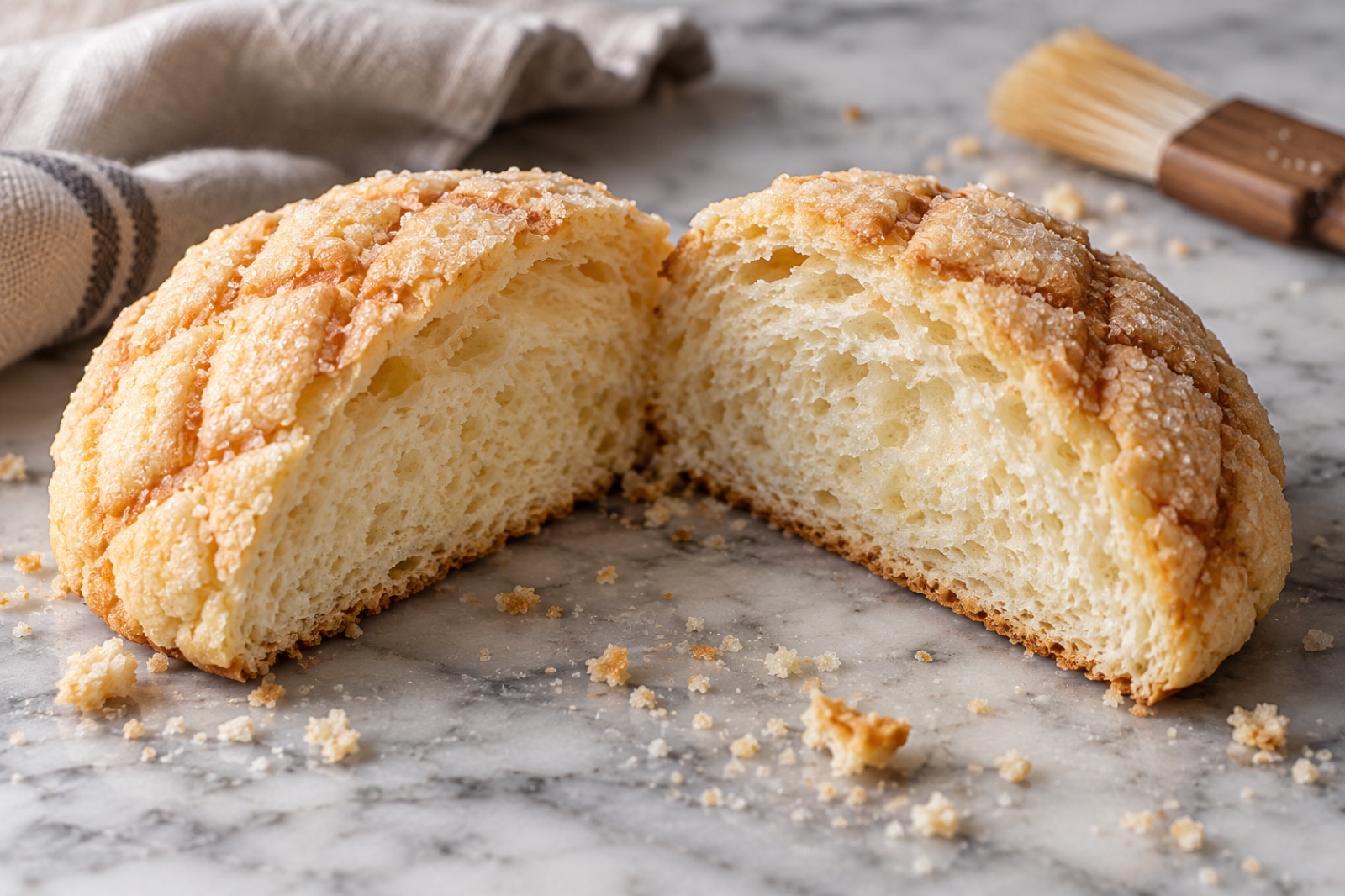
Imagine biting into a biscuit and a bread roll at the same time. That is a more useful starting expectation for a classic melonpan than imagining a bun full of fruit jam.
Zojirushi’s melonpan recipe uses a bread dough beneath a separate cookie dough. In its displayed BB-CEC20 version, vanilla appears in the cookie layer and melon does not appear in the ingredient list. The instructions place the cookie dough over the top and sides, rather than enclosing the bread completely. This is a concrete example of melonpan without melon fruit, not a rule that no melonpan can contain it. See Zojirushi’s melonpan recipe.
The two parts have different jobs. The outside gives you a sweet, firmer first contact; the bread underneath provides a softer mouthful. A plain version is not missing a filling. Its main contrast is already built into the surface and interior.
That changes what is worth noticing. Instead of asking only whether the centre is generous, notice whether you like the balance of topping and bread. Someone who enjoys the biscuit layer most may prefer a different version from someone who wants a gentler, bread-led snack. Neither preference requires treating one bun as the definitive standard for the whole category.
The resemblance between the scored surface and a melon skin is a familiar explanation. However, Yamazaki’s bread encyclopaedia presents several naming theories rather than one settled origin. It also describes the basic construction as bread dough covered with biscuit dough. It is more accurate to say that the appearance helps explain the name than to invent a single certain inventor or origin story. Read the manufacturer’s naming discussion.
A melon-flavoured version and a melon-shaped version are therefore different promises. If fruit flavour is what attracts you, ask specifically about melon juice, flavouring or filling. A pale green colour or a crosshatch pattern is not an ingredient declaration.
Yamazaki describes its current Large Melonpan in terms of a crisp exterior, soft interior and buttery flavour. That description is useful because it tells you what the maker wants the product to deliver, without turning the word melon into a fruit-content claim. See the actual product description.
For a first purchase, a simpler version makes the two-part construction easier to understand. Chocolate, cream or other additions can be enjoyable, but they add another comparison. If you begin with a heavily filled variation, it is harder to know whether you liked the bread, the topping or the extra dessert inside it.
Anpan puts sweet bean paste inside bread. If you already know anko from dorayaki or other Japanese sweets, the filling may be familiar, but the surrounding structure is different. This is a bread bun, not two pancakes pressed together and not a rice-based wrapper.
The history is useful here because it explains a choice, not merely a date. Kimuraya traces its anpan to 1874 and describes a fermentation starter made from rice, koji and water. The maker’s account places a familiar Japanese sweet filling inside a bread format. That is adaptation, rather than a reason to call the result an imitation of a European bun. Read Kimuraya’s account of its sakadane anpan.
Do not turn that particular fermentation method into a requirement for all anpan. A contemporary bakery can make a bean-filled bread using another dough. The filling category tells you more about what is inside than about the exact starter, flour or production method.
Kimuraya’s Sakura version combines smooth koshian with a salt-preserved cherry blossom. Its Ogura version uses textured tsubuan. These are named, verifiable examples of two different centres, not a claim that every anpan carries the same topping. Compare Sakura and Ogura.
If you want a more uniform filling, smooth paste is the clearer starting point. If you enjoy noticing the bean texture, the textured version gives you something else to explore. Neither label tells you that one must be sweeter than the other: texture and sugar level are separate questions.
The bread-to-filling balance also changes from bite to bite. The edge of a bun can give you mostly bread; a central bite can include much more paste. Before dismissing a bun as dry or overwhelmingly sweet, notice which part you have tasted. This is a useful way to describe your preference, not an instruction to like something you dislike.
Anpan can be especially interesting when you are curious about the meeting of bread and confectionery. You do not need to compare it with a specific Indian sweet to justify the combination. Familiarity with sweetened pulses might make the idea less surprising, but it does not predict the flavour of this particular filling or dough.
Our guide to Japanese sweets and anko explains the wider confectionery family. Here, keep the attention on the bun: how much filling accompanies the bread, how the two textures meet, and whether that balance suits the snack you wanted.
Curry pan is easier to understand as a sequence: outer coating, bread, curry filling. The filling supplies one part of the experience, but it does not make the surrounding bread irrelevant.
House Foods publishes a basic curry-pan recipe with both fried and baked methods. Its fried version uses an egg-and-breadcrumb coating; its baked version also uses breadcrumbs, with oil added before baking. So a rough, crumbed exterior alone cannot reliably tell you which cooking method a bakery used. Compare the manufacturer’s two methods.
For someone used to eating bread alongside a separate curry, enclosing the filling changes the control you have. You cannot choose the bread-to-curry ratio as freely with each mouthful. The bakery has already made much of that decision through the amount of filling, dough thickness and shape.
That is why two curry breads with a similar sauce can still feel different. A bread-led one may be a satisfying snack for a person who wants only a little filling. Someone looking for a strong curry centre may find the same piece underfilled. Describing that difference is more informative than calling one simply authentic and the other wrong.
Keep three judgments apart: the outer texture, the aroma of the filling and its chilli heat. A crisp crust is not evidence of a hotter curry. A dark filling does not identify which meat, stock or spice mixture it contains.
For an Indian reader, there is no obligation to approach it as a test of whether Japanese curry can compete with the curries you know. The more interesting question is whether the filling works inside this bread. The amount of bread in the bite is part of the seasoning experience.
House Foods’ accompanying cooking article notes that moisture from the filling can soften the bread after frying. That helps explain why a just-prepared example and one eaten later need not have the same texture. It does not tell you how long a particular shop’s product has been sitting out. Read the manufacturer’s curry-pan explanation.
If texture matters most, ask when the bread is intended to be eaten and whether the maker recommends reheating. Do not assume every filled bread should go into the same toaster for the same time. A method suitable for a plain slice may be inappropriate for a different filling, coating or package.
If you decide to make curry pan, use a complete recipe for the chosen method. House Foods specifically warns that overfilling can prevent the seam from sealing and lead to leaking filling and splattering oil. More filling is therefore not an automatic improvement. Its recipe is the place for the full preparation and cooking instructions; this guide is not a substitute for them.
For the sauce itself, our Japanese curry guide separates roux, curry powder, heat and sweetness. The extra question at the bakery is what the coating and dough add—and whether their ingredients fit your diet too.
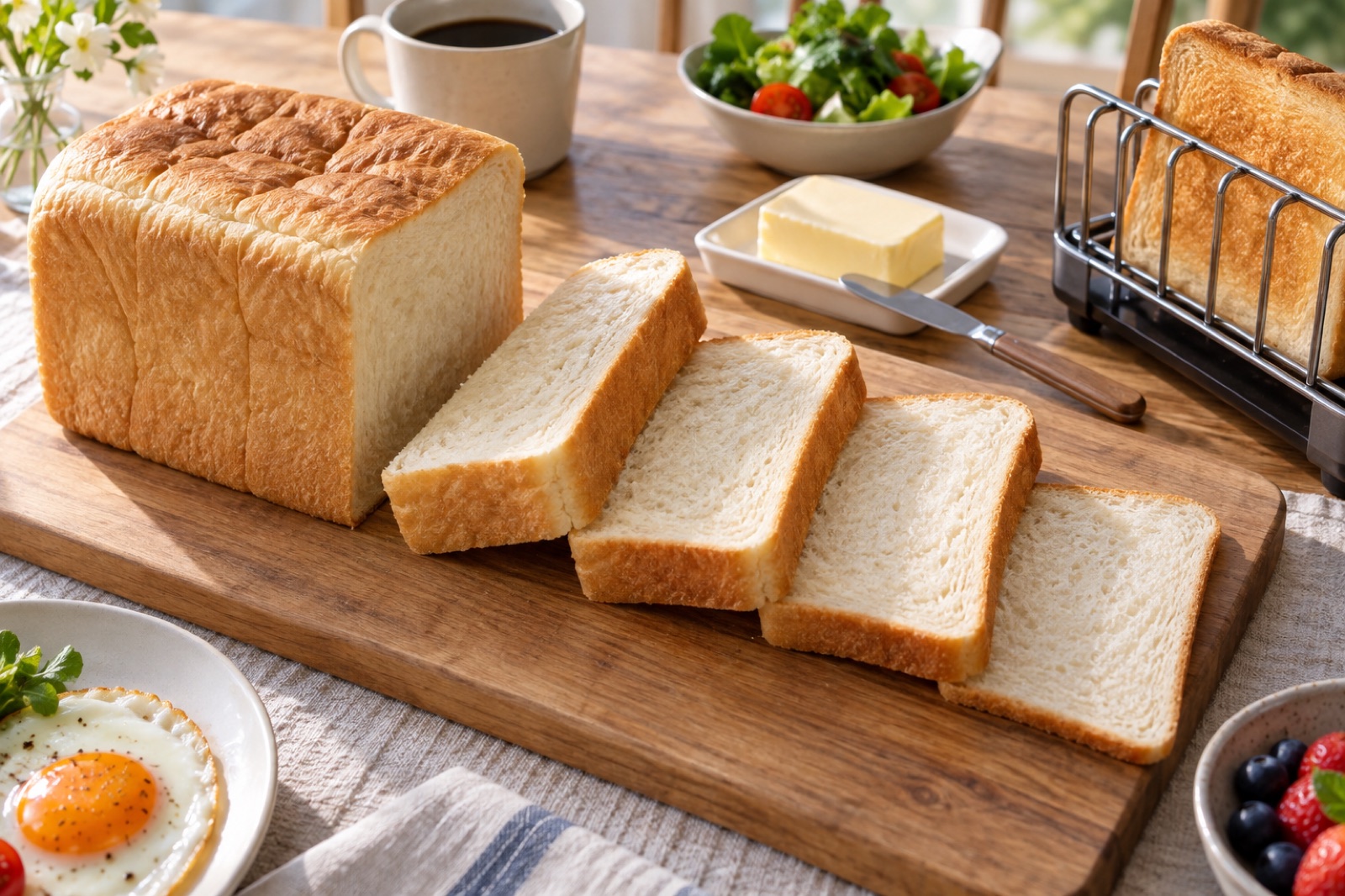
Shokupan is the loaf-bread side of this guide. There need not be a hidden filling or a decorative crust. A large part of the interest lies in the bread’s interior and in what happens when you slice, toast or turn it into a sandwich.
Two words help: crust means the outside, while crumb means the interior structure—not only the loose bits left on a plate. When you look at a cut slice, the crumb is the network of bread around the air spaces. You can examine how fine or open it looks without squeezing an unsold loaf at a shop.
Square-topped and mountain-topped loaves offer another visible clue. Yamazaki explains that a lidded tin constrains the rising dough into a square shape, while an open tin allows the top to rise into a mound. Shape tells you something about baking; it does not certify one recipe as better, richer or more suitable for every sandwich.
The photograph of a soft white slice also cannot reveal whether it contains milk or egg. Nor does it establish the production method. A label such as Japanese milk bread may be useful on a particular bakery’s menu, but it should lead to a question about that bakery’s recipe, not replace one.
Pasco describes its Chojuku process as treating flour with hot water, followed by a long, low-temperature maturation before baking. Its explanation connects that process with yudane, in which part of the flour is worked with hot water. This is a documented method used for a named range, not proof that every Japanese loaf is made identically. Read Pasco’s process explanation.
For a shopper, knowing the method’s name is useful mainly when it clarifies what a maker is offering. You do not need a technical password to enjoy toast. Ask whether you want a soft sandwich, a thick slice with a distinct toasted surface, or bread to support a topping. Those are eating decisions you can actually make.
For a baker, the method is more consequential. Do not add an arbitrary amount of boiling water to a standard dough because a social post says that all Japanese bread needs it. Choose a complete formula that accounts for the treated flour and water. A technique works within a recipe, not as a magic extra ingredient.
Slice numbers are a useful example of why bread labels deserve more than a glance. Within a comparable loaf format, cutting the loaf into fewer slices gives you thicker pieces. But a small packet containing three pieces is not automatically a whole loaf cut into three enormous slices.
Pasco’s current Chojuku Yamagata product page lists four-, five-, six- and eight-slice formats, as well as a three-piece pack. The last label describes pack contents. It should not be confused with the slicing style used to produce those pieces. Check the current product table and ingredients.
Here is a simplified, hypothetical comparison—not a specification for a commercial loaf. Imagine a loaf with a sliceable length of 120 mm, ignore cutting loss and end-shape differences, and divide it evenly:
| Equal divisions of the imagined loaf | Calculated slice thickness | Two slices together, before filling |
|---|---|---|
| 4 | 30 mm | 60 mm |
| 6 | 20 mm | 40 mm |
| 8 | 15 mm | 30 mm |
The arithmetic is simply length divided by the number of slices. It shows why changing the slice count can change a sandwich dramatically even before you add anything. Actual loaves have different dimensions, and their labels—not this illustration—determine what is in a package.
A second check uses real label figures. At the time of review, Pasco lists 240 kcal per slice for its four-slice Yamagata format and 120 kcal per slice for the eight-slice format. Two of the latter total 240 kcal by the label arithmetic. The six-slice format and the three-piece pack both list 160 kcal per slice. These are product-specific serving figures, not evidence that one slicing style has a fundamentally different recipe or is automatically healthier.
The lesson is about units: compare like with like. Per slice, per packet and per fixed weight answer different questions. A smaller number next to one slice can reflect a smaller portion rather than a special property of the bread.
For thick toast, a larger interior between the toasted faces may be part of the appeal. For a closed sandwich, two thick slices can dominate a modest filling. If you want to taste a delicate spread or keep a sandwich easy to bite, a thinner format may suit the purpose better.
Try describing the intended result before choosing the packet: “I want substantial toast,” “I want a thin sandwich,” or “I want an open slice for toppings.” This is more helpful than assuming the most expensive loaf or thickest slice must be best.
A sandwich’s attractive cut face is also only one view. Think about the edge, where there may be less filling, and the centre, where several ingredients meet. The useful design question is whether a normal bite gives you the balance you wanted—not whether the cross-section looks impressive in a photograph.
For readers avoiding egg, the distinction between a filling and a finished bread is particularly important. Sweet bean paste might be the ingredient you recognise, but the dough, surface treatment or additions need their own checks.
Kimuraya’s current Sakura and Ogura product pages both mark wheat, egg and milk in their allergen tables. The point is not that every anpan has those ingredients. It is that these named bean-filled buns do, so bean filling alone cannot answer the question.
The opposite mistake is to assume every Japanese loaf contains egg. Pasco’s FAQ says its Chojuku range does not use egg, while noting shared-equipment warnings for Chojuku rolls and focaccia. Its Yamagata loaf page nevertheless lists milk components and butter-containing margarine. No egg does not mean no dairy, and neither statement by itself establishes every other dietary requirement. Read Pasco’s current egg guidance and its qualifications.
With curry pan, ask about the filling and coating separately. A vegetable filling does not answer whether the curry uses an animal-derived stock, whether egg is used in the coating, or whether the bread includes an ingredient you avoid. Likewise, a baked version is not automatically egg-free simply because it is not deep-fried.
For a local bakery, a clear question is more useful than a broad label: “Does this batch contain egg in the dough, topping or coating?” If dairy is also excluded, say so separately. For allergies, ingredient information and cross-contact information are different; seek the maker’s specific guidance rather than treating this article as an individual safety guarantee.
The Japanese products above illustrate how to investigate. A similarly named product sold in India may have a different recipe, and a Japanese website is not a substitute for the actual package or local maker’s answer.
You do not need a tray full of unfamiliar breads. Pick the question you most want answered, then choose a comparison that isolates it.
Curious about melonpan? Start with a plain or simply flavoured version if one suitable for your diet is available. Notice a bite containing both the top and bread. If you later choose a cream-filled version, you can tell what the addition changes instead of treating it as the defining feature.
Curious about anpan? Compare smooth and textured filling where the bakery can identify them. Try not to change every other variable at once. If one bun is tiny and densely filled while the other is large and bread-led, you are comparing more than the texture of the paste.
Curious about shokupan? Compare two slice thicknesses for the same intended use. Keep the topping similar. A plain slice and a heavily buttered, sweetened toast will naturally answer different questions; they do not produce a fair judgment about the bread alone.
These are suggested observations, not results from a tasting we conducted. You can keep the notes very short: the part you enjoyed, the part that surprised you and what you would change next time. “I wanted more bread and less filling” is already a useful conclusion.
Cream pan offers a sensible next step if the filled-bun format interests you more than bean paste. Kimuraya’s current example encloses house-made custard in its sakadane dough. It is another filling choice, not simply anpan with a different English name. Check the actual version’s ingredients and storage directions. See the maker’s cream-pan description.
Japanese bakery culture is enjoyable partly because these formats invite variation. You can recognise the idea behind a bread without insisting that every shop produce the same version. A familiar shape is an introduction, not a promise that the filling, preparation and texture will be identical.
If you want a cookie-like surface with bread underneath, melonpan is the clearest place to start. If the centre is your curiosity, anpan offers a contrast between paste and bread. If you want a savoury filled snack, investigate the curry-pan filling and cooking method. If breakfast toast or sandwiches are the goal, pay attention to shokupan’s slice format before buying a loaf.
Once you separate crust, crumb and filling, the bakery shelf stops being a row of unfamiliar names. You can make a specific choice, explain why it suited you, and ask a better question next time. That is a more enjoyable way to discover Japanese bread than expecting every bun to deliver the same softness, sweetness or surprise.

AUTHOR OF THIS ARTICLE
SoJapan
SoJapan India Pvt. Ltd. is a Japanese-founded company based in Gurugram. We bring Japanese food, anime goods and apparel materials to Indian businesses, with a sister company in Kyoto that works directly with makers in Japan.