← JOURNAL6 Oct 2026
Okonomiyaki Explained: Osaka’s Mixed Pancake, Hiroshima’s Layers and Your First Order
 By SoJapan
Two plates can arrive with the same brown sauce and pale mayonnaise zigzag yet contain quite different meals. Cut into one and cabbage runs through the cooked batter. Cut into the other and you find a thin base, vegetables, noodles and egg arranged in layers.
Both can be okonomiyaki. The most useful Osaka–Hiroshima comparison begins under the toppings, with how the dish is assembled.
For Indian readers discovering Japanese food through anime, restaurant menus or cooking videos, “savoury pancake” is a useful first translation. It is not a complete description. You still need to know whether the ingredients are mixed or stacked, what is in the batter and sauce, and whether the preparation fits your dietary requirements.
This guide helps you choose a first order or a sensible home-cooking route. It explains published recipes rather than presenting an untested SOJPN recipe, and it does not assume that every imported ingredient is available locally.
Keep three distinctions in mind: style describes construction; toppings describe additions; dietary suitability depends on the whole preparation. A cabbage-heavy dish can still contain fish, meat or egg, and adding noodles does not remove the need to understand the layers beneath them.
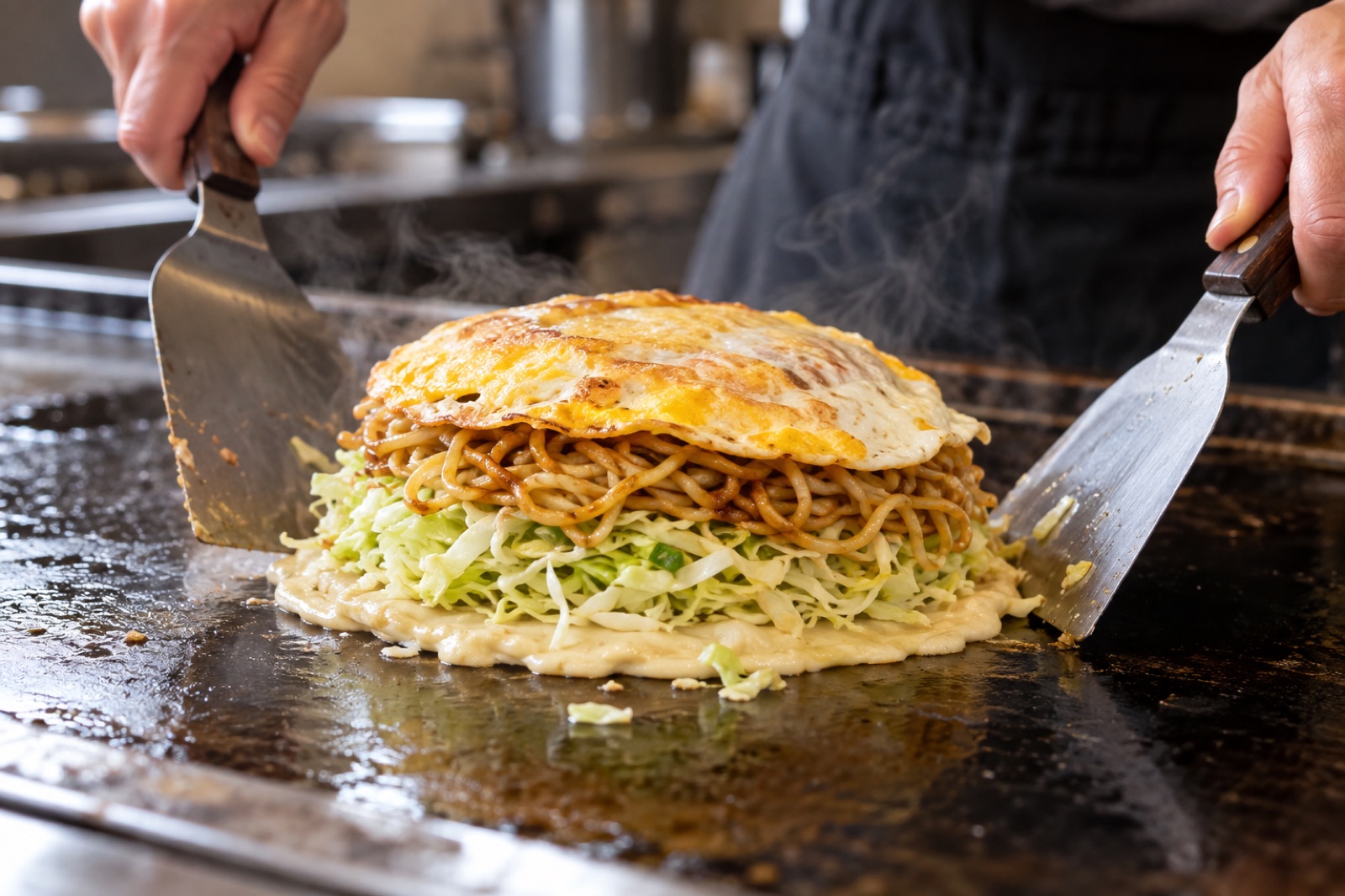
Osaka-style okonomiyaki belongs to the Kansai-style tradition. A typical version combines cabbage with batter and egg before cooking. Hiroshima-style uses a thin cooked batter base and builds other ingredients into layers, commonly including noodles. The Japan National Tourism Organization’s okonomiyaki guide sets out this basic distinction.
This is a more reliable introduction than judging the finished photograph. Sauce hides the surface, mayonnaise can obscure the edges, and a generous garnish does not tell you how the interior was made. Ask how the cook assembled it.
| What you are comparing | Typical Osaka/Kansai-style approach | Typical Hiroshima-style approach |
|---|---|---|
| Relationship between cabbage and batter | Cabbage is mixed into a batter-based mixture | Cabbage is piled over a thin base |
| Noodles in the basic version discussed here | Not included in the Osaka reference recipe | Prepared as a distinct part of the assembly |
| Egg in these reference methods | Mixed into the mixture | Cooked as a separate layer |
| Most useful thing to notice when eating | The cabbage and batter together | How a forkful or cut piece includes several layers |
The table is a reading aid, not a law covering every restaurant. The specific methods come from Otafuku’s Osaka-style recipe and Hiroshima-style recipe. Individual cooks and regional variations can differ.
If you enjoy the idea of vegetables held together in one savoury pancake, the mixed style is an approachable first choice. If the contrast of noodles, cabbage and a separate egg layer interests you, the layered style gives you more components to explore. That is a preference-based recommendation, not a ranking of authenticity or quality.
There is also no need to decide which Indian dish is its exact equivalent. A dosa, an uttapam or a chilla may provide a familiar point of reference for griddle cooking, but none of those names tells you what an okonomiyaki batter contains. Comparing the actual ingredients and construction is more useful than assigning a Japanese dish an Indian identity.
Imagine a flour-heavy breakfast pancake with a few vegetables sprinkled on top, and you may expect the wrong balance. In the mixed style, the cabbage is central to the structure and the bite. It is not merely a garnish that can be doubled or removed without changing the result.
Otafuku’s published Osaka example lists 120 g of cabbage and 30 g of okonomiyaki flour for one serving. Those two listed ingredient weights form a 4:1 ratio. That calculation does not mean the finished dish is 80% cabbage: water, egg, other ingredients and toppings also contribute to the whole. It simply illustrates why picturing a large quantity of pancake batter with a token spoonful of cabbage is misleading.
The number is recipe-specific. It is not a universal ratio for every flour mix or home kitchen. A different premix, cabbage cut or style may require a different method. Use it to understand the reference recipe, not to redesign another recipe by arithmetic alone.
A long strand and a short piece of cabbage do not occupy a mixing bowl in the same way. Follow the selected recipe’s cut instead of assuming that any bag of shredded cabbage produces the same mixture. This is especially relevant when switching between a recipe written for a finely mixed pancake and one written for a pile of layered vegetables.
Otafuku’s Kansai-style set guidance specifies cutting shredded cabbage into shorter pieces and shows a roughly 2 cm-thick pancake for that preparation. It recommends turning and steam-cooking without pressing the pancake down. Those instructions belong to that product and method, rather than to every style of okonomiyaki. See the manufacturer’s Kansai-style guidance.
The editorial lesson is to resist correcting an unfamiliar mixture towards the texture of a food you already know. If a cabbage-rich mixture looks less pourable than breakfast-pancake batter, adding water until it pours smoothly may move it away from the recipe’s intention. Check the specified quantities and ingredient state first.
Likewise, pressing a pancake because it looks thick is not a neutral gesture. In the mixed-style method just described, preserving the intended interior matters. “Make everything thinner” is not a reliable answer to uncertainty about cooking.
In a separate home-cooking note, Otafuku advises combining the final mixture one pancake at a time and cooking it promptly. It explains that a large batch can distribute batter and cabbage unevenly, while a mixed portion left standing can become watery.
That advice suggests a practical sequence for a small meal: prepare and measure the components, make sure the cooking space is ready, then combine the next portion. “Prep ahead” does not have to mean “mix the entire meal into one bowl ahead”.
If two pancakes turn out differently, ask whether they actually received comparable mixtures. One scoop may have contained more liquid and another more cabbage. That is a more useful first diagnosis than concluding that the second pan temperature was definitely wrong.
Avoid changing three things at once on the next attempt. Keep the recipe, portion and cabbage preparation consistent before deciding whether you need to adjust a particular step. This is a proposed troubleshooting approach, not a claim that we have tested your ingredients or cookware.
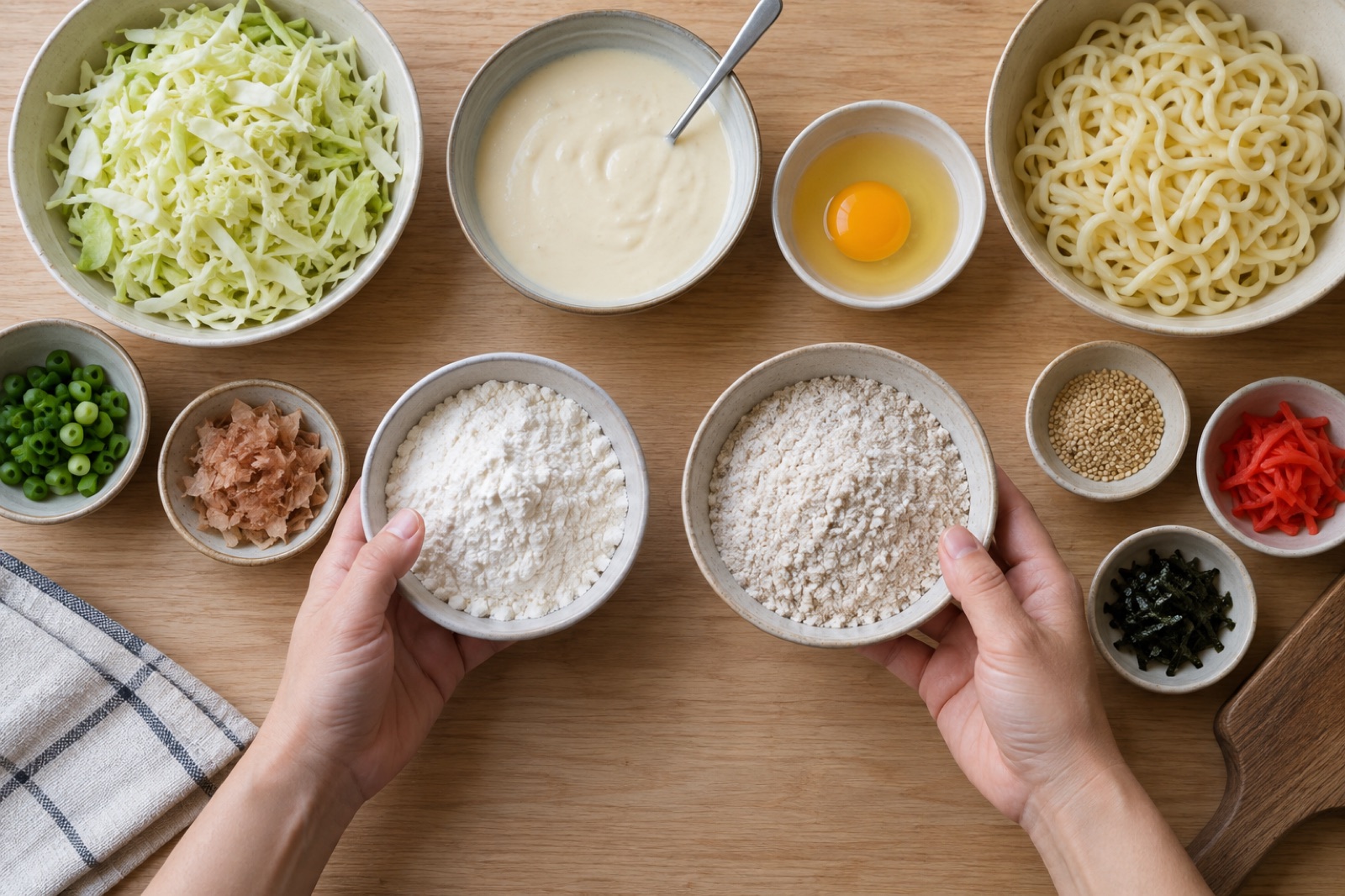
The layered version asks you to think about several components becoming one dish. A thin base supports vegetables; noodles are prepared separately; an egg layer joins the finished assembly. Stirring everything into the original bowl would produce a different structure.
Otafuku’s detailed Hiroshima-style cooking guide makes the sequence clearer than a finished photograph. It spreads a thin base, builds and turns the vegetable stack, cooks noodles in another area, combines them, then uses a separately spread egg before the final turn. This is a description of its workflow, not a replacement for the full recipe and cooking instructions.
Notice the practical consequence before choosing it as a first project: the method needs room for components at different stages. Having enough space for one finished circle is not necessarily the same as having enough working space to follow the entire method. Plan where the noodles and egg will cook before the first layer is on the heat.
That does not mean a household must buy a restaurant-sized teppan. It means you should choose a recipe expressly suited to the equipment you have. Do not compress a wide-hotplate method into one crowded pan and assume its timing and transfers remain unchanged.
The Kansai guidance above discourages pressing its mixed pancake. The Hiroshima guide, however, uses a light press during particular assembly stages. These instructions are not necessarily contradictory; they concern different structures and moments.
A transferable lesson is to read the action together with its purpose and timing. “Press lightly when joining these layers” does not mean flatten the cabbage pile throughout cooking. “Do not press this mixed pancake” does not mean a spatula must never touch a layered preparation. The recipe supplies the context that a short social-media tip can lose.
At the table, take a manageable piece that includes the layers rather than judging the dish from a loose strand of noodles alone. You are looking for how the components eat together. If the piece falls apart, you can still enjoy it; a tidy cross-section is not the only measure of a good meal.
The noodle choice is also worth asking about. JNTO’s introduction to Osaka’s griddle cooking notes yakisoba or udon in Hiroshima-style preparations. “It contains noodles” is therefore not a full description of the bite. Our udon guide explains why the noodle’s form and preparation matter before it reaches the final dish.
Brown sauce, pale mayonnaise, green seaweed and light fish flakes can look like a single recognisable finish in an illustration. At the table they are separate ingredients. Knowing their names helps you request a change precisely instead of asking for “the Japanese topping” to be removed.
Okonomi sauce supplies a concentrated sweet-savoury finish. Mayonnaise adds a different richness and tang. Aonori refers to the green seaweed garnish. Katsuobushi means dried fish shavings, not another type of seaweed. These ingredients appear in JNTO’s account of the dish, but their presence and quantities are not identical everywhere.
Tenkasu, the small tempura crumbs used within many preparations, deserves attention even though it may not be visible on top. Its appearance does not establish its ingredients. Otafuku’s Kansai set, for example, specifically describes squid ingredients in its included tempura crumbs. It should not be treated as an automatically vegetarian garnish simply because it looks like fried flour.
For a first taste, our suggestion is to keep optional extra sauce or mayonnaise separate until you have tried the portion as served. That lets you notice the cabbage, batter or noodles before adding more seasoning. It is not a claim that a particular restaurant has used the ideal quantity for your preferences.
Sweetness also does not mean the sauce is a dessert syrup, and “Japanese sauce” does not promise chilli heat. If you want a spicy addition, ask what it is rather than assuming every brown condiment on the table has the same function. A topping can change your experience of the dish without changing its underlying regional construction.
There is a visual trap here for fans recreating a food image: matching the zigzag does not establish that you have matched the recipe. You can make a beautiful finish over a poorly balanced interior, or an untidy finish over a satisfying one. Learn the mixture or layers first; decoration can follow.
For an Indian diner who avoids meat, seafood or egg, “vegetable okonomiyaki” is not sufficiently precise. A kitchen may use that phrase for the visible filling while preparing every version with the same egg-and-stock base.
The useful conversation moves from the inside out: flour mix, added liquid or stock, egg, fillings, crumbs, sauce, mayonnaise and finishing flakes. You are not asking the server to guess a dietary category; you are asking about specific components.
A flour mix can already contain fish seasoning. Otafuku’s Kansai-region 100 g okonomiyaki flour, for example, lists bonito extract and several fish powders alongside wheat flour, yam powder and other ingredients. Replacing the stock with water would not remove seasoning already in that powder. This is an exact-product example, not a claim about every okonomiyaki mix.
It also explains why a premix needs its own instructions even when dietary suitability is not a concern. The same product includes salt and baking powder: it is doing more than supplying plain flour. Adding all the seasoning and raising ingredients from a separate plain-flour recipe could duplicate things already in the packet. Read what you have before deciding what to add.
Sauce needs the same product-level attention. Two similarly named official Otafuku listings demonstrate why a brand name alone is not enough:
These listings do not identify what a particular Indian shop or restaurant currently stocks. Check the bottle actually being used, including its ingredient list, rather than relying on a photograph of another market’s packaging.
Removing pork is a topping change. Removing egg from a recipe that relies on it in the mixture or as a separate layer is a change to the construction. It may be possible, but the original result should not be promised unchanged.
Otafuku publishes a vegan variation using a wheat-flour and almond-milk mixture with kale and mushrooms. It is useful evidence that an adaptation can be designed deliberately, rather than made by removing ingredients one after another from a meat-and-egg recipe.
Treat it as that particular variation, not a guarantee about every substitute. Almond milk also introduces an ingredient that some diners need to avoid. The page’s optional mayonnaise suggestion still requires a specifically vegan product if the finished meal is to remain vegan; ordinary egg-containing mayonnaise would defeat the purpose.
Dietary labels answer different questions. Vegan does not automatically mean suitable for someone avoiding onion or garlic, and a wheat-based vegan pancake is not gluten-free. If you have an allergy, ingredient suitability and the kitchen’s cross-contact controls both need confirmation. Do not infer an allergen-free preparation from the absence of visible meat.
Our broader Japanese vegetarian food guide for Indian readers covers the stock and seasoning vocabulary in more detail. For this dish, the immediate priority is a clear answer about the actual mixture and sauces before cooking begins.
At home, the easiest mistake is assembling a recipe from attractive fragments: the flour quantity from one page, the cabbage quantity from another, the no-egg adaptation from a third and the cooking time from a short video. Every individual fragment may be reasonable; the combined method has not necessarily been tested by anyone.
Choose your route first. For a mixed-style introduction, use a complete pan recipe with a manageable portion. For a layered project, choose instructions that account for your cooking surface and transfers. If you need an egg-free or otherwise adapted meal, start with a recipe designed for that requirement.
Then read the ingredient list as a set of exact states. Plain wheat flour and seasoned okonomiyaki flour are not interchangeable labels. A quantity of cooked or ready-to-use noodles should not be replaced blindly with the same weight of dry noodles. “One cabbage” is less precise than a specified prepared weight, especially when your cabbage is a different size.
Suppose a selected recipe produces one pancake and you need two servings. Doubling its ingredient quantities can supply two portions; it does not tell you that the same pan should hold one pancake twice as thick.
As a simple geometry illustration, two circles with a diameter of 16 cm have twice the combined area of one such circle. To put the same volume into one circle at the same thickness, its diameter would need to be about 22.6 cm, because 16 × √2 ≈ 22.6. These are hypothetical dimensions, not a cooking recommendation or a manufacturer’s required size.
The purpose of the calculation is practical: extra mixture needs somewhere to go. A larger footprint may leave less room for a spatula; a thicker portion changes the cooking task. For a first attempt, making the specified portions separately is easier to compare with the recipe than improvising one oversized version.
Keep heating guidance attached to the exact method too. A hotplate temperature in degrees is not a directly transferable gas-knob position, and a published approximate time is not proof that your thicker or differently filled pancake is cooked through. Follow the chosen recipe and ingredient guidance; do not use browning alone to excuse an uncooked centre.
For a disappointing result, diagnose the stage rather than immediately adding more sauce. A watery mixture calls for checking measured liquid, vegetable preparation and waiting time. An awkward turn calls for checking portion size, pan space and the recipe’s timing. A result dominated by seasoning calls for reviewing both the premix and the toppings, not only the salt added at the end.
You can keep the next attempt simple: note the recipe, the exact flour or mix, prepared cabbage weight and one observation you want to investigate. Change one relevant decision, not the entire dish. That gives a home experiment a clearer purpose without pretending that a kitchen notebook is a professional product test.
Osaka versus Hiroshima is an excellent introduction, but it is not the whole map. Japan’s Ministry of Agriculture, Forestry and Fisheries records several variations within Hiroshima Prefecture itself. Kure’s version uses thin udon and is folded; Shōhara’s uses rice instead of noodles and ponzu rather than the usual okonomiyaki sauce. These examples alone show why “all Hiroshima versions contain exactly the same noodles” is too rigid. Read MAFF’s regional account.
The same account connects the dish’s development to the older issen yoshoku preparation and its transformation during the post-war period. That history is more useful than a claim that a single modern restaurant version defines every authentic plate. The dish has a regional identity, but it also has a history of change.
Do not confuse that flexibility with “anything round counts”. The mixed or layered method still tells you something meaningful. A clearly described adaptation lets the diner understand both what it draws from and what has changed. Calling a mushroom-and-egg-free version an adaptation is information, not an apology.
Monjayaki is another name you may encounter, particularly in Tokyo-related food content. JNTO distinguishes its much more fluid preparation: ingredients form a ring on the griddle and the liquid mixture is added inside. It should not be judged as a failed okonomiyaki because it does not become the same firm pancake. The menu name helps identify the intended result.
For a first restaurant order, ask three concise questions: is this mixed or layered, which noodles or major fillings are included, and can the complete preparation meet your dietary needs? If there is a hotplate at the table, also ask whether staff cook the dish or expect you to do so. A griddle is not automatically an invitation to take over.
Once those questions are answered, you can enjoy the meal without conducting an authenticity inspection. Notice the cabbage, the way the components hold together and how much topping you prefer. Your second order can explore a different style on the basis of what you actually liked.
The most rewarding first plate is not necessarily the one with the most toppings or the most impressive flip. It is the one you understand well enough to choose—and, if you cook it yourself, a method you can follow from the bowl to the final cut.
AUTHOR OF THIS ARTICLE
SoJapan
SoJapan India Pvt. Ltd. is a Japanese-founded company based in Gurugram. We bring Japanese food, anime goods and apparel materials to Indian businesses, with a sister company in Kyoto that works directly with makers in Japan.