The nicest thing about a loose-leaf notebook is not that you can remove a page. It is that you can put the right page beside another one: a corrected explanation next to the original problem, a character sketch beside its colour notes, or a vocabulary example beside the word you keep forgetting.
That freedom depends on a less glamorous detail: the paper has to fit. “A5 refill” sounds specific until you discover two A5 products with completely different hole patterns. “60 sheets” sounds generous until you realise it describes capacity, not the contents of the package.
For readers in India exploring Japanese stationery, this guide starts with those practical decisions. The examples use published specifications from Kokuyo, Maruman and Raymay Fujii, checked in September 2026. They are not products we claim to have tested, and Japanese product pages do not establish Indian stock, delivery or pricing.
Check these four things before choosing colours:
If you want a notebook that simply opens and preserves everything in order, a bound notebook may still be the easier choice. Loose leaf earns its place when moving, replacing or combining pages solves a real problem.
In a removable-page system, loose leaf means separate sheets intended to be held by a compatible binder. The binder provides the opening mechanism and cover; the refill provides the writing surface. A ring notebook is not automatically refillable just because you can see rings along its spine.
Maruman’s standard loose-leaf range gives a useful starting map. Its product selector pairs these paper dimensions with these hole counts. The table describes that range, not every notebook or planner carrying the same size name. Maruman’s loose-leaf sizes and formats.
| Standard refill in this range | Paper width × height | Punched holes | Useful starting question |
|---|---|---|---|
| A5 | 148 × 210 mm | 20 | Will a compact page hold my usual notes without constant turning? |
| B5 | 182 × 257 mm | 26 | Does the larger writing area justify the space it takes in my bag? |
| A4 | 210 × 297 mm | 30 | Do I need this much room for diagrams or full-size documents? |
Those are the sheet dimensions. The useful writing area is smaller once you allow for the punched margin, any printed margins and space your hand needs near the rings. A page that fits a printed diagram edge to edge may still be uncomfortable to annotate.
Try a simple planning exercise with ordinary paper before buying. Mark out the candidate rectangle and sketch the kind of page you actually use: a long equation, a paragraph with corrections, a drawing plus notes, or a two-column vocabulary entry. This tests available space, not the feel of a Japanese paper you do not yet own.
For an illustrative comparison, the listed B5 rectangle has an area of 182 × 257 = 46,774 square millimetres. The A5 rectangle has 148 × 210 = 31,080 square millimetres. B5 therefore offers about 50.5% more total sheet area in this comparison. That is not 50.5% more usable notes: the layout, margins and handwriting still decide what fits.
Check actual dimensions when a listing says “B5”, “semi-B5”, “slim” or “variant”. A familiar size label is a useful search term, but the measurements and intended refill system settle the purchase. Avoid choosing a binder first and hoping a vaguely similar paper size will adapt to it.
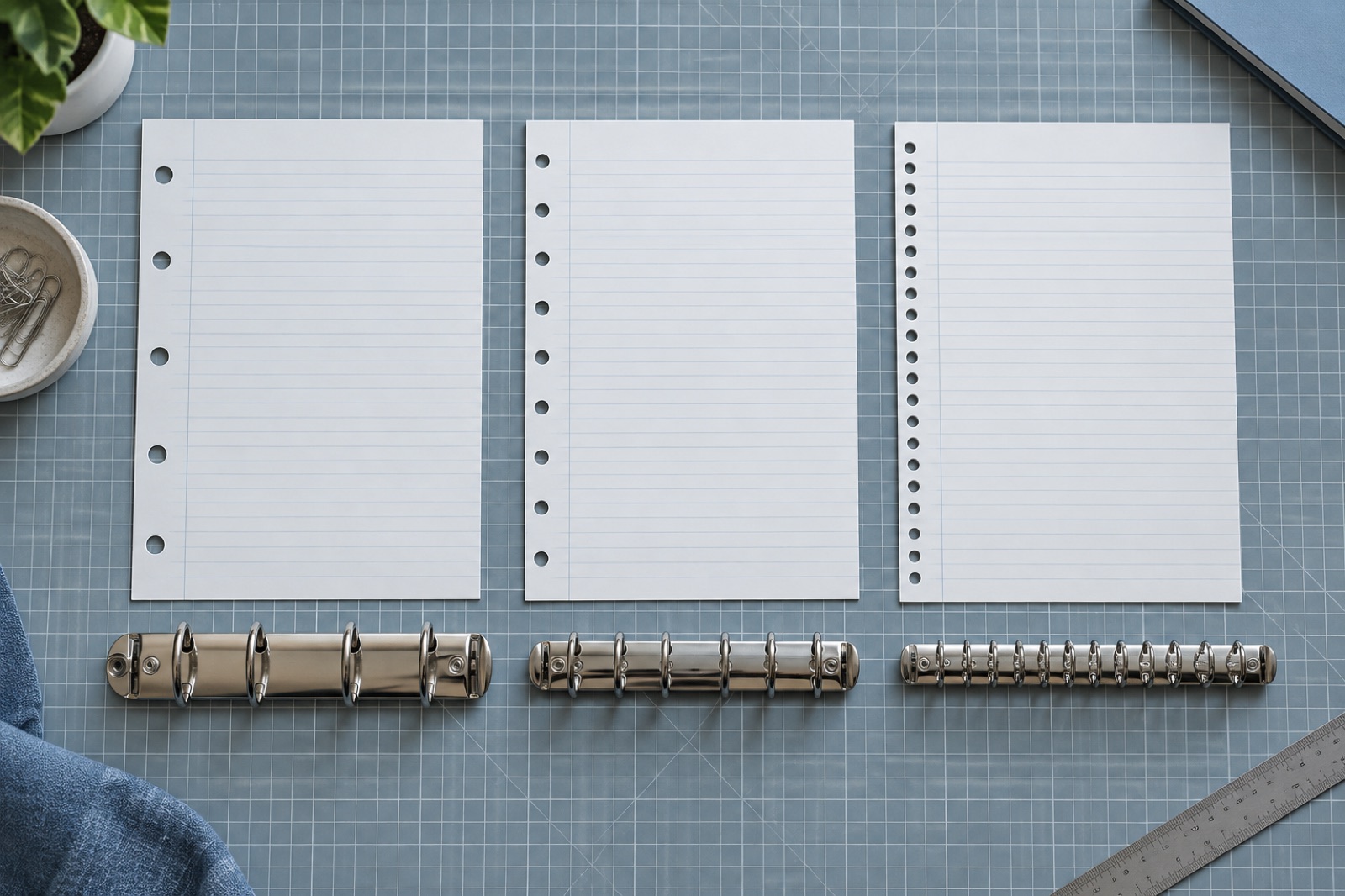
Paper size and hole pattern answer different questions. Size tells you the rectangle you are working with. The pattern tells you where the mechanism must pass through it. The same rectangle can be punched for different systems.
Raymay Fujii’s decona A5 accessories page lists 148 × 210 mm note refills for a six-hole planner system, including its Tomoe River note-paper options. These should not be mistaken for the 20-hole A5 loose leaf in the table above. Raymay Fujii decona A5 refills and accessories.
This is why a photograph showing the punched edge is worth requesting when a seller’s title is unclear. Ask for the exact manufacturer model code, the dimensions and the intended binder system. “Japanese A5 paper” is not enough information to confirm compatibility.
Matching hole counts is not the whole inspection, either. Alignment, spacing, the position of the edge and the manufacturer’s compatibility statement matter. Do not turn a paper specification into a blanket promise that every brand combination will work identically.
There is an interesting exception to the instinct to demand the same number on everything: purpose-made small inserts. Maruman’s L1431 Loose Leaf Mini is 128 × 86 mm with nine holes. It is designed as a small writable insert, not as an unsuccessfully shortened A5 sheet. Maruman L1431 Mini specifications.
A concrete example of mixed sizes appears in Maruman’s B5 Clean Tone Slim F019 binder, which includes full-size sheets and Mini sheets. The lesson is not that any nine-hole page fits any binder. It is that a supported accessory can occupy part of a larger mechanism; you should verify that intended relationship instead of guessing from the numbers alone.
Use a small insert for something that belongs beside a longer page: an unresolved question, a correction, or a reminder to check a source. If the note becomes central to understanding the topic, integrate it into a full page rather than letting layers of inserts hide the original text.
Kokuyo’s transparent A5 Smart Ring model ル-SP130T accepts A5 20-hole loose leaf, but its outside dimensions are 221 × 158 × 13 mm, stated as height, width and spine width. That is larger than an A5 sheet, as a cover and mechanism need room around the paper. Kokuyo A5 Smart Ring specifications.
For bag planning, compare the outside dimensions with the compartment you intend to use. For refill planning, compare the supported paper dimensions and pattern. Swapping these two measurements can make a perfectly ordinary specification seem contradictory.
Accessories add another layer. A side tab extends beyond the main sheet; a pocket may have a seam outside the space occupied by its contents. A binder can accept the punched edge while failing to cover the accessory’s outer edge. “The rings close” and “the whole setup fits” are different checks.
Maruman explicitly warns that commercially available pockets or indexes may protrude from its Clean Tone Slim F019. Its own stated body dimensions are 272 × 199 × 15 mm. This is a useful trade-off to notice: a compact cover does not necessarily shelter every accessory sold for that nominal paper size. Maruman Clean Tone Slim F019 and its accessory warning.
Before building a decorated system, imagine closing it with the proposed tabs and pocket in place. Is the tab protected? Does a filled pocket create a lump under the next writing page? Is a pen attached to the outside adding width where your bag is already tight?
The restrained starting choice is one compatible divider set, if needed, and no pocket until you know what must go inside it. A pocket for a specific loose handout has a job. A pocket filled with miscellaneous objects simply because it came in a bundle can make the notebook harder to use.
Three quantities often appear near one another in a listing: how many sheets the binder holds, how many are supplied, and how many are in a separately sold refill pack. None should be substituted for another.
Japanese packaging can help you untangle them. 穴 indicates holes and 枚 counts sheets or individual flat items. On the manufacturer pages used here, 最大収容枚数 labels maximum sheet capacity, while 標準収納枚数 labels standard storage capacity. セット内容 identifies the supplied set contents. Read the words around a number: “10枚” next to inner paper is not the same statement as “60枚” next to capacity. A translated shop title may omit that distinction, so retain the original model code when asking a seller to clarify.
The A5 Smart Ring above is specified for a maximum of 25 sheets, or a stack thickness of 2.5 mm, and is supplied with 10 inner sheets. Its larger B5 Smart Ring 60 counterpart, transparent model ル-SP706T, is specified for 60 sheets, or 6 mm, but also includes 10 inner sheets. Kokuyo B5 Smart Ring 60 specifications.
A sheet has two sides. Twenty-five sheets can provide fifty writing sides if both sides are usable for your purpose; writing on both sides does not double the physical stack. Conversely, calling a product “50 pages” does not prove that it contains fifty sheets. Read the maker’s unit, particularly when a retailer has translated the listing.
The thickness qualification is valuable. Heavy drawing paper, plastic dividers and filled pockets do not necessarily occupy the same space as the writing sheets used to express a binder’s nominal capacity. Do not treat a large printed sheet count as permission to force the mechanism shut.
Here are two B5 products that illustrate different jobs. The numbers are manufacturer specifications, not results from a comparative test.
| B5 / 26-hole example | Stated capacity | Outside height × width × thickness | What to investigate |
|---|---|---|---|
| Kokuyo Smart Ring 60, ル-SP706T | Maximum 60 sheets / 6 mm stack | 270 × 208 × 17 mm | A fold-back format for active notes; leave room for page turning |
| Maruman File 26, F678R | Standard capacity 200 sheets | 275 × 231 × 38 mm | A larger binder when storage matters more than a slim daily carry |
Maruman describes the File 26 as a storage-oriented binder with a locking metal mechanism. Its greater dimensions are part of the comparison, not an inconvenient detail to omit. Maruman File 26 F678R specifications.
Do not read the table as a ranking. The bigger binder has more stated capacity, but it also asks for more bag or shelf space. The smaller one can be the better working notebook if old material has somewhere else to go.
Suppose, purely as a planning example, you want to carry three subjects with twelve active sheets each, plus eight blank sheets. That is 3 × 12 + 8 = 44 paper sheets. Against a nominal 60-sheet figure, sixteen sheets remain before considering accessories and actual stack thickness.
That calculation is not a guarantee that sixteen more sheets plus arbitrary pockets will fit. It tells you where to begin a physical check. If your dividers are thick or you need a document wallet, the remaining usable room changes.
Now imagine adding six sheets per subject during a week: another eighteen sheets would make 62. You have exceeded the nominal figure before counting accessories. The useful response is to archive completed material or choose a different setup, not to discover how much strain the rings tolerate.
Your own rate may be entirely different. Count a few ordinary days of notes before buying storage for a term. A worked example should help you ask the question, not replace evidence from your actual study or hobby.
An attractive mechanism matters most when the notebook is open. Kokuyo describes Smart Ring covers folding back, allowing a smaller desk footprint, and a mechanism that opens widely for changing sheets. These are features of that series, not proof that every binder should be folded behind itself. Kokuyo’s Smart Ring design explanation.
Think about three possible working positions. You can write with the binder open as a spread, fold back a model designed for it, or remove the current sheet and write on a suitable flat support. Each arrangement solves a different problem.
An open spread keeps related pages visible together. That can help with a diagram and its explanation, but it occupies more desk space. Folding back reduces the open footprint, yet the rings remain something to check against your normal hand position. Removing the sheet clears the mechanism from the writing area, but means you must return and identify the page afterwards.
If possible, try the arrangement on a permitted display sample. Write only with permission. Check the top, middle and lower parts of a page rather than judging comfort from one short word near the centre. The important result is whether your usual writing movement has space.
Open and close a binder according to its own instructions, on a stable surface. Release the intended mechanism before lifting sheets; do not pull paper over closed rings or force an unfamiliar latch. Close it fully before returning it to a bag, and keep fingers clear of the moving parts.
The Smart Ring 60 product page identifies an added stopper feature. That is a reason to read its particular instructions, not to assume all models sharing “Smart Ring” have identical opening steps. A mechanism you understand is more useful than one you operate by trial and force.

A bound notebook provides order automatically: one page follows another. Loose leaf lets you change that order, which means the identifying information has to travel with the sheet. Otherwise a neatly organised binder can become a collection of anonymous notes.
Use a small header: topic, date and a short page identifier. For example, “Vectors / 29 Sep / V03” carries more information than “page 3”. If a later correction belongs after it, “V03a” is an option; the exact system matters less than keeping it understandable without relying on its current position.
For notes written on both sides, consider adding the identifier to the reverse as well. A photograph of the back of a sheet should not require someone to guess which front it belongs to. If you digitise pages, include the same identifier in the file name or caption.
Keep related material together for a reason. A problem, your attempted solution and a correction can form a useful sequence. Moving only the polished answer into a “finished” section may separate it from the mistake that made the explanation valuable.
Here are three original uses of removable pages, rather than promises that a stationery purchase improves learning:
A language notebook: keep a short example beside the vocabulary it uses. Move a confusing entry into a review section, but retain a reference to where it came from. Reorganising a page is not the same as practising the word; the system should make the practice easier to begin.
An anime journal: separate episode observations from a later character summary. Record the episode number with each note, and mark spoilers if you share the binder with someone watching behind you. When your interpretation changes, add a dated follow-up instead of rewriting the old entry as though you always knew the answer.
A drawing project: place a sketch beside notes about the design choices you want to revisit. Use paper appropriate to the medium rather than assuming ordinary note refills suit wet paint or heavy marker work. Label versions before rearranging them so that the discarded idea and the revised one do not become indistinguishable later.
Start with broad sections you can remember. If every session creates a new category, the classification system is becoming a second hobby. That may be enjoyable, but it is different from making notes easier to retrieve.
A sheet can fit every ring and still be a poor match for your pen. Maruman describes its standard writing paper as suitable for several writing tools and explains that it tests paper with different inks and instruments. Treat that as the manufacturer’s design claim, not a guarantee for every pen or an independent comparison with other brands. Maruman’s paper explanation.
The first compatibility check is mechanical: dimensions, pattern and intended system. The second is practical: can you write comfortably on the paper with the tools you use? Do both before buying a large refill supply.
Test a small area on paper you own or an authorised sample. Include your normal writing and, if relevant, an underline or highlight. Inspect both sides before deciding whether you want to use the reverse. An ink shadow visible through the sheet is different from ink actually penetrating it; neither result tells you whether the holes fit.
Our Japanese stationery guide covers ruling and paper behaviour in more detail. If you are switching to bottled ink, the first Japanese fountain-pen guide separates pen, ink and paper issues without assuming that a more expensive notebook fixes everything.
For printed inserts, check the printer’s supported paper sizes and media before feeding pre-punched sheets. A printable A5 layout does not establish that your particular loose leaf is suitable for your printer. Nor does shrinking an A4 document to A5 create an appropriate binding margin automatically.
If punching plain paper yourself, use a tool explicitly supporting the intended pattern and follow its sheet limit. Test alignment on an expendable sheet first. A six-hole planner punch is not a shortcut to a twenty-hole system, and adding new holes near existing ones may leave a weak edge.
Refill availability matters more than the novelty of the first binder. Before ordering an unfamiliar format, locate the exact paper specification you would need to buy again. Ask the seller whether the displayed variant is the one supplied, rather than relying on a colour photograph shared across several sizes.
Your purchase note can be short: binder model, supported paper size, hole pattern, capacity, supplied contents and the refill model you intend to use. Add accessory dimensions only if you are actually buying those accessories. This keeps the enquiry specific enough for a seller to answer.
Compare the total setup you need, not just the empty cover price. A binder supplied with a few sheets may require an additional refill pack; one with a substantial starter supply may not. Delivery charges and return conditions also matter, but they must come from the actual Indian listing or seller. Converting a Japanese recommended price into rupees does not establish a local selling price.
For a first trial, one binder, a modest quantity of compatible paper and a few clearly labelled sections are enough. With it lightly loaded, turn sheets from front to back and check that their edges do not catch. Add the planned dividers, then repeat the check before filling it further. Use the setup for a real task and distinguish insufficient page area, an awkward ring position, too much carried material and difficulty finding old notes. Each problem suggests a different adjustment.
If the physical format works but you keep carrying finished pages, separate active notes from storage. If the format itself is wrong, adding more accessories is unlikely to rescue it. And if moving pages offers no benefit to your work, a simple bound notebook remains a sensible outcome rather than a failed experiment.
The point of a Japanese loose-leaf system is to make a page useful in more than one position. Choose a refill that fits, a cover that accommodates the actual contents, and an order you can reconstruct when a sheet leaves the rings. Then let the notes—not the number of accessories—decide what you add next.

AUTHOR OF THIS ARTICLE
SoJapan
SoJapan India Pvt. Ltd. is a Japanese-founded company based in Gurugram. We bring Japanese food, anime goods and apparel materials to Indian businesses, with a sister company in Kyoto that works directly with makers in Japan.