← JOURNAL29 Sep 2026
Your First Japanese Fountain Pen: From the First Fill to a Page You Enjoy Writing
 By SoJapan
The first interesting thing about a fountain pen happens before you choose a beautiful ink colour. You put the nib on paper, reduce the pressure, and discover whether the pen will write comfortably in your normal hand.
That is a better starting point than asking which Japanese fountain pen is the most prestigious. A handsome pen can still be the wrong match for small notes. A fine nib can still produce an untidy line on unsuitable paper. A converter can contain a visible pocket of air without being broken.
For readers in India exploring Japanese stationery, this guide follows the pen from its first ink supply to ordinary notebook use. Pilot’s Kakuno and Platinum’s Preppy provide concrete examples, not a league table of products we have personally tested. Manufacturer information was checked in September 2026; the comparison exercises and conditional recommendations are editorial guidance.
Before the first page:
You can enjoy this hobby without collecting bottles immediately. The first useful achievement is a page whose writing you can predict.
A fountain pen contains an ink reservoir, a feed and a nib. In Platinum’s explanation, capillary action draws ink through the nib’s narrow channel into the paper, while air enters the reservoir as ink leaves. The feed also helps regulate the supply rather than simply acting as an open pipe. Platinum’s explanation of fountain-pen construction.
This matters because writing is a relationship between several parts. The reservoir may contain ink while the nib still fails to put down a consistent stroke. Conversely, a broad, untidy line does not automatically mean that the pen is releasing too much ink: what happens after ink reaches the sheet matters too.
The change in pressure is especially important. Pilot explains that excessive force can spread the nib’s slit, interrupt ink delivery and deform the nib. Its selection advice also distinguishes firmer nibs from softer ones for people with stronger writing pressure. A firmer nib is not permission to press indefinitely harder. Pilot’s guidance on nib choice and writing pressure.
Begin with relaxed, ordinary writing. Do not attempt dramatic thick-and-thin strokes simply because a video shows a nib bending. The beginner pens discussed here are not being recommended as flexible calligraphy tools.
There is another adjustment that pressure cannot fix: rotation. Pilot identifies a twisted writing position, with one side of the nib lifted from the sheet, as one possible cause of a missing first stroke. Try keeping the nib facing forward and its writing surface in contact with the page. This is a diagnostic possibility, not a claim that every skipping pen is being held incorrectly. Pilot’s explanation of first-stroke skipping.
Give yourself a modest task: a date, a short sentence and a few numbers. You are checking whether the tool works in your hand, not auditioning for a handwriting competition. If every word requires conscious wrestling with the grip, that is useful information about the fit.
Extra-fine, fine and medium labels help you navigate a range, but do not turn them into a universal ruler. A label on one model is not sufficient evidence that it will make an identical mark to the same label elsewhere. A photographed sample also combines a particular nib, ink, paper and writer.
Pilot’s guidance associates finer points with compact notes and wider points with larger writing tasks. The useful interpretation is to start with your available space. If your lowercase letters already touch one another, a wider stroke is unlikely to create more room inside them. If you mostly write large headings, the finest option need not be your default.
For an Indian reader, the most informative sample is whatever you really write: English, Hindi, Tamil, Bengali, another language, mathematical notation or a mixture. There is no need to invent a single “Indian handwriting” style. Copy a representative sentence and include the small details you need to distinguish at a glance.
A practical sample might contain a name, a date, a normal note and a line of figures. If you routinely use subscripts, punctuation or closely spaced annotations, include those. Check the result at normal reading distance after it dries, rather than deciding from a magnified photograph of one impressive word.
Line width and writing feel are different questions. You may like the appearance of a very small mark but dislike the sensation of that combination on your usual paper. Equally, a pleasantly smooth demonstration on a shop’s sample pad does not establish how the pen will behave in your own notebook.
If a seller permits a writing trial, ask whether you can use a small piece of your usual paper. Keep the comparison fair: normal handwriting size, the same sort of sentence and a light hand. Do not bear down to make one pen look darker. If no trial is possible, look for samples that identify both nib and paper, and treat them as context rather than a guarantee.
Nor should you assume that a gold nib is automatically the answer to discomfort. Platinum’s discussion of nib materials explains differences in stiffness, but even its comparison of gold alloys is qualified by using the same shape. Material alone does not describe the complete geometry or your grip. Platinum’s guide to nib materials.
For a first purchase, our priority would be a usable point size and comfortable hold before a precious-metal upgrade. That is a practical buying judgement, not a claim that expensive nibs have no appeal.
A cartridge is a replaceable, prefilled supply. A converter is a compatible refillable reservoir that lets the pen draw bottled ink. They answer different everyday preferences: simple replacement versus choosing and handling a bottle.
The word compatible does considerable work here. Do not buy a cartridge merely because its photograph resembles the one in your pen. Pilot’s current cartridge guidance describes its own cartridge system; that does not establish interchangeability with Platinum or another manufacturer. Match the pen’s documentation and the supply’s exact identification. Pilot’s cartridge compatibility guidance.
For a newcomer who mainly wants to start writing, an approved cartridge removes one decision and one filling operation. It also makes it easier to identify what ink is in the pen. Choosing cartridges is not a lesser form of the hobby.
A converter becomes interesting when bottled ink is part of what you want to explore. Before buying one, check whether it is included, whether the exact model fits, and whether the bottle you want is approved for that pen. A photograph showing a converter beside a pen is not a reliable package-contents list.
| Your immediate priority | A sensible starting direction | What to verify first |
|---|---|---|
| Write with minimal setup | A compatible prefilled cartridge | Exact cartridge type and whether one is supplied |
| Choose a bottled colour | A compatible converter and approved ink | Converter model, inclusion and filling instructions |
| Use the pen only occasionally | Consider the cap design as well as the nib | Manufacturer’s storage and cleaning guidance |
| Write small everyday notes | Compare finer nib options on your paper | Readability, grip and dry-page appearance |
These are routes into the hobby, not four products you need to own. Someone may reasonably choose the first and third priorities together. What matters is that the actual pen supports the combination.
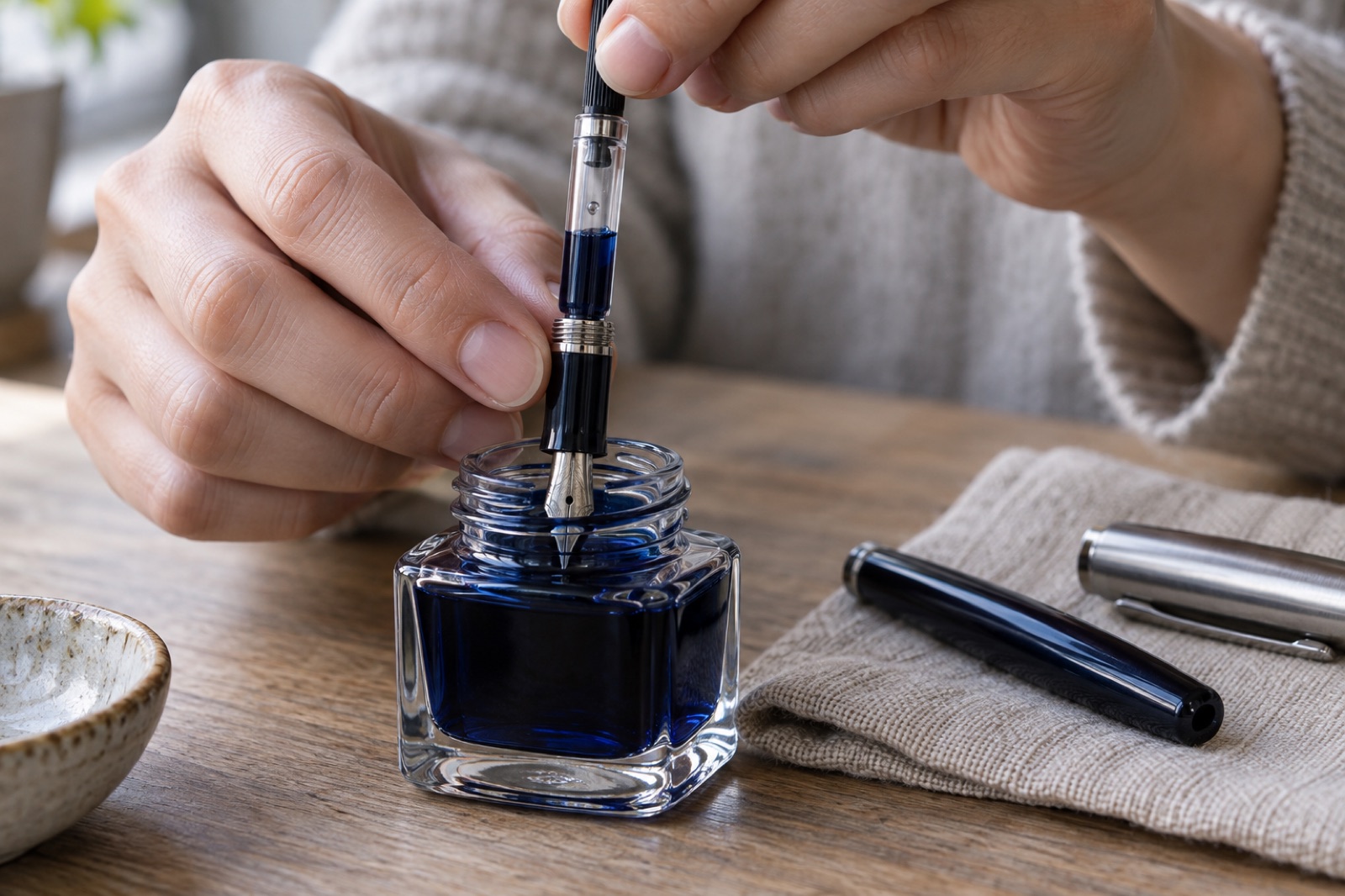
Pilot’s English Kakuno manual gives a useful model-specific starting point. For a cartridge, remove the barrel and insert the cartridge straight into the section, firmly and evenly, without twisting. Allow time for ink to reach the nib. Its illustrated writing cue is to keep the nib’s smiling face upward. Pilot Kakuno English instruction manual, PDF.
For bottled ink, that manual distinguishes two separately sold converters: CON-40, operated by rotating its knob, and CON-70N, operated by pressing its knob. Insert the compatible converter as directed, immerse the nib to the level shown in the diagram and use the specified control to draw ink. Avoid striking the nib against the bottle’s bottom, then wipe ink from the nib and section with a soft tissue or cloth. Consult the diagrams for the full sequence rather than treating the two mechanisms as interchangeable.
Prepare the space before opening the bottle. Clear away important papers, provide a place for the cap and barrel, and have an absorbent cloth ready. This is ordinary spill planning, not a requirement for a special desk mat or a collection of accessories.
Keep the first session simple. Fill one pen with one ink. If the first page looks unexpected, you then know what combination you are examining. Filling several new pens in different colours at once may be enjoyable later, but it makes a beginner’s troubleshooting less clear.
Pilot specifically explains that the CON-40 draws some air from the pen’s internal passages along with ink. Its specified ink intake is 0.4 ml, and visible air can remain after a normal fill. A reservoir that is not visually packed with ink is therefore not, by itself, evidence of failure. Pilot’s CON-40 filling explanation.
That number is useful for understanding the component, but it cannot honestly be converted into a universal number of notebook pages. Page size, how much you write, the nib and the resulting stroke all change the demand. A promise such as “one fill lasts a week” would need conditions that a generic beginner guide cannot supply.
For your own routine, record when you fill and when you next need ink. Keep the same setup for a few fills before deciding whether its capacity is inconvenient. That turns a specification into a personal observation without pretending that someone else’s writing schedule is yours.
Do not repeatedly dismantle the connection in pursuit of a perfectly full-looking reservoir. If you suspect an actual filling problem, compare your steps with the correct manual and ask the seller or manufacturer before improvising a repair.
Platinum’s Preppy demonstrates why a beginner comparison should include more than nib width. The brand describes a stainless-steel nib and its Slip & Seal cap mechanism, claiming that the pen resists drying out for a year with the cap closed. This is the manufacturer’s product claim, not an independently tested promise for every storage condition or ink. Platinum’s Preppy product family.
The distinction matters for an occasional journal writer. A cap designed to limit drying addresses a different question from whether a nib makes small letters. It does not establish that the pen will suit your grip, that you may leave it uncapped, or that maintenance instructions no longer apply.
Be precise about the version you are comparing. Platinum’s Preppy Crystal PSQC-400 page lists a 03 fine stainless-steel nib and an included black ink cartridge. Those are details of that listed model, not a promise that every Preppy package in every market has identical contents. Preppy Crystal official specification.
The model code is worth more than a seller’s broad description of “a Japanese beginner pen.” Ask for the nib designation and included supplies together. If the listing does not identify the cartridge, resolve that before adding a supposedly compatible pack from another listing.
There is no need to crown either Preppy or Kakuno the universal winner here. A reader interested in the Kakuno’s illustrated orientation cue is making a different choice from one particularly interested in the Preppy’s cap design. Neither feature can tell you how comfortable the pen will be in your hand.
The first bottle can be surprisingly distracting: a colour looks wonderful online, and the pen itself starts to feel like an accessory to that purchase. Reverse the order. Establish what the pen can use, then choose among suitable colours.
Pilot says that other manufacturers’ inks can be used in its fountain pens, but differences in viscosity and ingredients can affect writing performance. That is more nuanced than either “all fountain-pen ink is identical” or “every other brand will destroy the pen.” For a straightforward first setup, using ink explicitly recommended for the particular model reduces uncertainty. Pilot’s guidance on other manufacturers’ inks.
Do not treat “ink” alone as a compatibility statement. The label and maker’s instructions should identify the intended writing instrument. Likewise, waterproofness, permanence and suitability for a particular pen are separate claims. A colour name does not answer any of them.
Avoid homemade mixtures as a beginner experiment. Platinum sells a specifically designated Mixable Ink range, which illustrates the importance of an explicit mixing claim; it is not blanket permission to combine whatever bottles happen to be on your desk. Platinum’s explanation of its ink types.
For notes that must remain usable, first decide what “lasting” means in your situation. Do you need resistance to accidental water, acceptance on a form, or simply a colour you can read clearly? Check the actual ink specification and the receiving institution’s rules where relevant. We are not claiming that any pen in this guide is approved for a particular Indian examination.
You can still enjoy colour in less consequential pages: a reading journal, a private list of anime you want to revisit, or handwritten commentary beside a sketch. Keep the creative page and the official record as separate decisions when their requirements differ.
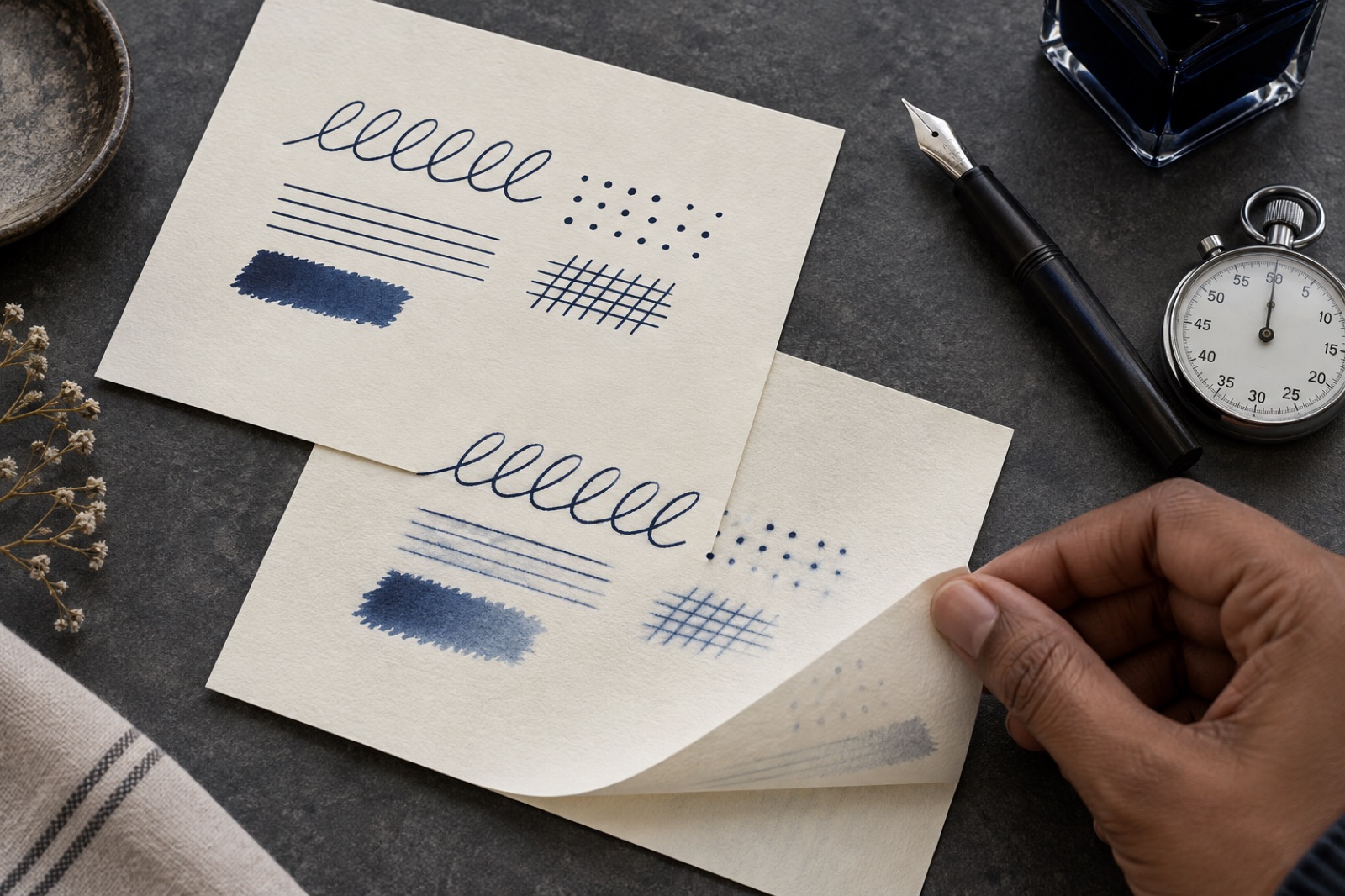
An unsatisfactory page can mean several things. Feathering describes fuzzy, spreading edges around the written line. Bleed-through means ink has penetrated through to the reverse. Show-through, often called ghosting, means the writing is visible through the sheet even when ink has not passed through it.
Look at the reverse rather than assuming every visible mark is bleed-through. Also inspect the front: letters whose small spaces close up create a different reading problem from a clean line that remains wet long enough to smudge.
MIDORI describes paper design in terms of resistance to feathering and bleed-through, drying time, writing sensation and translucency. Its explanation is a useful reminder that one adjective such as “smooth” does not capture every property you need. It is not proof that every ink behaves identically on the company’s paper. MIDORI’s explanation of writing paper.
A heavier sheet is not, by its stated weight alone, a guarantee of the result. Paper weight describes mass per area, not a test result for your ink. Nor is a notebook automatically suitable because the cover says it was designed in Japan. Ask about the paper intended for the writing task, then test the combination if you can.
Use your existing notebook and a second paper sample. With the same pen and ink, write the same sentence at your normal size on both. Add a few short lines or the notation you actually use. Label the samples so that you will remember which combination produced them.
Inspect the edges, then the reverse. Make a separate small mark for a smudge check and compare it after the same waiting interval on each sheet. The interval is your chosen test condition, not a drying-time claim from this article. Do not swipe across an important page to discover whether it has dried.
Ask four separate questions: can you read the small details, does the reverse remain usable, does the surface feel comfortable, and does the writing dry soon enough for your routine? A paper that suits leisurely journalling may not suit how quickly you turn pages during notes.
If you also change the ink and nib between the two samples, you will not know which change helped. Keep the first comparison narrow. It is cheaper and more informative than replacing the entire setup after one disappointing sheet.
For broader notebook choices, including ruling and space for diagrams, see our Japanese stationery guide to pens, pencils and notebooks. Here the question is specifically how liquid ink and the sheet behave together.
Describe the symptom before choosing a remedy. Does the first stroke fail but the rest of the word appear? Does nothing reach the page? Is the line consistent but fuzzy? Is there visible damage after a drop? Those observations should not all trigger the same response.
Start with non-invasive checks: confirm that there is ink, that the correct supply is seated as the manual directs, and that the nib is oriented normally. Try a small sample on another suitable sheet if the issue seems to be line spread. If the line is continuous but fuzzy only on one sheet, investigate the paper combination before treating the nib as broken. Stop pressing harder; force does not distinguish an ink-supply problem from a writing-position problem.
Cleaning also has boundaries. Pilot explicitly advises against pulling the nib and feed out of the section during cleaning, warns against alcohol on the body, and notes that frequent removal and reattachment can loosen a converter connection. Its separate warning that a Capless body must not be immersed is a reminder that instructions are model-specific. Pilot’s fountain-pen cleaning guidance.
Platinum’s general care page describes water cleaning of the nib section after removing the barrel and cartridge, including attention before changing colour or storing a pen unused. It does not amount to an instruction to soak an assembled pen, cap, trim and all. Follow your model’s manual, and ask for service when cleaning does not resolve the issue. Platinum’s fountain-pen care instructions.
Keep a useful boundary between ordinary care and repair. A visibly bent nib, a cracked part or persistent leakage is not an invitation to experiment with pliers, abrasive polishing or pulling components apart. Provide the seller with the exact model, ink used, symptom and what happened immediately before it began.
That description is more actionable than “this brand writes badly.” It also prevents an unnecessary upgrade when a replaceable supply or unsuitable sheet is the real issue.
Before ordering from a seller serving India, ask for the exact pen model, nib designation, included cartridge or converter, matching replacement supply and return or service terms. Confirm the actual listing’s stock and delivered price yourself; Japanese catalogue prices and overseas availability do not establish either locally.
A restrained first setup can be one pen, one compatible ink supply, an existing notebook and a small alternative paper sample. Add a converter or more colours when you have a reason to want them, rather than because an attractive photograph presents a complete collection as the minimum entry point.
Keep the first filled page. Write the pen model, nib label, ink and paper at the top, followed by normal handwriting. Later, that page gives you something concrete to compare with a different notebook or a new colour. It is your record, not somebody else’s review borrowed as an expectation.
The goal is not to make every mark look luxurious. It is to find a combination that lets you concentrate on what you are writing: an idea, a study note, a character observation or a letter. Once that happens, the pen has earned its place on your desk.
AUTHOR OF THIS ARTICLE
SoJapan
SoJapan India Pvt. Ltd. is a Japanese-founded company based in Gurugram. We bring Japanese food, anime goods and apparel materials to Indian businesses, with a sister company in Kyoto that works directly with makers in Japan.